Why do we need Firewalls n Internet connectivity
- Slides: 22
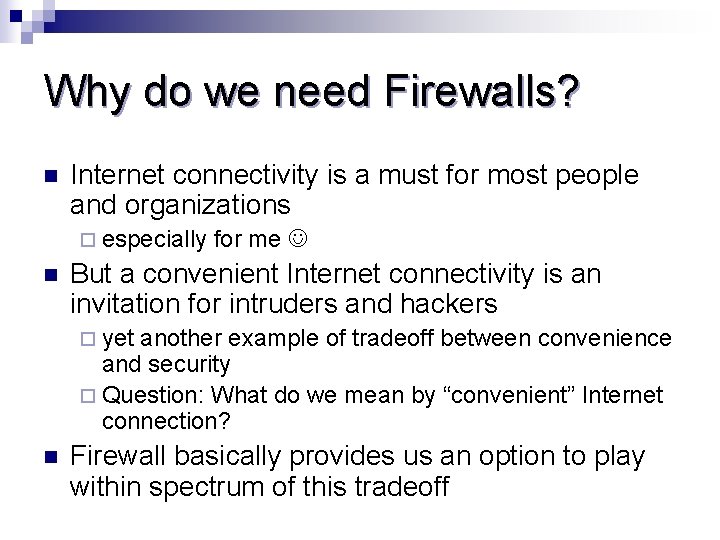
Why do we need Firewalls? n Internet connectivity is a must for most people and organizations ¨ especially n for me But a convenient Internet connectivity is an invitation for intruders and hackers ¨ yet another example of tradeoff between convenience and security ¨ Question: What do we mean by “convenient” Internet connection? n Firewall basically provides us an option to play within spectrum of this tradeoff
What is a Firewall? n Effective means of protecting local network of systems from network-based security threats from outer world ¨ while providing (limited) access to the outside world (the Internet)
Firewall Basics n The firewall is inserted between the internal network and the Internet (a choke point) ¨ Establish a controlled link and protect the network from Internet-based attacks n n keeps unauthorized users away, imposes restrictions on network services; only authorized traffic is allowed ¨ Location for monitoring security-related events n auditing, alarms can be implemented ¨ some firewalls supports IPSec, so VPNs can be implemented firewall-to-firewall ¨ some firewalls support NAT (not so security related) n Open discussion: can’t we put one firewall for each station within the local network? What are pros and cons?
Firewall Characteristics - 1 n Design goals: ¨ All traffic from inside from/to outside must pass through the firewall ¨ Only authorized traffic (defined by the local security policy) will be allowed to pass ¨ The firewall itself is immune to penetration (use of trusted system with a secure operating system)
Firewall Characteristics - 2 n General techniques for access control ¨ Service control n Determines the types of Internet services that can be accessed ¨ n Mostly using TCP/UDP port numbers Direction of traffic is important for the decision ¨ Some services are open for outbound, but not inbound (or vice versa) ¨ User control n Controls access to a service according to which user is attempting to access it n need to authenticate users. This is easy for internal users, but what can be done for external ones? ¨ Behavior control n Controls how particular services are used (e. g. filter email for spam control)
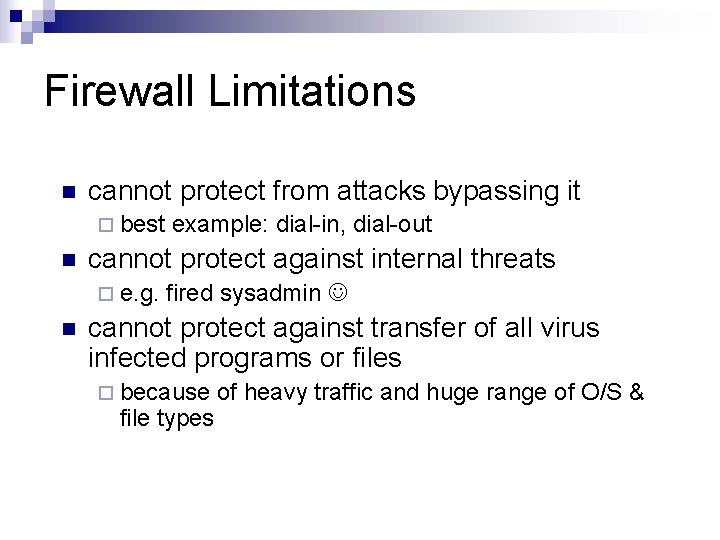
Firewall Limitations n cannot protect from attacks bypassing it ¨ best n cannot protect against internal threats ¨ e. g. n example: dial-in, dial-out fired sysadmin cannot protect against transfer of all virus infected programs or files ¨ because file types of heavy traffic and huge range of O/S &
Types of Firewalls Packet-filtering routers n Application-level gateways n Circuit-level gateways n
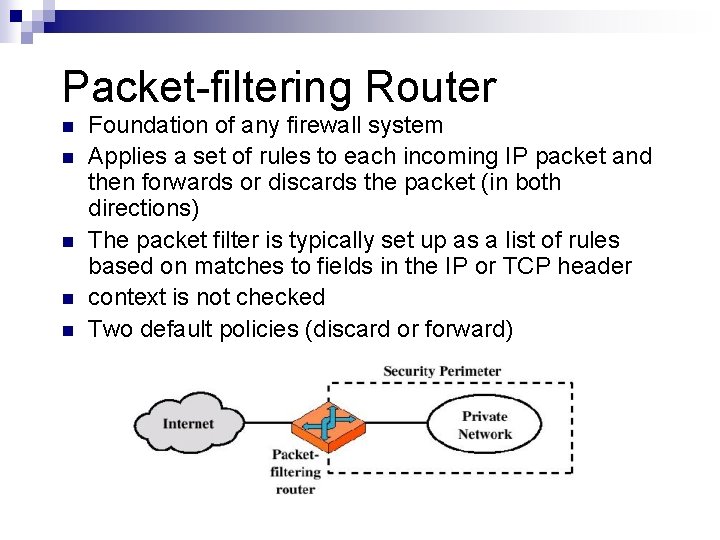
Packet-filtering Router n n n Foundation of any firewall system Applies a set of rules to each incoming IP packet and then forwards or discards the packet (in both directions) The packet filter is typically set up as a list of rules based on matches to fields in the IP or TCP header context is not checked Two default policies (discard or forward)
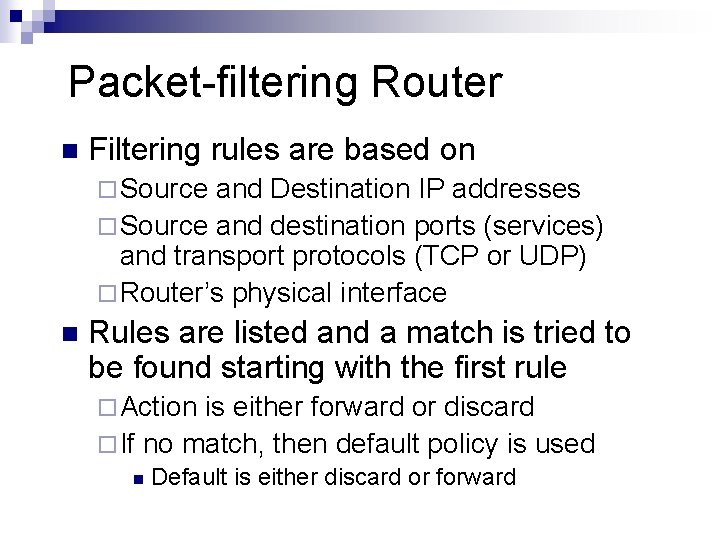
Packet-filtering Router n Filtering rules are based on ¨ Source and Destination IP addresses ¨ Source and destination ports (services) and transport protocols (TCP or UDP) ¨ Router’s physical interface n Rules are listed and a match is tried to be found starting with the first rule ¨ Action is either forward or discard ¨ If no match, then default policy is used n Default is either discard or forward
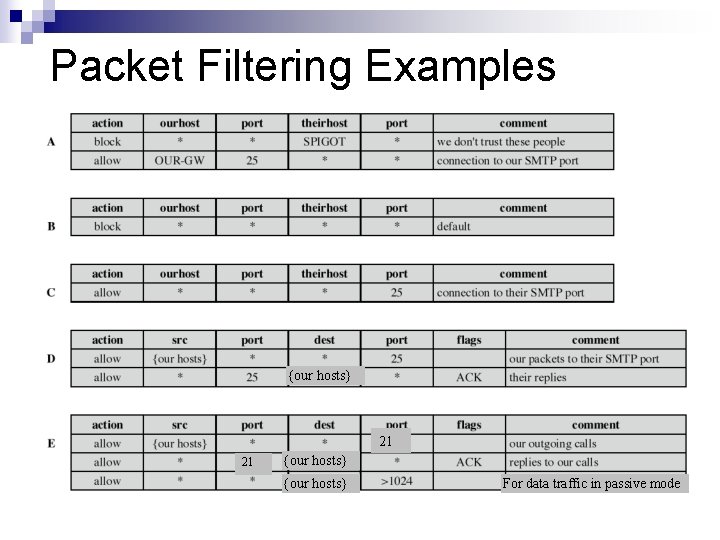
Packet Filtering Examples {our hosts} 21 21 {our hosts} For data traffic in passive mode
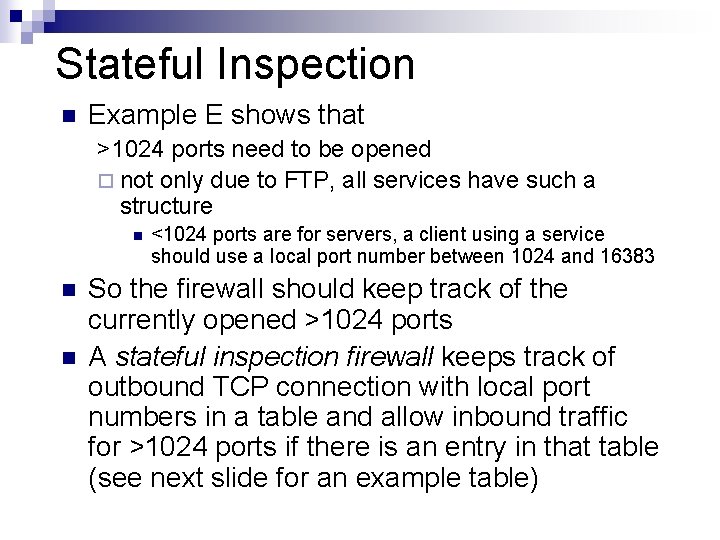
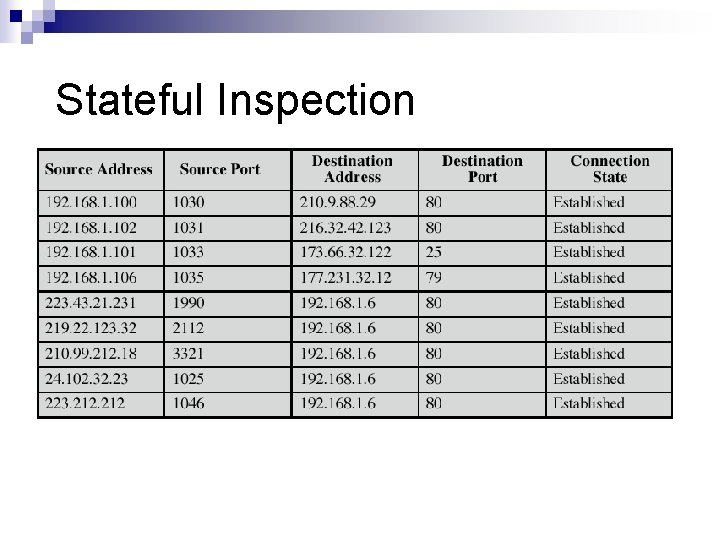
Stateful Inspection n Example E shows that >1024 ports need to be opened ¨ not only due to FTP, all services have such a structure n n n <1024 ports are for servers, a client using a service should use a local port number between 1024 and 16383 So the firewall should keep track of the currently opened >1024 ports A stateful inspection firewall keeps track of outbound TCP connection with local port numbers in a table and allow inbound traffic for >1024 ports if there is an entry in that table (see next slide for an example table)
Stateful Inspection
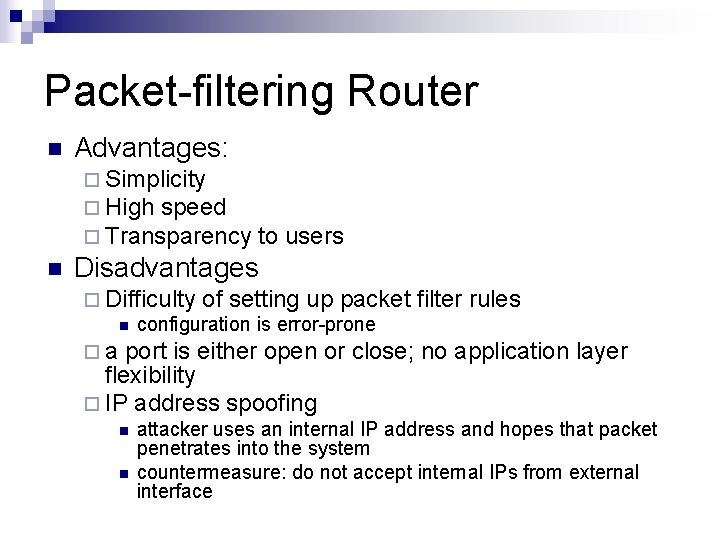
Packet-filtering Router n Advantages: ¨ Simplicity ¨ High speed ¨ Transparency n to users Disadvantages ¨ Difficulty of setting up packet filter rules n configuration is error-prone ¨ a port is either open or close; no application flexibility ¨ IP address spoofing n n layer attacker uses an internal IP address and hopes that packet penetrates into the system countermeasure: do not accept internal IPs from external interface
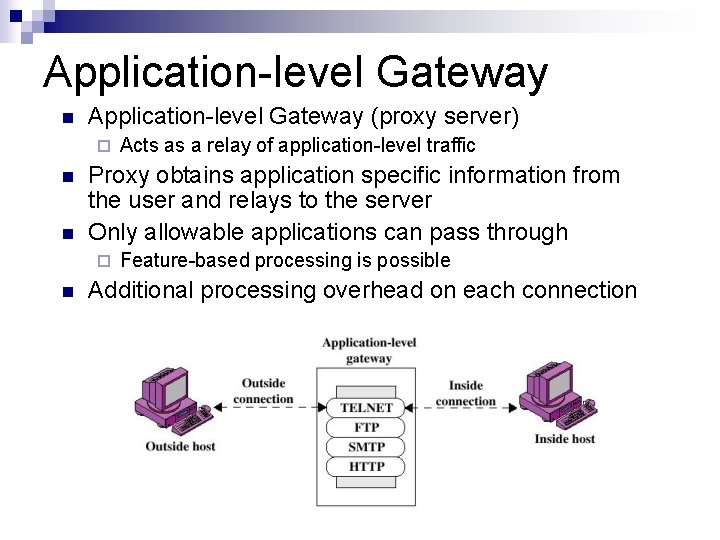
Application-level Gateway n Application-level Gateway (proxy server) ¨ n n Proxy obtains application specific information from the user and relays to the server Only allowable applications can pass through ¨ n Acts as a relay of application-level traffic Feature-based processing is possible Additional processing overhead on each connection
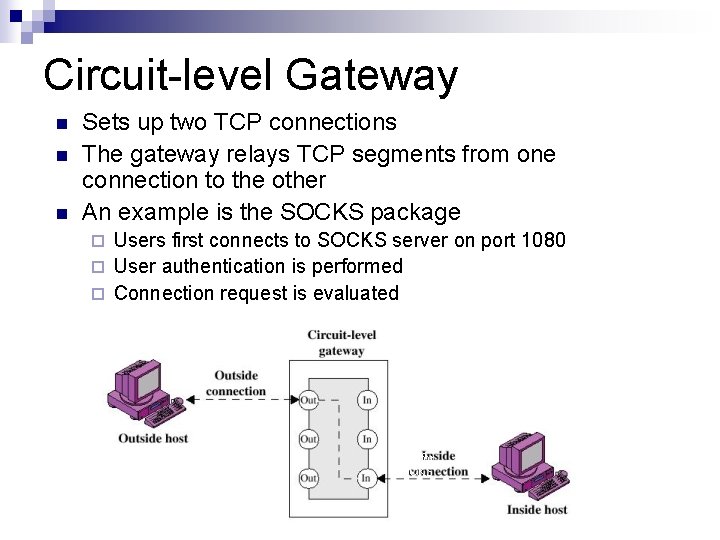
Circuit-level Gateway n n n Sets up two TCP connections The gateway relays TCP segments from one connection to the other An example is the SOCKS package Users first connects to SOCKS server on port 1080 ¨ User authentication is performed ¨ Connection request is evaluated ¨ Port 1080 for SOCKS
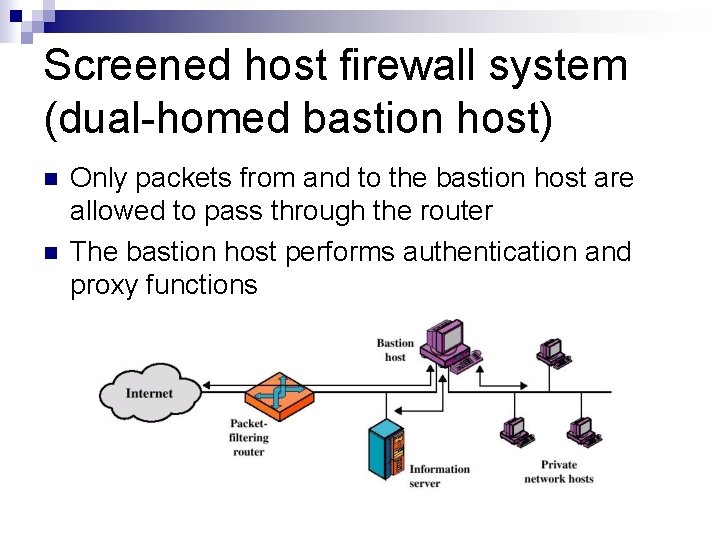
Bastion Host n A system identified by the firewall administrator as a critical strong point in the network security ¨ Used n The bastion host serves as a platform for an application-level or circuit-level gateway ¨ i. e. n in various firewall configuration (we’ll see now) a proxy Potentially exposed to "hostile" elements, hence is secured to withstand this ¨ Trusted system ¨ Carefully configured and maintained
Firewall Configurations n In addition to the use of simple configuration of a single system (single packet filtering router or single gateway), more complex configurations are possible
Screened host firewall system (dual-homed bastion host) n n Only packets from and to the bastion host are allowed to pass through the router The bastion host performs authentication and proxy functions
Dual-homed Bastion Host n Good security because of two reasons: ¨ This configuration implements both packet-level and application-level filtering ¨ An intruder must generally penetrate two separate systems in order to get to the internal network n This configuration also affords flexibility in providing direct Internet access to a public information server, e. g. Web server ¨ by configuring the router
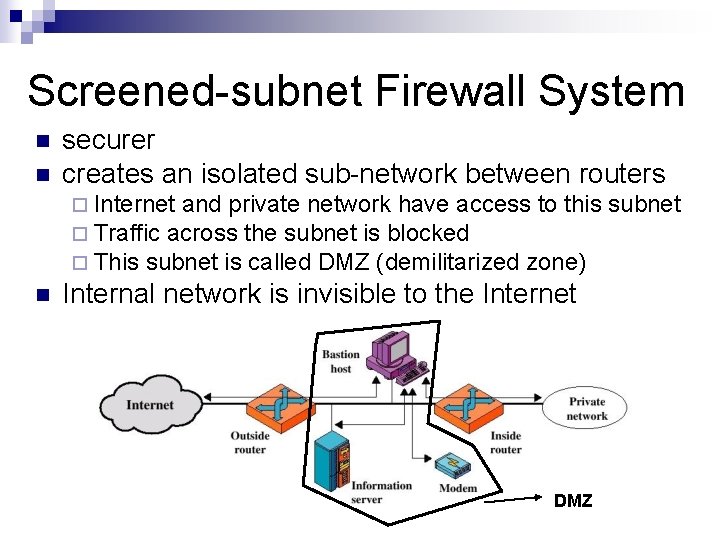
Screened-subnet Firewall System n n securer creates an isolated sub-network between routers ¨ Internet and private network have access to this ¨ Traffic across the subnet is blocked ¨ This subnet is called DMZ (demilitarized zone) n Internal network is invisible to the Internet DMZ subnet
Host-Based Firewalls n Software module to secure individual hosts ¨ filter packet flows ¨ Available as add-on for many OSs Often used on servers n Advantages: n ¨ tailored filter rules for specific host needs ¨ protection from both internal / external attacks ¨ additional layer of protection to organizational firewall
Personal Firewall controls traffic flow to/from PC/workstation n for both home or corporate use n software module on PC n ¨ or in home cable/DSL router/gateway typically less complex than standalone firewalls n primary role to deny unauthorized access n ¨ may also monitor/detect/block malware activity