What Should I Do Intersections of Tutoring and
- Slides: 14
What Should I Do? Intersections of Tutoring and Advising in the Writing Center KATRINA BELL, TRACI FREEMAN, PH. D. , AND ROY JO SARTIN COLKET CENTER FOR ACADEMIC EXCELLENCE AT COLORADO COLLEGE
Who are we? Katrina Bell (Kat) – Associate Director of the Writing Center at Colorado College Traci Freeman, Ph. D. – Director of the Colket Center for Academic Excellence Roy Jo Sartin – Fellowships Coordinator and Professional Writing Consultant
What is our institutional context? Colorado College Elite small liberal arts college (SLAC) located in Colorado Springs Defining feature: Block plan Student population: 2000, with increasing numbers of gifted first generation, international, and minority students Decentralized faculty advising model Partnerships for supporting students: Colket Center for Academic Excellence Career Center International Programs Butler Center (Diversity) Wellness Center Boettcher Center (Health) Collaborative for Community Engagement
Table Talk! - Introductions Who are you? What’s your institutional context? Why did you choose this session?
Why are we here today? “Educators, legislators, and the American public concur that learning outcomes of higher education should include effective citizenship, critical thinking and complex problem solving, interdependent relations with diverse others, and mature decision making. Many students enter college having learned how to follow formulas for success, lacking exposure to diverse perspectives, and unclear about their own beliefs, identities, and values. Moving from these entering characteristics to intended learning outcomes requires transformational learning, or ‘how we learn to negotiate and act on our own purposes, values, feelings, and meanings rather than those we have uncritically assimilated from others’. [This extraction] involves far more than information and skill acquisition. It requires a transformation of their views of knowledge, their identity, and their relations with others. Twenty-first-century learning outcomes require self-authorship: the internal capacity to define one’s belief system, identity, and relationships” (Baxter Magolda, 21 st C. 69).
Table Talk! - Exigency What is Baxter Magolda saying about the purpose of higher education and the preparation of our students? How does this resonate with your work in writing centers?
Why engage with Baxter Magolda? Baxter Magolda theorizes college student development Her major contributions to this discussion are: The theory of “self-authorship”: “the internal capacity to define one’s belief system, identity, and relationships” The “Learning partners” model for interaction with students: respecting their thoughts and feelings, thus affirming the value of their voices helping them view their experiences as opportunities for learning and growth collaborating with them to analyze their own problems, engaging in mutual learning with them” (Baxter Magolda 30)
Why engage with advising? Baxter Magolda’s concept of self-authorship has been taken up by the advising community to provide a theoretical framework for academic advising: National Association of Fellowships Advisors “value[s] the process above the result” (nafaadvisors. org). “The mission of the National Association of Fellowships Advisors (NAFA) is to promote the full potential of fellowship candidates through the application process, and to foster the continued growth and professionalization of fellowship advising in higher education” (nafadvisors. org) Advisors will: “Encourage the intellectual autonomy and passion of character of each student with whom they interact” & “Encourage students to self assess their qualifications for individual fellowships and to be realistic in their expectations of the process and the outcome”
How does the work of advisors and of writing centers intersect? Baxter Magolda’s concept of self-authorship applies to both academic advising and to writing center work: Theoretical connections: similar assumptions about the role of students as learners and the purpose of education Epistemological connections: knowledge is constructed by an individual in a community of practice Methodological connections: conversation, questioning, problem-posing Goals: empower students as agents of their own learning
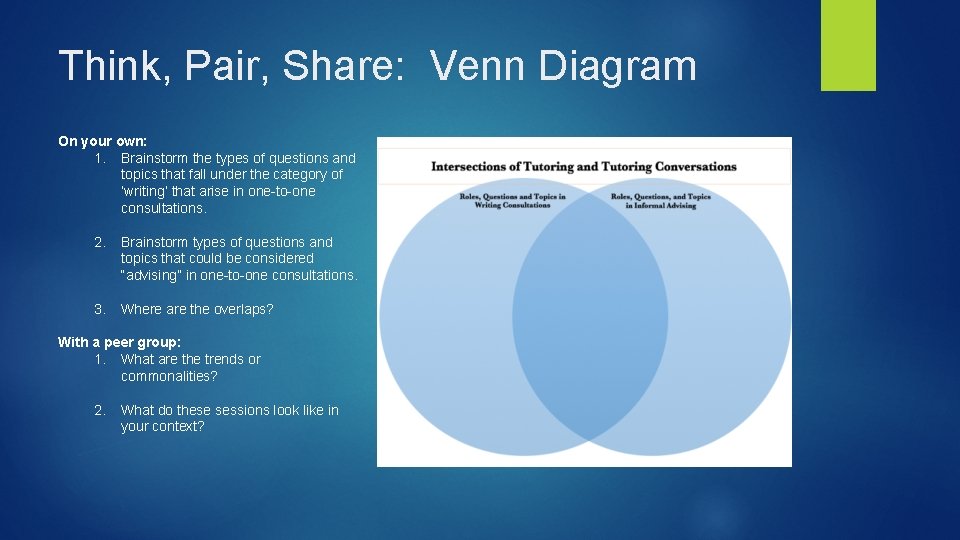
Think, Pair, Share: Venn Diagram On your own: 1. Brainstorm the types of questions and topics that fall under the category of ’writing’ that arise in one-to-one consultations. 2. Brainstorm types of questions and topics that could be considered “advising” in one-to-one consultations. 3. Where are the overlaps? With a peer group: 1. What are the trends or commonalities? 2. What do these sessions look like in your context?
Mad Libs! “The complex cognitive skills that students can develop through __________ include: seeing oneself as able to construct knowledge and have ideas without having to receive this information from others and, understanding that there are multiple ways to view any given situation or idea” (Pizzolato 20) “(v) __________is more effective if skills are taught by having students examine their own situation, identify strategies to overcome difficulties, and learn to apply them in other situations” (Pizzolato 23). “The role of the (n)__________ is to initiate conversation, listen, and help students learn from their experiences” (Baxter Magolda and King 9).
What’s next? How can we best prepare ourselves and our staff for conversations that operate in the liminal space between writing consultations and informal advising? How can we merge our theories with those outside of writing centers for a more complete view of student needs and services? How can we engage with our campuses in conversations about the links between writing consultations and advising?
Thank you! We appreciate that you have taken the time to chat with us at this roundtable. We can be reached via email: katrina. bell@coloradocollege. edu traci. freeman@coloradocollege. edu royjo. sartin@coloradocollege. edu
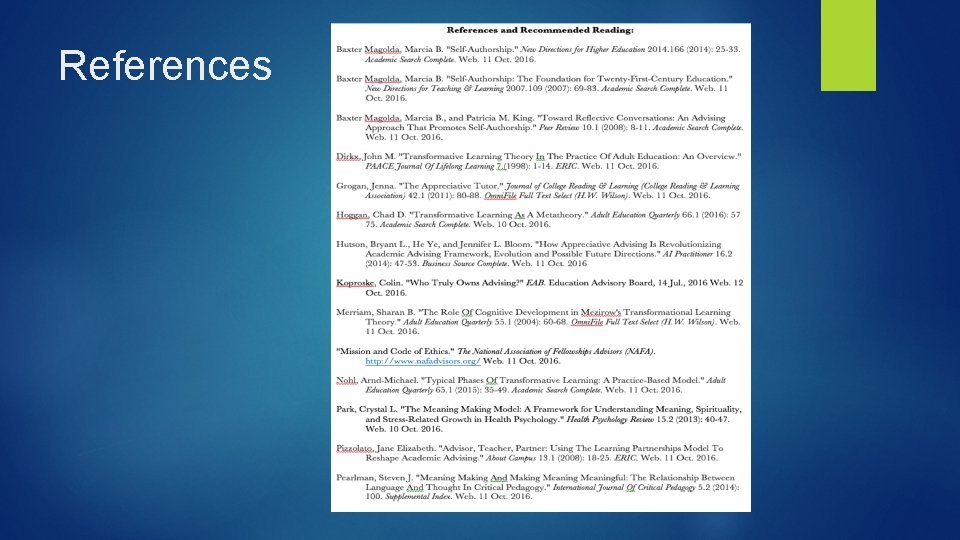
References