What is a Corpus What is not a





- Slides: 17
What is a Corpus? • What is not a corpus? § the Web § collection of citations § a text • Definition of a corpus “A corpus is a collection of pieces of language text in electronic form, selected according to external criteria to represent, as far as possible, a language or language variety as a source of data for linguistic research. ” (Sinclair, 2005)
Corpus design (some notions) • Criteria (external): language or language variety, mode, text type, domain, text location, etc. –Criteria will form cells • Sampling • Balance –Range of text categories in the corpus • Representativeness “Representativeness refers to the extent to which a sample includes the full range of variability in population. ” (Biber, 1993)
Corpus size • There is no maximum size! • The minimum size depends on: § The kind of query (e. g. frequent words, technical terms) § The methodology used for studying the data • Zipf’s law: half of the words in a corpus occur once only, a quarter twice only, etc. • Words occurring once only (hapax legomena) are unlikely to be of interest for more general study of a language • Words → sequence of words (frequency dropping) • Studies of collocations require bigger corpora • Corpora for specialised studies can be much smaller
Why use a corpus? • “As language teachers and professionals, we often have strong intuitions about language use… Corpus-based research, however, shows us that our intuitions are often completely wrong. ” (Biber 2005) • Even if our intuition is correct, the language we produce may not represent typical language use (Mc. Enery et al, 2006) • Corpus-based research: authentic data • Using a computer to study language: § § quick processing of data accurate and consistent non-biased allows enriching data with additional information
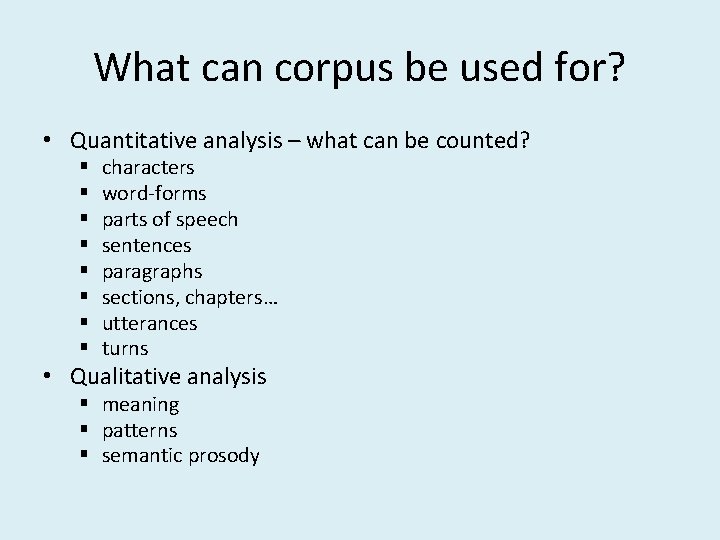
What can corpus be used for? • Quantitative analysis – what can be counted? § § § § characters word-forms parts of speech sentences paragraphs sections, chapters… utterances turns • Qualitative analysis § meaning § patterns § semantic prosody
Types of corpora (1) • Reference corpus – large, include spoken and written texts representing various social and situational strata • Monitor corpus – growing regularly, reflects language changes • Balanced corpus – balanced according to text type, genre, or domain • Sampled corpus – finite collection of carefully selected texts • Annotated corpus – enhanced with various types of linguistics information • Unannotated (raw) corpus – contains only plain texts with no additional linguistic information
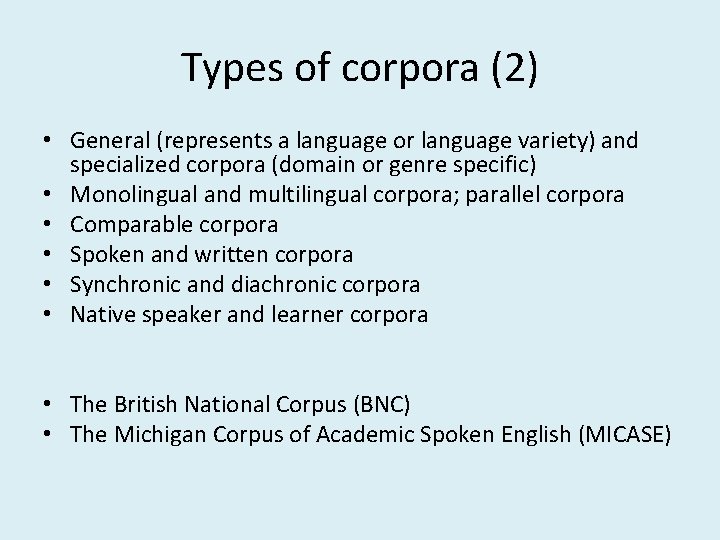
Types of corpora (2) • General (represents a language or language variety) and specialized corpora (domain or genre specific) • Monolingual and multilingual corpora; parallel corpora • Comparable corpora • Spoken and written corpora • Synchronic and diachronic corpora • Native speaker and learner corpora • The British National Corpus (BNC) • The Michigan Corpus of Academic Spoken English (MICASE)
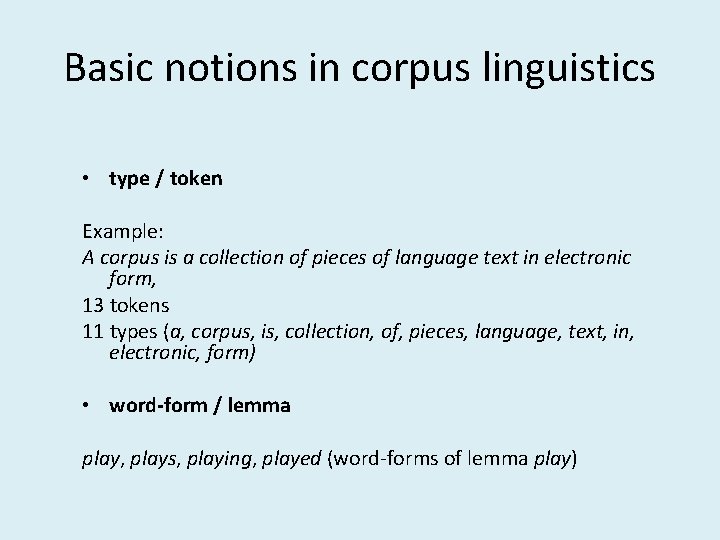
Basic notions in corpus linguistics • type / token Example: A corpus is a collection of pieces of language text in electronic form, 13 tokens 11 types (a, corpus, is, collection, of, pieces, language, text, in, electronic, form) • word-form / lemma play, plays, playing, played (word-forms of lemma play)
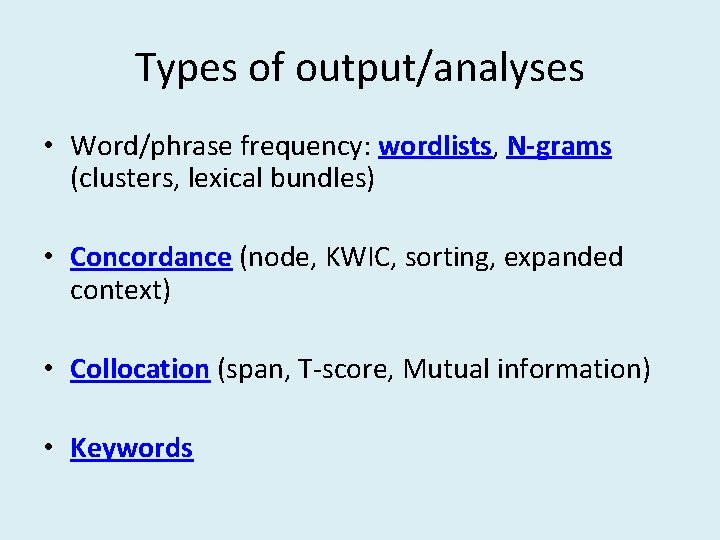
Types of output/analyses • Word/phrase frequency: wordlists, N-grams (clusters, lexical bundles) • Concordance (node, KWIC, sorting, expanded context) • Collocation (span, T-score, Mutual information) • Keywords
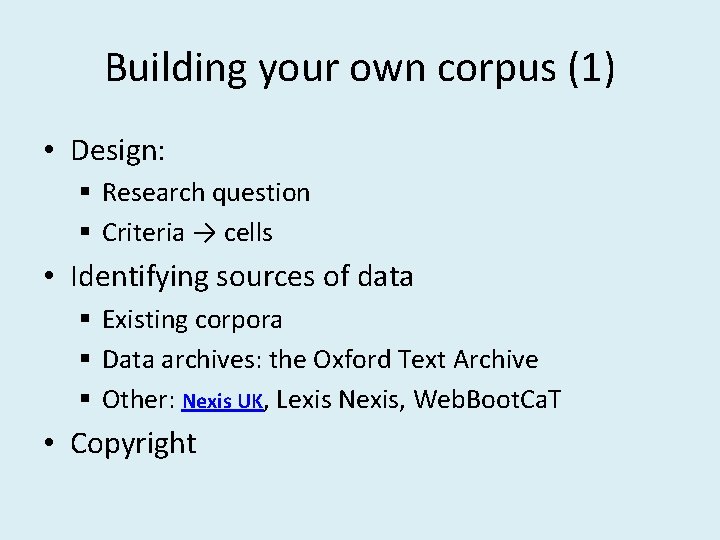
Building your own corpus (1) • Design: § Research question § Criteria → cells • Identifying sources of data § Existing corpora § Data archives: the Oxford Text Archive § Other: Nexis UK, Lexis Nexis, Web. Boot. Ca. T • Copyright
Building your own corpus (2) • Data collection § § Downloading Recording Scanning Keyboarding • Documentation • Preparing data: – – – data conversion to txt format (including transcription) character encoding clean-up mark-up alignment (parallel data)
Building your own corpus (3) • Selecting corpus tool for analysis • Adding value to data – annotation: § § part-of-speech (POS) tagging, tokenization lemmatization parsing other: semantic annotation, pragmatic annotation, error tagging, etc.
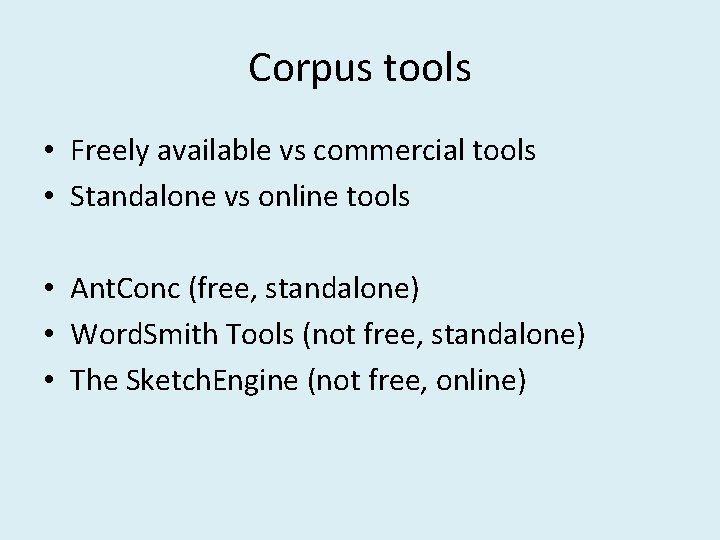
Corpus tools • Freely available vs commercial tools • Standalone vs online tools • Ant. Conc (free, standalone) • Word. Smith Tools (not free, standalone) • The Sketch. Engine (not free, online)
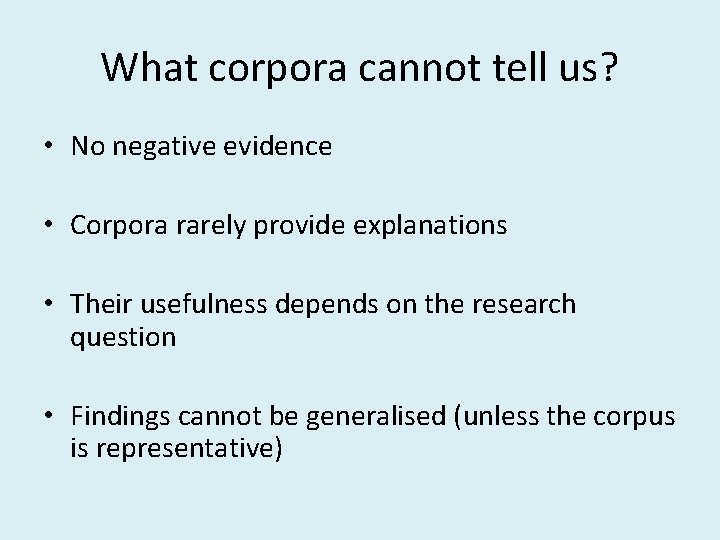
What corpora cannot tell us? • No negative evidence • Corpora rarely provide explanations • Their usefulness depends on the research question • Findings cannot be generalised (unless the corpus is representative)
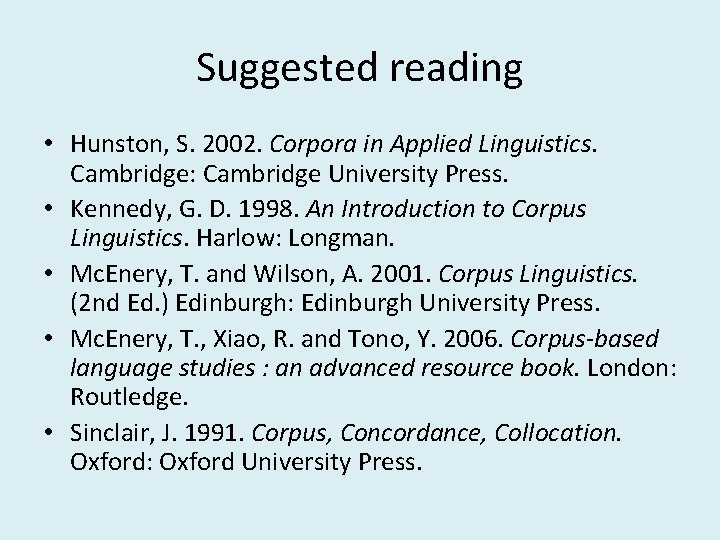
Suggested reading • Hunston, S. 2002. Corpora in Applied Linguistics. Cambridge: Cambridge University Press. • Kennedy, G. D. 1998. An Introduction to Corpus Linguistics. Harlow: Longman. • Mc. Enery, T. and Wilson, A. 2001. Corpus Linguistics. (2 nd Ed. ) Edinburgh: Edinburgh University Press. • Mc. Enery, T. , Xiao, R. and Tono, Y. 2006. Corpus-based language studies : an advanced resource book. London: Routledge. • Sinclair, J. 1991. Corpus, Concordance, Collocation. Oxford: Oxford University Press.
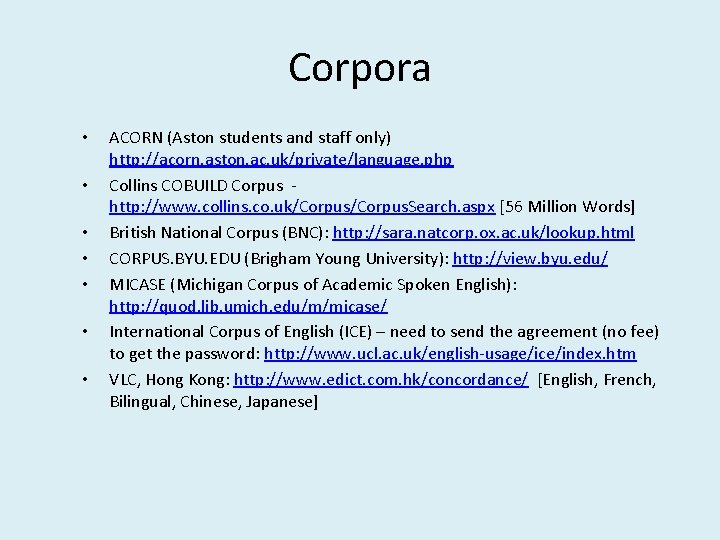
Corpora • • ACORN (Aston students and staff only) http: //acorn. aston. ac. uk/private/language. php Collins COBUILD Corpus http: //www. collins. co. uk/Corpus. Search. aspx [56 Million Words] British National Corpus (BNC): http: //sara. natcorp. ox. ac. uk/lookup. html CORPUS. BYU. EDU (Brigham Young University): http: //view. byu. edu/ MICASE (Michigan Corpus of Academic Spoken English): http: //quod. lib. umich. edu/m/micase/ International Corpus of English (ICE) – need to send the agreement (no fee) to get the password: http: //www. ucl. ac. uk/english-usage/ice/index. htm VLC, Hong Kong: http: //www. edict. com. hk/concordance/ [English, French, Bilingual, Chinese, Japanese]
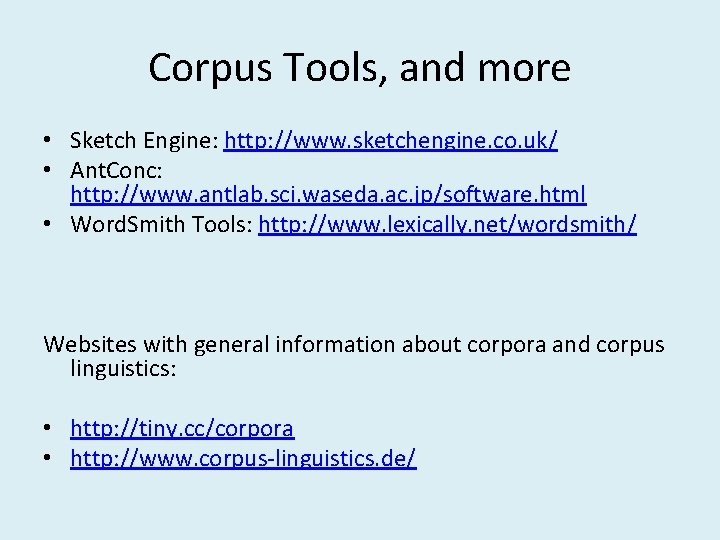
Corpus Tools, and more • Sketch Engine: http: //www. sketchengine. co. uk/ • Ant. Conc: http: //www. antlab. sci. waseda. ac. jp/software. html • Word. Smith Tools: http: //www. lexically. net/wordsmith/ Websites with general information about corpora and corpus linguistics: • http: //tiny. cc/corpora • http: //www. corpus-linguistics. de/