Welcome Giovanni LAMANNA 8 April 2019 Fundamental research
- Slides: 15
Welcome Giovanni LAMANNA 8 April 2019
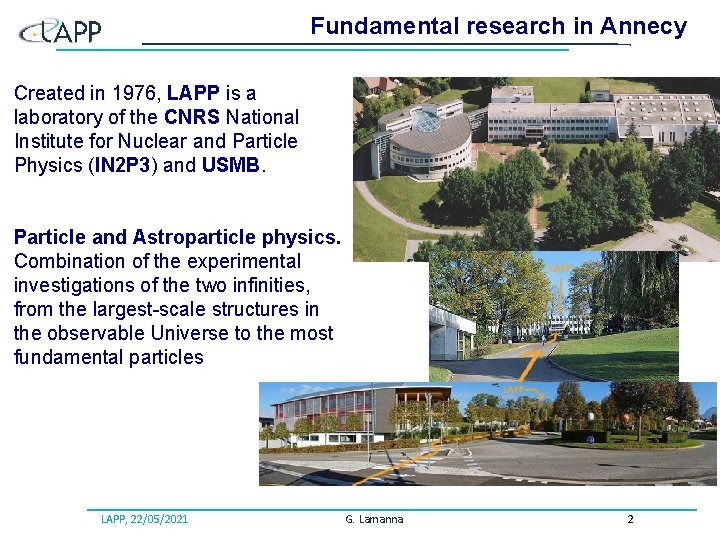
Fundamental research in Annecy Created in 1976, LAPP is a laboratory of the CNRS National Institute for Nuclear and Particle Physics (IN 2 P 3) and USMB. Particle and Astroparticle physics. Combination of the experimental investigations of the two infinities, from the largest-scale structures in the observable Universe to the most fundamental particles LAPP, 22/05/2021 G. Lamanna 2
Fundamental research in Annecy LAPP was born 43 years ago as a gateway-laboratory to CERN for French CNRS scientists. Today more than 150 researchers, engineers, technicians, administrative personnel, students. . Frontier technologies in different fields: • mechanics, • electronics, • mechatronics, • computer science, • scientific and control software and e-infrastructures. LAPP hosts a Theory Laboratory (LAPTh) within its premises. LAPP, 22/05/2021 G. Lamanna 3
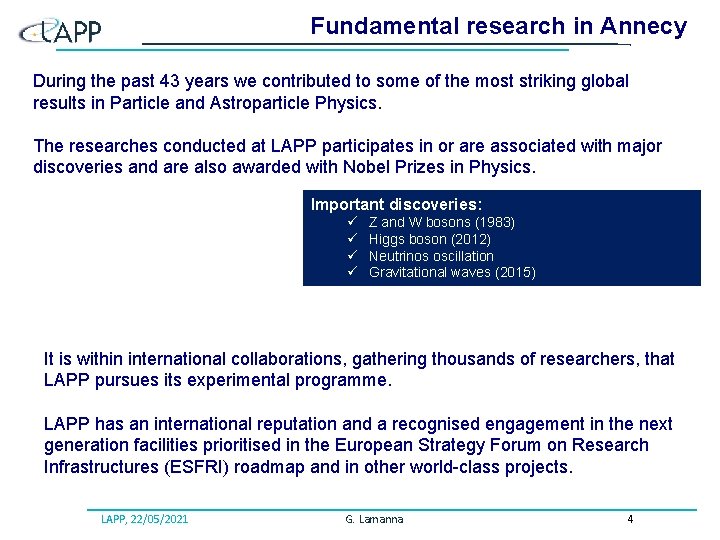
Fundamental research in Annecy During the past 43 years we contributed to some of the most striking global results in Particle and Astroparticle Physics. The researches conducted at LAPP participates in or are associated with major discoveries and are also awarded with Nobel Prizes in Physics. Important discoveries: ü ü Z and W bosons (1983) Higgs boson (2012) Neutrinos oscillation Gravitational waves (2015) It is within international collaborations, gathering thousands of researchers, that LAPP pursues its experimental programme. LAPP has an international reputation and a recognised engagement in the next generation facilities prioritised in the European Strategy Forum on Research Infrastructures (ESFRI) roadmap and in other world-class projects. LAPP, 22/05/2021 G. Lamanna 4
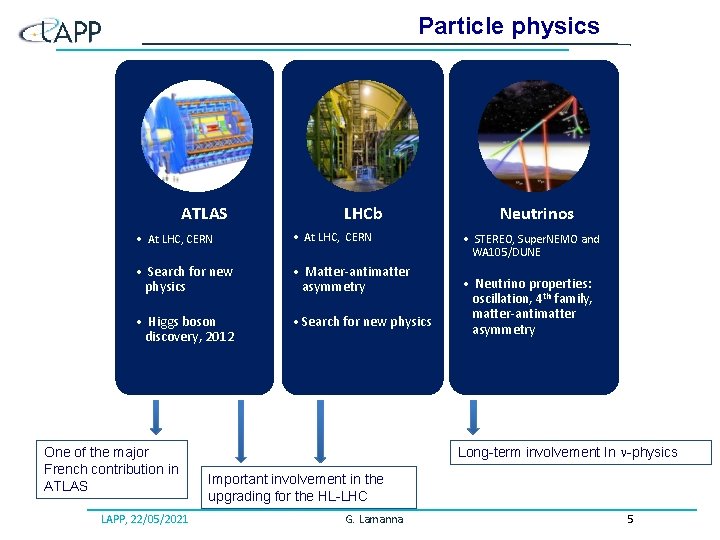
Particle physics ATLAS LHCb • At LHC, CERN • Search for new • Matter-antimatter asymmetry physics • Higgs boson discovery, 2012 One of the major French contribution in ATLAS LAPP, 22/05/2021 Neutrinos • STEREO, Super. NEMO and WA 105/DUNE • Search for new physics • Neutrino properties: oscillation, 4 th family, matter-antimatter asymmetry Long-term involvement In n-physics Important involvement in the upgrading for the HL-LHC G. Lamanna 5
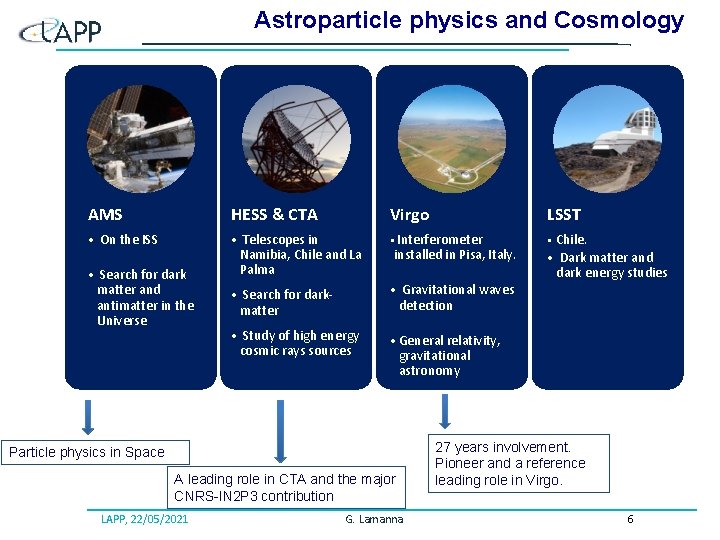
Astroparticle physics and Cosmology AMS HESS & CTA Virgo LSST • On the ISS • Telescopes in • Interferometer • Chile. • Search for dark matter and antimatter in the Universe • Search for darkmatter • Gravitational waves detection • Study of high energy cosmic rays sources • General relativity, gravitational astronomy Namibia, Chile and La Palma installed in Pisa, Italy. Particle physics in Space A leading role in CTA and the major CNRS-IN 2 P 3 contribution LAPP, 22/05/2021 G. Lamanna • Dark matter and dark energy studies 27 years involvement. Pioneer and a reference leading role in Virgo. 6
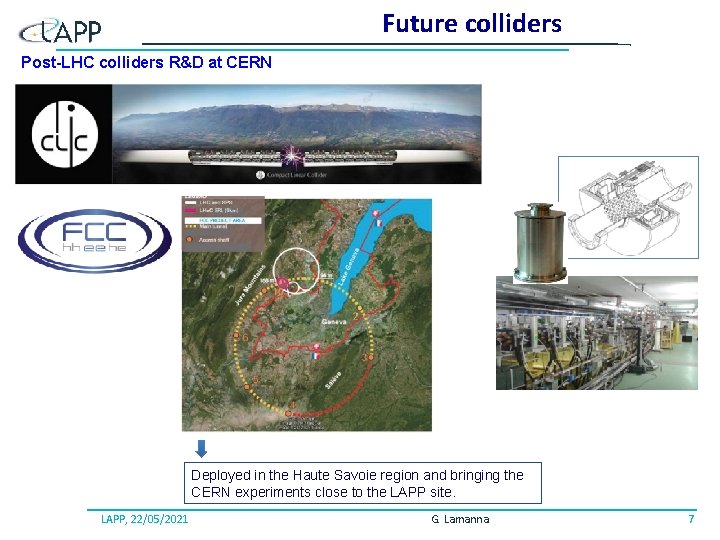
Future colliders Post-LHC colliders R&D at CERN Deployed in the Haute Savoie region and bringing the CERN experiments close to the LAPP site. LAPP, 22/05/2021 G. Lamanna 7
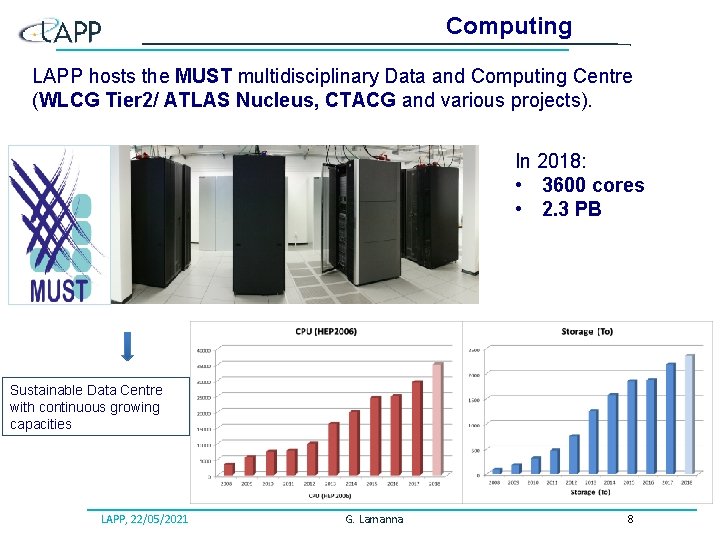
Computing LAPP hosts the MUST multidisciplinary Data and Computing Centre (WLCG Tier 2/ ATLAS Nucleus, CTACG and various projects). In 2018: • 3600 cores • 2. 3 PB Sustainable Data Centre with continuous growing capacities LAPP, 22/05/2021 G. Lamanna 8
ASTERICS Astronomy ESFRI & Research Infrastructure Cluster ASTERICS - 653477 • Astronomy ESFRI & Research Infrastructure Cluster • Horizon 2020 Work Programme INFRADEV-4 -2014/2015 Call – “Implementation and operation of cross-cutting services and solutions for clusters of ESFRI and other relevant research infrastructure initiatives” • Focus of ASTERICS: SKA, CTA, KM 3 Ne. T, close links to E-ELT, EGO, EUCLID, LSST. • Funded at 15 M€ for 4 years (1/5/2015 -30/4/2019) • 22 partners in 6 countries, representing a major collaboration in Astronomy/Astrophysics/Astroparticle Physics ASTRON, CNRS, INAF, UCAM, JIVE, INTA, UEDIN, UHEI, OU, FAU, VU, CEA, UVA, UGR, FOM, IEEC, IFAE, UCM, INFN, STFC, DESY, SURFnet. • 5 Work Packages. • WP 3: OBELICS (OBservatory E-environments LInked by common Challenge. S) LAPP, 22/05/2021 G. Lamanna 9 9
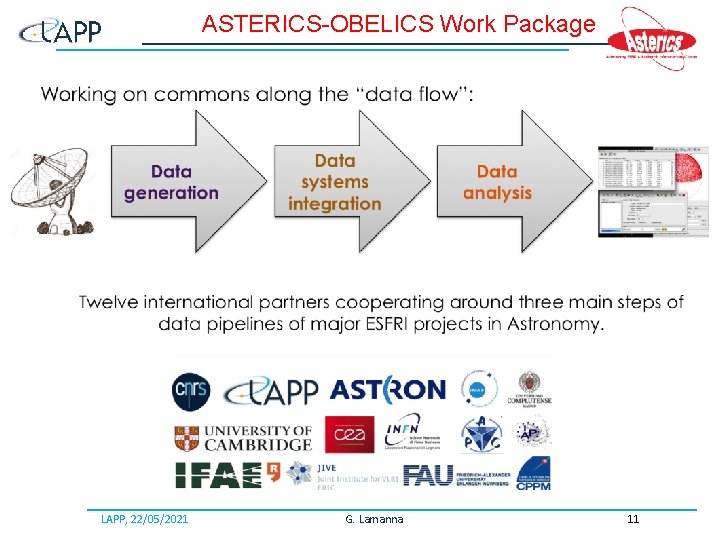
ASTERICS-OBELICS Work Package OBELICS: • Targeting common ESFRI-projects « Data Challenges » . o Large volumes of data. o Need computing resources, intensive simulation and large storage space. • Scopes: o Enable interoperability and software re-use. o Enable open standards and software libraries for multi-messenger data. o Develop common solutions, share prototypes, exchange experience. • Objectives: o Create an open innovation environment across ESFRI facilities. • Expected impact: o Economies of scale and saving resources. o Contribute to the construction and operation of ESFRI projects. LAPP, 22/05/2021 G. Lamanna 10 10
ASTERICS-OBELICS Work Package LAPP, 22/05/2021 G. Lamanna 11
Annecy, 22/05/2021 G. Lamanna 13
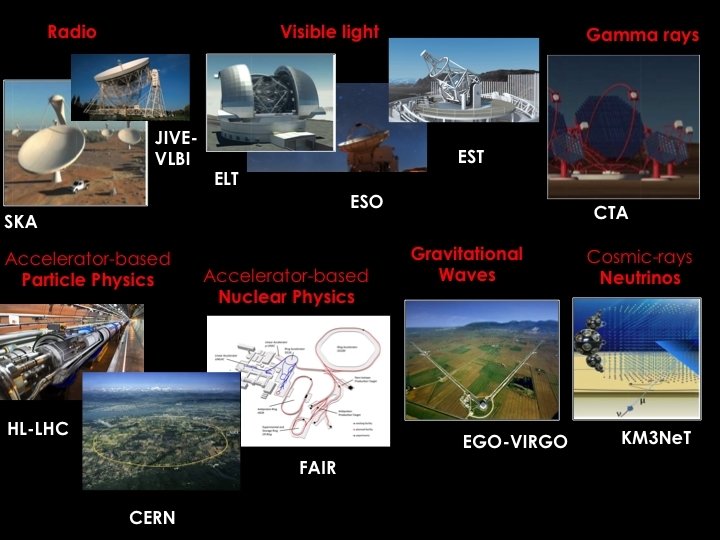
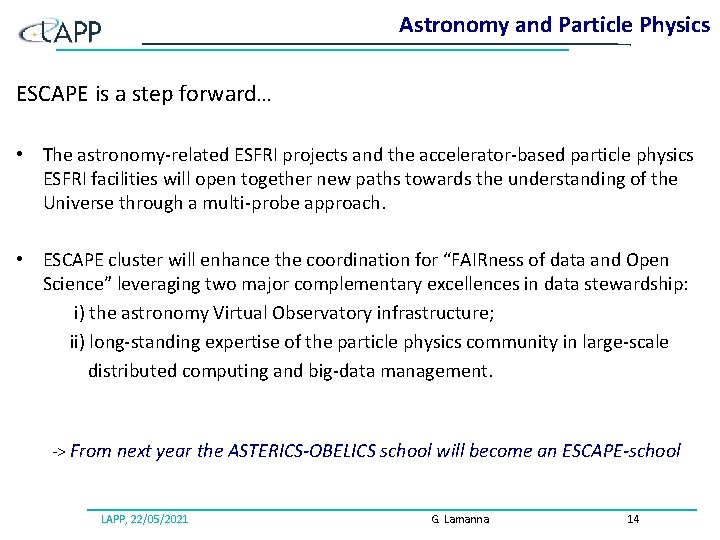
Astronomy and Particle Physics ESCAPE is a step forward… • The astronomy-related ESFRI projects and the accelerator-based particle physics ESFRI facilities will open together new paths towards the understanding of the Universe through a multi-probe approach. • ESCAPE cluster will enhance the coordination for “FAIRness of data and Open Science” leveraging two major complementary excellences in data stewardship: i) the astronomy Virtual Observatory infrastructure; ii) long-standing expertise of the particle physics community in large-scale distributed computing and big-data management. -> From next year the ASTERICS-OBELICS school will become an ESCAPE-school LAPP, 22/05/2021 G. Lamanna 14
A warm welcome ! (on behalf of the local organizing committee and from LAPP) Have a fruitful training, useful exchanges and discussions… … and enjoy Annecy !