Voltage quality regulation in Sweden Lars Strm Math


- Slides: 12
Voltage quality regulation in Sweden Lars Ström, Math Bollen, Rémy Kolessar Energy Markets Inspectorate Eskilstuna, Sweden
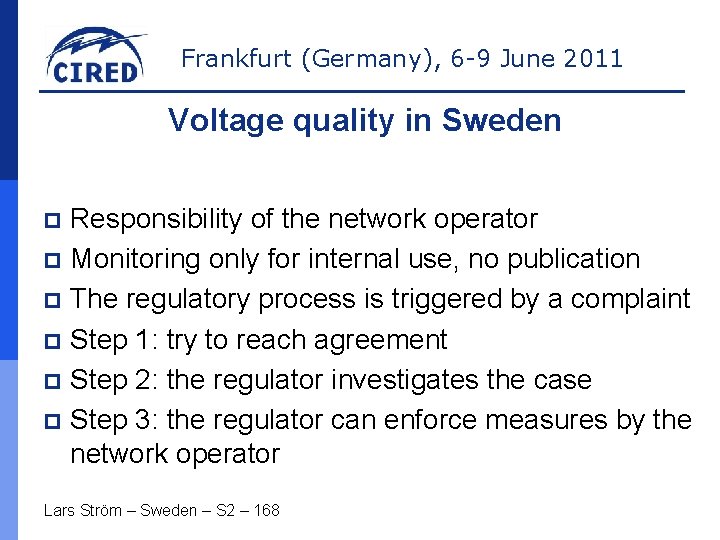
Frankfurt (Germany), 6 -9 June 2011 Voltage quality in Sweden Responsibility of the network operator p Monitoring only for internal use, no publication p The regulatory process is triggered by a complaint p Step 1: try to reach agreement p Step 2: the regulator investigates the case p Step 3: the regulator can enforce measures by the network operator p Lars Ström – Sweden – S 2 – 168
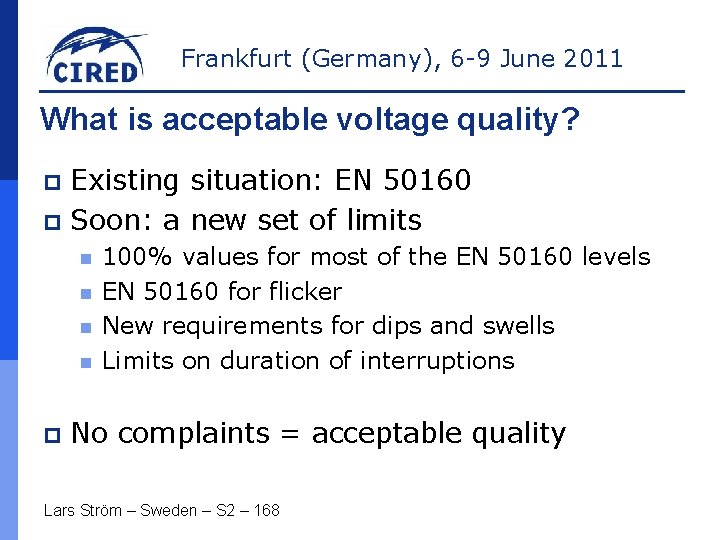
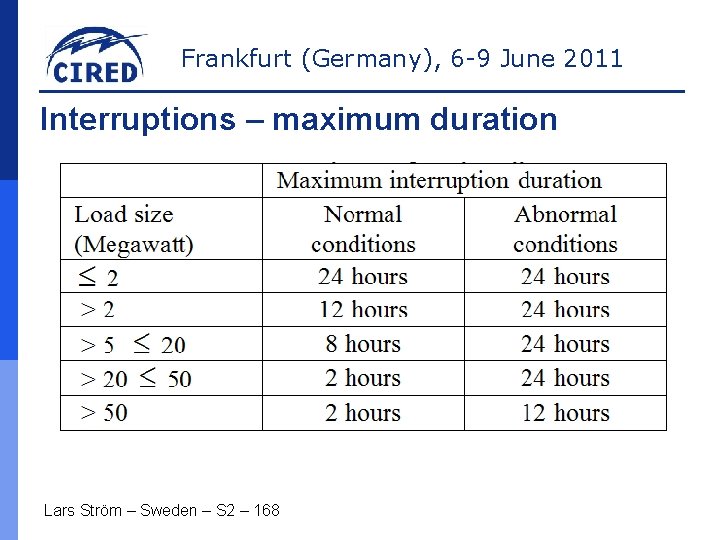
Frankfurt (Germany), 6 -9 June 2011 What is acceptable voltage quality? Existing situation: EN 50160 p Soon: a new set of limits p n n p 100% values for most of the EN 50160 levels EN 50160 for flicker New requirements for dips and swells Limits on duration of interruptions No complaints = acceptable quality Lars Ström – Sweden – S 2 – 168
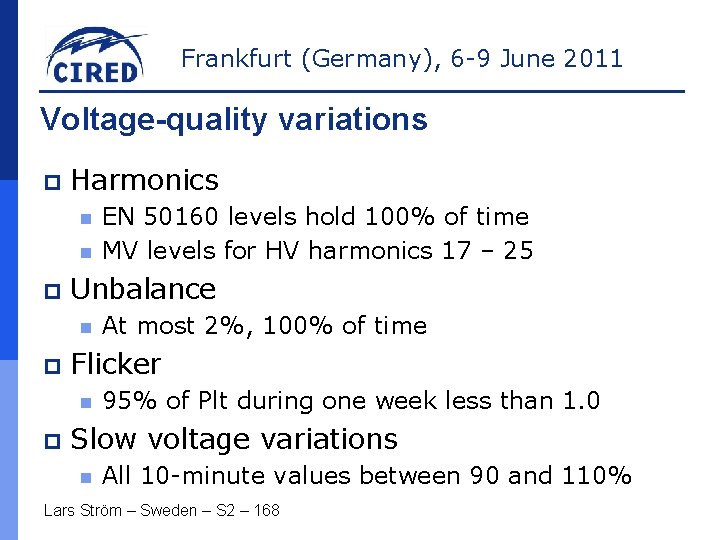
Frankfurt (Germany), 6 -9 June 2011 Voltage-quality variations p Harmonics n n p Unbalance n p At most 2%, 100% of time Flicker n p EN 50160 levels hold 100% of time MV levels for HV harmonics 17 – 25 95% of Plt during one week less than 1. 0 Slow voltage variations n All 10 -minute values between 90 and 110% Lars Ström – Sweden – S 2 – 168
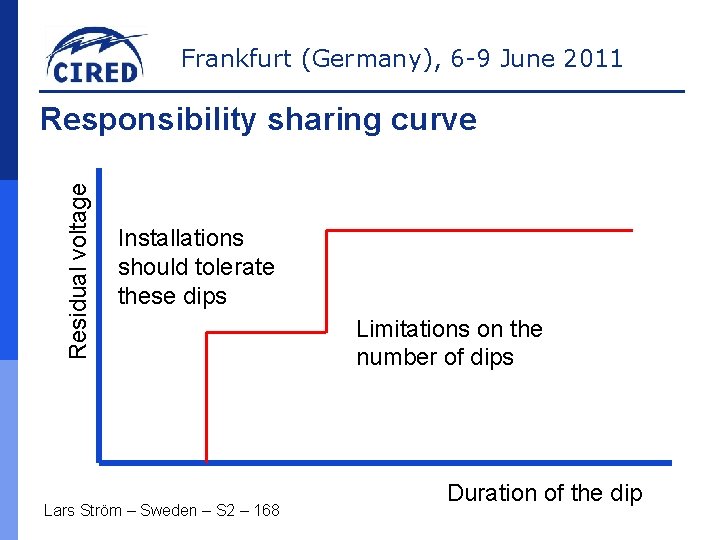
Frankfurt (Germany), 6 -9 June 2011 Residual voltage Responsibility sharing curve Installations should tolerate these dips Lars Ström – Sweden – S 2 – 168 Limitations on the number of dips Duration of the dip
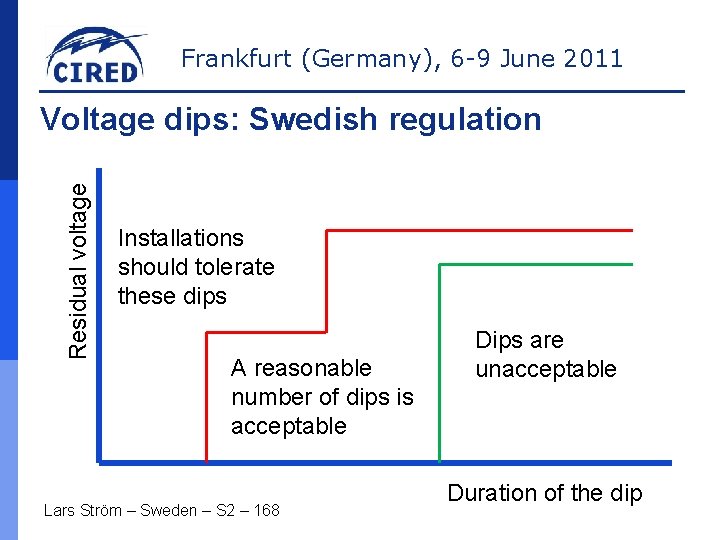
Frankfurt (Germany), 6 -9 June 2011 Residual voltage Voltage dips: Swedish regulation Installations should tolerate these dips A reasonable number of dips is acceptable Lars Ström – Sweden – S 2 – 168 Dips are unacceptable Duration of the dip
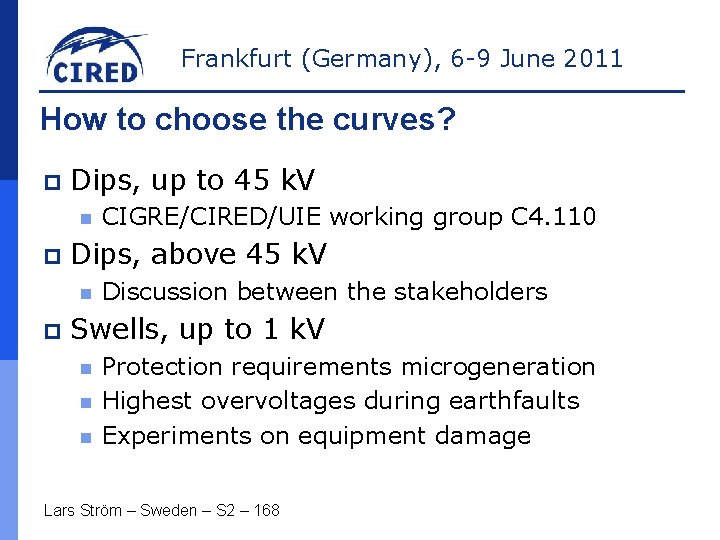
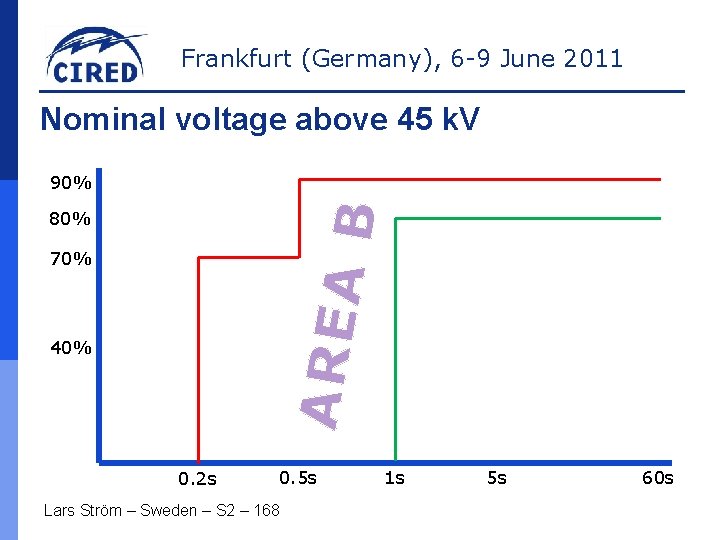
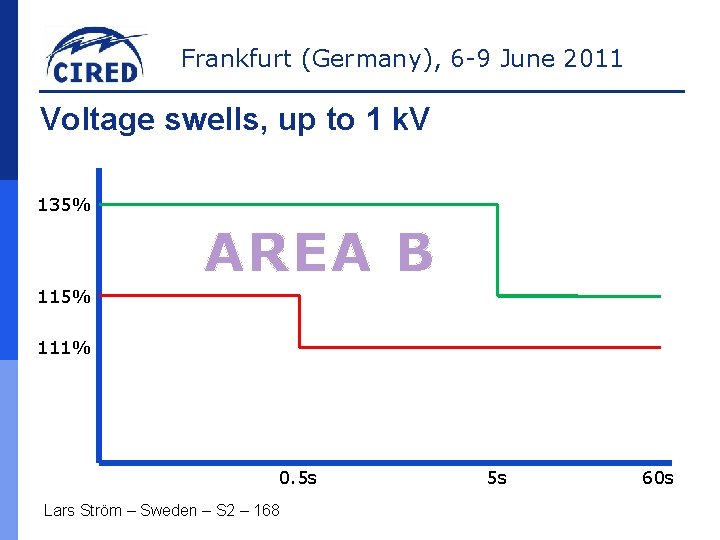
Frankfurt (Germany), 6 -9 June 2011 How to choose the curves? p Dips, up to 45 k. V n p Dips, above 45 k. V n p CIGRE/CIRED/UIE working group C 4. 110 Discussion between the stakeholders Swells, up to 1 k. V n n n Protection requirements microgeneration Highest overvoltages during earthfaults Experiments on equipment damage Lars Ström – Sweden – S 2 – 168
Frankfurt (Germany), 6 -9 June 2011 Nominal voltage 45 k. V and less 90% 70% 40% A 0. 2 s R 0. 5 s Lars Ström – Sweden – S 2 – 168 E A B 1 s 5 s 60 s
Frankfurt (Germany), 6 -9 June 2011 Nominal voltage above 45 k. V B 90% 80% AREA 70% 40% 0. 2 s 0. 5 s Lars Ström – Sweden – S 2 – 168 1 s 5 s 60 s
Frankfurt (Germany), 6 -9 June 2011 Voltage swells, up to 1 k. V 135% AREA B 115% 111% 0. 5 s Lars Ström – Sweden – S 2 – 168 5 s 60 s
Frankfurt (Germany), 6 -9 June 2011 Interruptions – maximum duration Lars Ström – Sweden – S 2 – 168
Frankfurt (Germany), 6 -9 June 2011 Conclusions New specification on what is considered acceptable voltage quality p Variations: 100% of time p Dips and swells: responsibility sharing p Interruptions: maximum duration p p Experience to be gained on what are reasonable numbers of dips and swells Lars Ström – Sweden – S 2 – 168