Ventura County Law Enforcement Crisis Intervention Team Academy

- Slides: 26
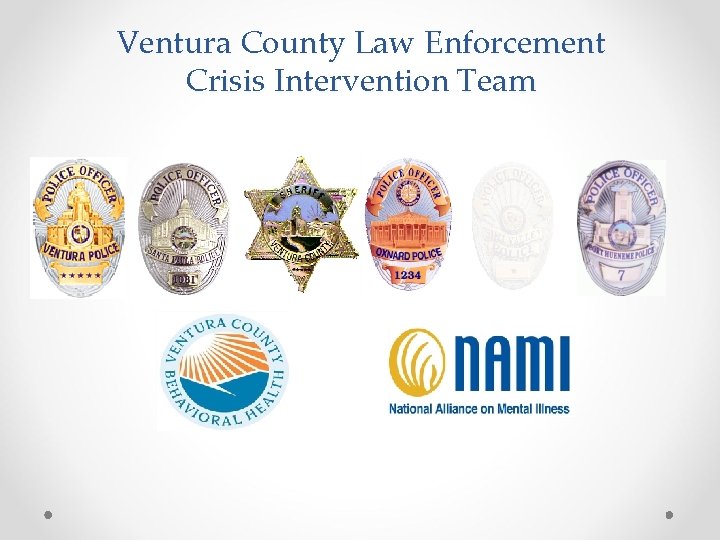
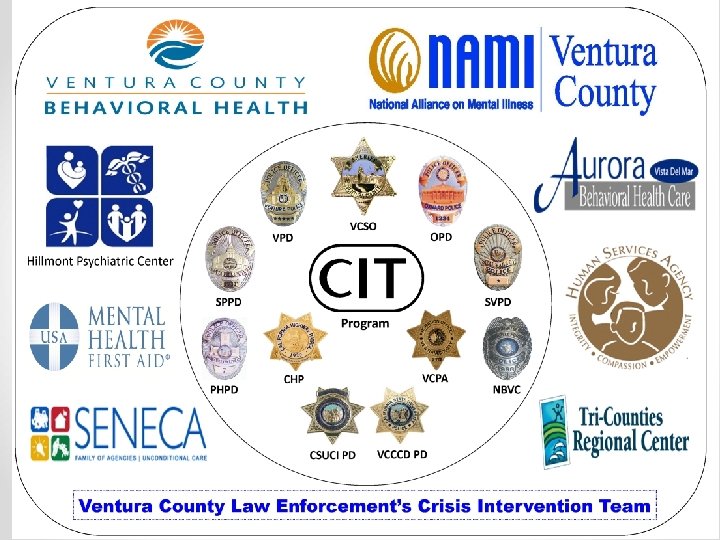
Ventura County Law Enforcement Crisis Intervention Team
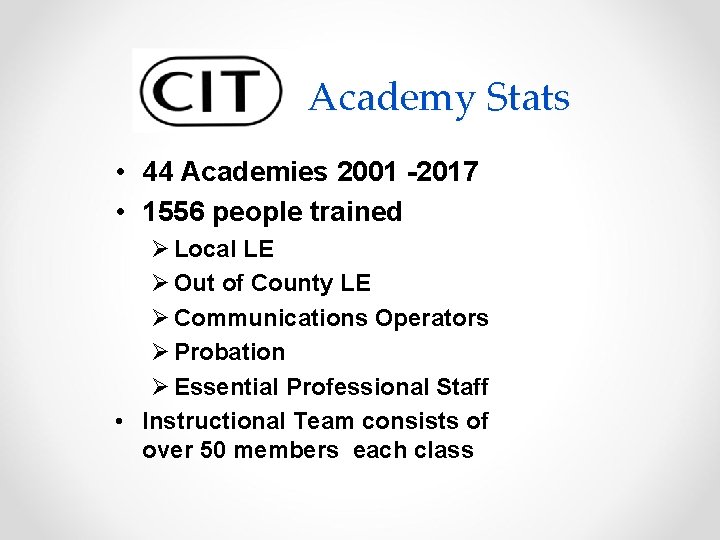
Academy Stats • 44 Academies 2001 -2017 • 1556 people trained Ø Local LE Ø Out of County LE Ø Communications Operators Ø Probation Ø Essential Professional Staff • Instructional Team consists of over 50 members each class
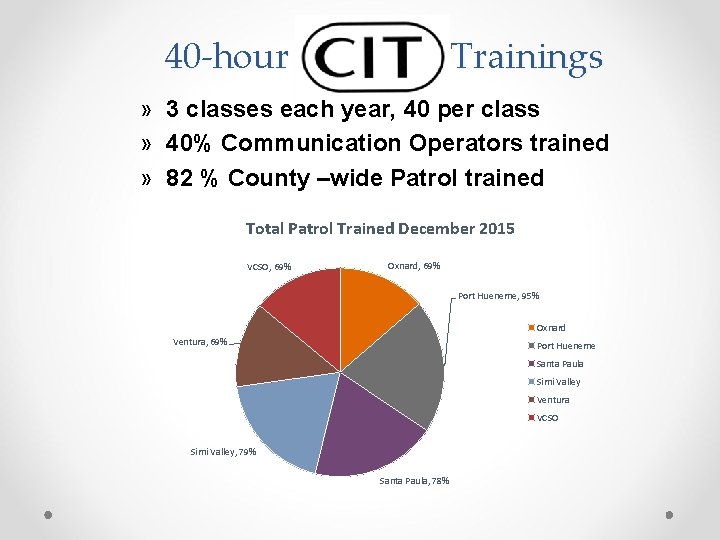
40 -hour Trainings » 3 classes each year, 40 per class » 40% Communication Operators trained » 82 % County –wide Patrol trained Total Patrol Trained December 2015 VCSO, 69% Oxnard, 69% Port Hueneme, 95% Oxnard Ventura, 69% Port Hueneme Santa Paula Simi Valley Ventura VCSO Simi Valley, 79% Santa Paula, 78%
How Did We Get Here? • Late 1990’s Officer Involved Shootings • Loss of life • Loss of Officers • Loss of Public confidence o Civil litigation • “There has to be a better way!” o LE leadership o Why me?
Research and Collaboration • Ventura County • VPD & VCBH o Memphis Model 1988 • Following a proven path • San Jose PD, May 2001 o Major Sam Cochran (Ret. ) o The partnership begins > • VPD, OPD, VCSO, VCBH & NAMI
Program Core Elements Ongoing Elements 1. Partnerships: Law Enforcement, Advocacy, Mental Health 2. Community Ownership: Planning, Implementation & Networking 3. Policies and Procedures
Program Core Elements Operational Elements 4. CIT: Officer, Dispatcher, Coordinator 5. Curriculum: CIT Training 6. Mental Health Receiving Facility: Emergency Service
Core Elements Sustaining Elements 7. Evaluation and Research 8. In‐Service Training 9. Recognition and Honors 10. Outreach: Developing CIT in Other Communities
Benefits of CIT • Immediacy of response • Increased officer safety • Reduced officer/citizen injuries • Increased jail diversion • Increased chance for consumer to connect to mental health system • Increased officer confidence in skills • Reduced liability • Reduced unnecessary arrests or use of force • Avoidance of costs to criminal justice system This is hard to prove • Positive perception of program • Linkages to long‐term services promoting recovery for the consumer and services in the behavioral health system
Multi-Agency Leadership • Law Enforcement administrative support o o Command Staff Sergeants Coordinators Champions (Change the culture) • Inter-agency cooperation and collaboration o Don’t let the plan stall waiting for all agencies to buy-in o Keep moving forward o Seek out the right people
Funding • The program is funded through a Memorandum of Agreement (MOA) between the Sheriff’s Office and 5 Police Dept. 's • Financial responsibility formula • Every MOA partner provides a percentage of the funding based upon the population of its jurisdiction • Grant funding has been utilized to help expand sustain the program
Program Staff Provides LE 8 -hour MIDD class in Patrol Orientation 40 -hour CIT Academy Act as a liaison between LE, behavioral health, and our stakeholders Staff reports Create training curriculums Quarterly Briefing Training LE presentations as requested Answer questions about, and connect LE to resources
CIT Program Staff Provides to Community Groups, Consumers and their Families • Presentations on the CIT program and how LE interacts with families and consumers • Mental Health First Aid hosting • Participate in community/stakeholder events • Follow-up with consumers and family members o Provide referrals to community resources
Coordinators Role • The station’s first point of contact • Knowledge of local resources • Maintain and improve stakeholder relationships • Work collaboratively with CIT Program Staff • Attend Quarterly Coordinator’s Meetings • Review CIT Cards in a timely manner • Proactive and timely information sharing • Recognize and report training issues • Help identify CIT Academy candidates • Nominate someone for CIT Officer of the Year
Funding Partnerships • Ventura County Behavioral Health through a Memorandum of Understanding (MOU) gives the CIT Program $100, 000 each fiscal year o These funds come from their Proposition 63 money earmarked for Prevention and Early Intervention Programs • Per the MOU the CIT Program agrees to train a minimum of 100 Ventura County Law Enforcement personnel each fiscal year • • Training rosters Surveys
Academy Hosting • Find the right venue • Supplies – Binders to Thumb drives o Role-play props • Follow your State’s certified extended course outline and retain copies from each class for your archives • Secure, confirm and re-confirm your instructors (Have a back-up plan) • All CIT instructors volunteer their time or participate while on duty • Command Staff Introduction (Be selective and prepare them) • Graduation
Upon completion of the course, Law Enforcement is better prepared to: • Understand signs and symptoms of mental illnesses and co‐occurring disorders • Recognize when those signs and symptoms represent a crisis situation • Safely de‐escalate individuals experiencing behavioral health crisis • Utilize community resources and use diversion strategies available to provide emergency assistance
Program Expansion and Stability • Lead agency -Ventura County Sheriffs Office o Program Administrator • Behavioral Health Department Liaison o Program staff o Law Enforcement Countywide Coordinator o Centralized location for the program o Quarterly meetings and regular contact with CIT Coordinators and CIT stakeholders
Community Stakeholders Quarterly Meetings Behavioral Health Hillmont Psychiatric Center Vista Del Mar Adult Protective Services Children Family Services NAMI VCMil. C Brain Injury Center Probation Agency Public Guardian’s Office Alzheimer’s Association Casa Pacifica Casa de Esperanza AWRC & TAY Centers Autism Society Other LE Agencies
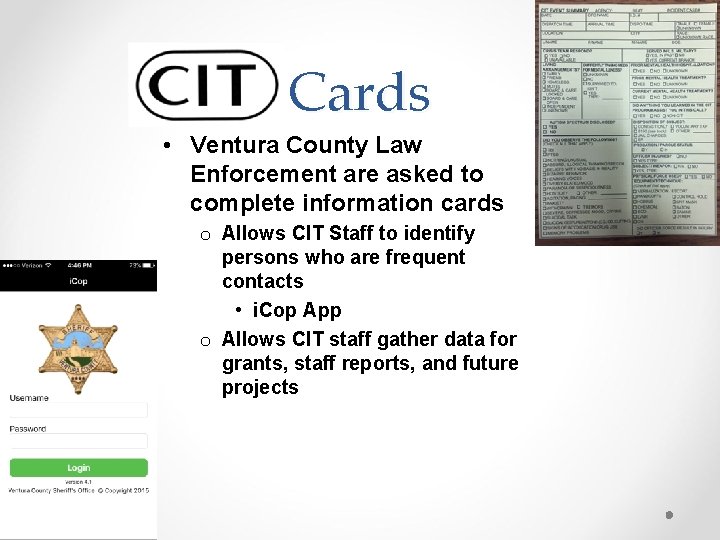
Cards • Ventura County Law Enforcement are asked to complete information cards o Allows CIT Staff to identify persons who are frequent contacts • i. Cop App o Allows CIT staff gather data for grants, staff reports, and future projects
Measures Officers’ Actions 88% of the contacts result in verbalization only (versus use-of-force) CIT Officers are less likely to use force, and they are…. 3 x more likely to have “contact only” 2 x less likely to use jail Handle CIT calls faster
What did officers say about the Academy? • 100% said they benefited from the training o 50% “very much” • 30% said they use new skills “often” • 95% felt they could better recognize a mental disorder • 92% felt better able to handle a call involving mental illness
Consumer & Family Member Feedback • 90% believed that the CIT trained officer was able to recognize the mental disorder • 90% believed the CIT officer was able to de-escalate the crisis in an satisfactory manner
Ventura County Mark Stadler Program Administrator mark. stadler@ventura. org (805) 388 -5107 Scott Walker Program Assistant scott. walker@ventura. org (805) 383 -4806 Sergeant John Franchi County CIT Coordinator john. franchi@ventura. org (805) 388 -5135