Velocity Polygon for a CrankSlider Introduction Velocity Polygon


- Slides: 8
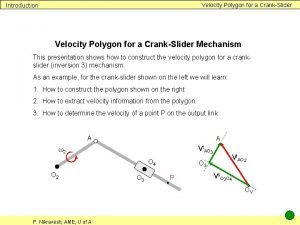
Velocity Polygon for a Crank-Slider Introduction Velocity Polygon for a Crank-Slider Mechanism This presentation shows how to construct the velocity polygon for a crankslider (inversion 3) mechanism. As an example, for the crank-slider shown on the left we will learn: 1. How to construct the polygon shown on the right 2. How to extract velocity information from the polygon 3. How to determine the velocity of a point P on the output link A A Vt. AO 3 ω2 O 4 O 2 O 3 P Vt. AO 2 Vs. O 3 O 4 OV P. Nikravesh, AME, U of A
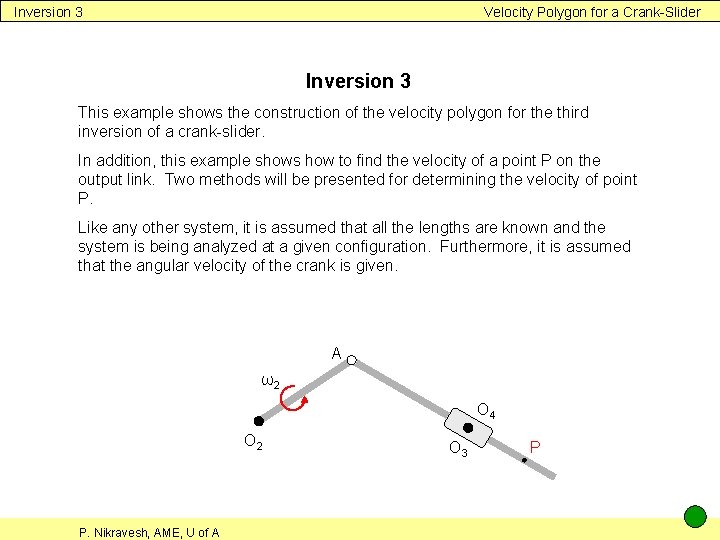
Inversion 3 Velocity Polygon for a Crank-Slider Inversion 3 This example shows the construction of the velocity polygon for the third inversion of a crank-slider. In addition, this example shows how to find the velocity of a point P on the output link. Two methods will be presented for determining the velocity of point P. Like any other system, it is assumed that all the lengths are known and the system is being analyzed at a given configuration. Furthermore, it is assumed that the angular velocity of the crank is given. A ω2 O 4 O 2 P. Nikravesh, AME, U of A O 3 P
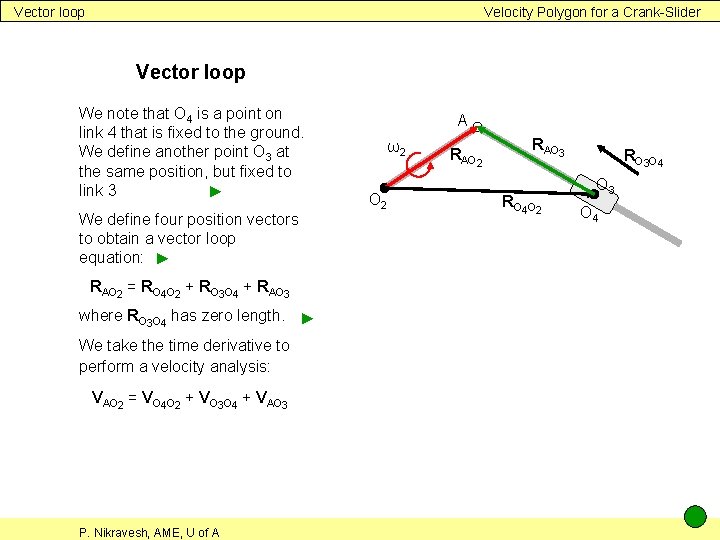
Vector loop Velocity Polygon for a Crank-Slider Vector loop We note that O 4 is a point on link 4 that is fixed to the ground. We define another point O 3 at the same position, but fixed to link 3 ► We define four position vectors to obtain a vector loop equation: ► RAO 2 = RO 4 O 2 + RO 3 O 4 + RAO 3 where RO 3 O 4 has zero length. ► We take the time derivative to perform a velocity analysis: VAO 2 = VO 4 O 2 + VO 3 O 4 + VAO 3 P. Nikravesh, AME, U of A A ω2 O 2 RAO 3 RO 4 O 2 RO 3 O 4
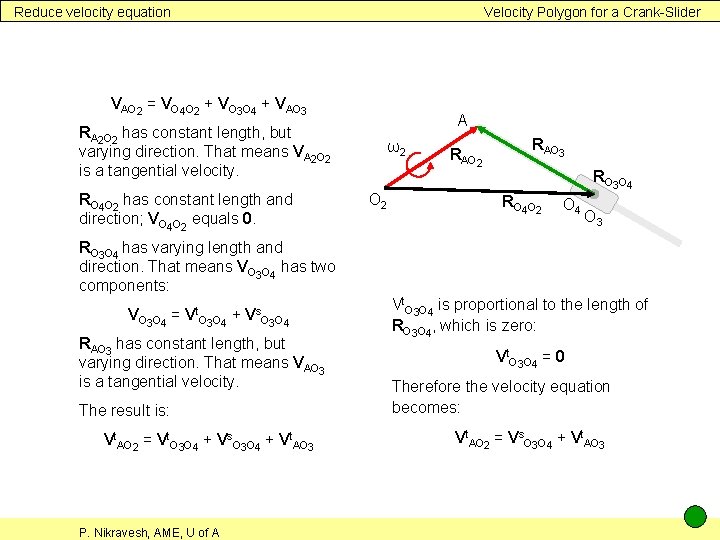
Reduce velocity equation Velocity Polygon for a Crank-Slider VAO 2 = VO 4 O 2 + VO 3 O 4 + VAO 3 RA 2 O 2 has constant length, but varying direction. That means VA 2 O 2 is a tangential velocity. RO 4 O 2 has constant length and direction; VO 4 O 2 equals 0. A ω2 O 2 RAO 3 RO 3 O 4 RO 4 O 2 O 4 O 3 RO 3 O 4 has varying length and direction. That means VO 3 O 4 has two components: V O 3 O 4 = Vt. O 3 O 4 + Vs. O 3 O 4 RAO 3 has constant length, but varying direction. That means VAO 3 is a tangential velocity. The result is: Vt. AO 2 = Vt. O 3 O 4 + Vs. O 3 O 4 + Vt. AO 3 P. Nikravesh, AME, U of A Vt. O 3 O 4 is proportional to the length of RO 3 O 4, which is zero: Vt. O 3 O 4 = 0 Therefore the velocity equation becomes: Vt. AO 2 = Vs. O 3 O 4 + Vt. AO 3
Velocity polygon Velocity Polygon for a Crank-Slider Vt. AO 2 = Vs. O 3 O 4 + Vt. AO 3 We can calculate Vt. AO 2 : Vt. AO 2 = ω2 ∙ RAO 2 The direction is found by rotating RAO 2 90° in the direction of ω2 ► Vs. O 3 O 4 The direction of parallel to link 3 ► ω2 Now we can draw the velocity polygon: Vt. AO 2 is added to the origin ► Vs. O 3 O 4 starts at OV ► Vt. AO 3 ends at A ► We construct the polygon ► RAO 3 RAO 2 RO 3 O 4 O 2 RO 4 O 2 is The direction of Vt. AO 3 is perpendicular to RAO 3 ► P. Nikravesh, AME, U of A A O 4 A Vt. AO 3 Vt. AO 2 Vs. O 3 O 4 OV O 3
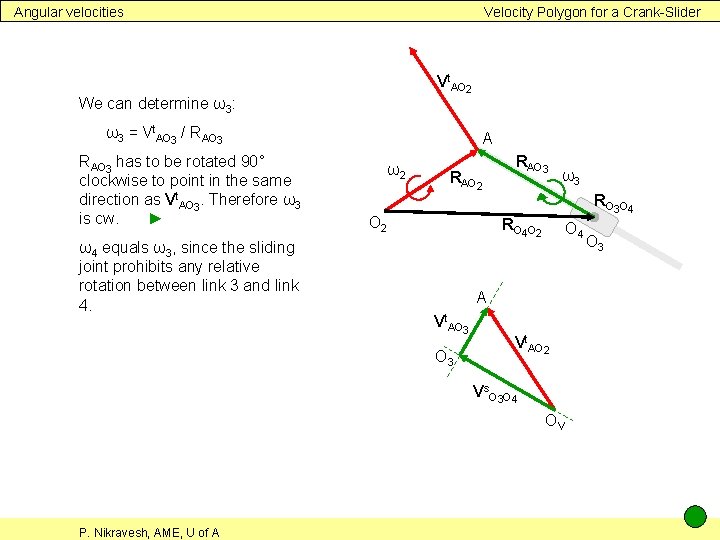
Angular velocities Velocity Polygon for a Crank-Slider Vt. AO 2 We can determine ω3: ω3 = Vt. AO 3 / RAO 3 has to be rotated 90° clockwise to point in the same direction as Vt. AO 3. Therefore ω3 ► is cw. ω4 equals ω3, since the sliding joint prohibits any relative rotation between link 3 and link 4. A ω2 RAO 3 ω3 RO 3 O 4 O 2 RO 4 O 2 O 4 A Vt. AO 3 Vt. AO 2 Vs. O 3 O 4 OV P. Nikravesh, AME, U of A O 3
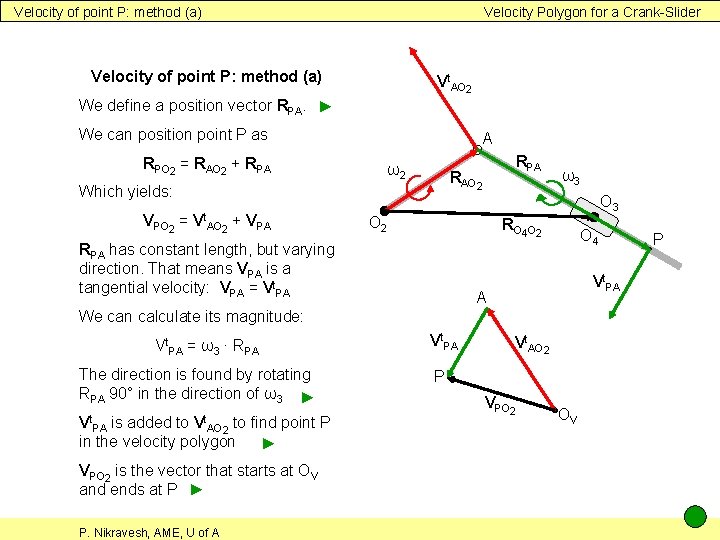
Velocity of point P: method (a) Velocity Polygon for a Crank-Slider Velocity of point P: method (a) Vt. AO 2 We define a position vector RPA. ► We can position point P as RPO 2 = RAO 2 + RPA A ω2 RAO 2 Which yields: VPO 2 = Vt. AO 2 + VPA RPA ω3 O 2 RO 4 O 2 RPA has constant length, but varying direction. That means VPA is a tangential velocity: VPA = Vt. PA O 4 Vt. PA A We can calculate its magnitude: Vt. PA = ω3 ∙ RPA The direction is found by rotating RPA 90° in the direction of ω3 ► Vt. PA Vt. AO 2 is added to to find point P in the velocity polygon ► VPO 2 is the vector that starts at OV and ends at P ► P. Nikravesh, AME, U of A Vt. PA Vt. AO 2 P VPO 2 OV P
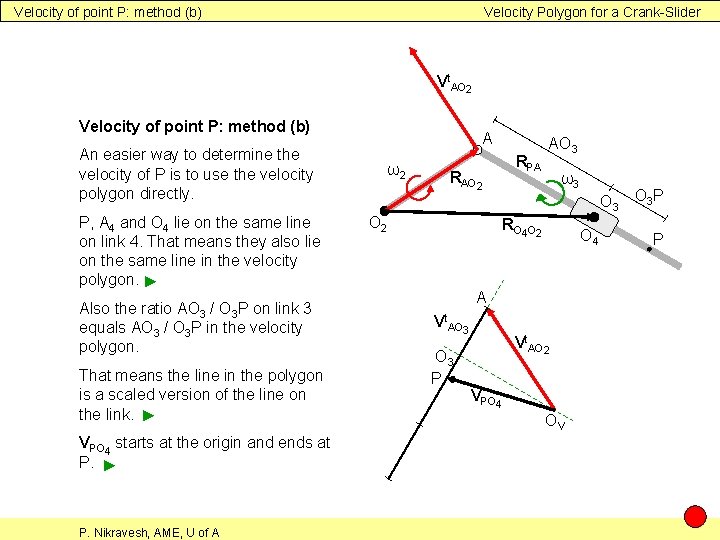
Velocity of point P: method (b) Velocity Polygon for a Crank-Slider Vt. AO 2 Velocity of point P: method (b) An easier way to determine the velocity of P is to use the velocity polygon directly. P, A 4 and O 4 lie on the same line on link 4. That means they also lie on the same line in the velocity polygon. ► Also the ratio AO 3 / O 3 P on link 3 equals AO 3 / O 3 P in the velocity polygon. That means the line in the polygon is a scaled version of the line on the link. ► VPO 4 starts at the origin and ends at P. ► P. Nikravesh, AME, U of A A ω2 RPA RAO 2 AO 3 ω3 O 2 RO 4 O 2 O 4 A Vt. AO 3 P Vt. AO 2 VPO 4 OV O 3 P P