VARIETIES OF THE THIRD MISSION UniversitySociety Interaction in
- Slides: 9
VARIETIES OF THE THIRD MISSION: University-Society Interaction in Three Research Areas Terhi Esko, University of Helsinki Teollisuuskatu 23 00014 University of Helsinki terhi. esko@helsinki. fi ESA Conference Geneva 10. 9. 2011
Project group (2011 -) Juha Tuunainen, Helsinki Institute of Science and Technology Studies (HIST) Reijo Miettinen, Center for Research on Activity, Development and Learning (CRADLE) Terhi Esko, Network for Higher Education and Innovation Research (HEINE) Kaija Hartikainen, Faculty of Arts, University of Helsinki Cooperation: 1) Georg Krücken (Kassel), 2) Uwe Schimank (Bremen) ja 3) Nicole Schultze (Fraunhofer Institut, Karlsruhe)
Background Policy context: third mission of universities and social impact of university research Bayh-Dole Act (USA 1980): commercialization of research results (patents, licencing, spin off companies) theoretizations: Mode 2, postacademic science, triple helix etc. Empirical research on the third mission is narrow and scarce Great variance between disciplines: patenting central only in some disciplines, mainly pharmaceuticals Attention on technical sciences rather than on humanities and social sciences
Three cases Urban studies Finno-Ugric Research studies on learning difficulties (Niilo Mäki Institute)
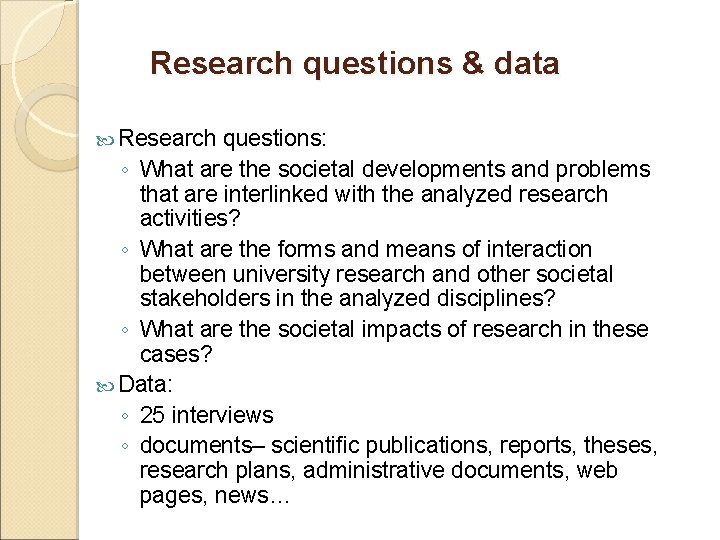
Research questions & data Research questions: ◦ What are the societal developments and problems that are interlinked with the analyzed research activities? ◦ What are the forms and means of interaction between university research and other societal stakeholders in the analyzed disciplines? ◦ What are the societal impacts of research in these cases? Data: ◦ 25 interviews ◦ documents– scientific publications, reports, theses, research plans, administrative documents, web pages, news…
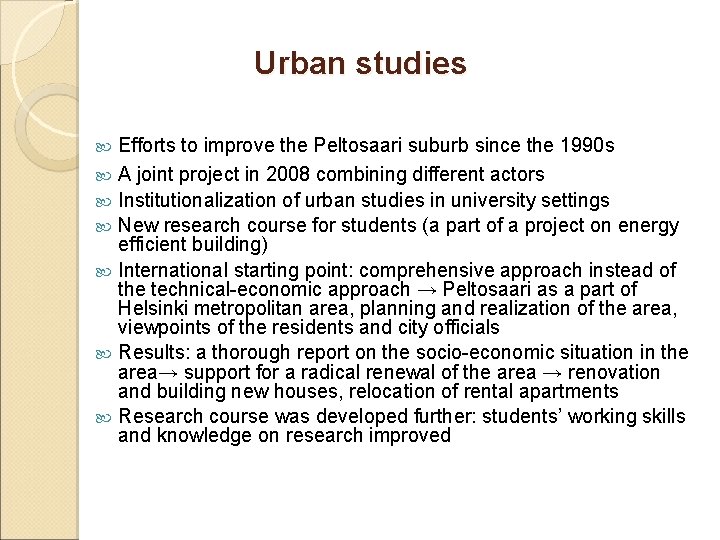
Urban studies Efforts to improve the Peltosaari suburb since the 1990 s A joint project in 2008 combining different actors Institutionalization of urban studies in university settings New research course for students (a part of a project on energy efficient building) International starting point: comprehensive approach instead of the technical-economic approach → Peltosaari as a part of Helsinki metropolitan area, planning and realization of the area, viewpoints of the residents and city officials Results: a thorough report on the socio-economic situation in the area→ support for a radical renewal of the area → renovation and building new houses, relocation of rental apartments Research course was developed further: students’ working skills and knowledge on research improved
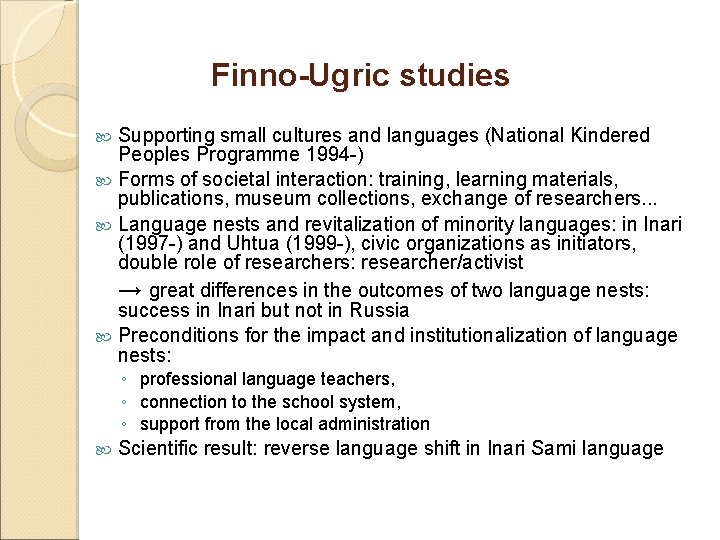
Finno-Ugric studies Supporting small cultures and languages (National Kindered Peoples Programme 1994 -) Forms of societal interaction: training, learning materials, publications, museum collections, exchange of researchers. . . Language nests and revitalization of minority languages: in Inari (1997 -) and Uhtua (1999 -), civic organizations as initiators, double role of researchers: researcher/activist → great differences in the outcomes of two language nests: success in Inari but not in Russia Preconditions for the impact and institutionalization of language nests: ◦ professional language teachers, ◦ connection to the school system, ◦ support from the local administration Scientific result: reverse language shift in Inari Sami language
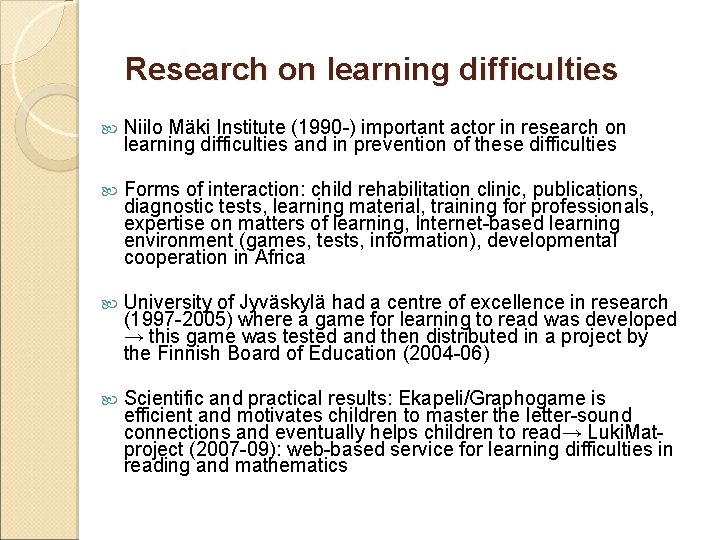
Research on learning difficulties Niilo Mäki Institute (1990 -) important actor in research on learning difficulties and in prevention of these difficulties Forms of interaction: child rehabilitation clinic, publications, diagnostic tests, learning material, training for professionals, expertise on matters of learning, Internet-based learning environment (games, tests, information), developmental cooperation in Africa University of Jyväskylä had a centre of excellence in research (1997 -2005) where a game for learning to read was developed → this game was tested and then distributed in a project by the Finnish Board of Education (2004 -06) Scientific and practical results: Ekapeli/Graphogame is efficient and motivates children to master the letter-sound connections and eventually helps children to read→ Luki. Matproject (2007 -09): web-based service for learning difficulties in reading and mathematics
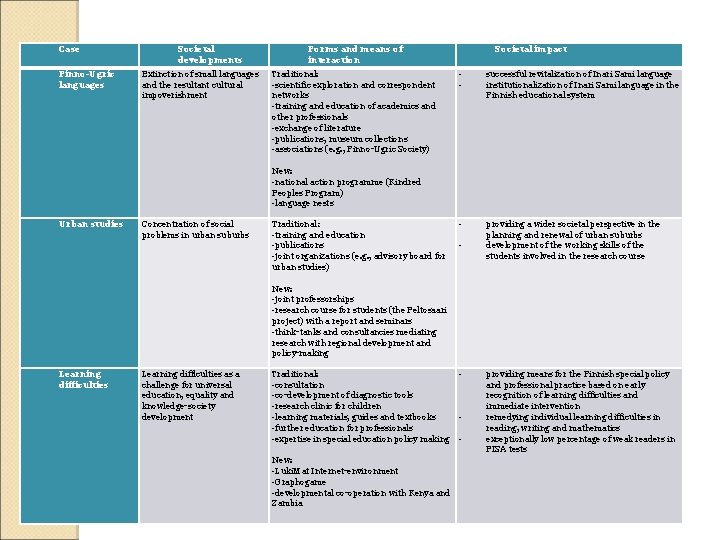
Case Finno-Ugric languages Urban studies Learning difficulties Societal developments Forms and means of interaction Societal impact - successful revitalization of Inari Sami language institutionalization of Inari Sami language in the Finnish educational system Traditional: -training and education -publications -joint organizations (e. g. , advisory board for urban studies) New: -joint professorships -research course for students (the Peltosaari project) with a report and seminars -think-tanks and consultancies mediating research with regional development and policy-making - providing a wider societal perspective in the planning and renewal of urban suburbs development of the working skills of the students involved in the research course Traditional: - Extinction of small languages and the resultant cultural impoverishment Traditional: Concentration of social problems in urban suburbs Learning difficulties as a challenge for universal education, equality and knowledge-society development -scientific exploration and correspondent networks -training and education of academics and other professionals -exchange of literature -publications, museum collections -associations (e. g. , Finno-Ugric Society) New: -national action programme (Kindred Peoples Program) -language nests -consultation -co-development of diagnostic tools -research clinic for children -learning materials, guides and textbooks -further education for professionals -expertise in special education policy making New: -Luki. Mat Internet-environment -Graphogame -developmental co-operation with Kenya and Zambia - - providing means for the Finnish special policy and professional practice based on early recognition of learning difficulties and immediate intervention remedying individual learning difficulties in reading, writing and mathematics exceptionally low percentage of weak readers in PISA tests