Using Pronouns Correctly What are the cases of


- Slides: 20
Using Pronouns Correctly What are the cases of personal pronouns? The nominative case The objective case The possessive case Review A Review B
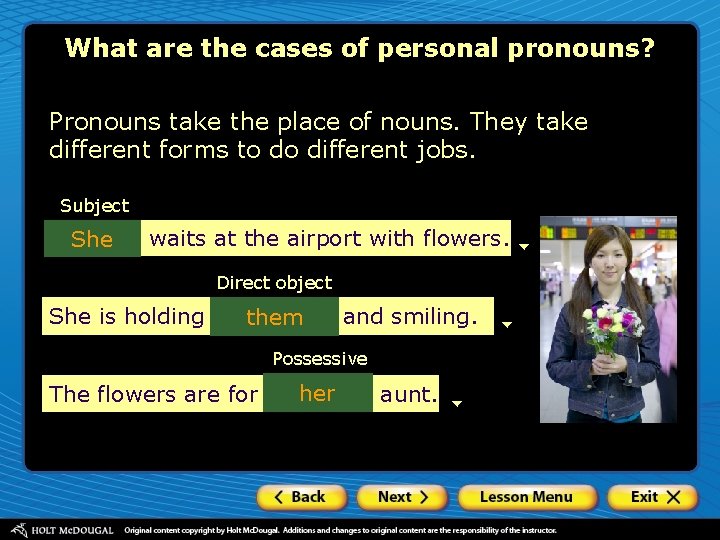
What are the cases of personal pronouns? Pronouns take the place of nouns. They take different forms to do different jobs. Subject Ming-na waits at the airport with flowers. She Direct object She is holding thethem flowers and smiling. Possessive her The flowers are for Ming-na’s aunt.
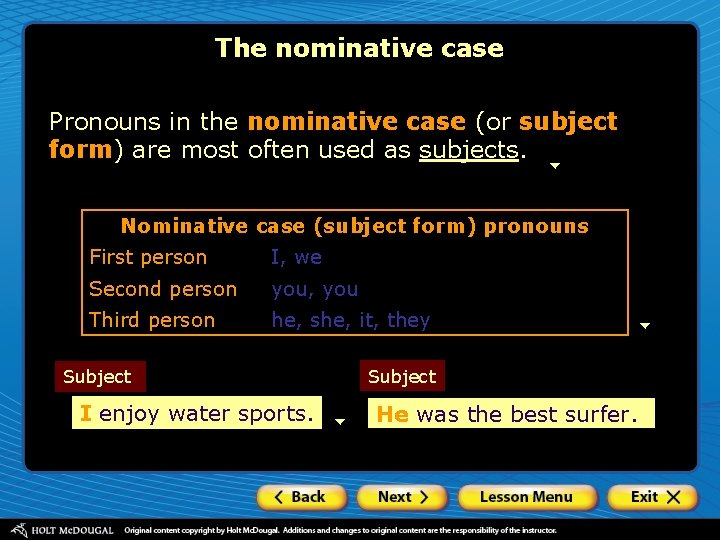
The nominative case Pronouns in the nominative case (or subject form) are most often used as subjects. Nominative case (subject form) pronouns First person I, we Second person you, you Third person he, she, it, they Subject I enjoy water sports. Subject He was the best surfer.
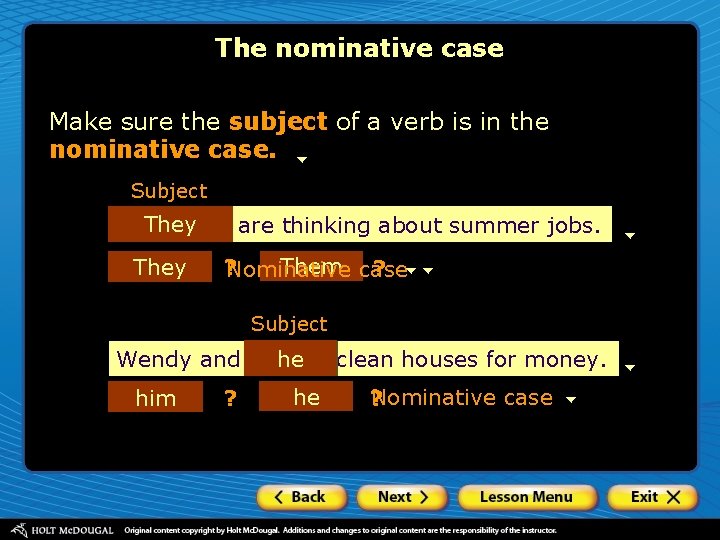
The nominative case Make sure the subject of a verb is in the nominative case. Subject My. They friends are thinking about summer jobs. They Them case ? Nominative ? Subject he clean houses for money. Wendy and Jerome him ? he Nominative case ?
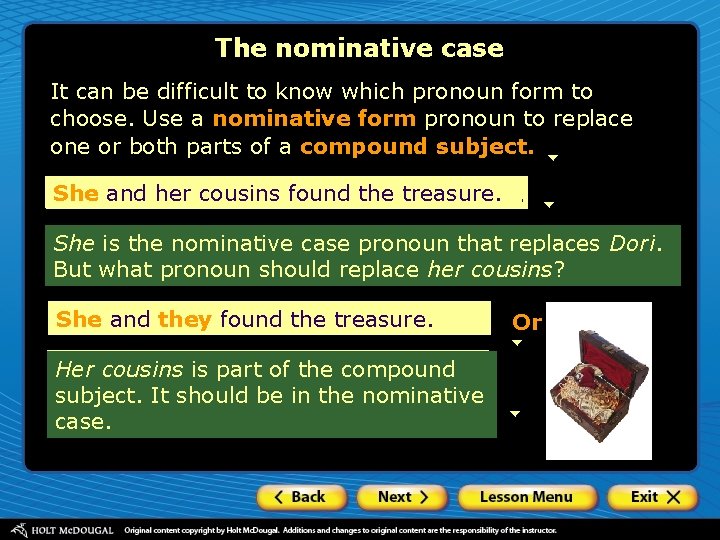
The nominative case It can be difficult to know which pronoun form to choose. Use a nominative form pronoun to replace one or both parts of a compound subject. She found the treasure. Dori and hercousins found the treasure. She is the nominative case pronoun that replaces Dori. But what pronoun should replace her cousins? Dori and She and they found the treasure. Doricousins and them found the compound treasure. Her is part of the subject. It should be in the nominative case. Or
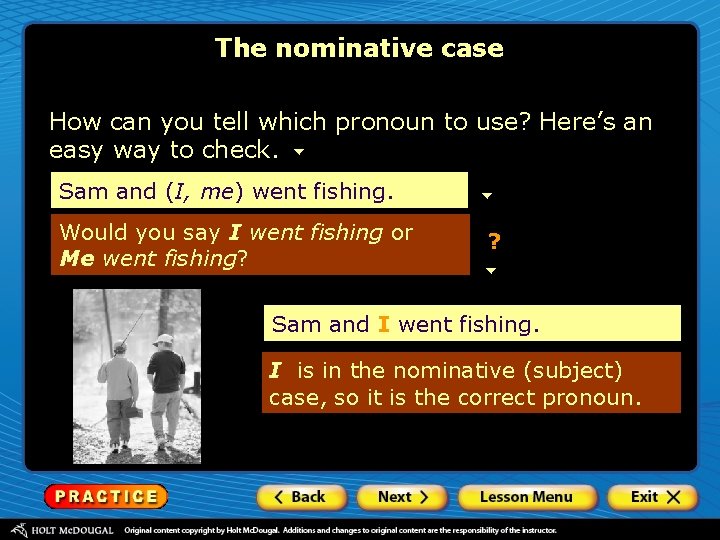
The nominative case How can you tell which pronoun to use? Here’s an easy way to check. Sam and (I, me) went fishing. Would you say I went fishing or Me went fishing? ? Sam and I went fishing. I is in the nominative (subject) case, so it is the correct pronoun.
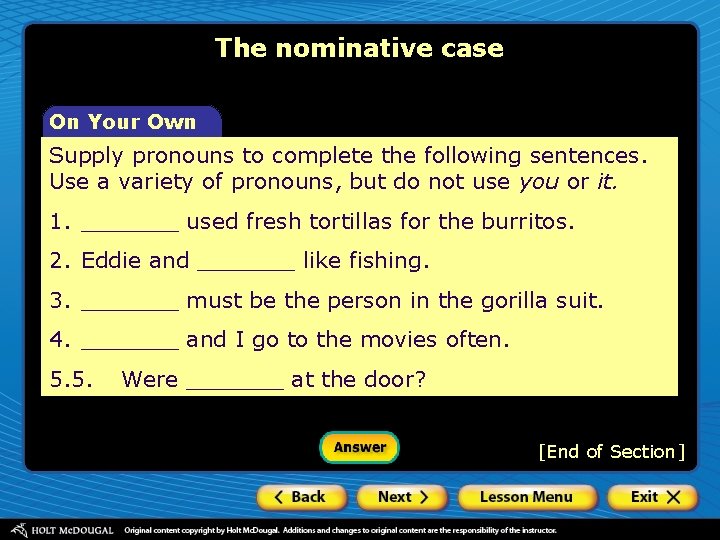
The nominative case On Your Own Supply pronouns to complete the following sentences. Use a variety of pronouns, but do not use you or it. 1. _______ used fresh tortillas for the burritos. 2. Eddie and _______ like fishing. 3. _______ must be the person in the gorilla suit. 4. _______ and I go to the movies often. 5. 5. Were _______ at the door? [End of Section]
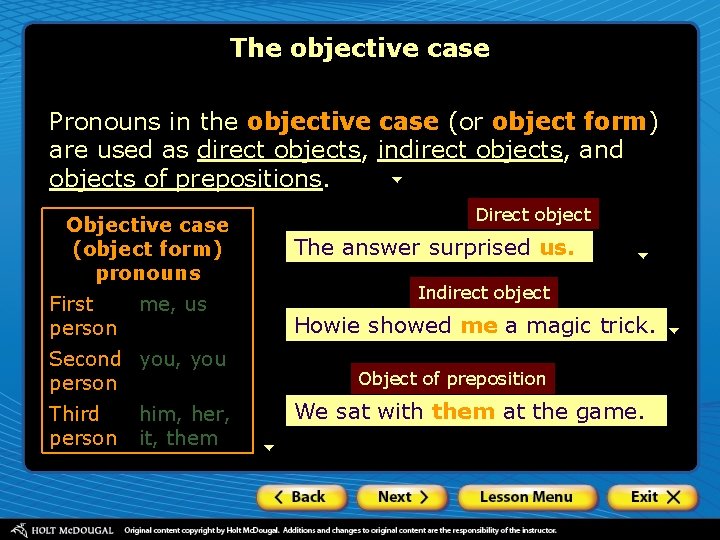
The objective case Pronouns in the objective case (or object form) are used as direct objects, indirect objects, and objects of prepositions. Objective case (object form) pronouns First person me, us Second you, you person Third person him, her, it, them Direct object The answer surprised us. Indirect object Howie showed me a magic trick. Object of preposition We sat with them at the game.
The objective case A direct object should be in the objective case. Direct object us Mom helped ______ with our projects. Objective case we ? us ? Direct object She took Pete and ______ me to the fabric store. me I case ? Objective ?
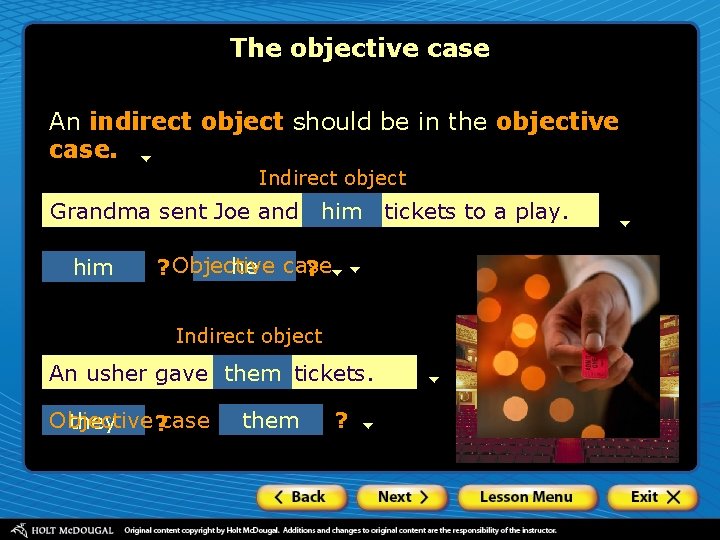
The objective case An indirect object should be in the objective case. Indirect object Grandma sent Joe and _____ him tickets to a play. him he case ? Objective ? Indirect object them tickets. An usher gave _____ Objective they ? case them ?
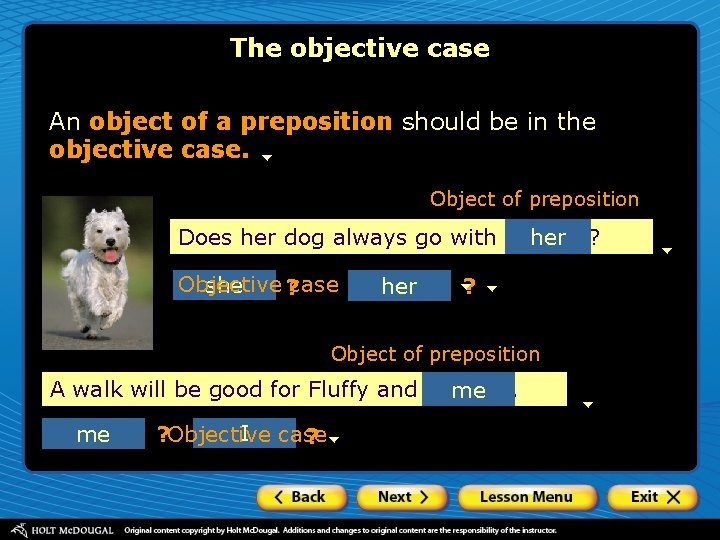
The objective case An object of a preposition should be in the objective case. Object of preposition Does her dog always go with ______? her Objective she ? case her ? Object of preposition A walk will be good for Fluffy and ______. me me I case ? Objective ?
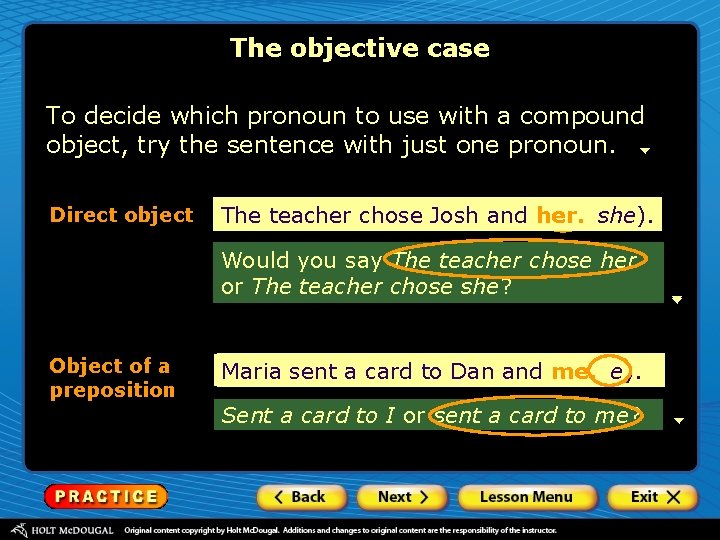
The objective case To decide which pronoun to use with a compound object, try the sentence with just one pronoun. Direct object The teacher chose Josh and (her, her. she). Would you say The teacher chose her or The teacher chose she? Object of a preposition Maria sent aa card to to Dan and me. (I, me). Sent a card to I or sent a card to me?
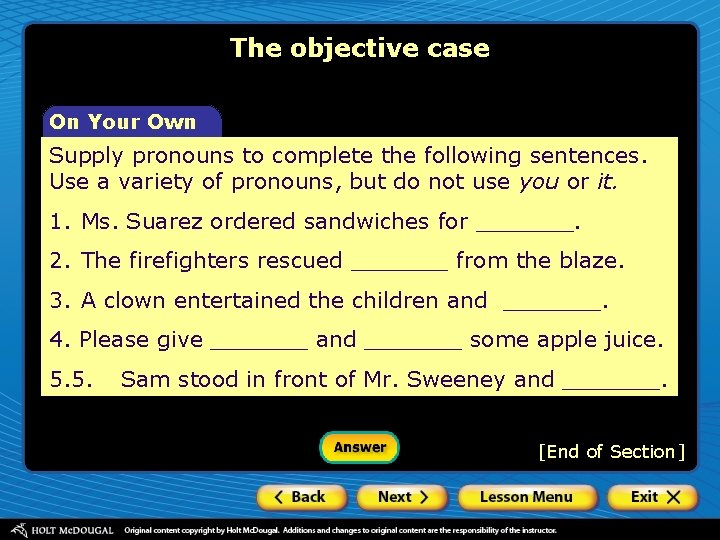
The objective case On Your Own Supply pronouns to complete the following sentences. Use a variety of pronouns, but do not use you or it. 1. Ms. Suarez ordered sandwiches for _______. 2. The firefighters rescued _______ from the blaze. 3. A clown entertained the children and _______. 4. Please give _______ and _______ some apple juice. 5. 5. Sam stood in front of Mr. Sweeney and _______. [End of Section]
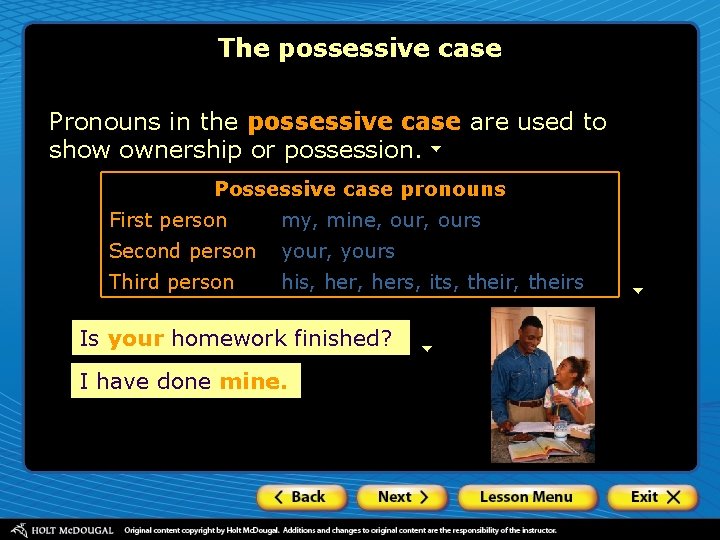
The possessive case Pronouns in the possessive case are used to show ownership or possession. Possessive case pronouns First person my, mine, ours Second person your, yours Third person his, hers, its, theirs Is your homework finished? I have done mine.
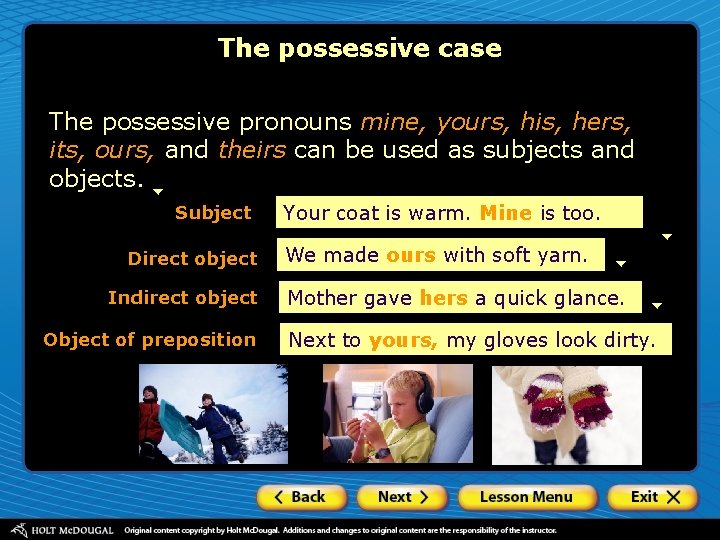
The possessive case The possessive pronouns mine, yours, his, hers, its, ours, and theirs can be used as subjects and objects. Subject Direct object Indirect object Object of preposition Your coat is warm. Mine is too. We made ours with soft yarn. Mother gave hers a quick glance. Next to yours, my gloves look dirty.
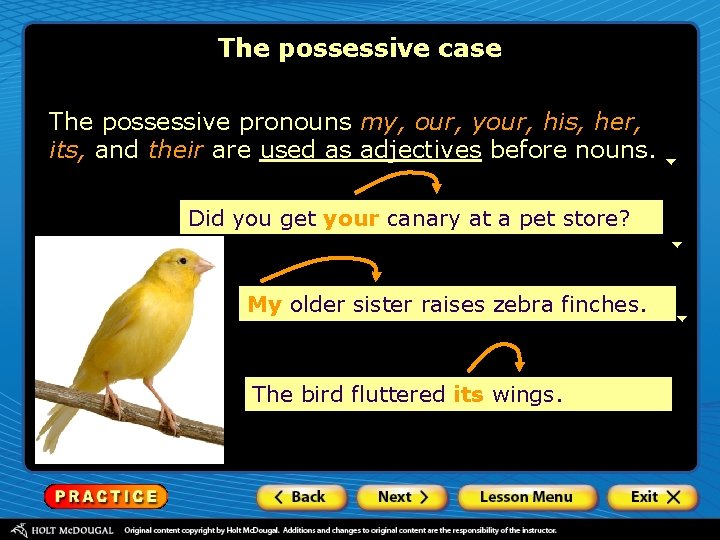
The possessive case The possessive pronouns my, our, your, his, her, its, and their are used as adjectives before nouns. Did you get your canary at a pet store? My older sister raises zebra finches. The bird fluttered its wings.
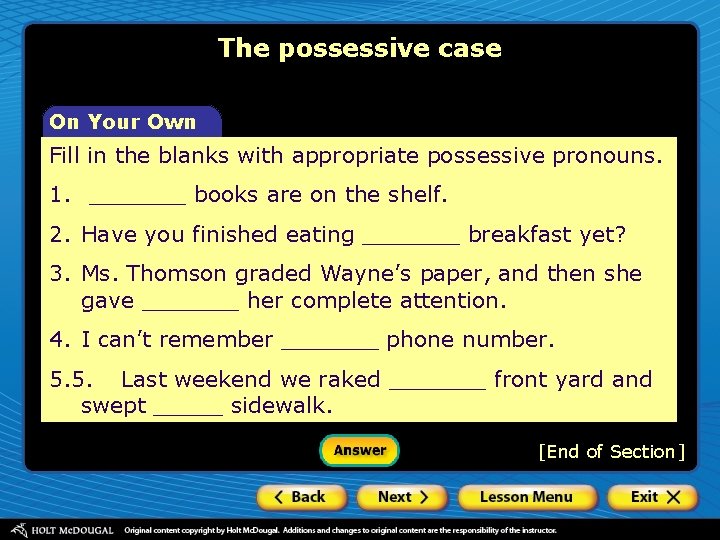
The possessive case On Your Own Fill in the blanks with appropriate possessive pronouns. 1. _______ books are on the shelf. 2. Have you finished eating _______ breakfast yet? 3. Ms. Thomson graded Wayne’s paper, and then she gave _______ her complete attention. 4. I can’t remember _______ phone number. 5. 5. Last weekend we raked _______ front yard and swept _____ sidewalk. [End of Section]
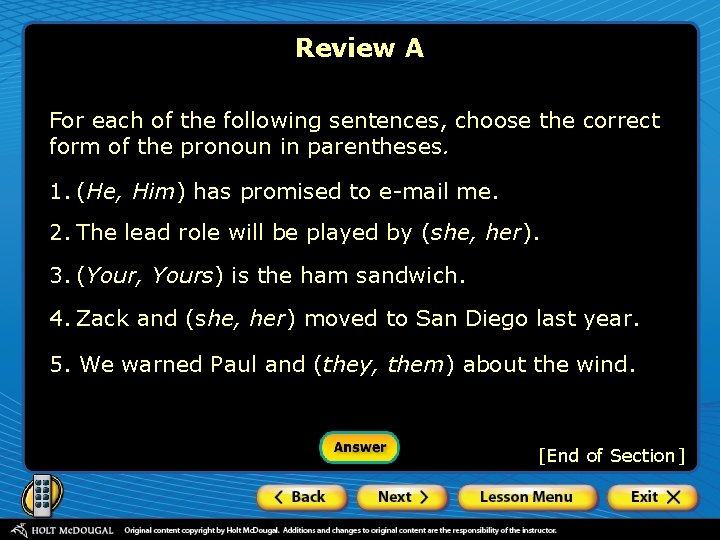
Review A For each of the following sentences, choose the correct form of the pronoun in parentheses. 1. (He, Him) has promised to e-mail me. 2. The lead role will be played by (she, her). 3. (Your, Yours) is the ham sandwich. 4. Zack and (she, her) moved to San Diego last year. 5. We warned Paul and (they, them) about the wind. [End of Section]
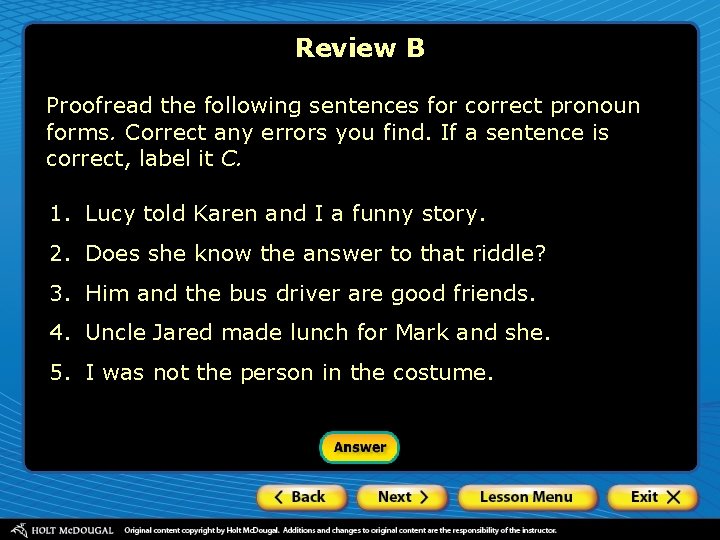
Review B Proofread the following sentences for correct pronoun forms. Correct any errors you find. If a sentence is correct, label it C. 1. Lucy told Karen and I a funny story. 2. Does she know the answer to that riddle? 3. Him and the bus driver are good friends. 4. Uncle Jared made lunch for Mark and she. 5. I was not the person in the costume.
The End