Types of Arguments Toulmin Model Toulmin Model 1


- Slides: 13
Types of Arguments
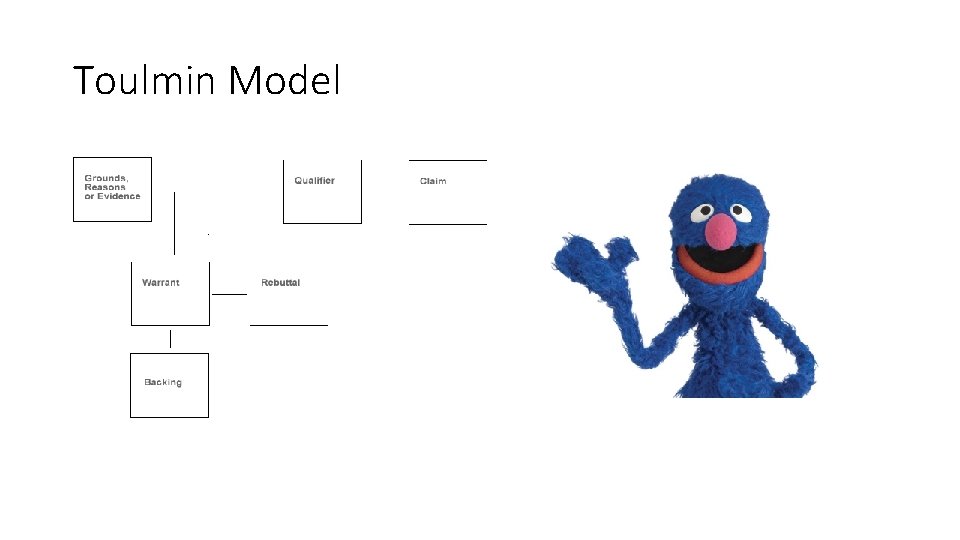
Toulmin Model
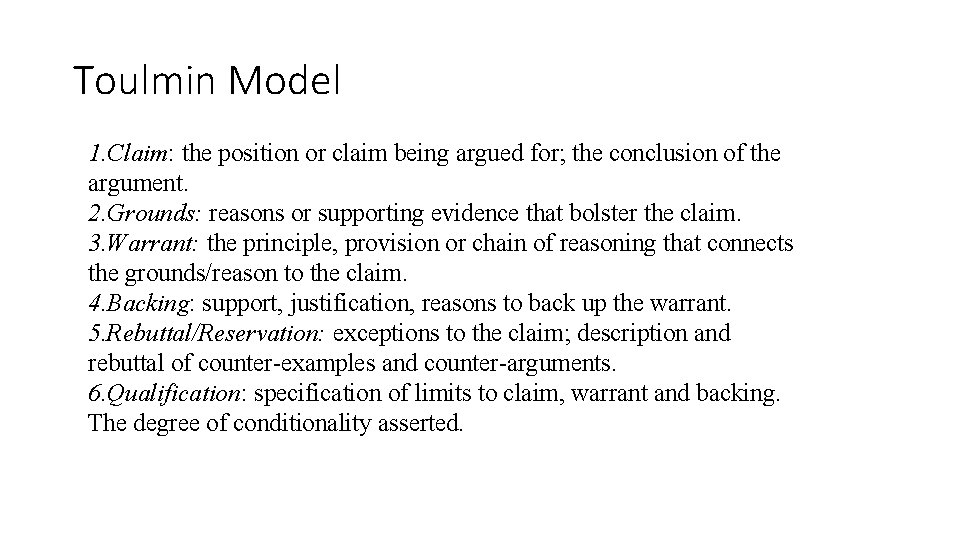
Toulmin Model 1. Claim: the position or claim being argued for; the conclusion of the argument. 2. Grounds: reasons or supporting evidence that bolster the claim. 3. Warrant: the principle, provision or chain of reasoning that connects the grounds/reason to the claim. 4. Backing: support, justification, reasons to back up the warrant. 5. Rebuttal/Reservation: exceptions to the claim; description and rebuttal of counter-examples and counter-arguments. 6. Qualification: specification of limits to claim, warrant and backing. The degree of conditionality asserted.
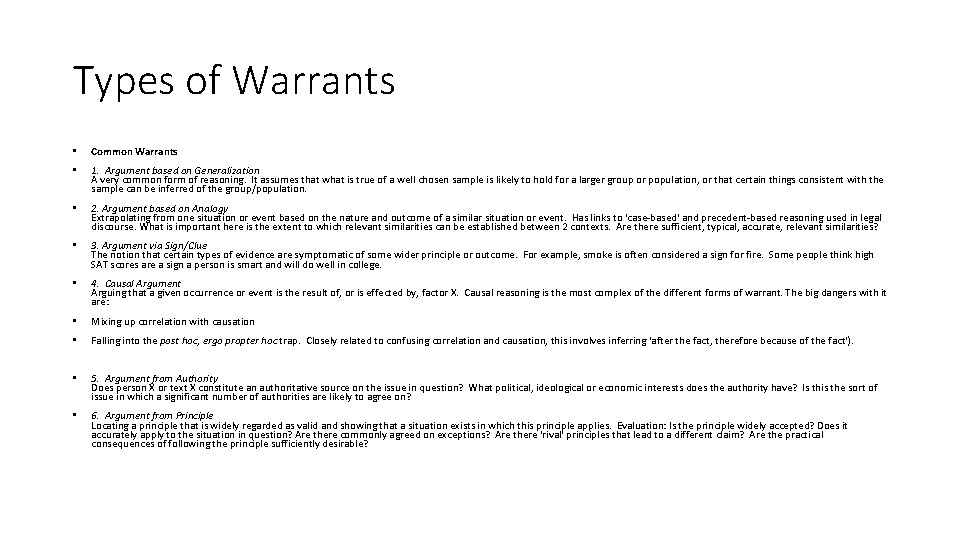
Types of Warrants • Common Warrants • 1. Argument based on Generalization A very common form of reasoning. It assumes that what is true of a well chosen sample is likely to hold for a larger group or population, or that certain things consistent with the sample can be inferred of the group/population. • 2. Argument based on Analogy Extrapolating from one situation or event based on the nature and outcome of a similar situation or event. Has links to 'case-based' and precedent-based reasoning used in legal discourse. What is important here is the extent to which relevant similarities can be established between 2 contexts. Are there sufficient, typical, accurate, relevant similarities? • 3. Argument via Sign/Clue The notion that certain types of evidence are symptomatic of some wider principle or outcome. For example, smoke is often considered a sign for fire. Some people think high SAT scores are a sign a person is smart and will do well in college. • 4. Causal Argument Arguing that a given occurrence or event is the result of, or is effected by, factor X. Causal reasoning is the most complex of the different forms of warrant. The big dangers with it are: • Mixing up correlation with causation • Falling into the post hoc, ergo propter hoc trap. Closely related to confusing correlation and causation, this involves inferring 'after the fact, therefore because of the fact'). • 5. Argument from Authority Does person X or text X constitute an authoritative source on the issue in question? What political, ideological or economic interests does the authority have? Is this the sort of issue in which a significant number of authorities are likely to agree on? • 6. Argument from Principle Locating a principle that is widely regarded as valid and showing that a situation exists in which this principle applies. Evaluation: Is the principle widely accepted? Does it accurately apply to the situation in question? Are there commonly agreed on exceptions? Are there 'rival' principles that lead to a different claim? Are the practical consequences of following the principle sufficiently desirable?
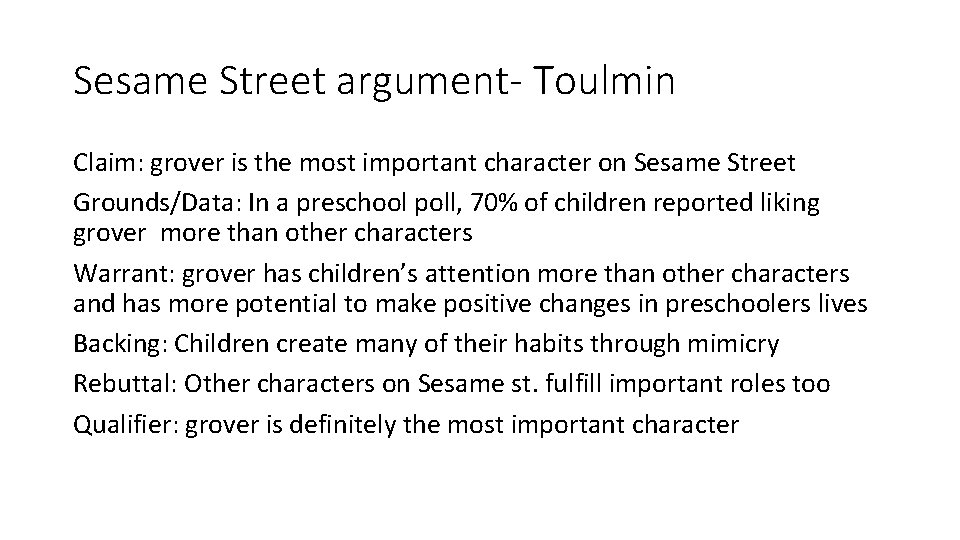
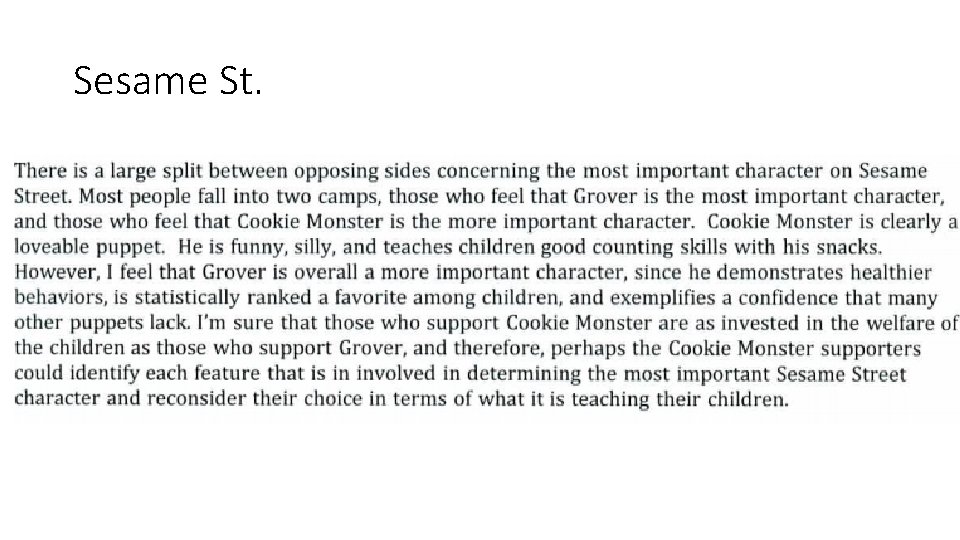
Sesame Street argument- Toulmin Claim: grover is the most important character on Sesame Street Grounds/Data: In a preschool poll, 70% of children reported liking grover more than other characters Warrant: grover has children’s attention more than other characters and has more potential to make positive changes in preschoolers lives Backing: Children create many of their habits through mimicry Rebuttal: Other characters on Sesame st. fulfill important roles too Qualifier: grover is definitely the most important character
Try it: Claim: Canada is better than America Grounds: Warrant: Backing: Rebuttal: Qualifier:
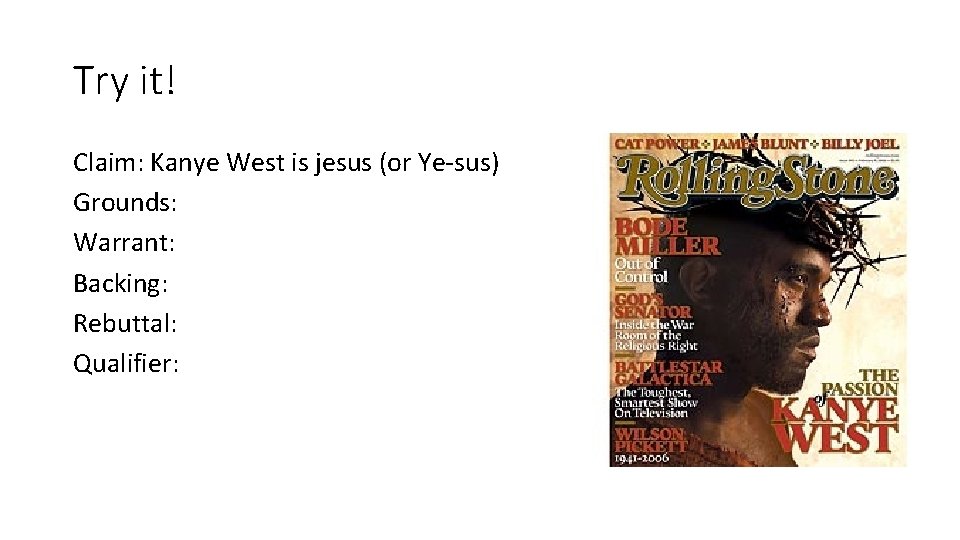
Try it! Claim: Kanye West is jesus (or Ye-sus) Grounds: Warrant: Backing: Rebuttal: Qualifier:
Rogerian 1. An introduction to the problem and a demonstration that the opponent's position is understood. 2. A statement of the contexts in which the opponent's position may be valid. 3. A statement of the writer's position, including the contexts in which it is valid. 4. A statement of how the opponent's position would benefit if he were to adopt elements of the writer's position. If the writer can show that the positions complement each other, that each supplies what the other lacks, so much the better.
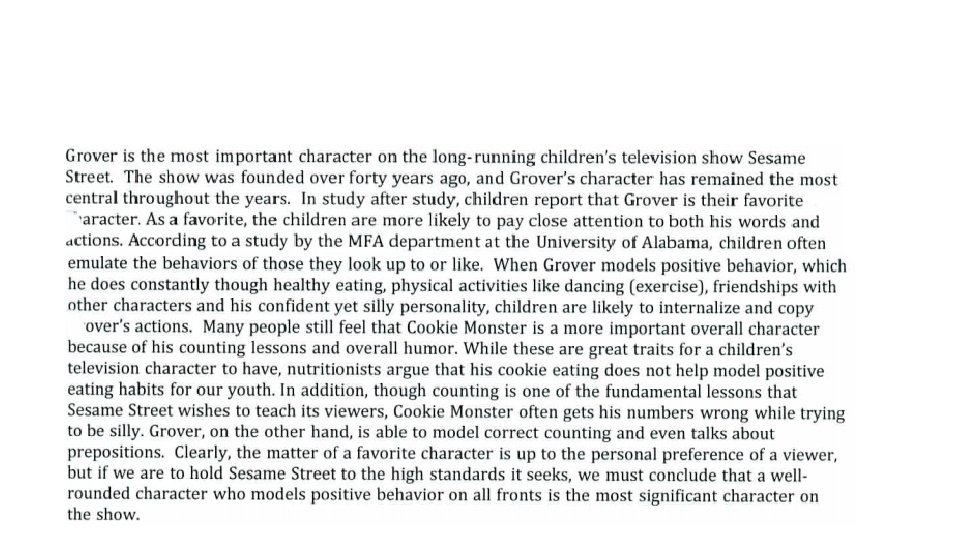
Sesame St.
Try it: This time with Rogerian Claim: Canada is better than America 1. Intro 2. Opposition validation 3. Supporting validation 4. Offering change of view
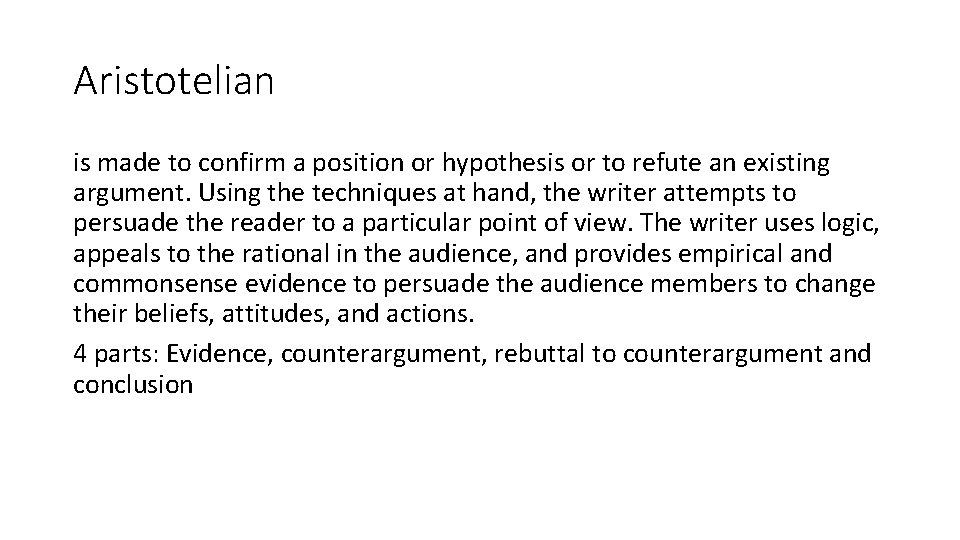
Aristotelian is made to confirm a position or hypothesis or to refute an existing argument. Using the techniques at hand, the writer attempts to persuade the reader to a particular point of view. The writer uses logic, appeals to the rational in the audience, and provides empirical and commonsense evidence to persuade the audience members to change their beliefs, attitudes, and actions. 4 parts: Evidence, counterargument, rebuttal to counterargument and conclusion
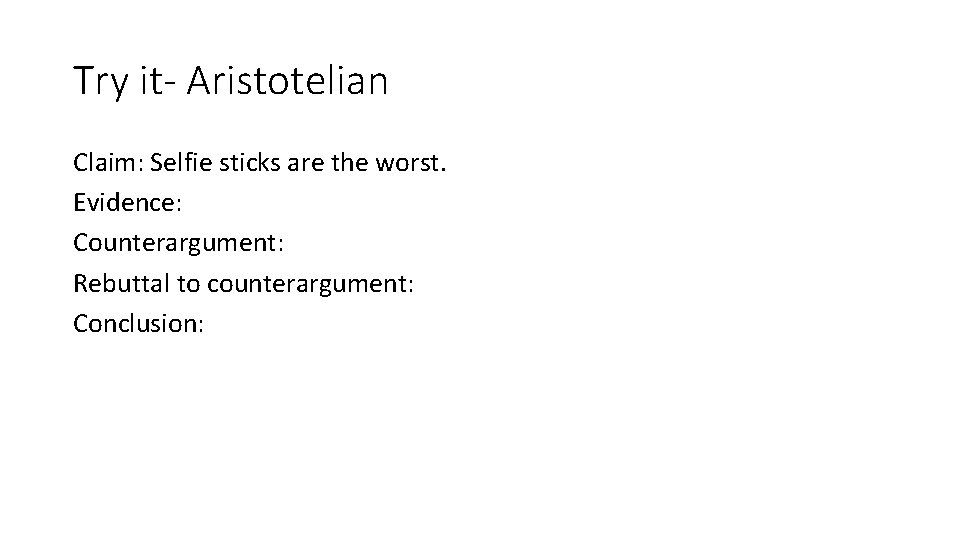
Try it- Aristotelian Claim: Selfie sticks are the worst. Evidence: Counterargument: Rebuttal to counterargument: Conclusion: