Transferring Market Information to Oyster Growing Stakeholders in

- Slides: 17
Transferring Market Information to Oyster Growing Stakeholders in Bahia Santa Maria: Synopsis of the Oyster Market in Guamuchil, Mexico Martínez-Cordero*, F. J. , Q. S. W Fong, M. C. Haws, E. Gaxiola-Camacho, and G. Rodríguez-Domínguez
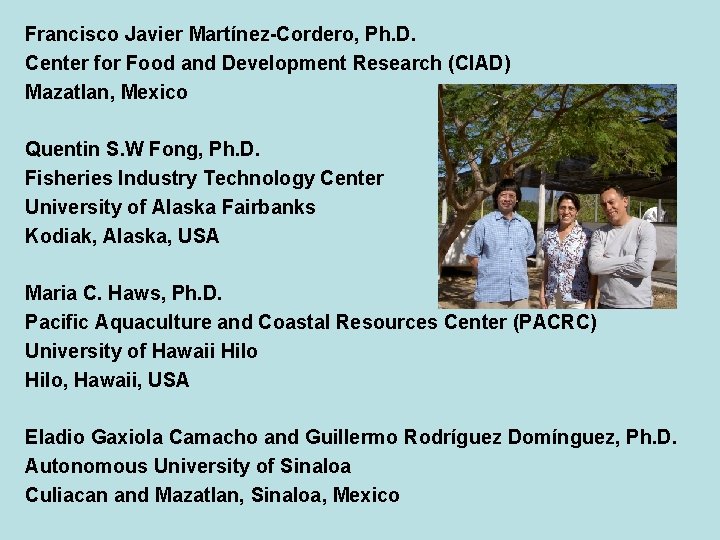
Francisco Javier Martínez-Cordero, Ph. D. Center for Food and Development Research (CIAD) Mazatlan, Mexico Quentin S. W Fong, Ph. D. Fisheries Industry Technology Center University of Alaska Fairbanks Kodiak, Alaska, USA Maria C. Haws, Ph. D. Pacific Aquaculture and Coastal Resources Center (PACRC) University of Hawaii Hilo, Hawaii, USA Eladio Gaxiola Camacho and Guillermo Rodríguez Domínguez, Ph. D. Autonomous University of Sinaloa Culiacan and Mazatlan, Sinaloa, Mexico
Background • Bivalves are an important fishery and aquaculture resource in Mexico • Most oyster culture on the Pacific Coast consists of Crassostrea gigas and C. cortesiensis (native species) • Bivalves, along with tilapia, have been prioritized by Mexico Government for diversification of aquaculture • Since 2003, this CRSP project team has worked to expand improve bivalve culture as an alternative for poor coastal communities
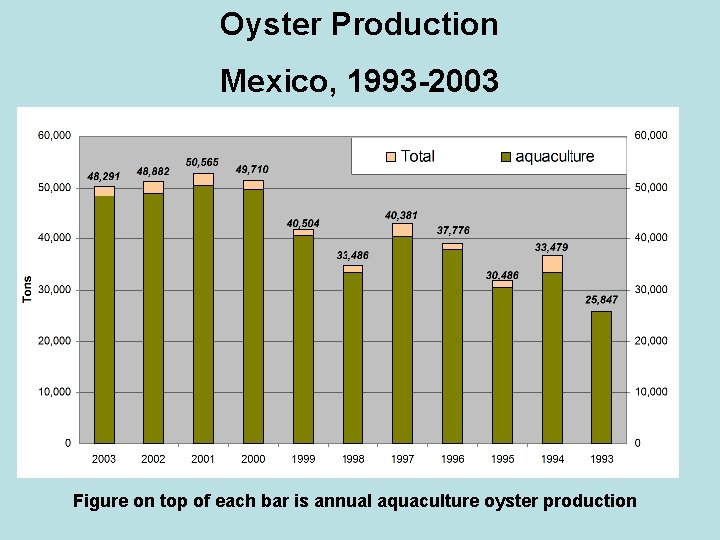
Oyster Production Mexico, 1993 -2003 Figure on top of each bar is annual aquaculture oyster production
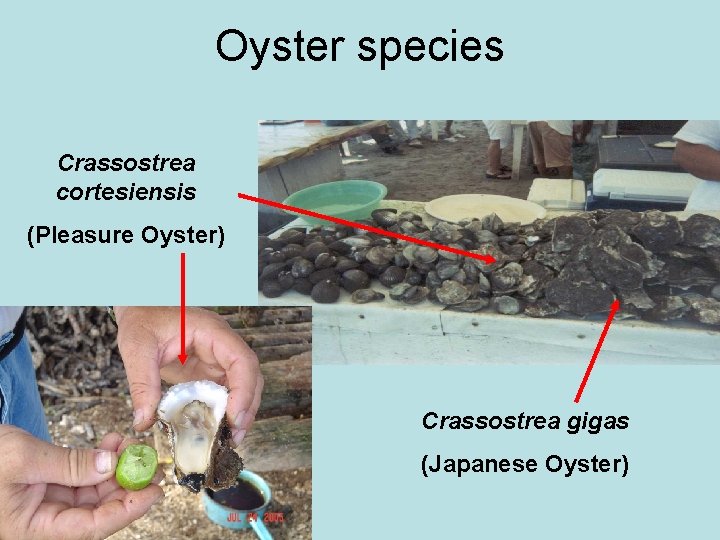
Oyster species Crassostrea cortesiensis (Pleasure Oyster) Crassostrea gigas (Japanese Oyster)
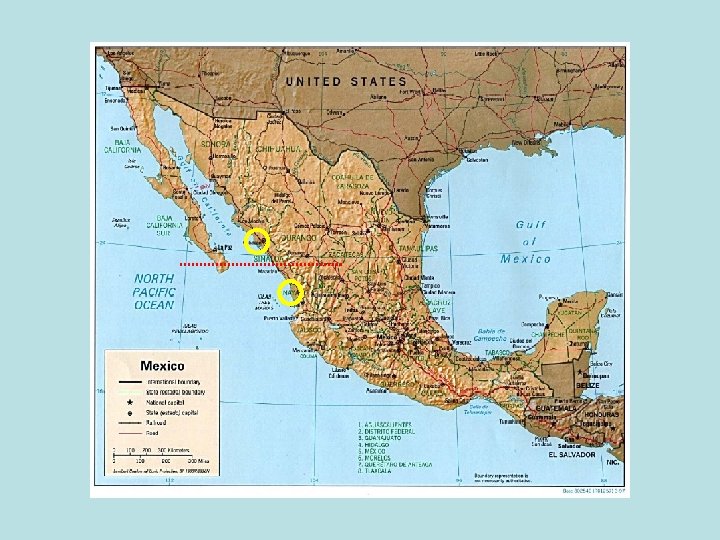
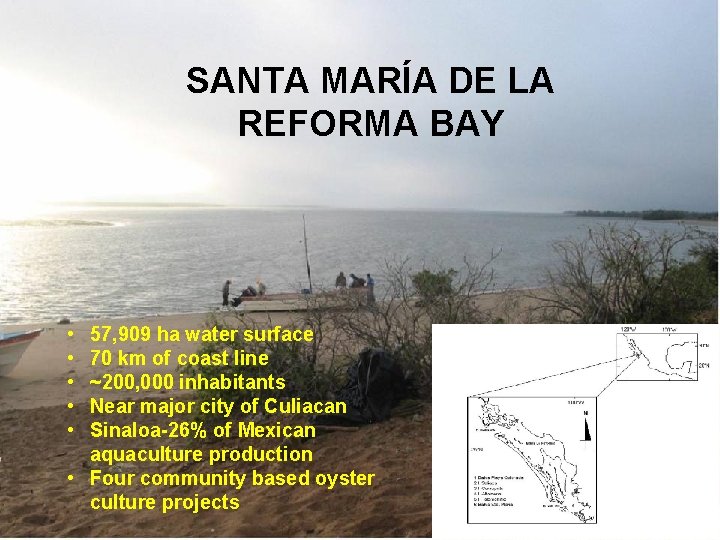
SANTA MARÍA DE LA REFORMA BAY • • • 57, 909 ha water surface 70 km of coast line ~200, 000 inhabitants Near major city of Culiacan Sinaloa-26% of Mexican aquaculture production • Four community based oyster culture projects
Improvement of bivalve culture requires market information For example: What size of oyster should be grown? What prices would the buyer would pay? What is the preferred minimum shelf-life for the products? Is sanitation an important attribute? Does harvest location matter? This information will help farmers in market identification and development of market penetration strategies
Objective Overall: • Assist oyster growing cooperatives in BSM to identify opportunities for marketing of oysters within the state of Sinaloa Specific: • Elicit the preference structure of managers/owners of seafood restaurants for oysters • Recommend steps to be taken by growers for market penetration strategies based on the findings • Use the process to educate Mexican small-scale oyster growing stakeholders in market research techniques and application of results.
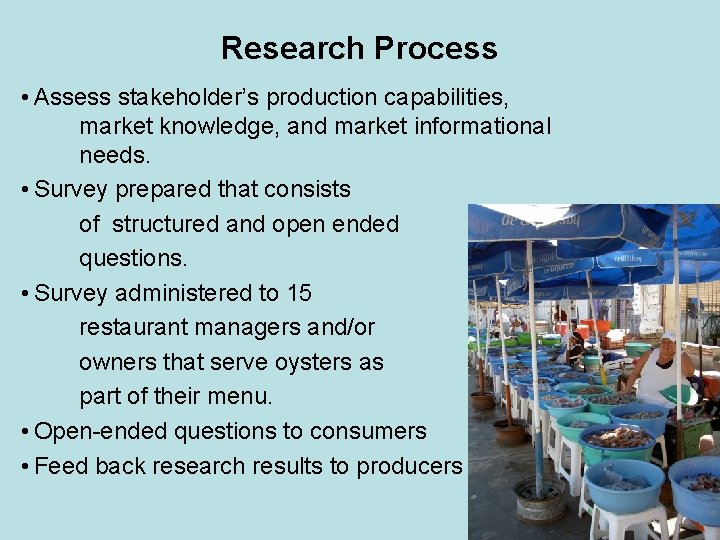
Research Process • Assess stakeholder’s production capabilities, market knowledge, and market informational needs. • Survey prepared that consists of structured and open ended questions. • Survey administered to 15 restaurant managers and/or owners that serve oysters as part of their menu. • Open-ended questions to consumers • Feed back research results to producers
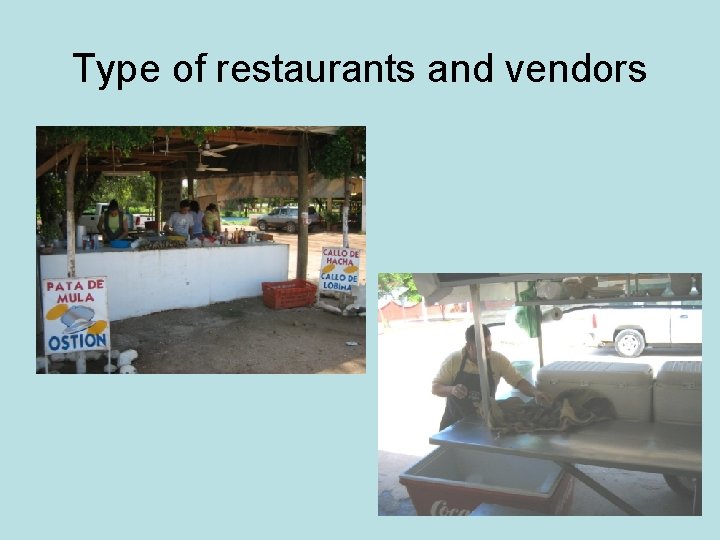
Type of restaurants and vendors
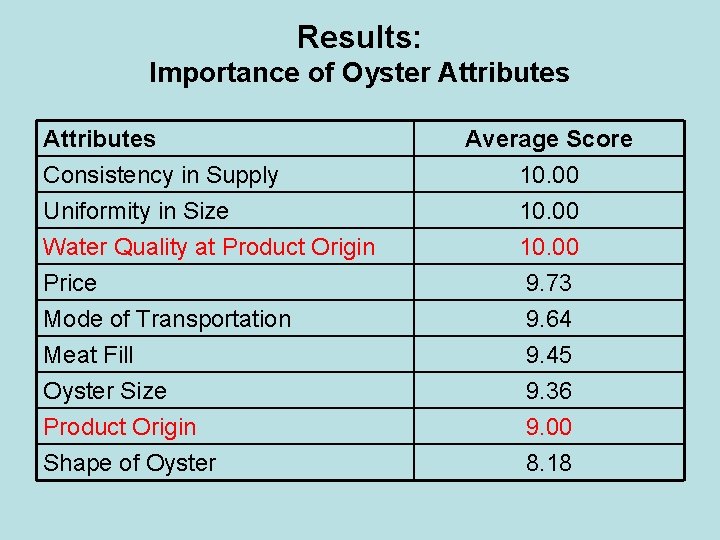
Results: Importance of Oyster Attributes Consistency in Supply Uniformity in Size Water Quality at Product Origin Price Mode of Transportation Meat Fill Oyster Size Product Origin Shape of Oyster Average Score 10. 00 9. 73 9. 64 9. 45 9. 36 9. 00 8. 18
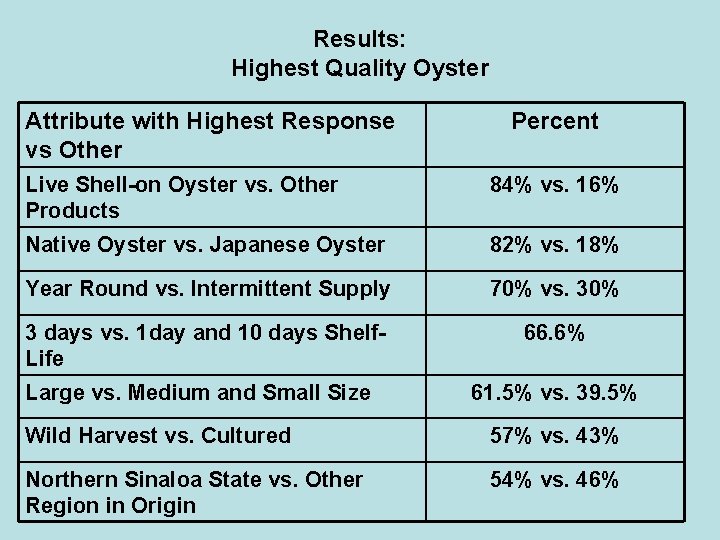
Results: Highest Quality Oyster Attribute with Highest Response vs Other Percent Live Shell-on Oyster vs. Other Products 84% vs. 16% Native Oyster vs. Japanese Oyster 82% vs. 18% Year Round vs. Intermittent Supply 70% vs. 30% 3 days vs. 1 day and 10 days Shelf. Life 66. 6% Large vs. Medium and Small Size 61. 5% vs. 39. 5% Wild Harvest vs. Cultured 57% vs. 43% Northern Sinaloa State vs. Other Region in Origin 54% vs. 46%
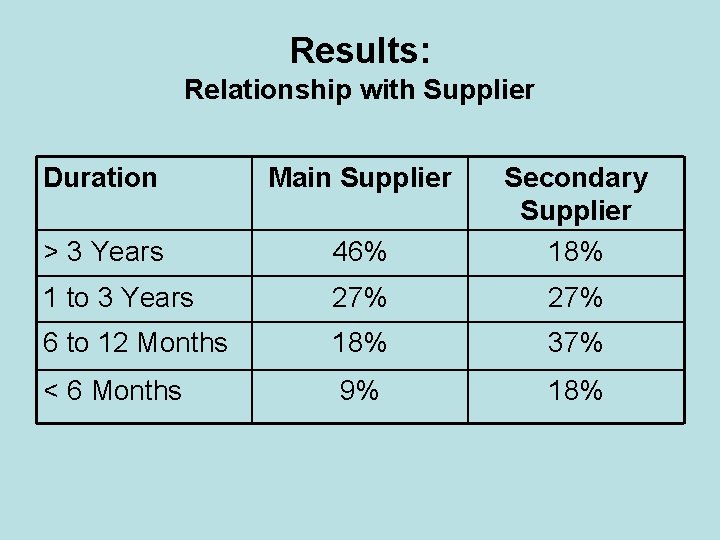
Results: Relationship with Supplier Duration Main Supplier > 3 Years 46% Secondary Supplier 18% 1 to 3 Years 27% 6 to 12 Months 18% 37% < 6 Months 9% 18%
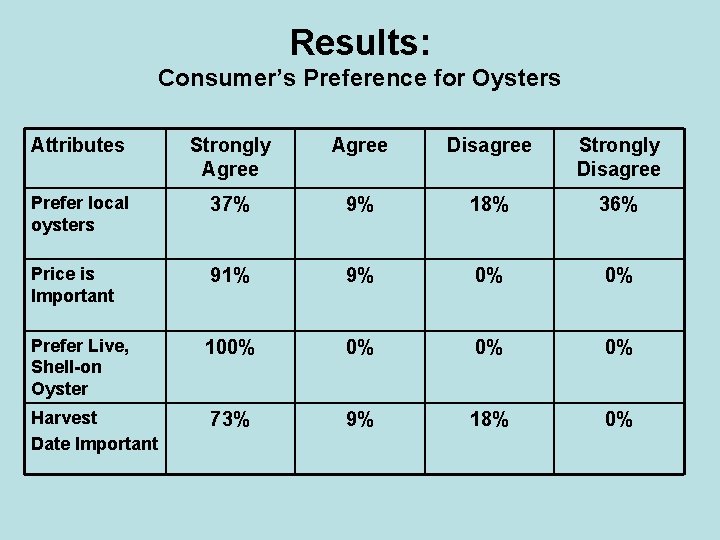
Results: Consumer’s Preference for Oysters Attributes Strongly Agree Disagree Strongly Disagree Prefer local oysters 37% 9% 18% 36% Price is Important 91% 9% 0% 0% 100% 0% 73% 9% 18% 0% Prefer Live, Shell-on Oyster Harvest Date Important
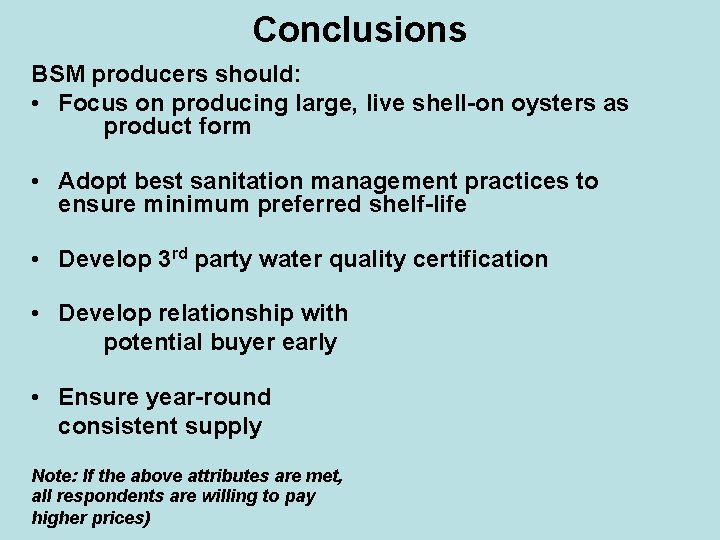
Conclusions BSM producers should: • Focus on producing large, live shell-on oysters as product form • Adopt best sanitation management practices to ensure minimum preferred shelf-life • Develop 3 rd party water quality certification • Develop relationship with potential buyer early • Ensure year-round consistent supply Note: If the above attributes are met, all respondents are willing to pay higher prices)
Funding for this research was provided by the COLLABORATIVE RESEARCH SUPPORT PROGRAM The Aqua. Fish CRSP is funded in part by United States Agency for International Development (USAID) Cooperative Agreement No. EPP-A-00 -06 -00012 -00 and by US and Host Country partners. The contents of this presentation do not necessarily represent an official position or policy of the United States Agency for International Development (USAID). Mention of trade names or commercial products in this presentation does not constitute endorsement or recommendation for use on the part of USAID or the Aqua. Fish Collaborative Research Support Program. The accuracy, reliability, and originality of the work presented are the responsibility of the individual authors.