Topic 4 4 Social and Cognitive Factors in


- Slides: 9
Topic 4. 4 - Social and Cognitive Factors in Learning
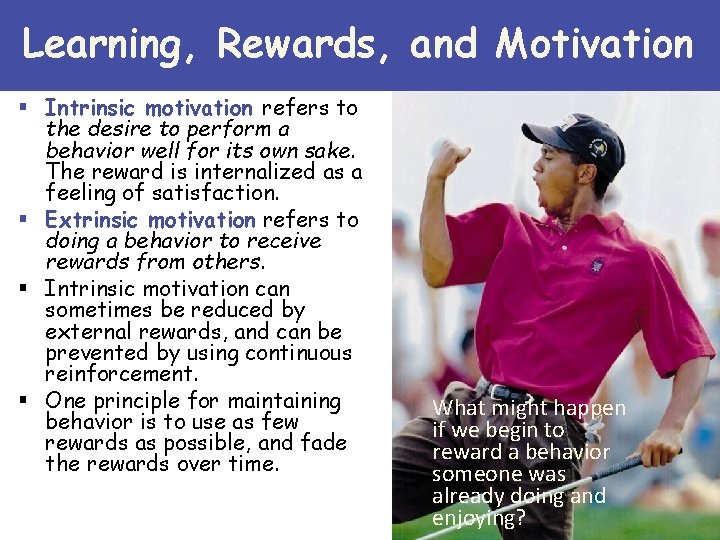
Learning, Rewards, and Motivation § Intrinsic motivation refers to the desire to perform a behavior well for its own sake. The reward is internalized as a feeling of satisfaction. § Extrinsic motivation refers to doing a behavior to receive rewards from others. § Intrinsic motivation can sometimes be reduced by external rewards, and can be prevented by using continuous reinforcement. § One principle for maintaining behavior is to use as few rewards as possible, and fade the rewards over time. What might happen if we begin to reward a behavior someone was already doing and enjoying?
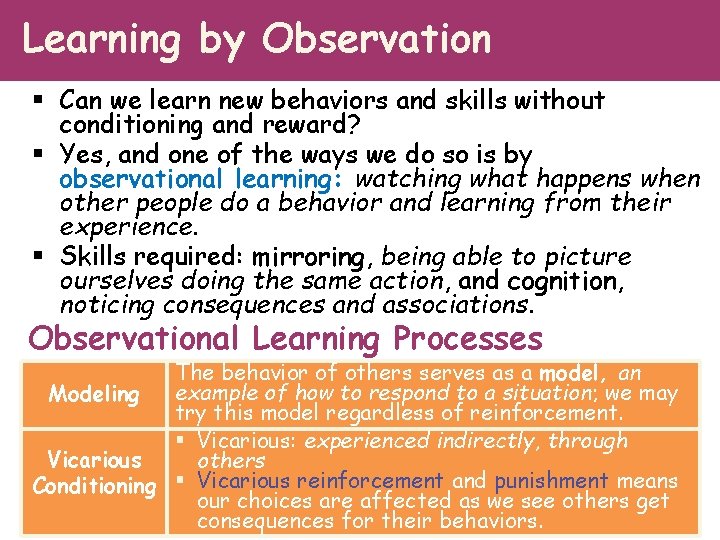
Learning by Observation § Can we learn new behaviors and skills without conditioning and reward? § Yes, and one of the ways we do so is by observational learning: watching what happens when other people do a behavior and learning from their experience. § Skills required: mirroring, being able to picture ourselves doing the same action, and cognition, noticing consequences and associations. Observational Learning Processes The behavior of others serves as a model, an example of how to respond to a situation; we may Modeling try this model regardless of reinforcement. § Vicarious: experienced indirectly, through Vicarious others Conditioning § Vicarious reinforcement and punishment means our choices are affected as we see others get consequences for their behaviors.
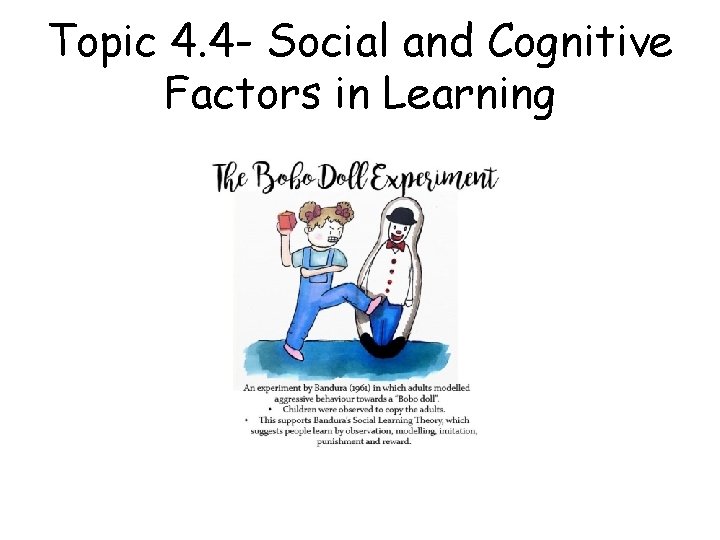
Albert Bandura’s Bobo Doll Experiment (1961) § Kids saw adults punching an inflated doll while narrating their aggressive behaviors such as “kick him. ” § These kids were then put in a toy-deprived situation… and acted out the same behaviors they had seen. Bobo Doll Experiment
So HOW do we learn just by watching? The answer is likely mirroring in the brain § When we watch others doing or feeling something, neurons fire in patterns that would fire if we were doing the action or having the feeling ourselves. § These neurons are referred to as mirror neurons, and they fire only to reflect the actions or feelings of others. Notice the similarities in the firing patterns…what is the difference in the 2 brains?
Mirroring Plus Vicarious Reinforcement § Mirroring enables observational learning; we cognitively practice a behavior just by watching it. § If you combine this with vicarious reinforcement, we are even more likely to get imitation. § Monkey A saw Monkey B getting a banana after pressing four symbols. Monkey A then pressed the same four symbols (even though the symbols were in different locations).
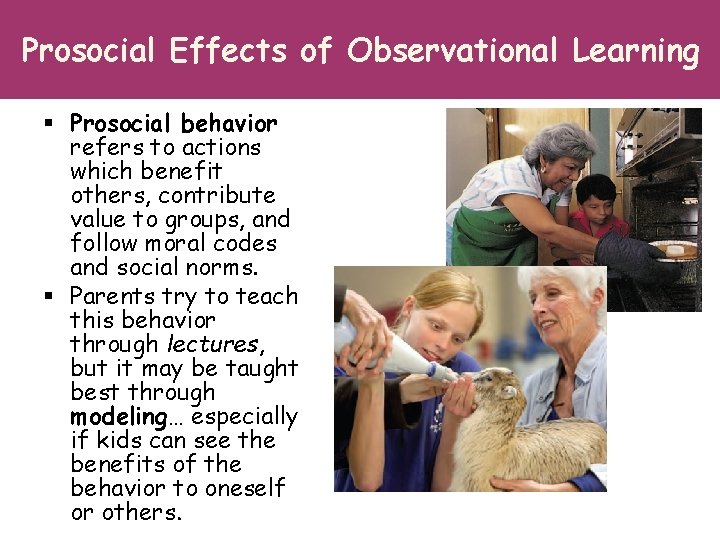
Prosocial Effects of Observational Learning § Prosocial behavior refers to actions which benefit others, contribute value to groups, and follow moral codes and social norms. § Parents try to teach this behavior through lectures, but it may be taught best through modeling… especially if kids can see the benefits of the behavior to oneself or others.
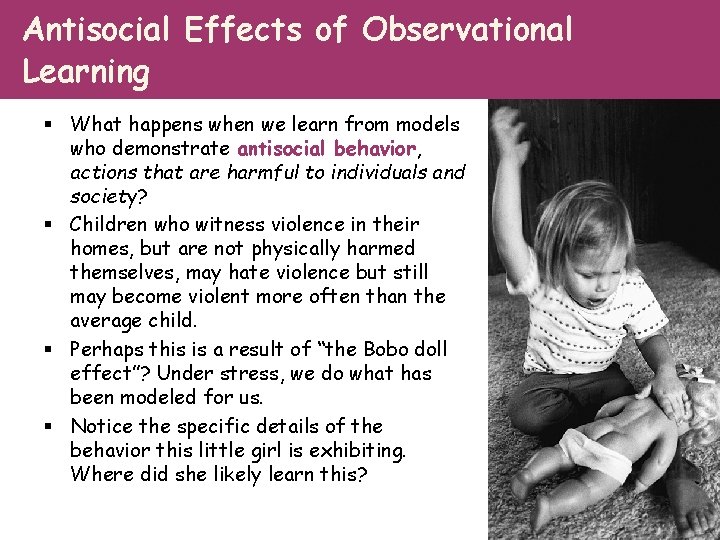
Antisocial Effects of Observational Learning § What happens when we learn from models who demonstrate antisocial behavior, actions that are harmful to individuals and society? § Children who witness violence in their homes, but are not physically harmed themselves, may hate violence but still may become violent more often than the average child. § Perhaps this is a result of “the Bobo doll effect”? Under stress, we do what has been modeled for us. § Notice the specific details of the behavior this little girl is exhibiting. Where did she likely learn this?
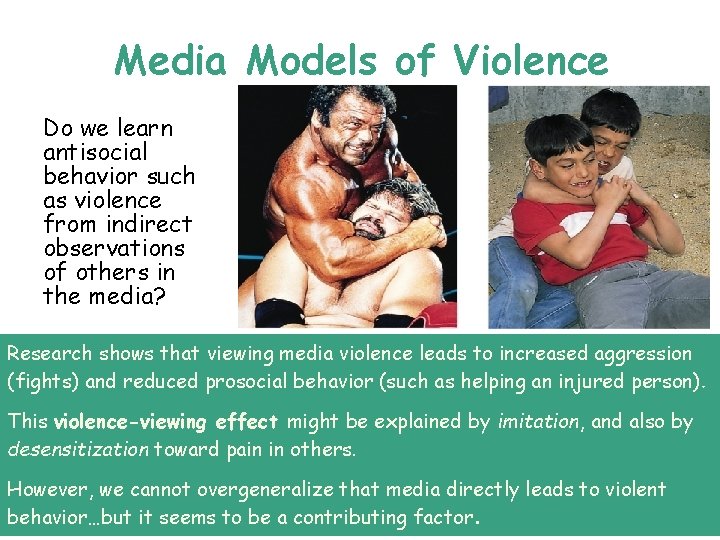
Media Models of Violence Do we learn antisocial behavior such as violence from indirect observations of others in the media? Research shows that viewing media violence leads to increased aggression (fights) and reduced prosocial behavior (such as helping an injured person). This violence-viewing effect might be explained by imitation, and also by desensitization toward pain in others. However, we cannot overgeneralize that media directly leads to violent behavior…but it seems to be a contributing factor.