Todays Topics l Universes of Discourse l Truth
- Slides: 15
Today’s Topics l. Universes of Discourse l. Truth Functional Expansions of Quantified Formulae l. Expansions, Consistency and Validity
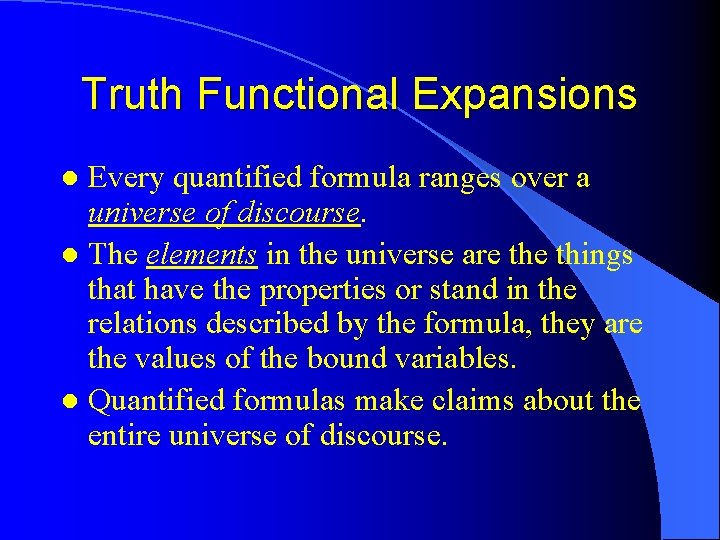
Truth Functional Expansions Every quantified formula ranges over a universe of discourse. l The elements in the universe are things that have the properties or stand in the relations described by the formula, they are the values of the bound variables. l Quantified formulas make claims about the entire universe of discourse. l
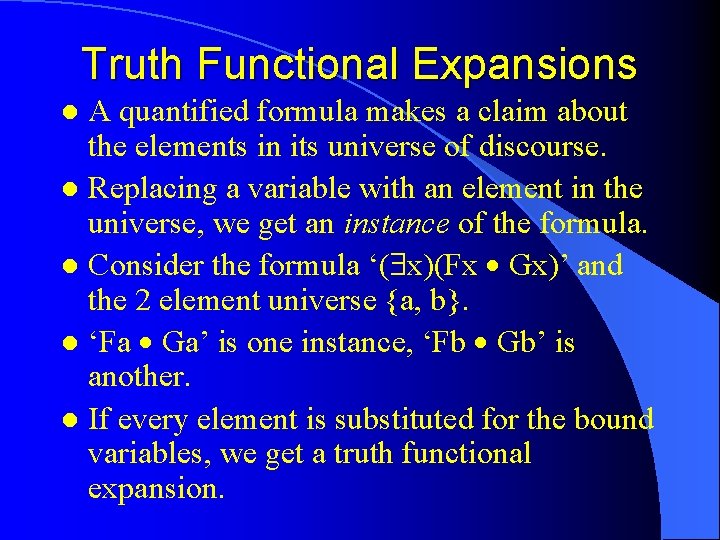
Truth Functional Expansions A quantified formula makes a claim about the elements in its universe of discourse. l Replacing a variable with an element in the universe, we get an instance of the formula. l Consider the formula ‘( x)(Fx Gx)’ and the 2 element universe {a, b}. l ‘Fa Ga’ is one instance, ‘Fb Gb’ is another. l If every element is substituted for the bound variables, we get a truth functional expansion. l
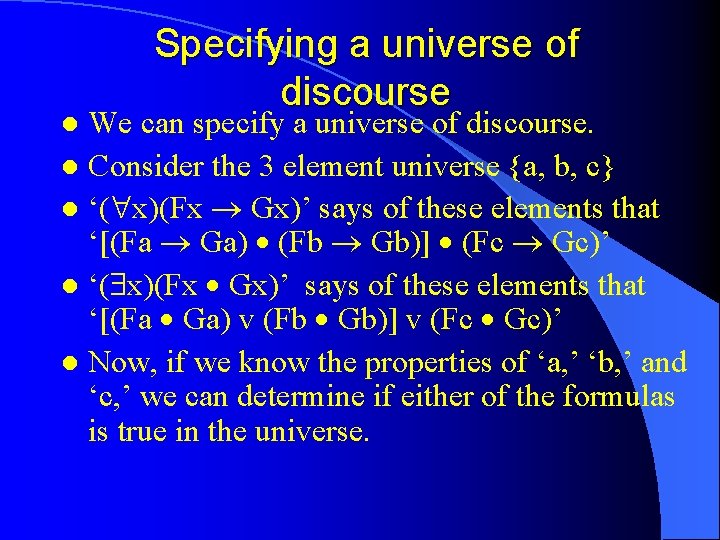
Specifying a universe of discourse We can specify a universe of discourse. l Consider the 3 element universe {a, b, c} l ‘( x)(Fx Gx)’ says of these elements that ‘[(Fa Ga) (Fb Gb)] (Fc Gc)’ l ‘( x)(Fx Gx)’ says of these elements that ‘[(Fa Ga) v (Fb Gb)] v (Fc Gc)’ l Now, if we know the properties of ‘a, ’ ‘b, ’ and ‘c, ’ we can determine if either of the formulas is true in the universe. l
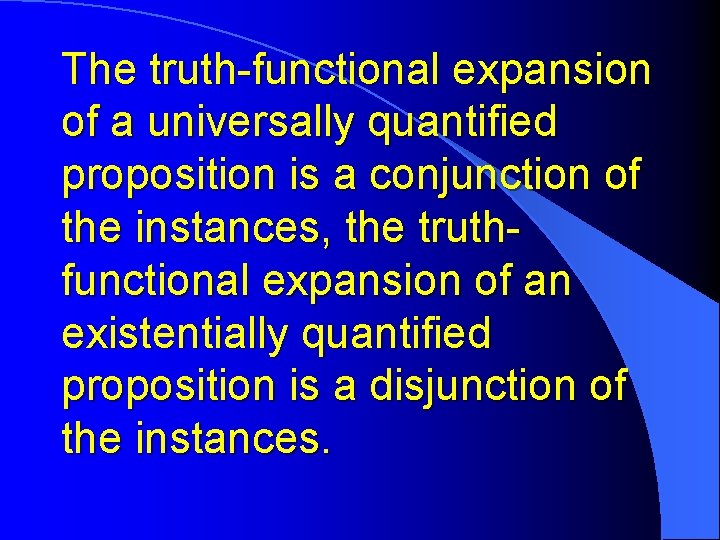
The truth-functional expansion of a universally quantified proposition is a conjunction of the instances, the truthfunctional expansion of an existentially quantified proposition is a disjunction of the instances.
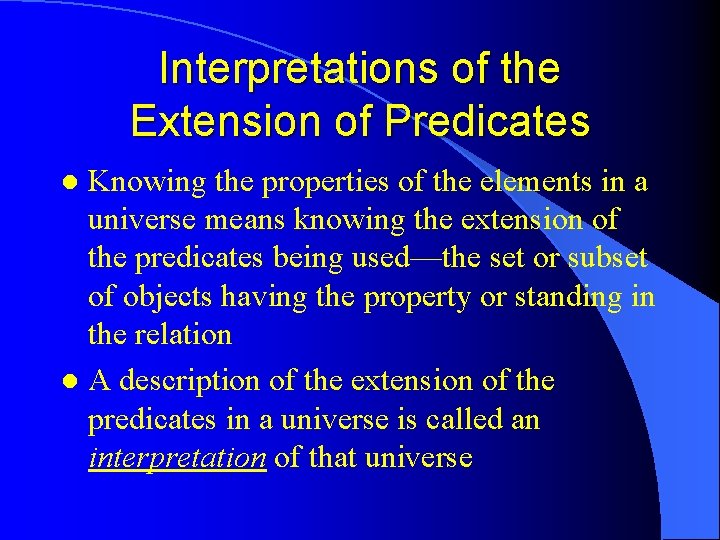
Interpretations of the Extension of Predicates Knowing the properties of the elements in a universe means knowing the extension of the predicates being used—the set or subset of objects having the property or standing in the relation l A description of the extension of the predicates in a universe is called an interpretation of that universe l
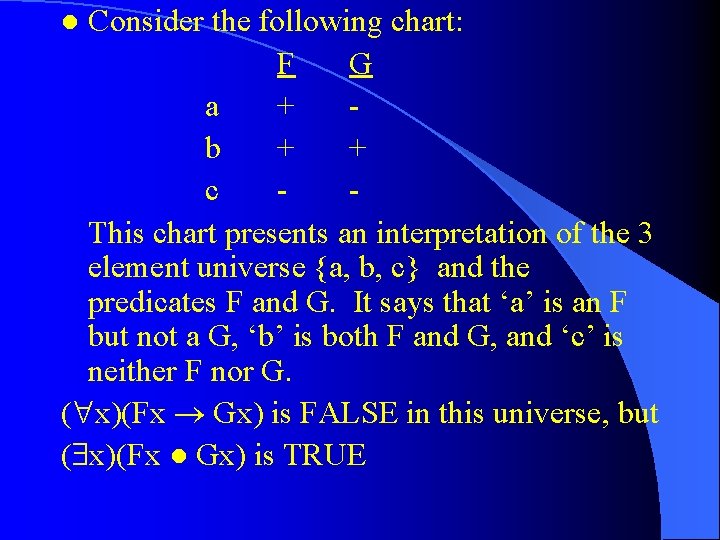
Consider the following chart: F G a + b + + c This chart presents an interpretation of the 3 element universe {a, b, c} and the predicates F and G. It says that ‘a’ is an F but not a G, ‘b’ is both F and G, and ‘c’ is neither F nor G. ( x)(Fx Gx) is FALSE in this universe, but ( x)(Fx ● Gx) is TRUE l
The truth-functional expansion of a universally quantified proposition is a conjunction of the instances, the truthfunctional expansion of an existentially quantified proposition is a disjunction of the instances.
Expansions can be used to show that a statement, or set of statements, is consistent or that an argument is non-valid.
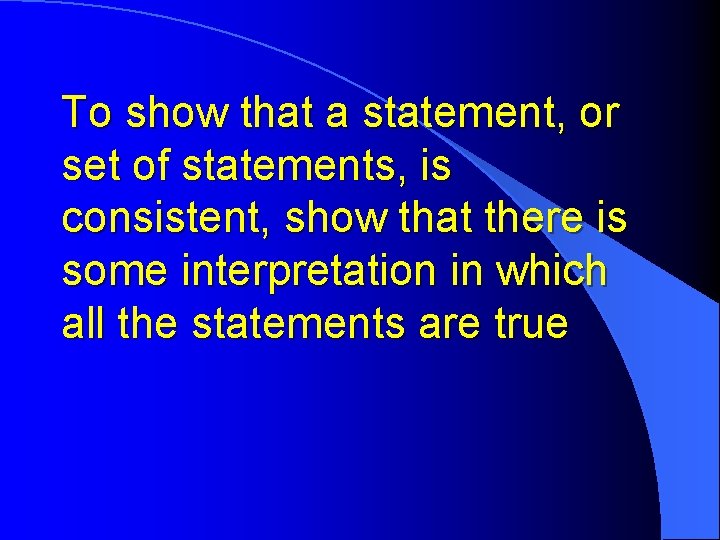
To show that a statement, or set of statements, is consistent, show that there is some interpretation in which all the statements are true
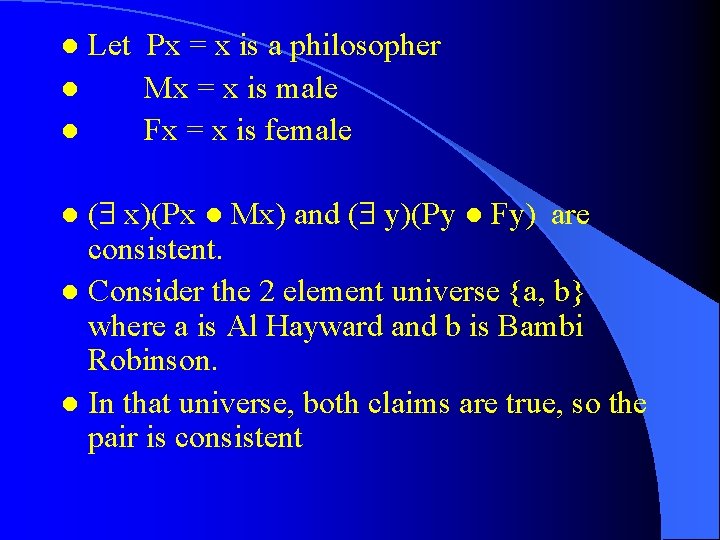
Let Px = x is a philosopher l Mx = x is male l Fx = x is female l ( x)(Px ● Mx) and ( y)(Py ● Fy) are consistent. l Consider the 2 element universe {a, b} where a is Al Hayward and b is Bambi Robinson. l In that universe, both claims are true, so the pair is consistent l
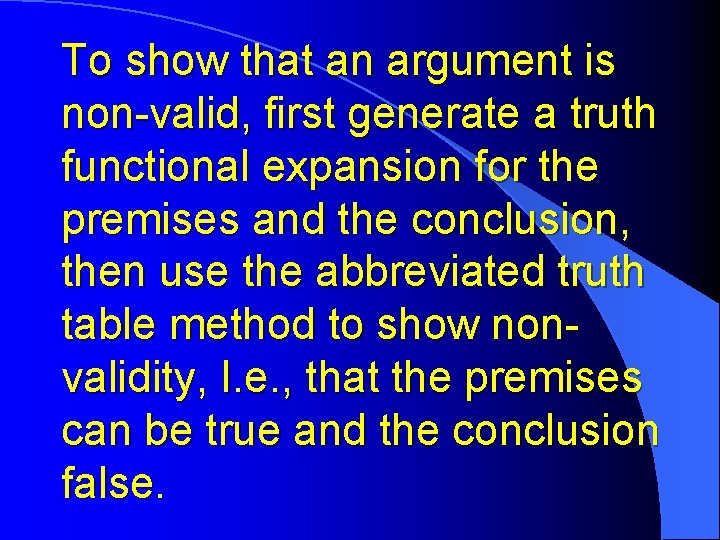
To show that an argument is non-valid, first generate a truth functional expansion for the premises and the conclusion, then use the abbreviated truth table method to show nonvalidity, I. e. , that the premises can be true and the conclusion false.
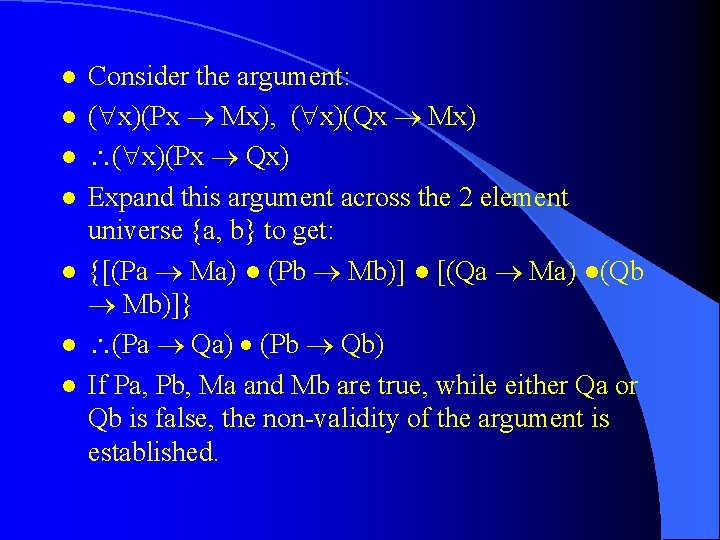
l l l l Consider the argument: ( x)(Px Mx), ( x)(Qx Mx) ( x)(Px Qx) Expand this argument across the 2 element universe {a, b} to get: {[(Pa Ma) ● (Pb Mb)] ● [(Qa Ma) ●(Qb Mb)]} (Pa Qa) (Pb Qb) If Pa, Pb, Ma and Mb are true, while either Qa or Qb is false, the non-validity of the argument is established.
Alternatively, you can simply create an interpretation of the predicates under which the argument is shown to be nonvalid l In the previous example, let Px = x is greater than 6, Mx = x is greater than 4, Qx = x is greater than 10.
Try some on your own. Download the Handout Expansions Study guide and review it. l Download the Handout Expansions Exercises and create some expansions of your own and then determine whether the quantified formulas are true or false in a specified universe. l