Tijana Grujic Economic Crisis and Welfare state in

- Slides: 17
Tijana Grujic Economic Crisis and Welfare state in Sweden and Spain
About me § Born in Belgrade 1982 § Graduated Economics in 2009 (Belgrade University) § Student Phoenix. EM Dynamics of Health and Welfare in 2009 -2011 (Universitat Autónoma de Barcelona/ Linköping University)
Time path § October 2009 Familiarizing with the literature § March 2010 Welfare State Historical Background Evidence of contemporary crisis strikes § June 2010 Data extraction/analysis Time limitations (Will society produce enough material in meantime that could be examined by this research?
Contents § Introduction § Welfare State § Historical background of Welfare State in Sweden and Spain § Crisis Management § Instead of Conclusion
Introduction § „The crisis has hit different parts of the World in a different ways and intensity, but it has hit them all, regardless of their political, social and economic configuration. “ Hobsbaum, 2002
What is Welfare State? § A Welfare State is a concept of government where the state plays a key role in the protection and promotion of the economic and social well-being of its citizens. It is based on the principles of equality of opportunity, equitable distribution of wealth, and public responsibility for those unable to avail themselves of the minimal provisions for a good life. http: //www. britannica. com
Two types of Welfare State § In the first model state is primarily concerned with directing the resources to “the people most in need”. This requires a tight bureaucratic control over the people concerned, with a maximum of interference in their lives to establish who are "in need“. The unintended result is that there is a sharp divide between the receivers and the producers of social welfare. This model is dominant in the US. § In the second model the state distributes welfare with as little bureaucratic interference as possible, to all people who fulfill easily established criteria (e. g. having children, receiving medical treatment, etc). This requires high taxing of which almost everything is channeled back to the taxpayers with minimum expenses for bureaucratic personnel. The intended – and also largely achieved – result is that there will be a broad support for the system since most people will receive at least something. It is dominant in Scandinavia.
Welfare State § Crisis of Welfare State itself (For vs. Against Welfare State) § “…historic co-evolution between elements of economy, politics and socio-cultural relations” (Jessop, 2000)
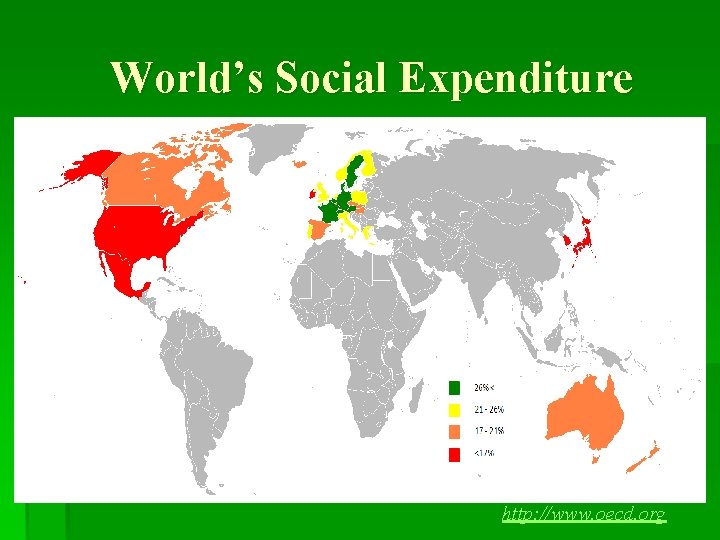
World’s Social Expenditure http: //www. oecd. org
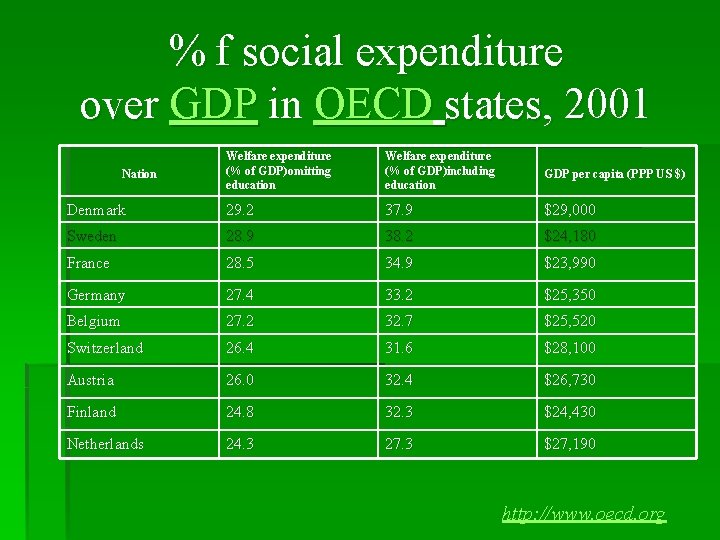
% f social expenditure over GDP in OECD states, 2001 Welfare expenditure (% of GDP)omitting education Welfare expenditure (% of GDP)including education GDP per capita (PPP US $) Denmark 29. 2 37. 9 $29, 000 Sweden 28. 9 38. 2 $24, 180 France 28. 5 34. 9 $23, 990 Germany 27. 4 33. 2 $25, 350 Belgium 27. 2 32. 7 $25, 520 Switzerland 26. 4 31. 6 $28, 100 Austria 26. 0 32. 4 $26, 730 Finland 24. 8 32. 3 $24, 430 Netherlands 24. 3 27. 3 $27, 190 Nation http: //www. oecd. org
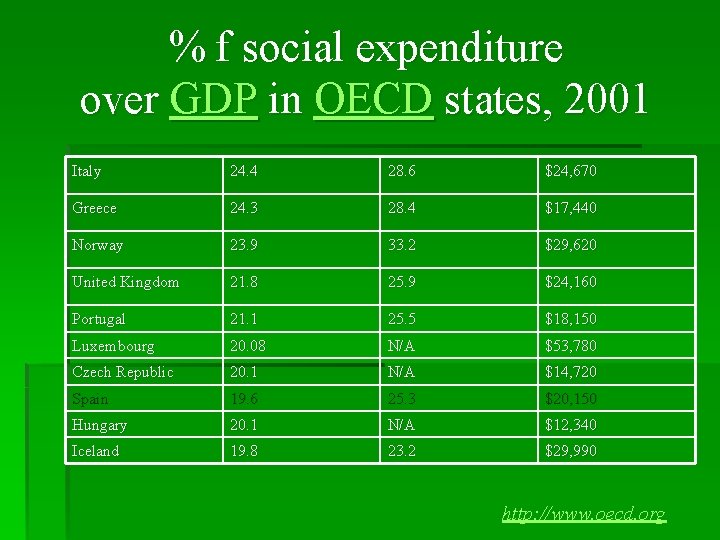
% f social expenditure over GDP in OECD states, 2001 Italy 24. 4 28. 6 $24, 670 Greece 24. 3 28. 4 $17, 440 Norway 23. 9 33. 2 $29, 620 United Kingdom 21. 8 25. 9 $24, 160 Portugal 21. 1 25. 5 $18, 150 Luxembourg 20. 08 N/A $53, 780 Czech Republic 20. 1 N/A $14, 720 Spain 19. 6 25. 3 $20, 150 Hungary 20. 1 N/A $12, 340 Iceland 19. 8 23. 2 $29, 990 http: //www. oecd. org
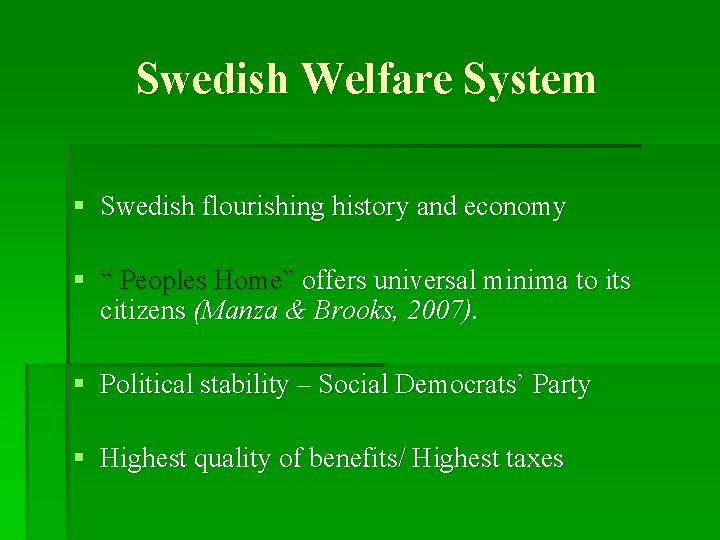
Swedish Welfare System § Swedish flourishing history and economy § “ Peoples Home” offers universal minima to its citizens (Manza & Brooks, 2007). § Political stability – Social Democrats’ Party § Highest quality of benefits/ Highest taxes
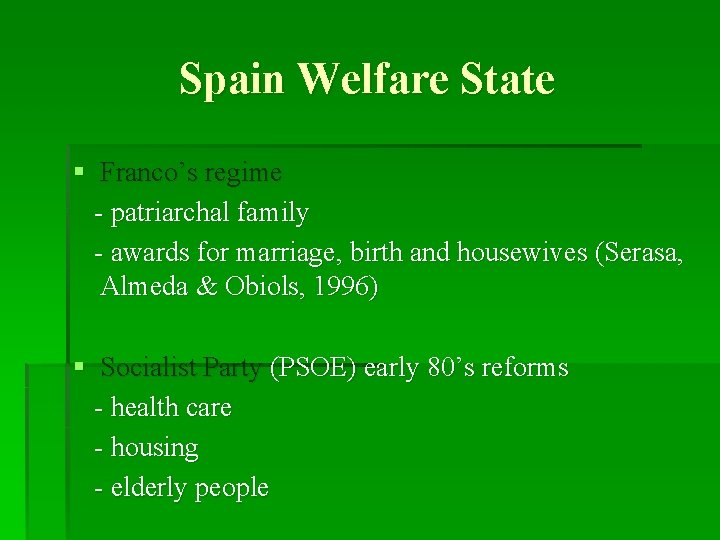
Spain Welfare State § Franco’s regime - patriarchal family - awards for marriage, birth and housewives (Serasa, Almeda & Obiols, 1996) § Socialist Party (PSOE) early 80’s reforms - health care - housing - elderly people
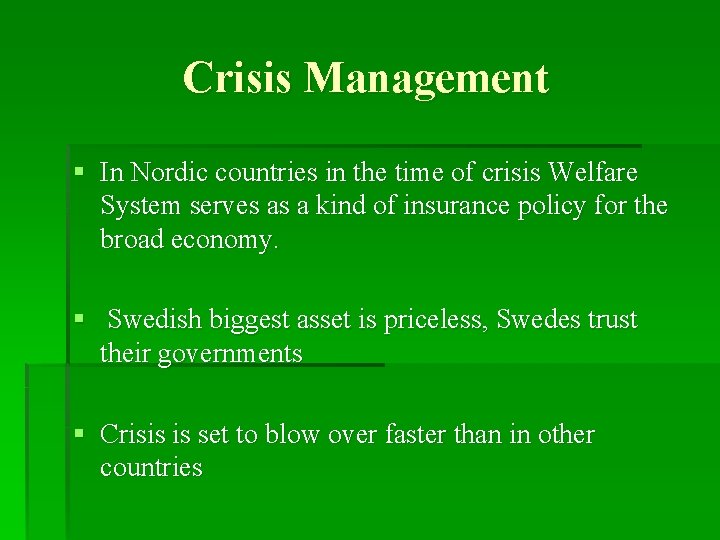
Crisis Management § In Nordic countries in the time of crisis Welfare System serves as a kind of insurance policy for the broad economy. § Swedish biggest asset is priceless, Swedes trust their governments § Crisis is set to blow over faster than in other countries
Crisis Management § Spain has had one of the fastest growing economies the last few years, which have made the signs of the impact of the economic crisis significant § 2010 budget should aim to rise taxes by 1. 5% GDP § Unemployment of 20%
Instead of Conclusion “ To say that other countries should emulate the Swedish social model is about as helpful as telling an average-looking person to look like a Swedish supermodel. There are special circumstances and a certain background that limit the ability to imitate. In the case of the supermodel, it is about genetics. In the context of Welfare System, it is about the historical, economical and cultural background. ” Johan Norberg
Thank you grujic. tijana@gmail. com