ThinkWritePairShare When your teacher says to write a
- Slides: 12
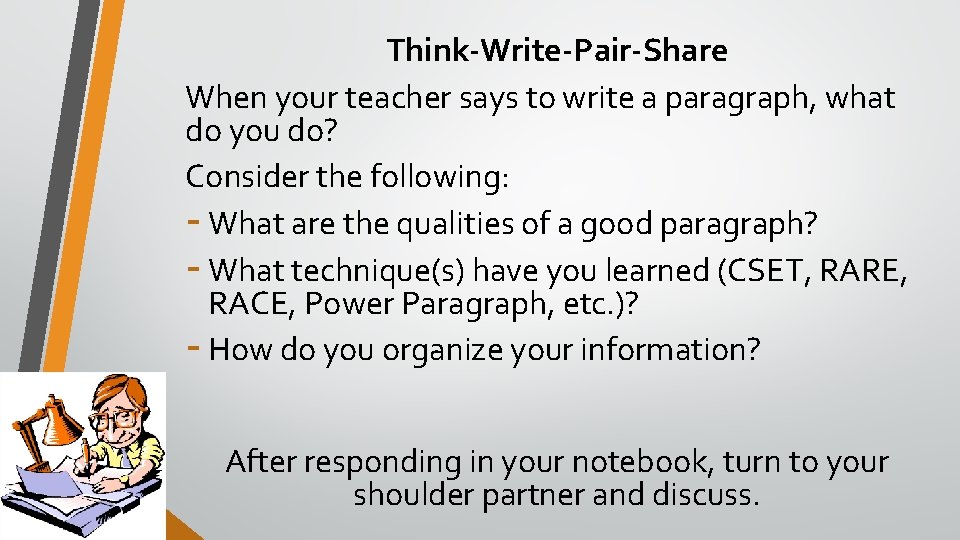
Think-Write-Pair-Share When your teacher says to write a paragraph, what do you do? Consider the following: - What are the qualities of a good paragraph? - What technique(s) have you learned (CSET, RARE, RACE, Power Paragraph, etc. )? - How do you organize your information? After responding in your notebook, turn to your shoulder partner and discuss.
Answering Text-Based Questions Using the C. S. E. T. Format
When should I use C. S. E. T. ? • C. S. E. T. is a four-part method for writing a paragraph. • It is similar to R. A. C. E. , R. A. R. E. , and the Power Paragraph. • Look for signal phrases in the question: • “Use evidence from the text…” • “Use textual support…. ” • “Include specific example(s)…” Example: “The Butterfly Effect” occurs when a small event has a large impact. Explain how this concept applies to this story. Use at least one piece of evidence from the text for support.
Why do I need to use CSET? • CSET is a technique to organize your writing. • Your writing needs to be clear so that the reader can follow your train of thought. • If your reader cannot follow your train of thought, your ideas will not be heard. • All teachers, regardless of content area, use CSET. It was developed by a UD professor.
C = Claim • It is the first sentence of your response. • This sentence answers the question/prompt or states your position on the topic • It is one sentence in length. Example: “The Butterfly Effect” literally occurs when Eckels steps on the butterfly.
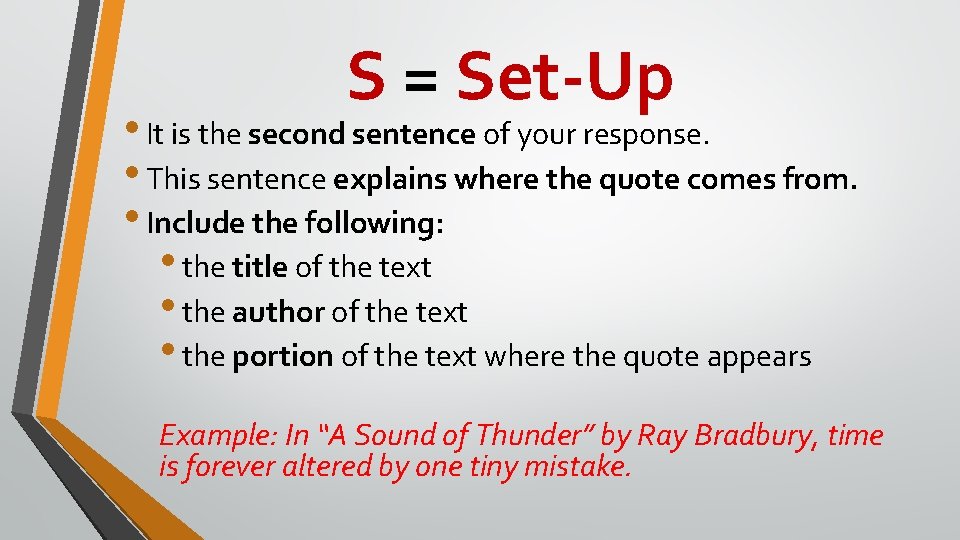
S = Set-Up • It is the second sentence of your response. • This sentence explains where the quote comes from. • Include the following: • the title of the text • the author of the text • the portion of the text where the quote appears Example: In “A Sound of Thunder” by Ray Bradbury, time is forever altered by one tiny mistake.
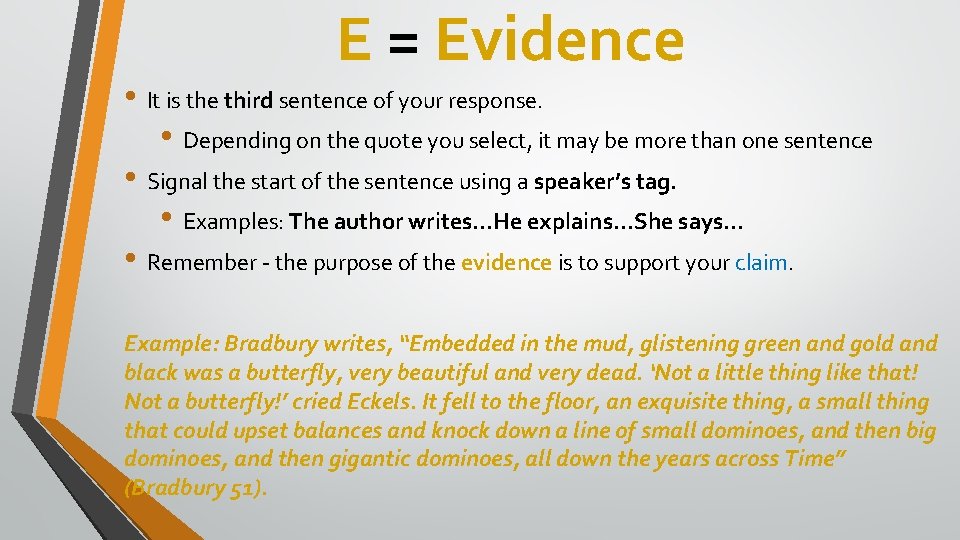
E = Evidence • It is the third sentence of your response. • Depending on the quote you select, it may be more than one sentence • Signal the start of the sentence using a speaker’s tag. • Examples: The author writes…He explains…She says… • Remember - the purpose of the evidence is to support your claim. Example: Bradbury writes, “Embedded in the mud, glistening green and gold and black was a butterfly, very beautiful and very dead. ‘Not a little thing like that! Not a butterfly!’ cried Eckels. It fell to the floor, an exquisite thing, a small thing that could upset balances and knock down a line of small dominoes, and then big dominoes, and then gigantic dominoes, all down the years across Time” (Bradbury 51).
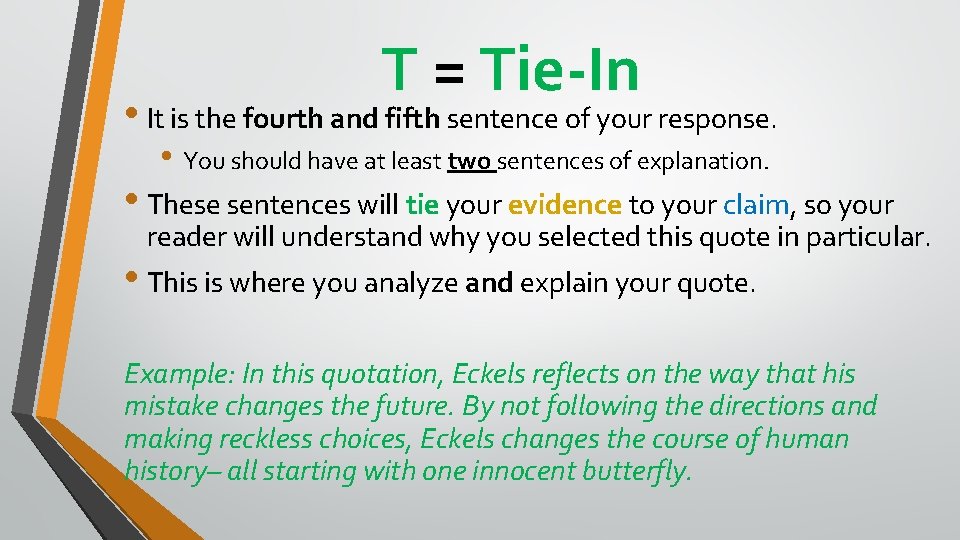
T = Tie-In • It is the fourth and fifth sentence of your response. • You should have at least two sentences of explanation. • These sentences will tie your evidence to your claim, so your reader will understand why you selected this quote in particular. • This is where you analyze and explain your quote. Example: In this quotation, Eckels reflects on the way that his mistake changes the future. By not following the directions and making reckless choices, Eckels changes the course of human history– all starting with one innocent butterfly.
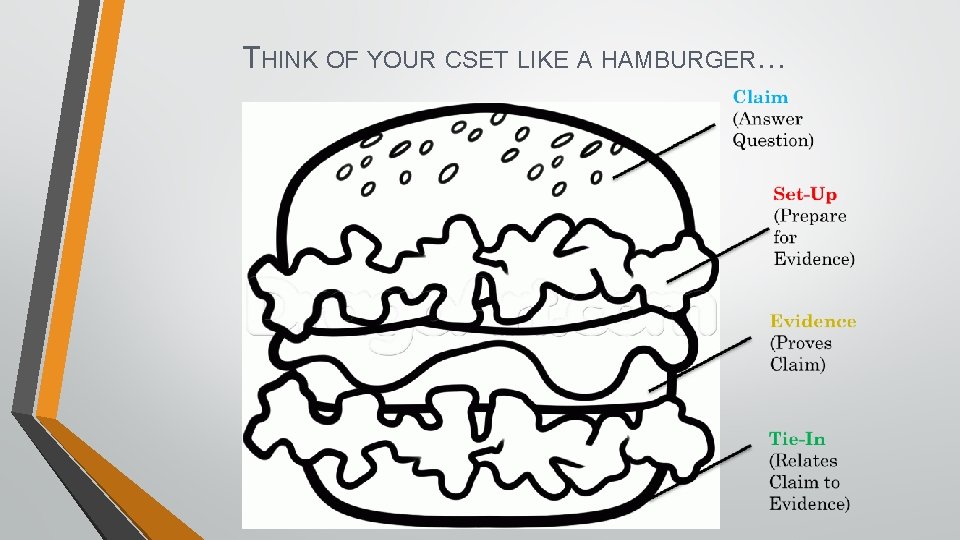
THINK OF YOUR CSET LIKE A HAMBURGER…
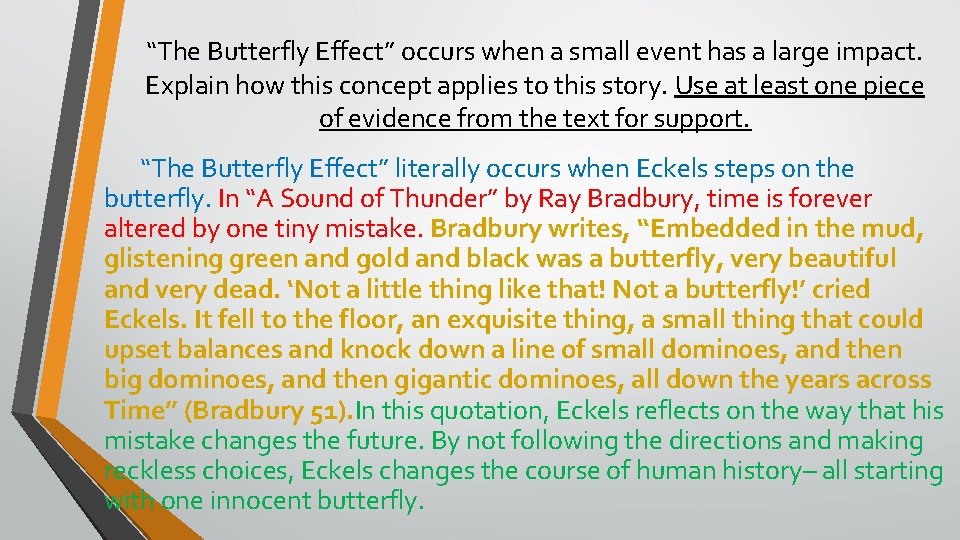
“The Butterfly Effect” occurs when a small event has a large impact. Explain how this concept applies to this story. Use at least one piece of evidence from the text for support. “The Butterfly Effect” literally occurs when Eckels steps on the butterfly. In “A Sound of Thunder” by Ray Bradbury, time is forever altered by one tiny mistake. Bradbury writes, “Embedded in the mud, glistening green and gold and black was a butterfly, very beautiful and very dead. ‘Not a little thing like that! Not a butterfly!’ cried Eckels. It fell to the floor, an exquisite thing, a small thing that could upset balances and knock down a line of small dominoes, and then big dominoes, and then gigantic dominoes, all down the years across Time” (Bradbury 51). In this quotation, Eckels reflects on the way that his mistake changes the future. By not following the directions and making reckless choices, Eckels changes the course of human history– all starting with one innocent butterfly.
Your Turn! 1. Read the essay “His Name Was Pete. ” 2. In a CSET paragraph, explain the narrator’s attitude toward Pete’s death. Use at least one piece of textual evidence for support. 3. If you finish early, exchange CSETs with your seat partner. Tell your partner one positive about their CSET and one way they can improve it.
3 -2 -1 Exit Ticket • On the handout provided, write: • 3 things you learned today about CSET • 2 phrases that signal you should use CSET • 1 question you still have about CSET