The Writing of Recommendations for Turing Scholars Alan
- Slides: 10
The Writing of Recommendations for Turing Scholars Alan Kaylor Cline Department of Computer Science The University of Texas at Austin February 9, 2013
The Writing of Recommendations for Turing Scholars and Dean’s Scholars and universities and many other academic programs Alan Kaylor Cline Department of Computer Science The University of Texas at Austin February 9, 2013
Letter Writing is topical http: //www. guardian. co. uk/education/2013/jan /28/application-university-job-reference
This is not adversarial • We are on the same team • We all want what is best for the applicant • At TS we are subject to some constraints
Honesty • That includes The Whole Truth • Threats to honesty – privacy – liability
We try to norm using: • Current and past student UT records • Records of others from their HS • Records of others recommended by the same person • … We try to norm the schools and the letter writers. Thus, in the long run exaggerating the qualities of an applicant may hurt other applicants later on.
Negative Letter? • The effect of a letter admitting that an applicant was marginal will likely result in the rejection of the applicant. However • By far most applicants are rejected anyway and For subsequent letters, your word will be golden.
Can we – Should we – read between the lines? Paul Grice: we expect people to answer questions with the strongest true and relevant statement. • “North Carolina State has lost their last two games”. (true, but misleading if they lost their last four games) • “John submits his assignments in a timely fashion. ” (and if that’s the strongest thing you say, he must not be much of a CS student). http: //en. wikipedia. org/wiki/Paul_Grice
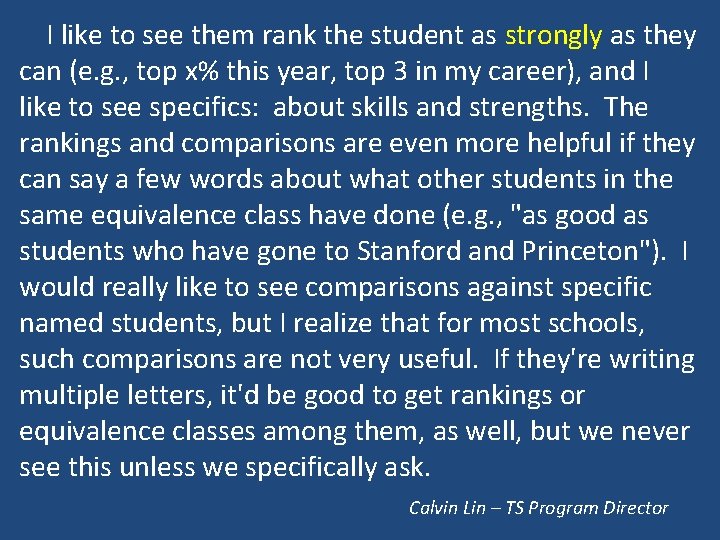
I like to see them rank the student as strongly as they can (e. g. , top x% this year, top 3 in my career), and I like to see specifics: about skills and strengths. The rankings and comparisons are even more helpful if they can say a few words about what other students in the same equivalence class have done (e. g. , "as good as students who have gone to Stanford and Princeton"). I would really like to see comparisons against specific named students, but I realize that for most schools, such comparisons are not very useful. If they're writing multiple letters, it'd be good to get rankings or equivalence classes among them, as well, but we never see this unless we specifically ask. Calvin Lin – TS Program Director
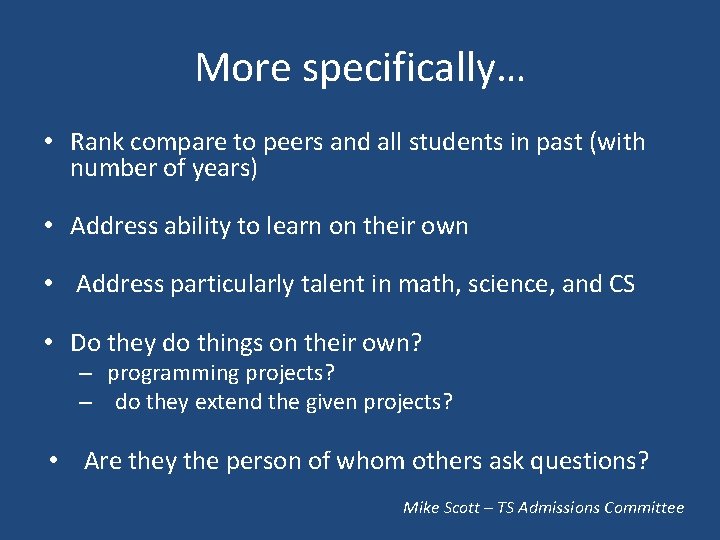
More specifically… • Rank compare to peers and all students in past (with number of years) • Address ability to learn on their own • Address particularly talent in math, science, and CS • Do they do things on their own? – programming projects? – do they extend the given projects? • Are they the person of whom others ask questions? Mike Scott – TS Admissions Committee