
LGBTQ rights and activism 1 Alan Turing 1912
LGBTQ rights and activism 1
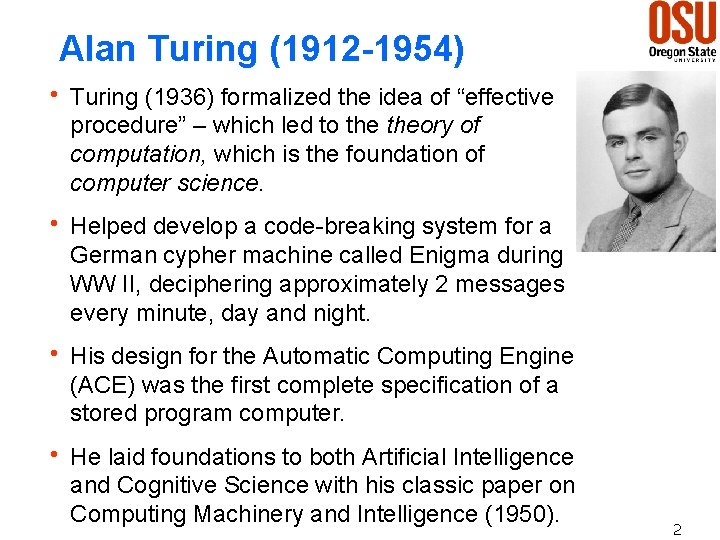
Alan Turing (1912 -1954) h Turing (1936) formalized the idea of “effective procedure” – which led to theory of computation, which is the foundation of computer science. h Helped develop a code-breaking system for a German cypher machine called Enigma during WW II, deciphering approximately 2 messages every minute, day and night. h His design for the Automatic Computing Engine (ACE) was the first complete specification of a stored program computer. h He laid foundations to both Artificial Intelligence and Cognitive Science with his classic paper on Computing Machinery and Intelligence (1950). 2
The Tragedy of Turing h Turing was also homosexual, which was a crime in 20’th century England. h In 1952, he was convicted of “gross indecency” and sentenced to 12 months of therapy. h The same year, he published “The chemical basis of Morphogenesis, ” his most cited paper! h Turing died of cyanide poisoning in 1954, most likely killing himself. h He was granted “royal pardon” in 2013 by the queen 3
Definitions h Sexual orientation 5 Homosexual: attracted to the same sex/gender as the individual g Lesbian: Homosexual woman g Gay: Homosexual man 5 Heterosexual: attracted to the opposite sex or gender 5 Bisexual: attracted to both sexes or genders h Gender identity 5 Transgender: Gender identity is different from sex 5 Cisgender: Gender identity aligns with sex h Queer: An umbrella term for genders and orientations that do not easily fit into any of the other categories (reclamation of a derogatory term), non-binary, gender-fluid 4
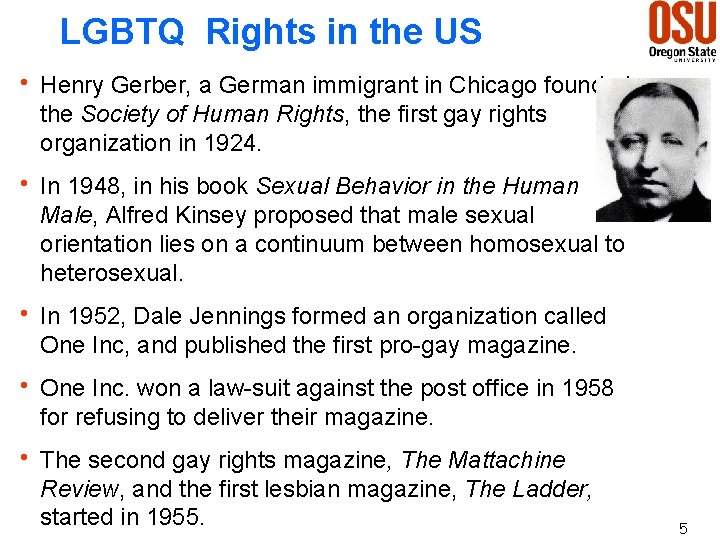
LGBTQ Rights in the US h Henry Gerber, a German immigrant in Chicago founded the Society of Human Rights, the first gay rights organization in 1924. h In 1948, in his book Sexual Behavior in the Human Male, Alfred Kinsey proposed that male sexual orientation lies on a continuum between homosexual to heterosexual. h In 1952, Dale Jennings formed an organization called One Inc, and published the first pro-gay magazine. h One Inc. won a law-suit against the post office in 1958 for refusing to deliver their magazine. h The second gay rights magazine, The Mattachine Review, and the first lesbian magazine, The Ladder, started in 1955. 5
Setbacks (1950’s and 60’s) h In 1952, American Psychological Society declared homosexuality a form of mental disorder. h In 1953, president Dwight Eisenhover banned gays from federal jobs. h Most states barred homosexual activities h Gay bars became the places of refuge h Police cracked down on gay and lesbian bars h Bartenders deny drinks to people who are suspected of being gay 6
The Mattachine Society h In 1966, the Mettachine society staged a “sip in” and were denied drinks in Greenwich village. h The resulting uproar led to a reversal of anti-gay liquor laws. h Engaging in sexual activities was still illegal, and the bars continued to be raided. h Crime families like Genovese family took over most gay bars in the Greenwich village. h Stonewall inn was one of them. The Mafia paid the police to keep away while they served illegal alcohol. 7
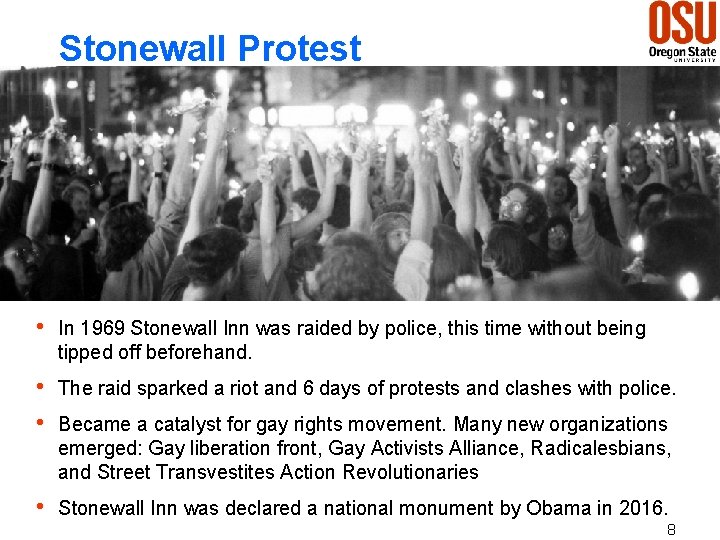
Stonewall Protest h In 1969 Stonewall Inn was raided by police, this time without being tipped off beforehand. h The raid sparked a riot and 6 days of protests and clashes with police. h Became a catalyst for gay rights movement. Many new organizations emerged: Gay liberation front, Gay Activists Alliance, Radicalesbians, and Street Transvestites Action Revolutionaries h Stonewall Inn was declared a national monument by Obama in 2016. 8
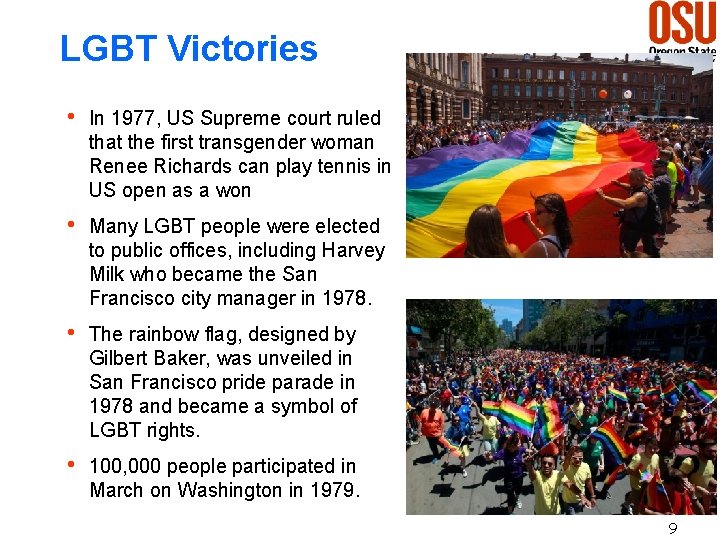
LGBT Victories h In 1977, US Supreme court ruled that the first transgender woman Renee Richards can play tennis in US open as a won h Many LGBT people were elected to public offices, including Harvey Milk who became the San Francisco city manager in 1978. h The rainbow flag, designed by Gilbert Baker, was unveiled in San Francisco pride parade in 1978 and became a symbol of LGBT rights. h 100, 000 people participated in March on Washington in 1979. 9
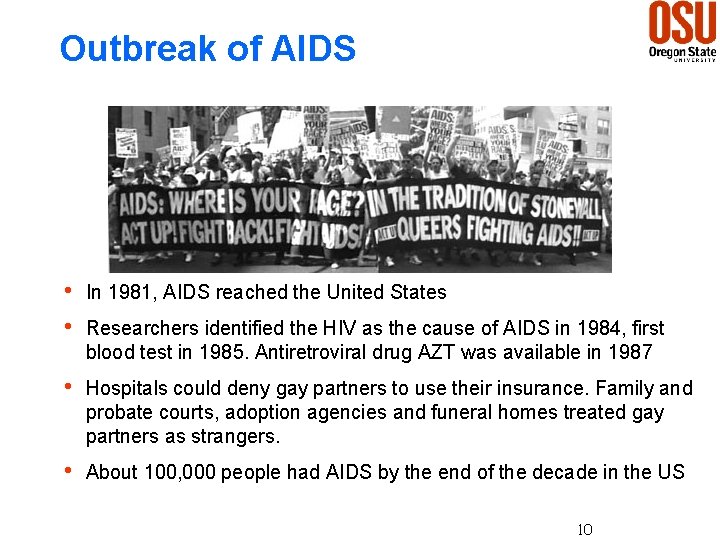
Outbreak of AIDS h In 1981, AIDS reached the United States h Researchers identified the HIV as the cause of AIDS in 1984, first blood test in 1985. Antiretroviral drug AZT was available in 1987 h Hospitals could deny gay partners to use their insurance. Family and probate courts, adoption agencies and funeral homes treated gay partners as strangers. h About 100, 000 people had AIDS by the end of the decade in the US 10
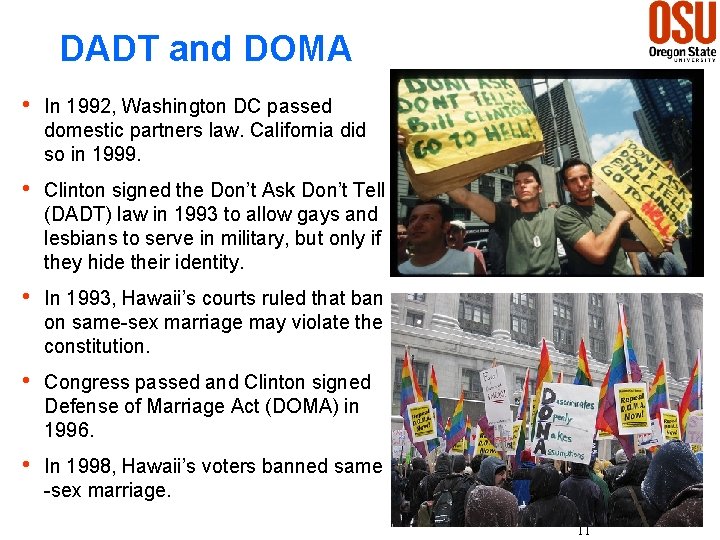
DADT and DOMA h In 1992, Washington DC passed domestic partners law. California did so in 1999. h Clinton signed the Don’t Ask Don’t Tell (DADT) law in 1993 to allow gays and lesbians to serve in military, but only if they hide their identity. h In 1993, Hawaii’s courts ruled that ban on same-sex marriage may violate the constitution. h Congress passed and Clinton signed Defense of Marriage Act (DOMA) in 1996. h In 1998, Hawaii’s voters banned same -sex marriage. 11
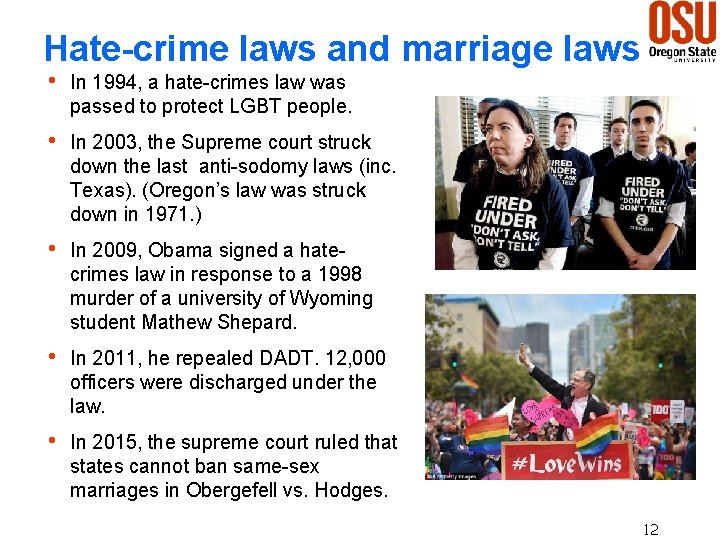
Hate-crime laws and marriage laws h In 1994, a hate-crimes law was passed to protect LGBT people. h In 2003, the Supreme court struck down the last anti-sodomy laws (inc. Texas). (Oregon’s law was struck down in 1971. ) h In 2009, Obama signed a hate- crimes law in response to a 1998 murder of a university of Wyoming student Mathew Shepard. h In 2011, he repealed DADT. 12, 000 officers were discharged under the law. h In 2015, the supreme court ruled that states cannot ban same-sex marriages in Obergefell vs. Hodges. 12
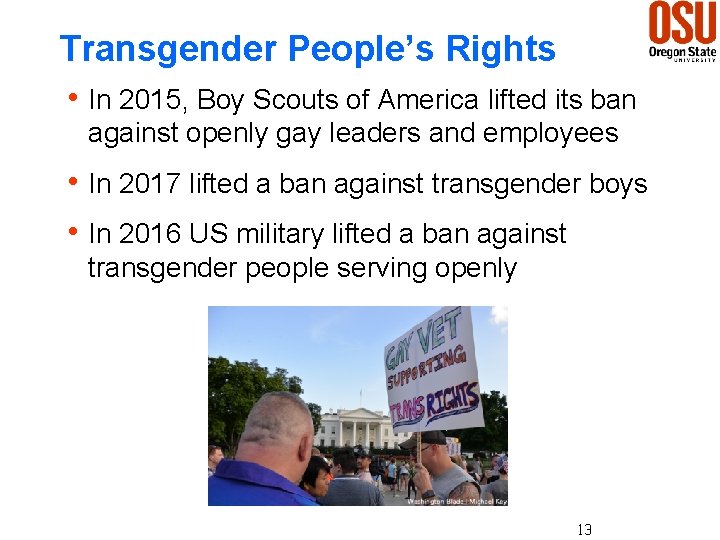
Transgender People’s Rights h In 2015, Boy Scouts of America lifted its ban against openly gay leaders and employees h In 2017 lifted a ban against transgender boys h In 2016 US military lifted a ban against transgender people serving openly 13
Unfinished Work h In 2017 Trump reinstated the ban against transgender people in military h The plan to count LGBTQ people in the 2020 census was revoked h Universal work place and anti-discrimination policies are still lacking h Many state laws allow religious exceptions to LGBTQ rights h Bathroom laws prohibit transgender people from using public restrooms of their choice 14
Discussion Topics h Why is there so much resistance to let people be who they are? h What changed the public opinion on issues? h What did you notice about the rate of change? h What lessons can we draw for other social movements? 15
Take Away Messages h A lot of human tragedy is due to unequal distribution of power, fear of the unknown, and lack of empathy towards people different from us. h It takes a long struggle to change peoples’ minds. Frequent setbacks are common. h Political activism, persistence and hard work by dozens of rights organizations were the keys for changes in the public opinion. h “The arc of moral universe is long, but it bends towards justice. ” – Martin Luther King Jr. h Technology, when properly used, can be an accelerator and force multiplier for social good. 16
- Slides: 16