The United States Constitution The U S Constitution





- Slides: 22
The United States Constitution
The U. S. Constitution I. Preamble - Introduction A. Purpose 1. 2. 3. 4. 5. 6. Form a more perfect Union. Establish justice. Insure domestic tranquility. Provide for the common defense. Promote the general welfare. Secure the blessings of liberty to ourselves and our posterity.
Seven Principles of the Constitution
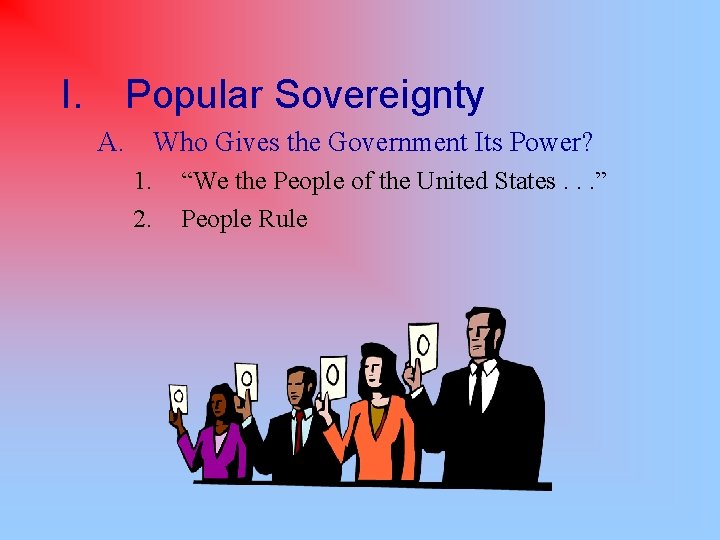
I. Popular Sovereignty A. Who Gives the Government Its Power? 1. 2. “We the People of the United States. . . ” People Rule
II. Republicanism A. How Are People’s Views Represented? 1. Vote for representative. a. Why? i. Fear that public opinion might not be the best!
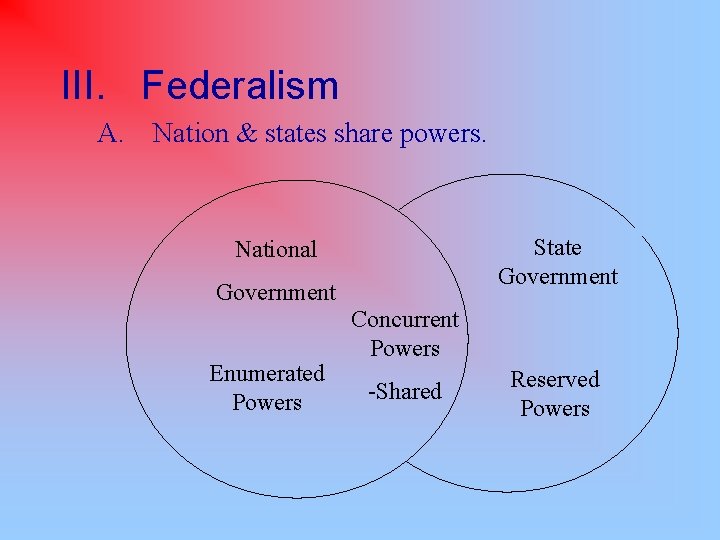
III. Federalism A. Nation & states share powers. State Government National Government Enumerated Powers Concurrent Powers -Shared Reserved Powers
IV. Separation of Powers A. How Is Power Divided? 1. B. Division of Government into Branches Why? 1. No single branch has too much power. Legislative Branch Executive Branch Judicial Branch Makes the laws. Enforces the laws. Interprets the laws.
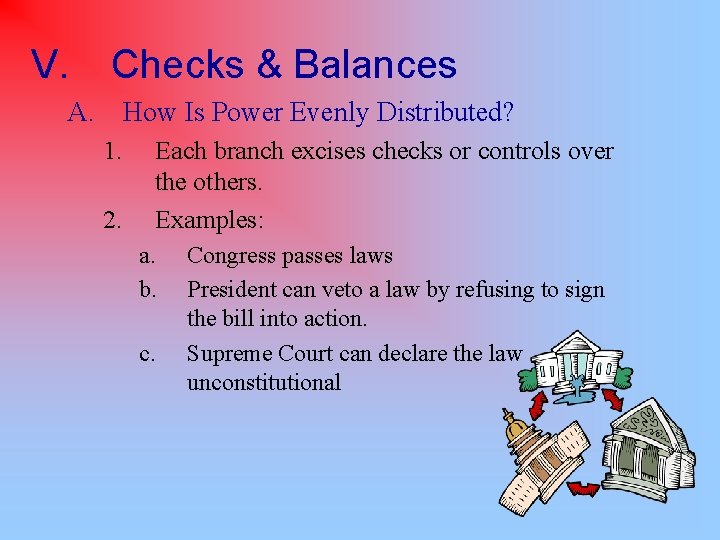
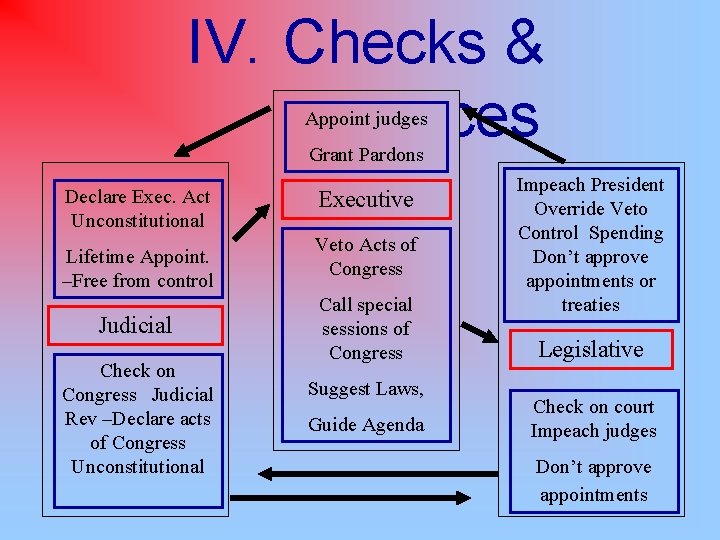
V. Checks & Balances A. How Is Power Evenly Distributed? 1. 2. Each branch excises checks or controls over the others. Examples: a. b. c. Congress passes laws President can veto a law by refusing to sign the bill into action. Supreme Court can declare the law unconstitutional
VI. Limited government A. How is Abuse of Power Prevented? 1. 2. Powers that are denied. Examples: a. No preference shall be given to one state over another b. States shall not issue $
VII. Individual Rights A. How Are Personal Freedoms Protected? B. The Bill of Rights 1. First Ten Amendments a. 2. Guaranteed Example: a. b. Right to meet peacefully (assemble). Free speech.
I. Legislative Branch Make the Laws A. Duties 1. 2. 3. 4. 5. 6. Pass laws, taxes, & $ bills Declares war Approves treaties & presidential appointments Impeach president Print & coin $ Regulates trade
A. Bicameral Congress 1. House of Representatives a. b. Number of Reps based on population Missouri has 8 reps (710, 767 each, approx. ) i. We live in the 8 th district ii. Jo Ann Emerson (R) c. d. Serves a 2 year term Why? i. Deal with more local issues & these can change more quickly
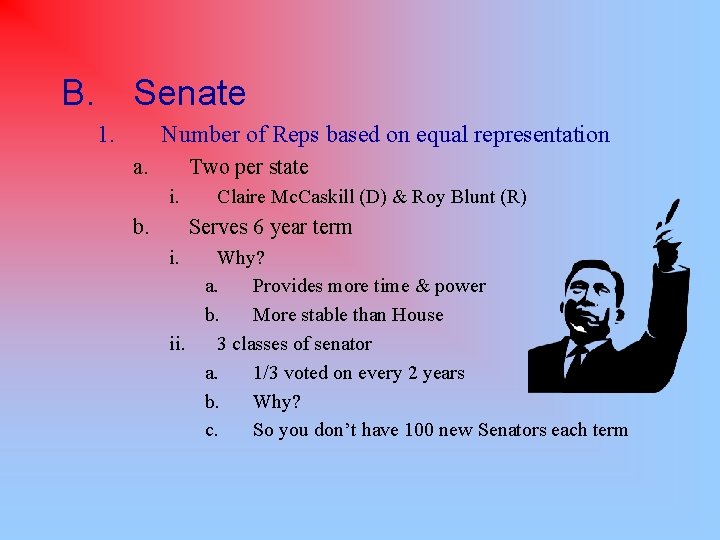
B. Senate 1. Number of Reps based on equal representation a. Two per state i. b. Claire Mc. Caskill (D) & Roy Blunt (R) Serves 6 year term i. Why? a. Provides more time & power b. More stable than House ii. 3 classes of senator a. 1/3 voted on every 2 years b. Why? c. So you don’t have 100 new Senators each term
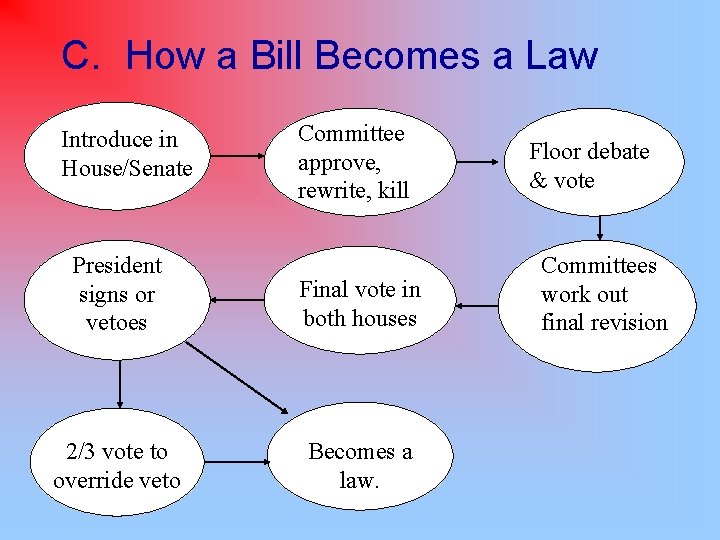
C. How a Bill Becomes a Law Introduce in House/Senate Committee approve, rewrite, kill President signs or vetoes Final vote in both houses 2/3 vote to override veto Becomes a law. Floor debate & vote Committees work out final revision
D. Elastic Clause 1. Known as “Necessary & Proper” Clause 2. Congress may use “all means which are appropriate, . . . Which are not prohibited” 3. Allows future generations to expand the meaning of the Constitution. 13 States 50 States Agriculture, Rural. Industrial, Urban, High-tech 4 Million People 275 Million People
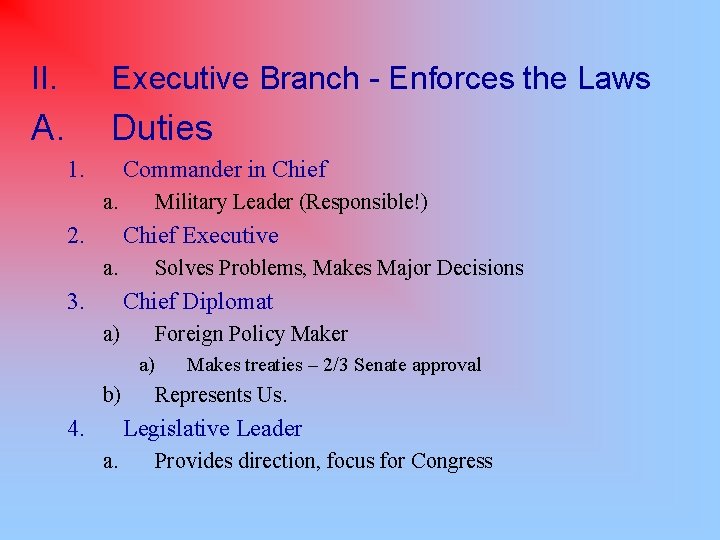
II. Executive Branch - Enforces the Laws A. Duties 1. Commander in Chief a. 2. Military Leader (Responsible!) Chief Executive a. 3. Solves Problems, Makes Major Decisions Chief Diplomat a) Foreign Policy Maker a) b) 4. Makes treaties – 2/3 Senate approval Represents Us. Legislative Leader a. Provides direction, focus for Congress
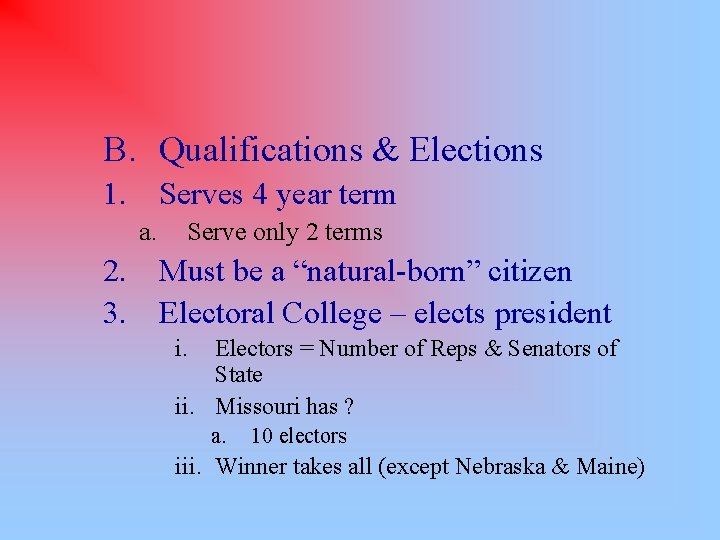
B. Qualifications & Elections 1. Serves 4 year term a. Serve only 2 terms 2. Must be a “natural-born” citizen 3. Electoral College – elects president i. Electors = Number of Reps & Senators of State ii. Missouri has ? a. 10 electors iii. Winner takes all (except Nebraska & Maine)
C. Executive - Other 1. Vice-President a. President of the Senate i. Only votes when there is a tie. 2. Impeachment a. Why? i. Treason, bribery, other high crimes b. Process i. House brings charges ii. Senate conducts trial iii. Chief Justice presides c. Example of Checks & Balances
III. The Judicial Branch – Interprets the Laws A. Duties 1. Judicial Review a. Determine if a law is Constitutional! i. Does it violate the constitution & individual rights!
B. Selection 1. Appointed by President a. 2. Approved by Senate Lifetime appointment a. Why? i. To insure impartiality & protect from outside pressures & influence!
C. Federal Court System 1. Supreme Court a. Highest court in the Land 2. 12 U. S. Courts of Appeal b. Hear trials on appeal 3. 94 U. S. District Courts c. Federal Trials
IV. Checks & Balances Appoint judges Grant Pardons Declare Exec. Act Unconstitutional Lifetime Appoint. –Free from control Judicial Check on Congress Judicial Rev –Declare acts of Congress Unconstitutional Executive Veto Acts of Congress Call special sessions of Congress Suggest Laws, Guide Agenda Impeach President Override Veto Control Spending Don’t approve appointments or treaties Legislative Check on court Impeach judges Don’t approve appointments