The Promise and Potential of Rosie D Empowering













- Slides: 29
The Promise and Potential of Rosie D. Empowering Parents and Serving Children
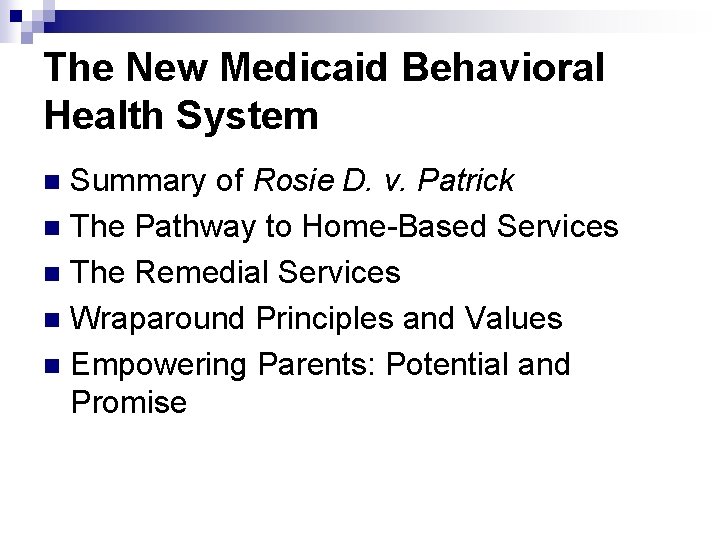
The New Medicaid Behavioral Health System Summary of Rosie D. v. Patrick n The Pathway to Home-Based Services n The Remedial Services n Wraparound Principles and Values n Empowering Parents: Potential and Promise n
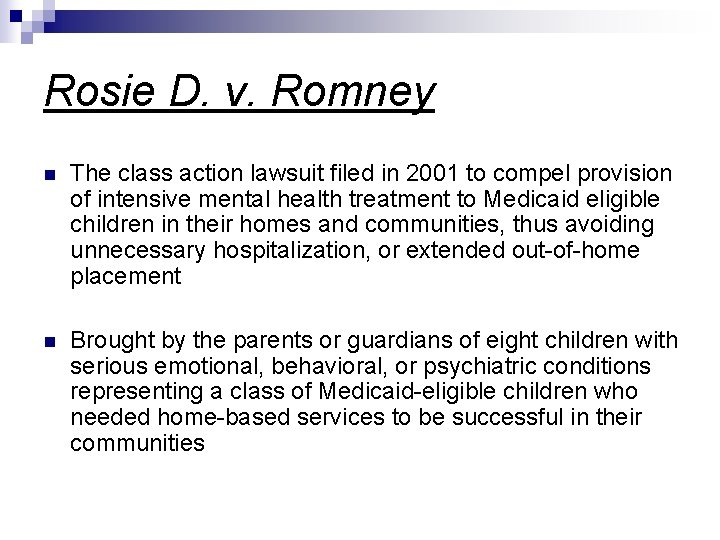
Rosie D. v. Romney n The class action lawsuit filed in 2001 to compel provision of intensive mental health treatment to Medicaid eligible children in their homes and communities, thus avoiding unnecessary hospitalization, or extended out-of-home placement n Brought by the parents or guardians of eight children with serious emotional, behavioral, or psychiatric conditions representing a class of Medicaid-eligible children who needed home-based services to be successful in their communities
The Legal Claims n The federal Medicaid program mandates Early Periodic Screening Diagnosis and Treatment – EPSDT – for children under 21 n EPSDT mandates screening and treatment necessary “to correct or ameliorate a physical or mental condition” n States must provide this treatment promptly and for as long as needed
The Role of Parents in the Litigation The inspiration for the lawsuit n The most patient participants in the litigation process n The most powerful witnesses at trial n The most important players in the implementation process n The potential beneficiaries of the remedy n
The Remedy n Court finds Massachusetts in violation of EPSDT provisions of the Federal Medicaid Act n Court orders the State to develop in-home services, including comprehensive care coordination, screening, assessments, in–home supports and crisis services n Plaintiffs and Commonwealth begin regular implementation meetings
New Court-Ordered Services n n n n Behavioral health screening Comprehensive diagnostic assessments Intensive Care Coordination In-Home Therapy Services In-Home Behavioral Services Therapeutic Mentoring Family Support Workers (Parent Partners) Mobile Crisis and Crisis Stabilization Units
Eligibility for Services n n n Any Medicaid-eligible child (Mass. Health Member) who is determined to have a serious emotional disturbance (SED) is eligible for intensive care coordination SED is defined by two federal agencies which use slightly different definitions Any child who meets EITHER definition, as determined by the mental health evaluation, is eligible
Federal SAMHSA Definition of SED From birth up to age 18 n Who currently or at any time during the past year n Has had a diagnosable mental, behavioral, or emotional disorder n That resulted in functional impairment which substantially interferes with or limits the child's role or functioning in family, school, or community activities. n
Federal IDEA Definition of SED A condition exhibiting one or more of the following characteristics over a long period of time and to a marked degree that adversely affects a child’s educational performance…
Federal IDEA Definition of SED n n n An inability to learn that cannot be explained by intellectual, sensory, or health factors An inability to build or maintain satisfactory interpersonal relationships with peers and teachers Inappropriate behaviors or feelings under normal circumstances n n General pervasive mood of unhappiness or depression A tendency to develop physical symptoms or fears associated with personal or school problems
Co-morbidity and Dual Diagnosis Children with SED, in addition to any other disabling condition, such as autism spectrum disorders, developmental disability or substance abuse will be eligible for the Rosie D. remedy. Children who meet medical necessity criteria for the remaining in-home services can be eligible without a finding of SED.
Pathway to Home-Based Services Screening or Identification n Mental Health Evaluation n Referral for Care Coordination n Comprehensive Home-Based Assessment n Wraparound Treatment Planning n Delivery of Services n
Screening or Identification ¨ As of January 1, 2008, primary care doctors/nurses must offer voluntary screening for behavioral health concerns at well child visits or upon request, using one of several standardized screening instruments ¨ Parents, state agencies, and other child serving entities can also refer children in need of screening ¨ Children with known conditions can bypass screening and be referred directly to a mental health professional for evaluation ¨ Mass. Health will be maintaining data on screenings, referrals, and families ability to access treatment
Mental Health Evaluation n n If a positive screen occurs, a referral can be made for a mental health evaluation Parents can also seek behavioral health evaluations directly if a need has already been identified As of November 30, 2008, all diagnostic evaluations will incorporate the Child and Adolescent Needs and Strengths (CANS) survey The CANS includes a structured interview to assess and child and family’s strengths and their service needs State has trained mental health professionals in hospitals, clinics and state agencies to use the CANS, increasing rates and time for conducting evaluations
Intensive Care Coordination ¨ Provided by a regional network of Community Service Agencies (CSAs) ¨ Care coordinator works in partnership with family and youth to ensure meaningful involvement in all aspects of treatment ¨ Facilitates completion of a comprehensive homebased assessment and development of a care planning team including state agencies, schools and other providers ¨ Prepares and oversees implementation of a single integrated treatment plan ¨ Parents can self-refer or be referred by a mental health clinician or other professional
Treatment Plan ¨ Single plan that is child/family centered ¨ Integrates other agency/provider plans ¨ Team determines the type, amount, intensity and duration of home-based services ¨ Components of plan include: n Treatment goals and objectives n Identification and role of specific providers n Frequency, intensity and location of service delivery n Crisis plans
Home-Based Service Descriptions n n n Mobile Crisis Services Crisis Stabilization Units In-Home Behavioral Services In-Home Therapy Therapeutic Mentoring Parent Partners
Mobile Crisis Services ¨ Mobile, on-site, face-to-face response to youth in crisis, available up to 72 hours ¨ Delivered by a clinical/paraprofessional team in the home or other community setting ¨ Designed to assess, de-escalate and stabilize a child in crisis, offering safety planning, referrals and support to maintain the youth in their natural setting
Crisis Stabilization Units ¨A community-based, staff secure treatment setting offering short term crisis stabilization services for up to 7 days ¨ Designed to facilitate immediate engagement of family/caretakers in problem solving, skillbuilding, crisis counseling, service linkages and coordination with existing providers ¨ Focused on youth’s rapid return to the community, avoiding a higher level of care
Behavior Management Therapy and Behavior Monitoring ¨ Clinical/paraprofessional team addresses challenging behaviors in the home and community which interfere with youth’s successful functioning ¨ Therapist provides behavioral assessment, develops a behavior management plan with the family and reviews effectiveness of the interventions ¨ Behavior Monitor helps implement the plan, modeling and re-enforcing behavior management strategies in the home and community
In-Home Therapy Services ¨ Includes 24/7 urgent response, flexibility in scheduling, frequency and duration of sessions ¨ Works to foster understanding of family dynamics, develop strategies to address stressors, enhance problem solving and communication skills, identify community resources, address risk and safety planning, coordinate care ¨ Therapist works with youth and the family on development of specific clinical treatment goals to improve youth’s functioning ¨ A paraprofessional may assist by supporting the youth and family in day-to-day implementation of treatment goals
Therapeutic Mentoring Services ¨ Structured one-to-one relationship between paraprofessional and youth, addressing daily living, social and communication skills in variety of home and community settings ¨ Includes coaching and training in age-appropriate behaviors, problem-solving, conflict resolution and interpersonal relationships using recreational and social activities ¨ Delivered pursuant to plan of care and supervised by a clinician, focus on ensuring youth’s successful navigation of various social contexts, skill acquisition and functional progress towards treatment goals
Caregiver/Peer to Peer Support ¨ Available through CSA’s and stand alone providers ¨ Structured, one-to-one, strength-based relationship with parent/caregiver of youth ¨ Delivered by a family partner with experience caring for a child with special needs and utilizing child and family serving systems ¨ Supports caregiver in addressing child’s behavioral health needs by identifying formal and informal supports, offering assistance in navigating childserving systems and fostering empowerment through education, coaching and training
Revised Implementation Timelines July 1, 2009: Intensive Care Coordination, Family Partners & Mobile Crisis October 1, 2009: In-home Behavioral Services and Therapeutic Mentoring November 1, 2009: In-Home Therapy December 1, 2009: Crisis Stabilization Units
Wrap. Around Priniciples and Values ICC team and in-home providers responsible for Maintaining fidelity to several core principals: ¨ strength-based ¨ individualized ¨ child-centered ¨ family-driven ¨ community-based ¨ multi-system ¨ culturally competent
The Potential of Wraparound to Empower Families n n n Families and children are the most important participants in the process Their vision and hopes are central to the process Their strengths, rather than needs, guide the process Their culture, style, and preferences must be addressed by the process They are in charge
What this means for children and their families n n A new array of home and community–based services Supports available with the length and intensity that youth with serious emotional disturbance need An approach which empowers families to direct their own care A process which coordinates all agencies and providers in one team and produces one unified treatment plan
What this means for parent advocates n n A new resource to help support children in their homes/communities and in the least restrictive educational environment A team of community experts available to work with/influence the school A need for familiarity with eligibility requirements, steps for referral, available services and the expectations of wrap-around A legal entitlement beyond special education