The Physics of Waves Wave Math 9 12


- Slides: 22
The Physics of Waves Wave Math 9 -12 Science Std: Phys 4 b
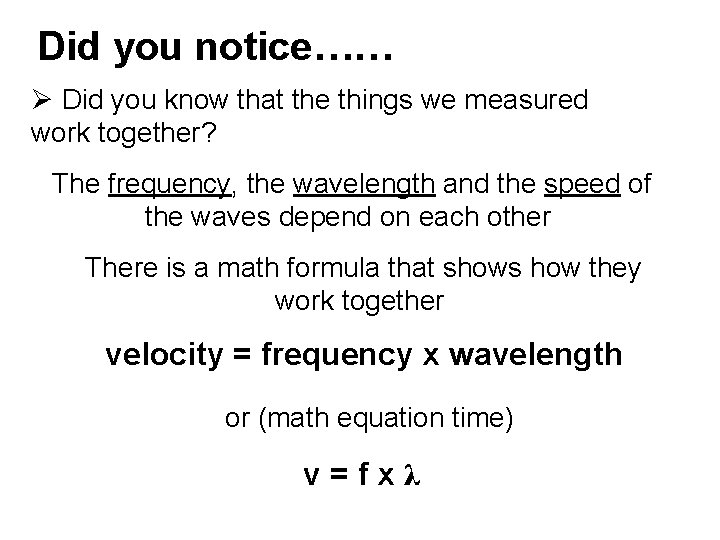
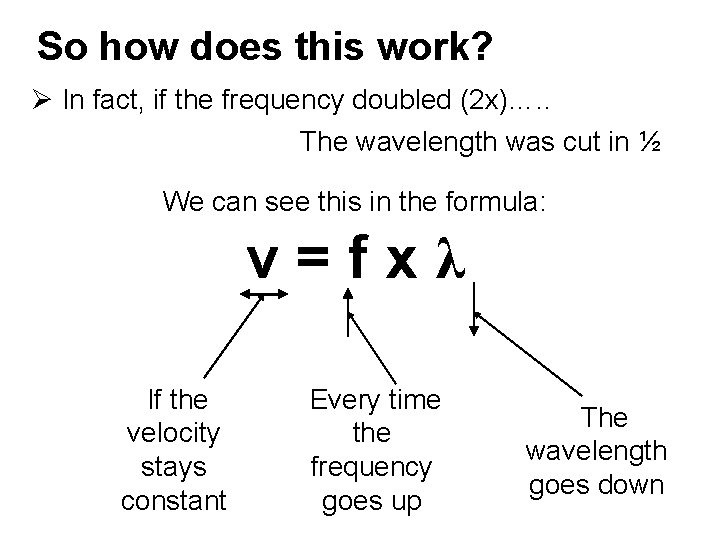
Did you notice…… Ø Did you know that the things we measured work together? The frequency, the wavelength and the speed of the waves depend on each other There is a math formula that shows how they work together velocity = frequency x wavelength or (math equation time) v=fxλ
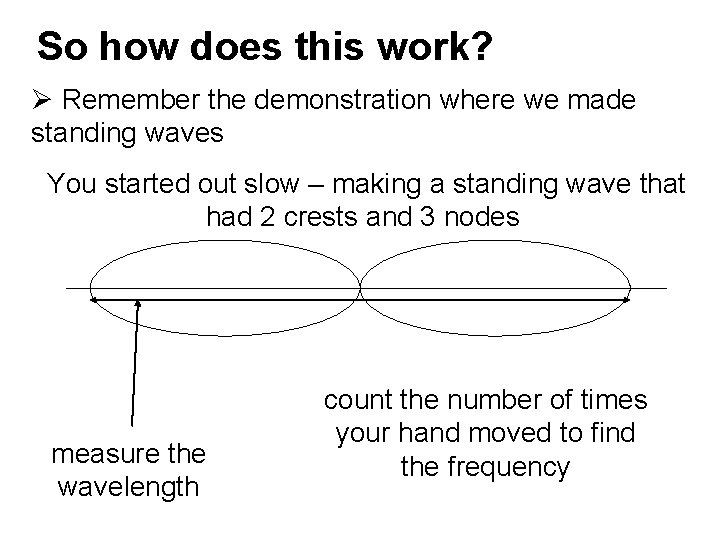
So how does this work? Ø Remember the demonstration where we made standing waves You started out slow – making a standing wave that had 2 crests and 3 nodes measure the wavelength count the number of times your hand moved to find the frequency
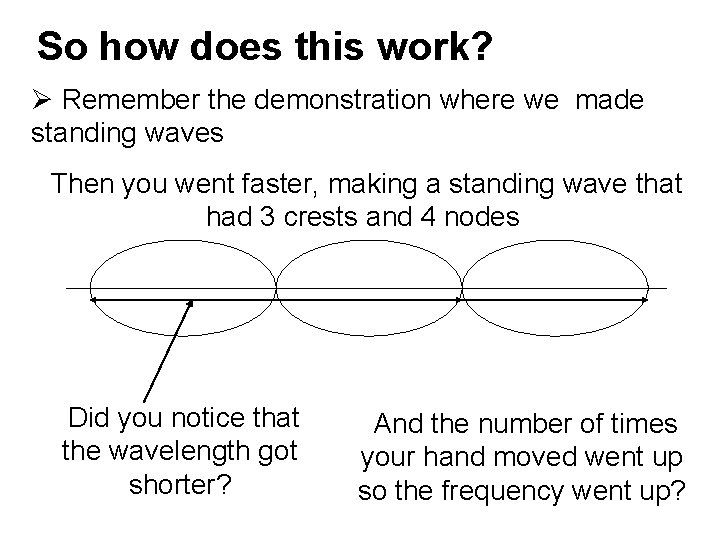
So how does this work? Ø Remember the demonstration where we made standing waves Then you went faster, making a standing wave that had 3 crests and 4 nodes Did you notice that the wavelength got shorter? And the number of times your hand moved went up so the frequency went up?
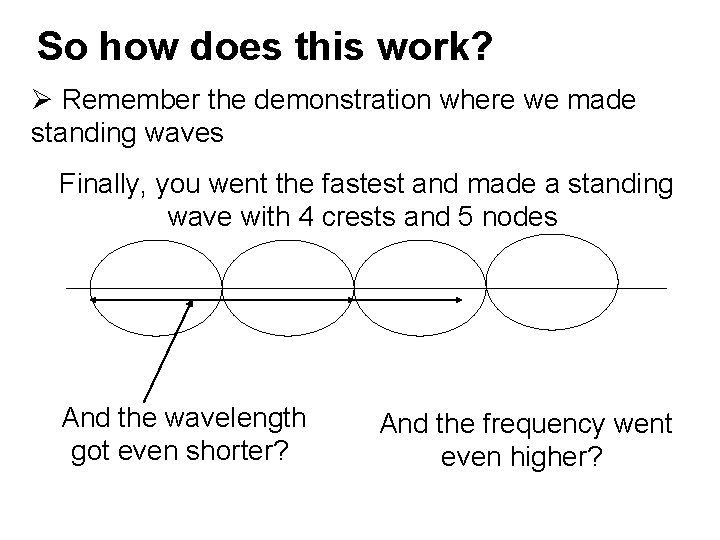
So how does this work? Ø Remember the demonstration where we made standing waves Finally, you went the fastest and made a standing wave with 4 crests and 5 nodes And the wavelength got even shorter? And the frequency went even higher?
So how does this work? Ø In fact, if the frequency doubled (2 x)…. . The wavelength was cut in ½ We can see this in the formula: v=fxλ If the velocity stays constant Every time the frequency goes up The wavelength goes down
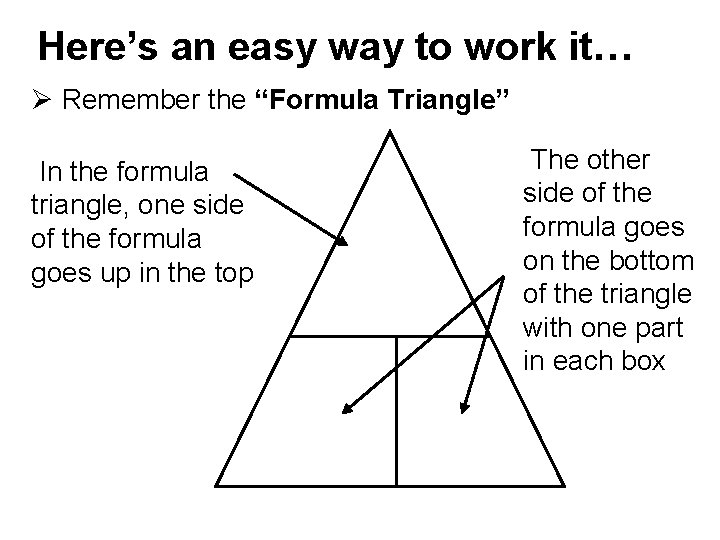
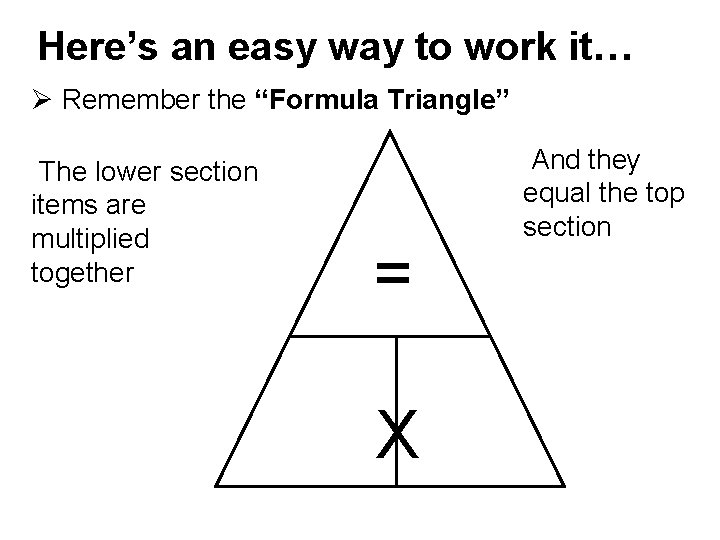
Here’s an easy way to work it… Ø Remember the “Formula Triangle” In the formula triangle, one side of the formula goes up in the top The other side of the formula goes on the bottom of the triangle with one part in each box
Here’s an easy way to work it… Ø Remember the “Formula Triangle” The lower section items are multiplied together = X And they equal the top section
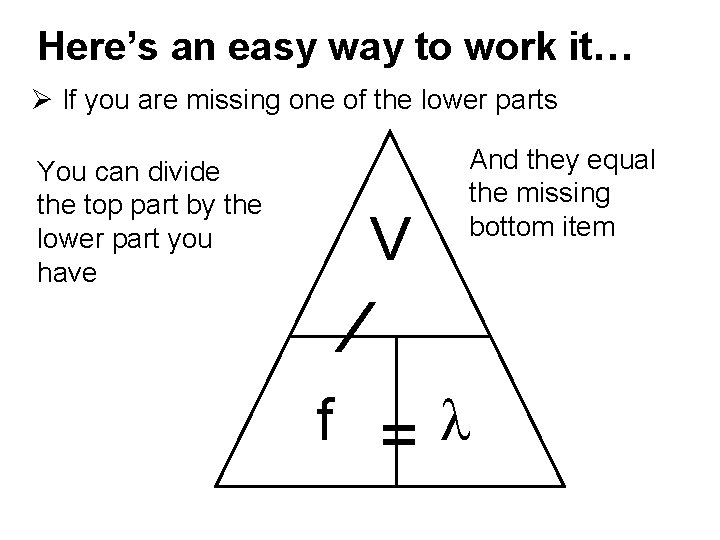
Here’s an easy way to work it… Ø So for the formula v = f x λ The two items on the bottom are multiplied together V And they equal the top item = f Xλ
Here’s an easy way to work it… Ø If you are missing one of the lower parts You can divide the top part by the lower part you have V And they equal the missing bottom item ∕ f =λ
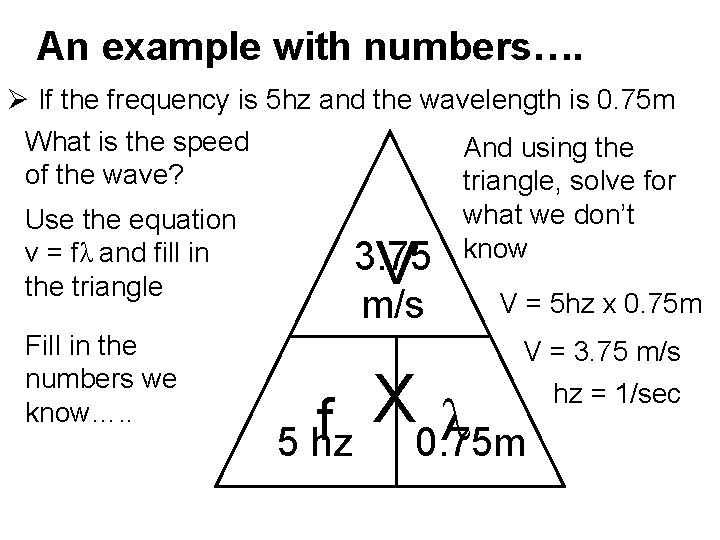
An example with numbers…. Ø If the frequency is 5 hz and the wavelength is 0. 75 m What is the speed And using the of the wave? triangle, solve for what we don’t Use the equation v = fλ and fill in 3. 75 know the triangle V = 5 hz x 0. 75 m m/s Fill in the V = 3. 75 m/s numbers we hz = 1/sec know…. . V X λ f 5 hz 0. 75 m
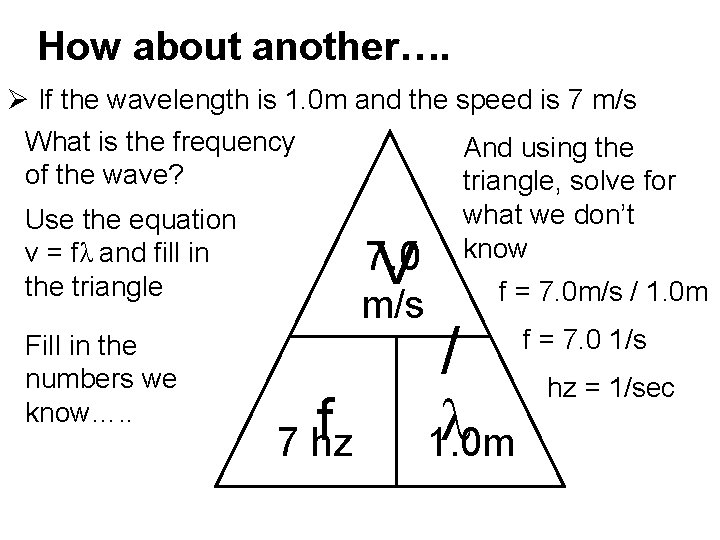
How about another…. Ø If the wavelength is 1. 0 m and the speed is 7 m/s What is the frequency And using the of the wave? triangle, solve for what we don’t Use the equation v = fλ and fill in 7. 0 know the triangle f = 7. 0 m/s / 1. 0 m V m/s Fill in the numbers we know…. . f 7 hz / λ 1. 0 m f = 7. 0 1/s hz = 1/sec
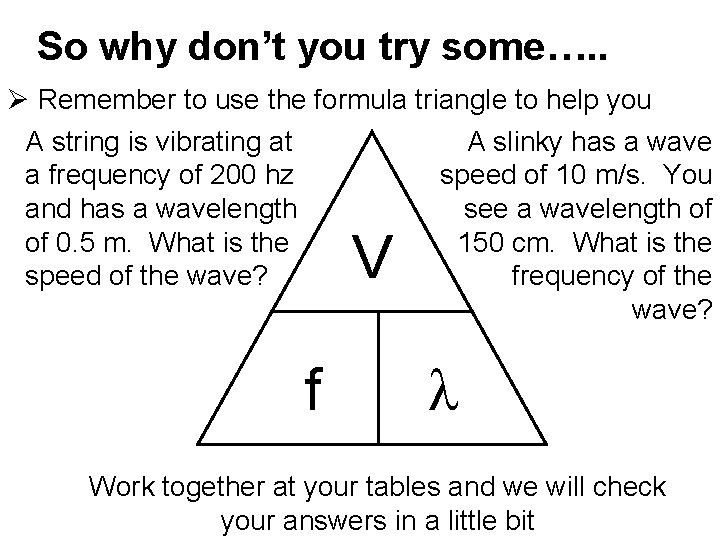
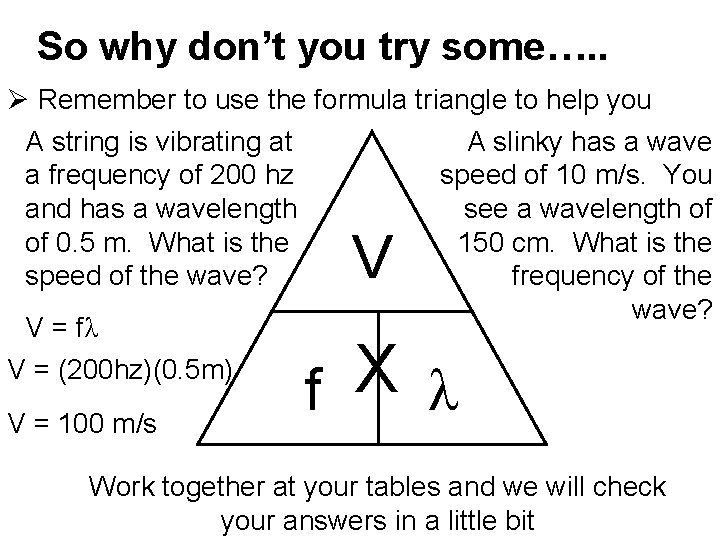
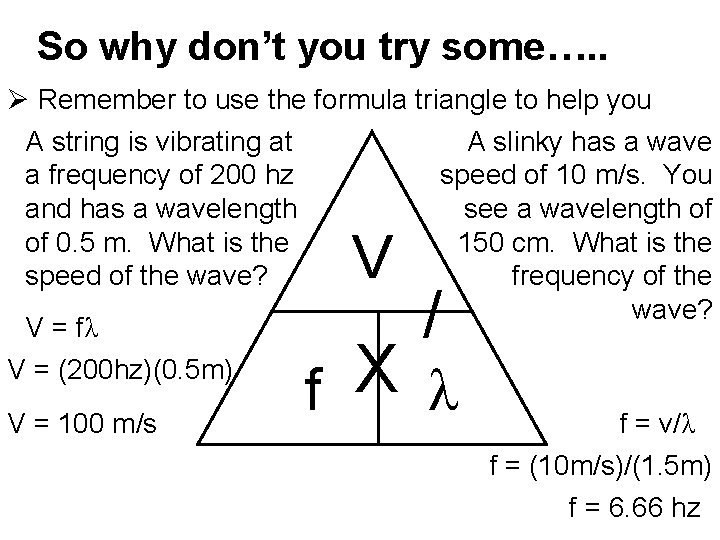
So why don’t you try some…. . Ø Remember to use the formula triangle to help you A string is vibrating at A slinky has a wave a frequency of 200 hz speed of 10 m/s. You and has a wavelength see a wavelength of of 0. 5 m. What is the 150 cm. What is the speed of the wave? frequency of the wave? V f λ Work together at your tables and we will check your answers in a little bit
So why don’t you try some…. . Ø Remember to use the formula triangle to help you A string is vibrating at A slinky has a wave a frequency of 200 hz speed of 10 m/s. You and has a wavelength see a wavelength of of 0. 5 m. What is the 150 cm. What is the speed of the wave? frequency of the wave? V = fλ V = (200 hz)(0. 5 m) V V = 100 m/s X λ f Work together at your tables and we will check your answers in a little bit
So why don’t you try some…. . Ø Remember to use the formula triangle to help you A string is vibrating at A slinky has a wave a frequency of 200 hz speed of 10 m/s. You and has a wavelength see a wavelength of of 0. 5 m. What is the 150 cm. What is the speed of the wave? frequency of the wave? V = fλ V = (200 hz)(0. 5 m) V V = 100 m/s / X λ f f = v/λ f = (10 m/s)/(1. 5 m) f = 6. 66 hz
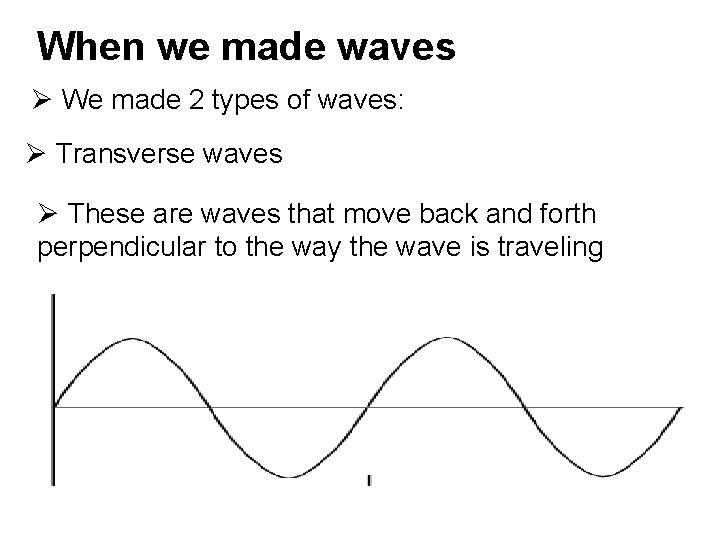
When we made waves Ø We made 2 types of waves: Ø Transverse waves Ø These are waves that move back and forth perpendicular to the way the wave is traveling
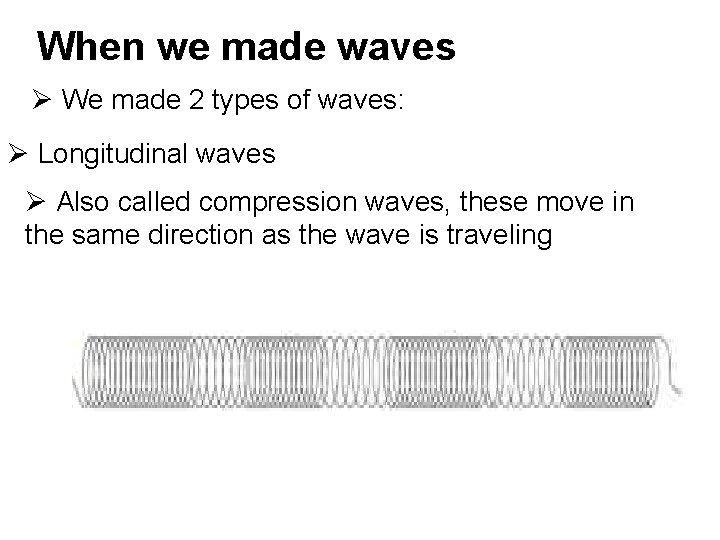
When we made waves Ø We made 2 types of waves: Ø Longitudinal waves Ø Also called compression waves, these move in the same direction as the wave is traveling
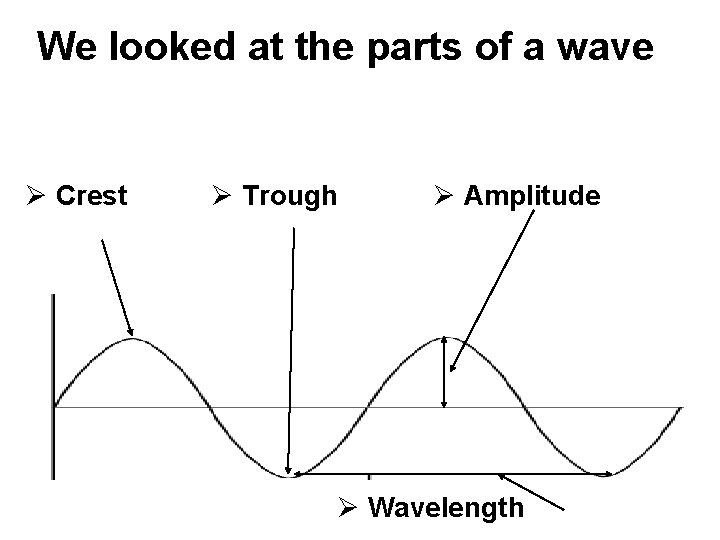
We looked at the parts of a wave Ø Crest Ø Trough Ø Amplitude Ø Wavelength
And we counted the frequency Remember that the frequency is the count of how many times a wavelength goes by in one time interval (normally, the # of crests per second)
We even talked about the period The period is a measure of the amount of time it takes for one wavelength to go by
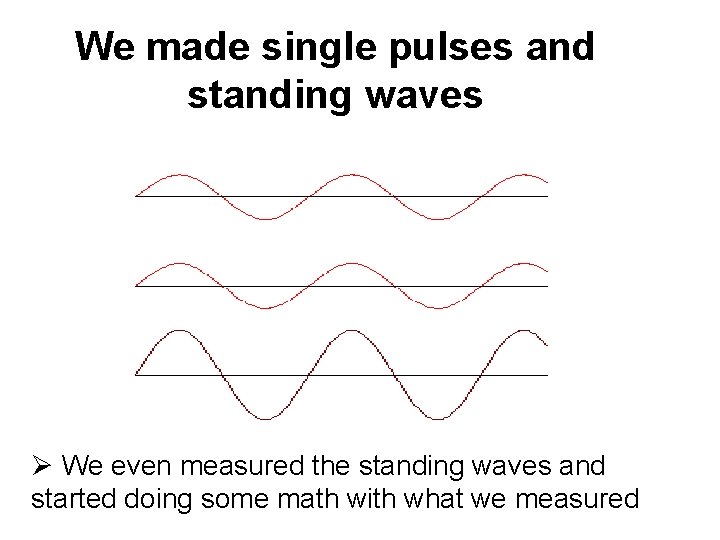
We made single pulses and standing waves Ø We even measured the standing waves and started doing some math with what we measured