The participatory process in the development of a
- Slides: 14
The participatory process in the development of a strategic Health Plan Pirous Fateh-Moghadam Health Observatory Autonomous Province of Trento
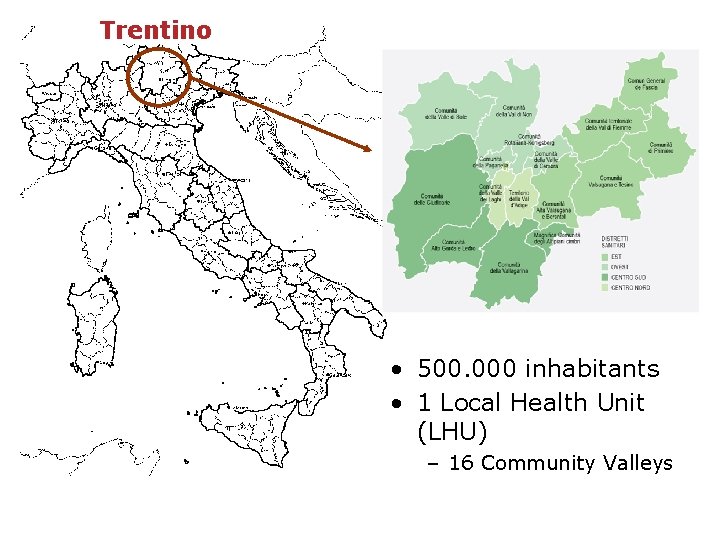
Trentino • 500. 000 inhabitants • 1 Local Health Unit (LHU) – 16 Community Valleys
The challenge in 2015 • The Health department received the political input to develop a health plan that takes into account the main strategic WHO documents, including Health 2020, the SDGs and the Hi. AP approach • And we should Ensure that a participatory approach is followed
Key steps (I should mention that at the time I had no previous experience with participatory approach) • A working group for the development of the Health Plan has been set up – Participation of both the health and the social sector • A Hi. AP-commission was established which involves all sectors of the regional government • A first draft of the strategic Health Plan 20152025 was written by the working group
Key steps • Thanks to the Unit for Participation and transparency a web based platform has been developed allowing to comment on the draft and make new proposals – At first open to technical stakeholders then to the general public • We had additional face to face meetings for feed back and collection of proposals for privileged stakeholders and the general public • According to comments and proposals new drafts of the Plan where issued
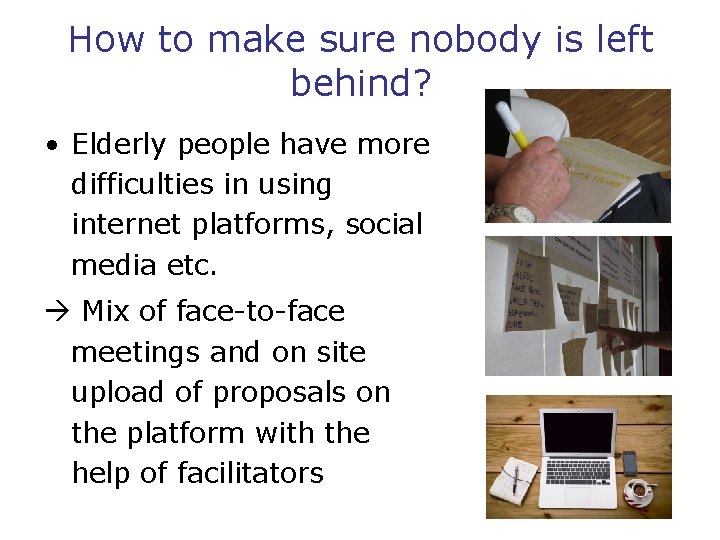
How to make sure nobody is left behind? • Elderly people have more difficulties in using internet platforms, social media etc. Mix of face-to-face meetings and on site upload of proposals on the platform with the help of facilitators
Who partecipated • To access platform some information on gender, age, education, citizenship were requested – in order to be able to monitor partecipation (is it representative of our population? ) • We checked at mid-term: – Gender and age well represented – Educational level somewhat higher than average – no (zero) immigrant (10% of population)… how involve those who do not partecipate?
We had to think about something different… • We organized a special meeting using Open space technology and invited 20 health mediators-qualified interpreters to collect their input, comments and proposals on the Health Plan • It came out very nicely. . .
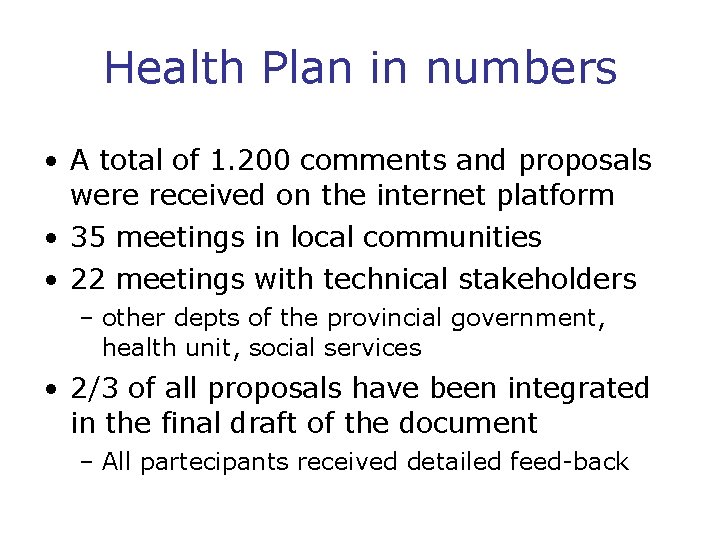
Health Plan in numbers • A total of 1. 200 comments and proposals were received on the internet platform • 35 meetings in local communities • 22 meetings with technical stakeholders – other depts of the provincial government, health unit, social services • 2/3 of all proposals have been integrated in the final draft of the document – All partecipants received detailed feed-back
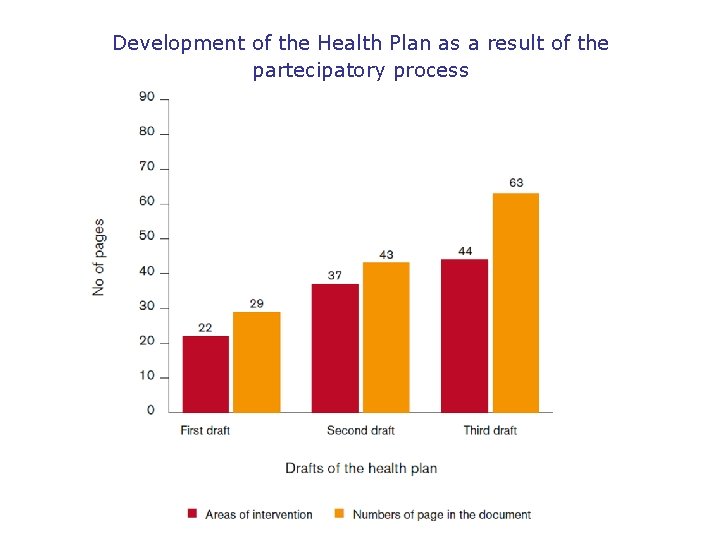
Development of the Health Plan as a result of the partecipatory process
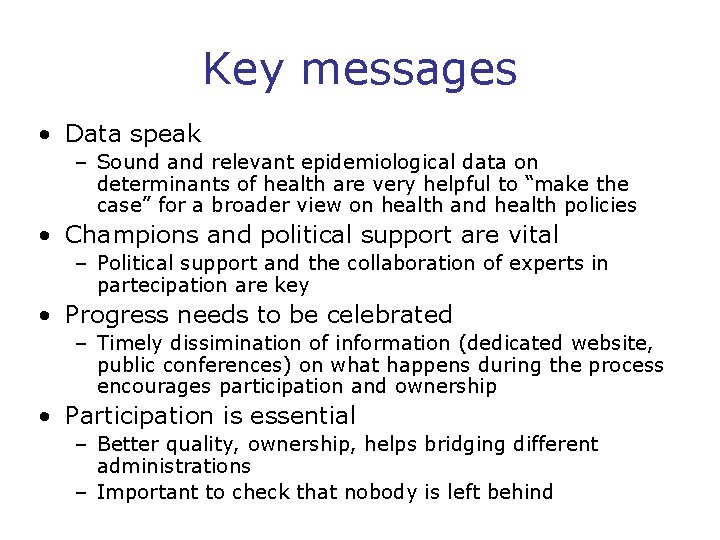
Key messages • Data speak – Sound and relevant epidemiological data on determinants of health are very helpful to “make the case” for a broader view on health and health policies • Champions and political support are vital – Political support and the collaboration of experts in partecipation are key • Progress needs to be celebrated – Timely dissimination of information (dedicated website, public conferences) on what happens during the process encourages participation and ownership • Participation is essential – Better quality, ownership, helps bridging different administrations – Important to check that nobody is left behind
Enabling factors • Political leadership: health counsellor in favor of strategic health planning beyond health sector and participatory approach • Tecnical high level leadership: WHO-RHN membership strong guidance and support • Tecnical local support on participatory approach – Already in place a special project with trained facilitators in search for pratical applications • Development of local widespread leadership remains difficult: not everybody in the health and social service workforce really “believes” in the partecipatory approach …
Limitations • The application of the partecipatory approach in the development of the Health Plan remained an isolated example • Most of the public health planning continues as usual • More has to be done to integrate and disseminate the partecipatory approach in the routine of public health planning and evaluation culture. • So thank you very much for your attention and enjoy the workshop and your stay in Brussels!
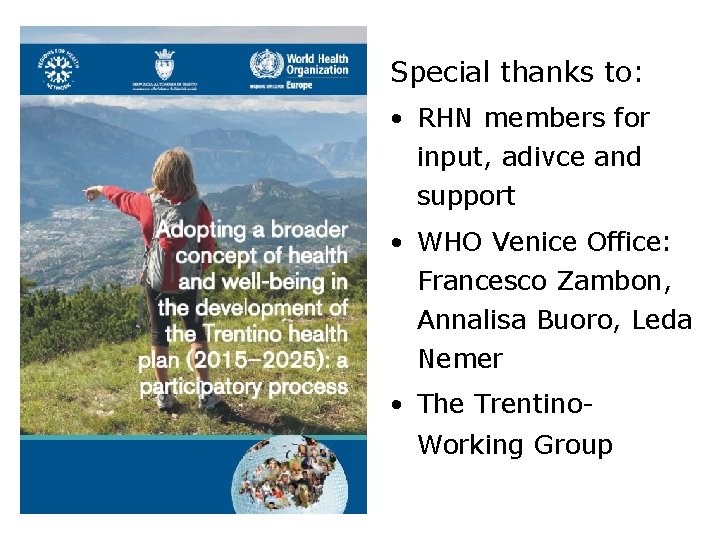
Special thanks to: • RHN members for input, adivce and support • WHO Venice Office: Francesco Zambon, Annalisa Buoro, Leda Nemer • The Trentino. Working Group