THE MINORITY REPORT Critical Lenses and LiteraryFilm Interpretation
- Slides: 11
THE MINORITY REPORT Critical Lenses and Literary/Film Interpretation
Critical Lens � The reading and understanding of a text changes based on critical lenses through which the reader interprets that text. Readers can make thoughtful judgments about a text based on the effectiveness of an author’s rhetoric.
Considerations � Considerations: What is the difference between literary and film criticism? Can the same story be interpreted and thus portrayed differently by using different lenses? How can viewers interpret the same text using different lenses?
Lenses � � Literary theories were developed as a means to understand the various ways people read texts. The proponents of each theory believe their theory is theory, but most of us interpret texts according to the "rules" of several different theories at a time. All literary theories are lenses through which we can see texts. You should read according to any of them, but it is sometimes fun to "decide" to read a text with one in mind because you often end up with a whole new perspective on your reading.
Archetypal Lens � � � � Archetypal Criticism: In criticism, "archetype" signifies narrative designs, character types, or images that are said to be identifiable in a wide variety of works of literature, as well as in myths, dreams, and even ritualized modes of social behavior. death/rebirth journey underground/the heavenly ascent the search for the father the Promethean rebel-hero, the scapegoat the fatal woman.
Historical Lens � � Historical Criticism: Using this theory requires that you apply to a text specific historical information about the time during which an author wrote. History, in this case, refers to the social, political, economic, cultural, and/or intellectual climate of the time.
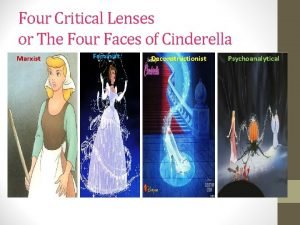
Psychological and Psychoanalytic Lens Psychological and Psychoanalytic Criticism: Psychological criticism deals with a work of literature primarily as an expression, in fictional form, of the personality, state of mind, feelings, and desires of its author. 1. Reference to the author's personality is used to explain and interpret a literary work. 2. Reference to literary works is made in order to establish, biographically, the personality of the author. 3. The mode of reading a literary work itself is a way of experiencing the distinctive subjectivity or consciousness of its author. �
Marxist Lens � Marxist Criticism: A Marxist critic grounds theory and practice on the economic and cultural theory of Karl Marx and Friedrich Engels, especially on the following claims: � 1. The evolving history of humanity, its institutions and its ways of thinking are determined by the changing mode of "material production"-or-basic economic organization. � 2. Historical changes economic organization cause changes both in the constitution and power relations of social classes, which carry on a conflict for economic, political, and social advantage.
� 3. Human consciousness in any era maintains an ideology-a set of concepts, beliefs, values, and ways of thinking and feeling-through which human beings perceive, and explain reality. � A Marxist critic typically undertakes to interpret literature from any era by revealing the economic, class, and ideological determinants behind an author’s writing, and to examine the relation of the text to the social reality of that time and place. � Simply put - This school of critical theory focuses on power and money in works of literature. Who has the power/money? Who does not? Why? What happens as a result?
Quick Facts � � Phillip K. Dick is a science fiction writer who has written many short stories that are now movies. Three of them are: “Do Androids Dream of Electric Sheep” – Blade Runner “The Minority Report” – Minority Report “The Adjustment Team” – The Adjustment Bureau
Quick Facts Cont. � � Dick explored sociological, political and metaphysical themes in novels dominated by monopolistic corporations, authoritarian governments, and altered states. Most of his most recently adapted stories were written in the late 50 s and early 60 s. He was a fraternal twin at birth. His twin sister died at six weeks old. He was educated in Quaker schools and raised by a single mother.