THE MARKET AND THE POLIS A Theory of

- Slides: 11
THE MARKET AND THE POLIS A Theory of Policy Politics
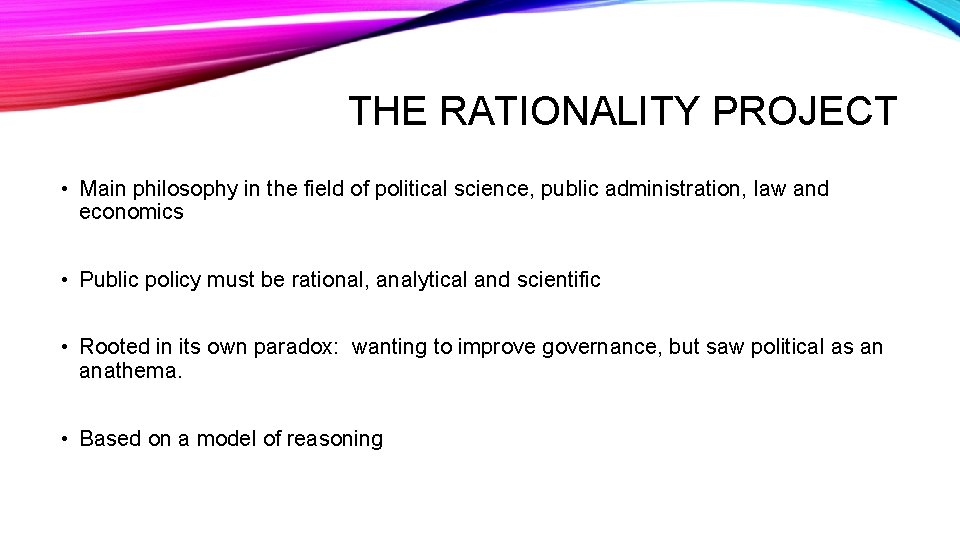
THE RATIONALITY PROJECT • Main philosophy in the field of political science, public administration, law and economics • Public policy must be rational, analytical and scientific • Rooted in its own paradox: wanting to improve governance, but saw political as an anathema. • Based on a model of reasoning
POLITICAL REASONING • Mode of policy analysis that recognizes political conflict, but also see it’s valuable elements. • Rational analysis isn’t above politics, but rather the elements underlying rational analysis are in and of themselves defined by political struggle • Have to resolve the basic difference between the market and community. • The model of reasoning is totally rational and ignores feelings and moral intuition. The underlying model of society is the market. • Political reasoning is by metaphor and analogy. The underlying model of society is community.
DEFINITIONS The Market • A social system in which individuals pursue their own welfare by exchanging things with others whenever trades are mutually beneficial. The Polis • A model of the polis is a model of community. It assumes collective will and collective effort. Membership is in some sense the primary political issue.
CHARACTERISTICS OF THE POLIS • Community • • Collective will and collective effort Membership primary politica issue Political community and cultural community Mutual aid is social insurance • Altruism • • Powerful human motive True definition not possible (no self benefit) As fierce as self interests How something is implemented at the street level (moral underground)
CHARACTERISTICS OF THE POLIS • Public Interest • In polis public interest is intentional • Fill box of public interest with forethought, planning and conscious effort • In market public interest is by product of individual interests • Fill empty box of public interest as an afterthought with the side effects of other activities • Commons Problems • This leads from the above. How do you have both private and collective benefits? • The balance between self interest and public interest. • Collective action problems
CHARACTERISTICS OF THE POLIS • Influence • Bridge the gap between self-interest and public interest by the following: • Influence • Cooperation • loyalty • Cooperation as important as competition. • Politics involves seeking allies • Cooperation is central to power in politics • Loyalty • Cooperation goes hand in hand with loyalty
CHARACTERISTICS OF THE POLIS • Groups rather than individuals are the building blocks of the polis • People belong to institutions and organizations • Policy making is about functioning of groups – form, split, fight, coalesce, divide, etc. • Decisions of the polis are collective • Information • In the ideal market information is “perfect” • “In the polis, by contrast, information s ambiguous, incomplete, often strategically shaded and sometimes deliberately withheld. ” (p. 30) • The differences between truth and perception • Information is never complete
CHARACTERISTICS OF THE POLIS • Passion • Contrasting to the laws of matter • Laws of passion: • Passion feeds on itself • Resource expansion through exercise, use, practice and expression – professions? • The whole is greater than the sum of it’s parts • Things can mean and therefore be more than one thing at once • All these things lead to the power of the polis
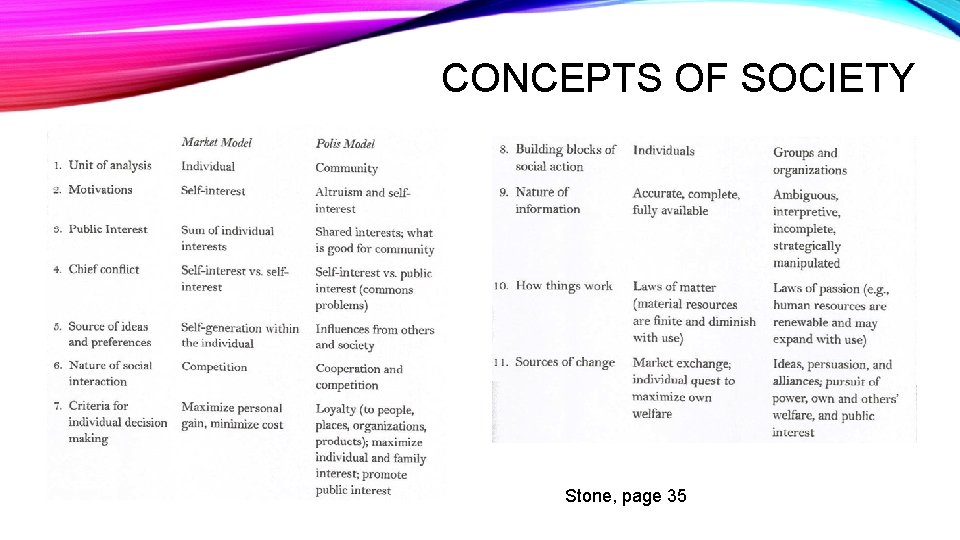
CHARACTERISTICS OF THE POLIS • It is a community with ideas and effort apart from individual goals. • It’s members are motivated by both altruism and self interest. • It has a public interest, whose meaning people fight about and act upon. • Most of its policy problems are commons problems. • Influence is pervasion and the boundary between influence and coercion is always contested. • Cooperation is as important as competition. • Loyalty is the norm. • Groups and organizations form the building blocks. • Information is interpretive, incomplete and strategic. • It is governed by laws of passion as well as laws of matter. Stone, pg. 34
CONCEPTS OF SOCIETY Stone, page 35