The Kazakh Steppe also called the Great Dala

- Slides: 5
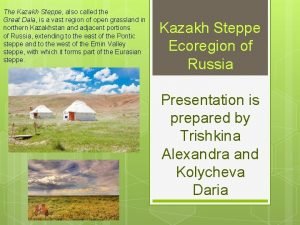
The Kazakh Steppe, also called the Great Dala, is a vast region of open grassland in northern Kazakhstan and adjacent portions of Russia, extending to the east of the Pontic steppe and to the west of the Emin Valley steppe, with which it forms part of the Eurasian steppe. Kazakh Steppe Ecoregion of Russia Presentation is prepared by Trishkina Alexandra and Kolycheva Daria
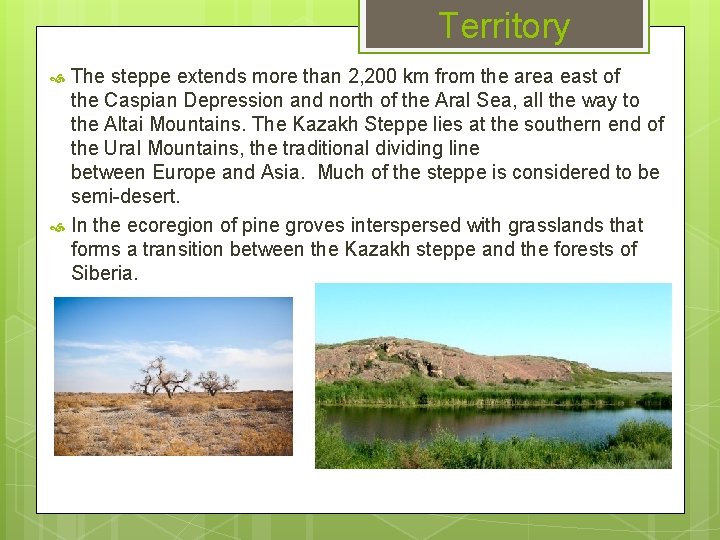
Territory The steppe extends more than 2, 200 km from the area east of the Caspian Depression and north of the Aral Sea, all the way to the Altai Mountains. The Kazakh Steppe lies at the southern end of the Ural Mountains, the traditional dividing line between Europe and Asia. Much of the steppe is considered to be semi-desert. In the ecoregion of pine groves interspersed with grasslands that forms a transition between the Kazakh steppe and the forests of Siberia.
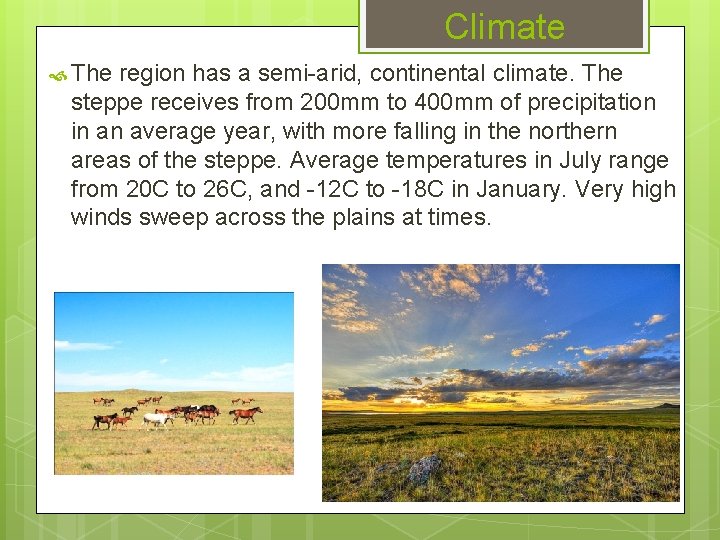
Climate The region has a semi-arid, continental climate. The steppe receives from 200 mm to 400 mm of precipitation in an average year, with more falling in the northern areas of the steppe. Average temperatures in July range from 20 C to 26 C, and -12 C to -18 C in January. Very high winds sweep across the plains at times.
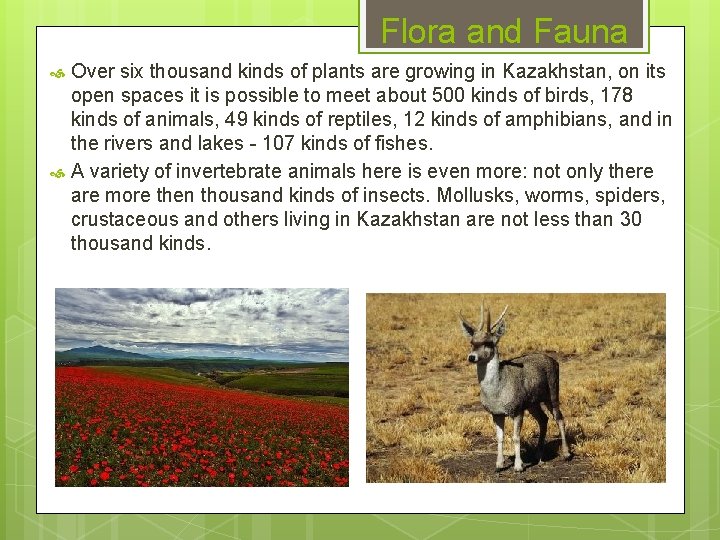
Flora and Fauna Over six thousand kinds of plants are growing in Kazakhstan, on its open spaces it is possible to meet about 500 kinds of birds, 178 kinds of animals, 49 kinds of reptiles, 12 kinds of amphibians, and in the rivers and lakes - 107 kinds of fishes. A variety of invertebrate animals here is even more: not only there are more then thousand kinds of insects. Mollusks, worms, spiders, crustaceous and others living in Kazakhstan are not less than 30 thousand kinds.
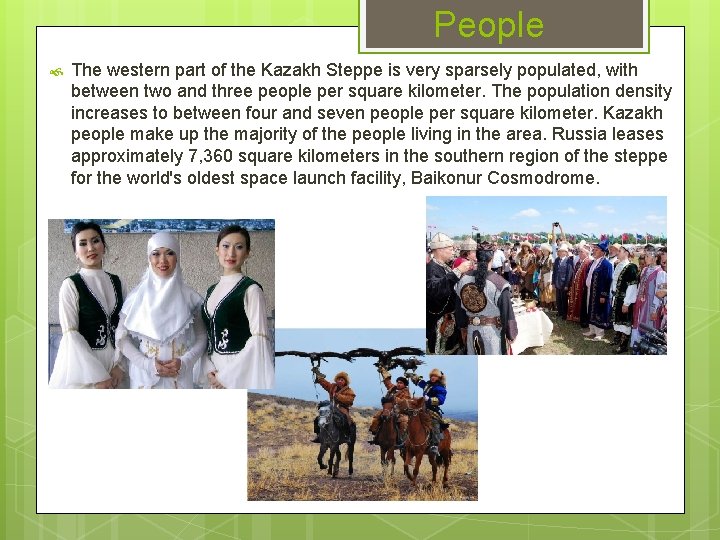
People The western part of the Kazakh Steppe is very sparsely populated, with between two and three people per square kilometer. The population density increases to between four and seven people per square kilometer. Kazakh people make up the majority of the people living in the area. Russia leases approximately 7, 360 square kilometers in the southern region of the steppe for the world's oldest space launch facility, Baikonur Cosmodrome.