THE HISTORY OF ASTRONOMY Developing a Model of
- Slides: 10
THE HISTORY OF ASTRONOMY Developing a Model of the Solar System
BABYLONIANS About 1600 B. C. § Recorded position of planets § Times of eclipses Early Chinese, Central American, and North European cultures show evidence of studying astronomy
ANCIENT GREEKS Thales § Used Babylonian data to predict eclipses Eratosthenes § Measured the circumference of the Earth Hipparchus § Produced first star catalog and recorded the names of constellations
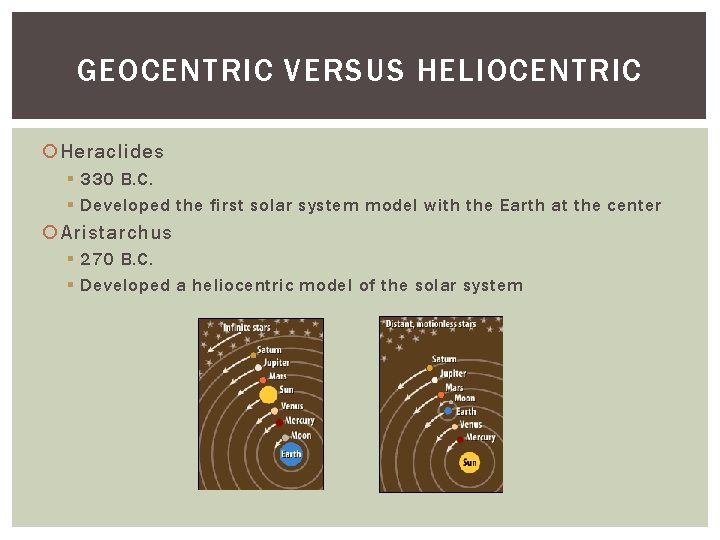
GEOCENTRIC VERSUS HELIOCENTRIC Heraclides § 330 B. C. § Developed the first solar system model with the Earth at the center Aristarchus § 270 B. C. § Developed a heliocentric model of the solar system
PTOLEMY 200 A. D. Librarian of Alexandria Believed Heraclides’ geocentric model of the solar system to be correct His model seemed to adequately explain the motion of the planets, but it was complicated.
COPERNICUS 1500’s Believed in the heliocentric model of the solar system The Heliocentric model was not popular with the church
TYCHO BRAHE 1580’S Built the Danish Observatory Measured positions of planets and stars Showed that the sun was much farther from the Earth than the moon is
KEPLER 1600’s Brahe’s student § Used Brahe’s data to formulate Laws of Planetary Motion § Used elliptical orbits instead of circular orbits
GALILEO 1620’s § Developed laws of motion § Natural versus forced § Rest versus uniform motion Used a telescope to discover § § § Spots on the sun Mountains and “seas” on the moon Multiple stars in the Milky Way Phases of Venus Jupiter’s moons
NEWTON 1680’s Developed the law of universal gravitation Developed the first reflecting telescope