The French Revolution So What is Happening in
- Slides: 23
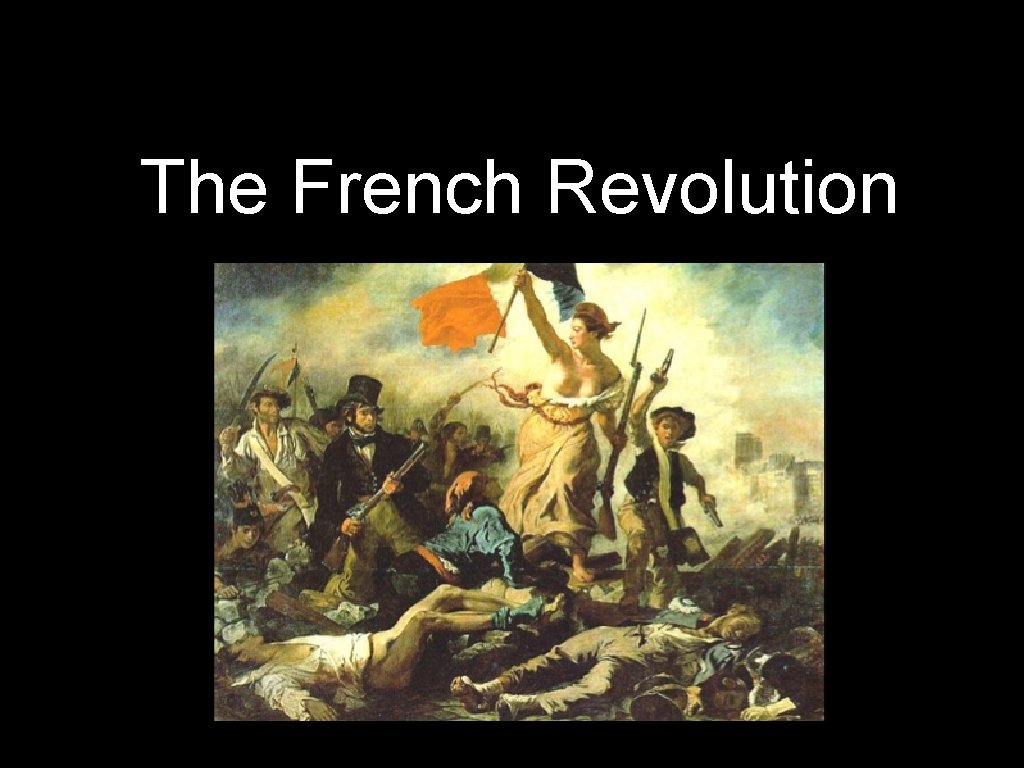
The French Revolution
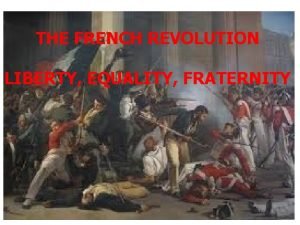
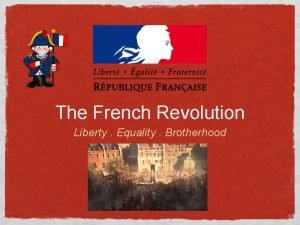
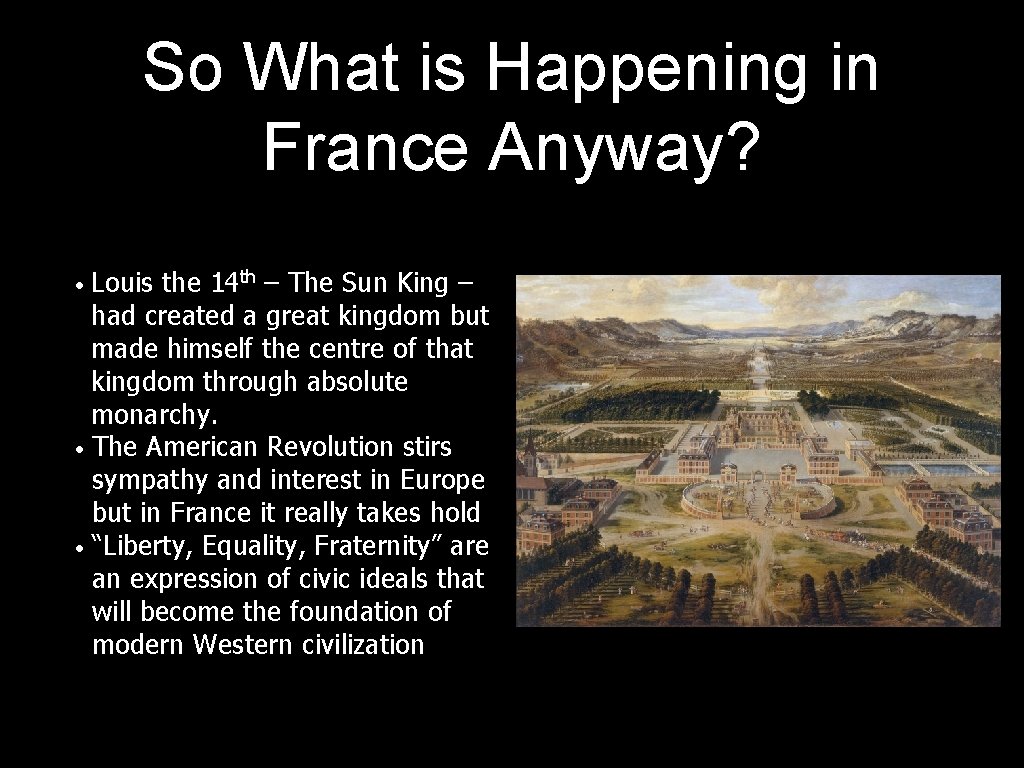
So What is Happening in France Anyway? Louis the 14 th – The Sun King – had created a great kingdom but made himself the centre of that kingdom through absolute monarchy. • The American Revolution stirs sympathy and interest in Europe but in France it really takes hold • “Liberty, Equality, Fraternity” are an expression of civic ideals that will become the foundation of modern Western civilization •
What were they fighting for? • Those who made the Revolution possible believed they were rising up against a despotic government that gave no voice to it’s people • Ironically, France’s government is really no different than most other governments in Europe at the time • Louis XVI is a good natured king but is viewed as weak and indecisive and image is important! • Marie Antionette his wife was a Hapsburg princess who was frivolous, tactless and had a habit of being meddlesome • While these a precipitating factors they aren’t the cause of the French Revolution
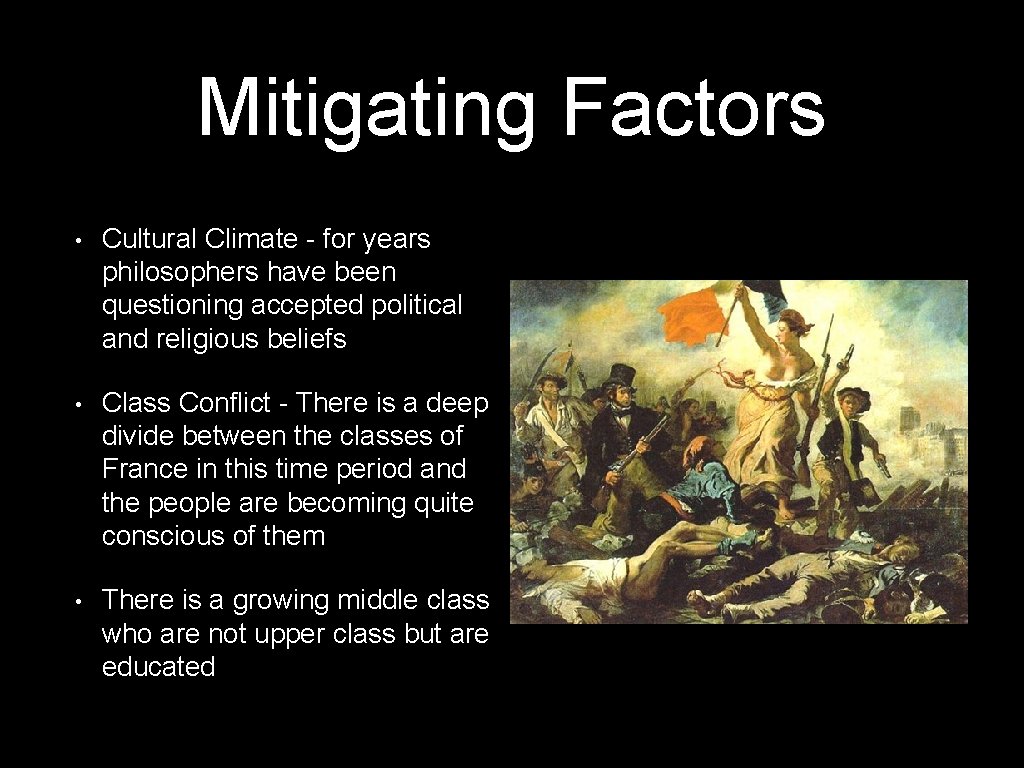
Mitigating Factors • Cultural Climate - for years philosophers have been questioning accepted political and religious beliefs • Class Conflict - There is a deep divide between the classes of France in this time period and the people are becoming quite conscious of them • There is a growing middle class who are not upper class but are educated
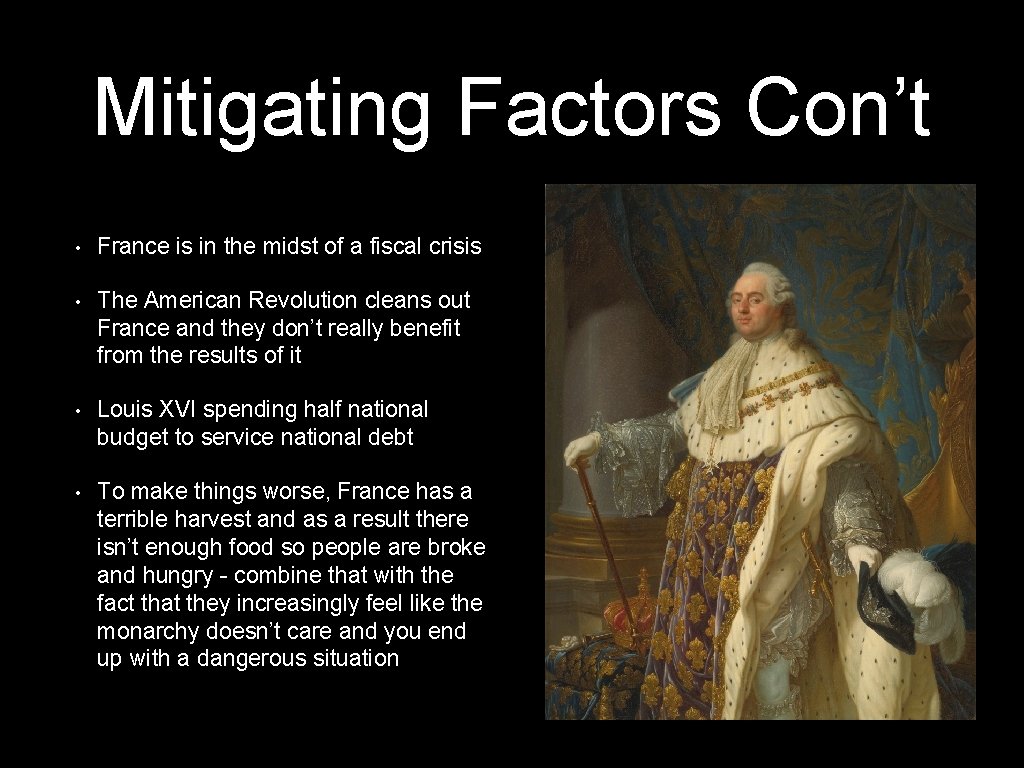
Mitigating Factors Con’t • France is in the midst of a fiscal crisis • The American Revolution cleans out France and they don’t really benefit from the results of it • Louis XVI spending half national budget to service national debt • To make things worse, France has a terrible harvest and as a result there isn’t enough food so people are broke and hungry - combine that with the fact that they increasingly feel like the monarchy doesn’t care and you end up with a dangerous situation
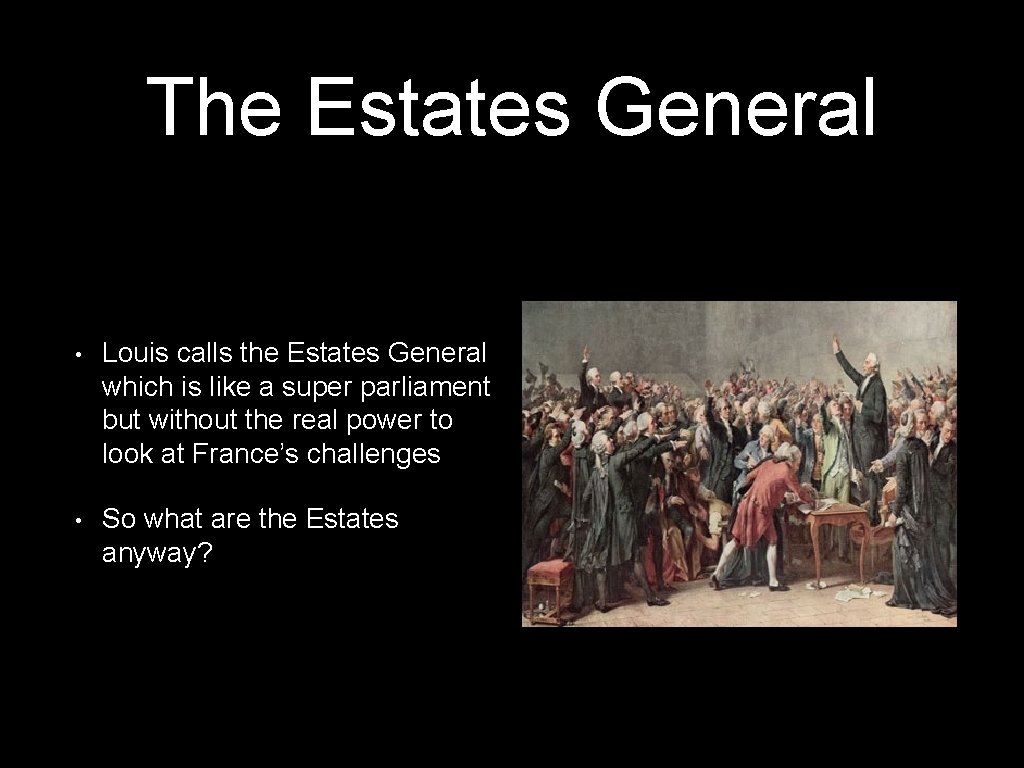
The Estates General • Louis calls the Estates General which is like a super parliament but without the real power to look at France’s challenges • So what are the Estates anyway?
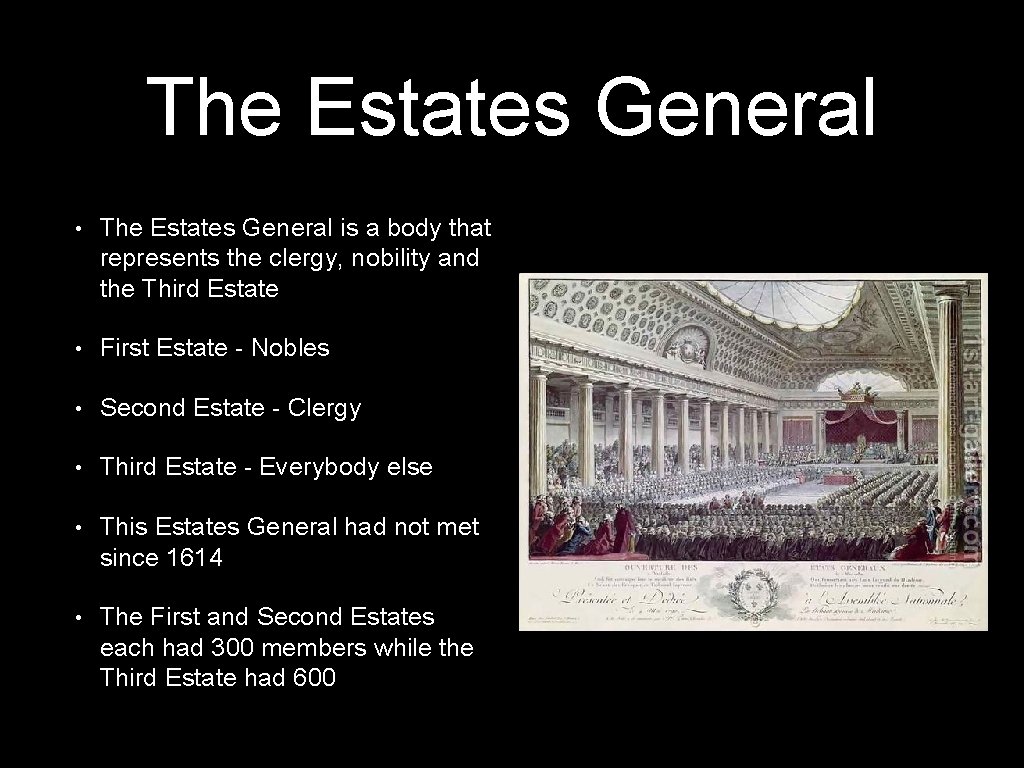
The Estates General • The Estates General is a body that represents the clergy, nobility and the Third Estate • First Estate - Nobles • Second Estate - Clergy • Third Estate - Everybody else • This Estates General had not met since 1614 • The First and Second Estates each had 300 members while the Third Estate had 600
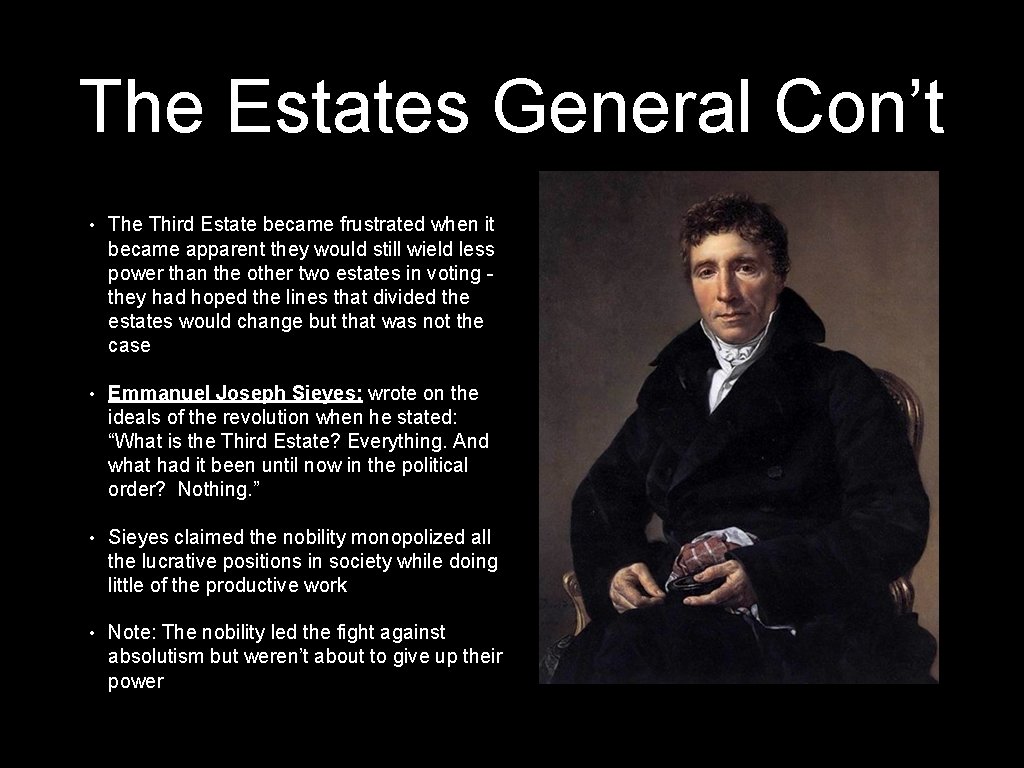
The Estates General Con’t • The Third Estate became frustrated when it became apparent they would still wield less power than the other two estates in voting they had hoped the lines that divided the estates would change but that was not the case • Emmanuel Joseph Sieyes: wrote on the ideals of the revolution when he stated: “What is the Third Estate? Everything. And what had it been until now in the political order? Nothing. ” • Sieyes claimed the nobility monopolized all the lucrative positions in society while doing little of the productive work • Note: The nobility led the fight against absolutism but weren’t about to give up their power
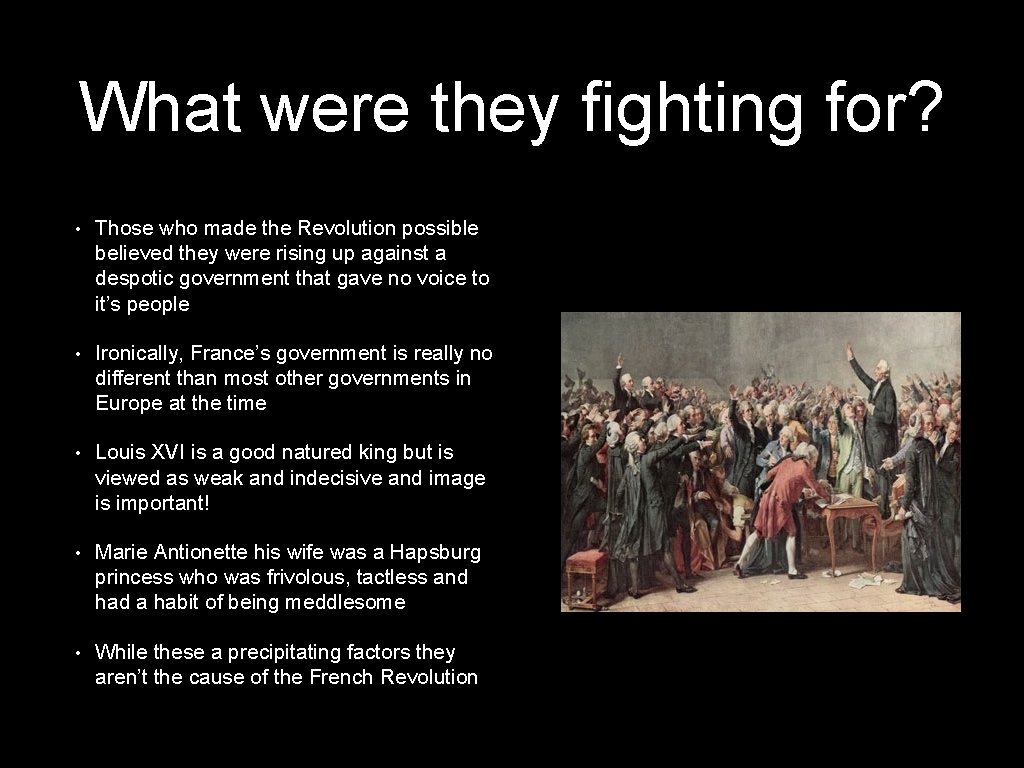
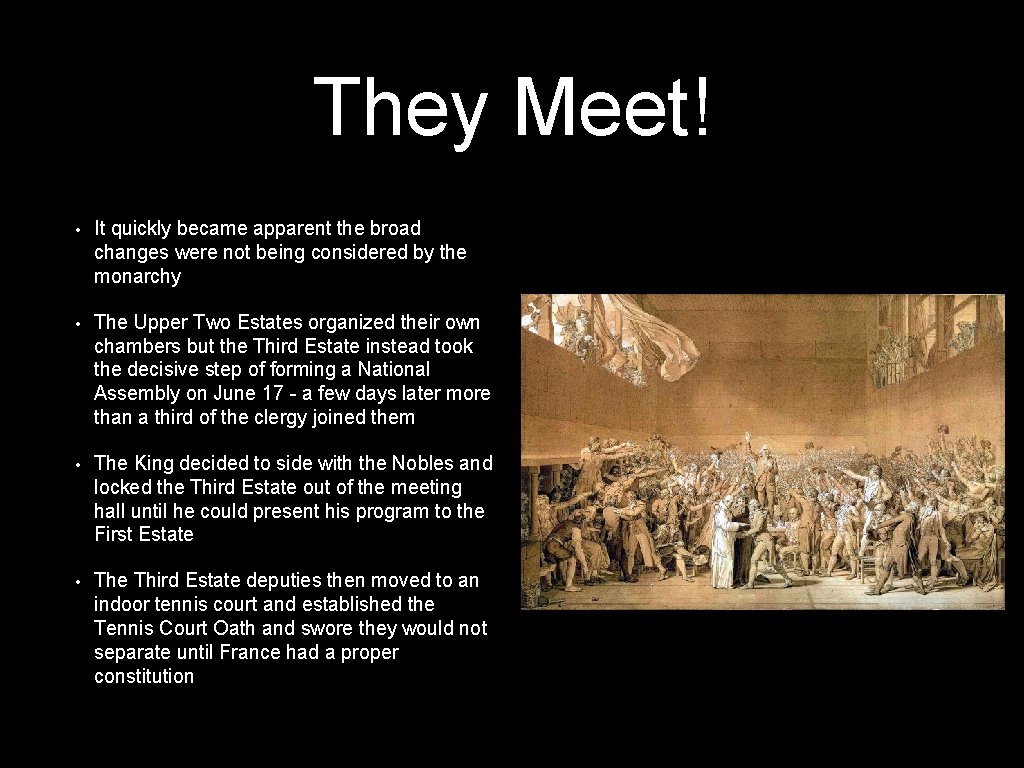
They Meet! • It quickly became apparent the broad changes were not being considered by the monarchy • The Upper Two Estates organized their own chambers but the Third Estate instead took the decisive step of forming a National Assembly on June 17 - a few days later more than a third of the clergy joined them • The King decided to side with the Nobles and locked the Third Estate out of the meeting hall until he could present his program to the First Estate • The Third Estate deputies then moved to an indoor tennis court and established the Tennis Court Oath and swore they would not separate until France had a proper constitution
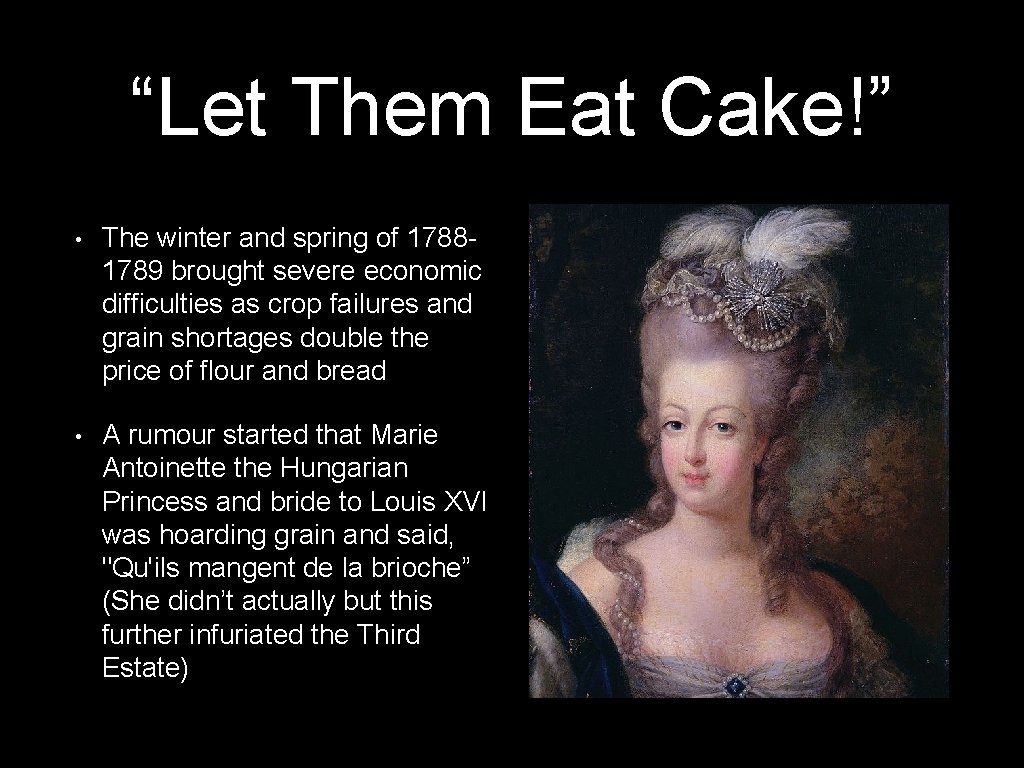
“Let Them Eat Cake!” • The winter and spring of 17881789 brought severe economic difficulties as crop failures and grain shortages double the price of flour and bread • A rumour started that Marie Antoinette the Hungarian Princess and bride to Louis XVI was hoarding grain and said, "Qu'ils mangent de la brioche” (She didn’t actually but this further infuriated the Third Estate)
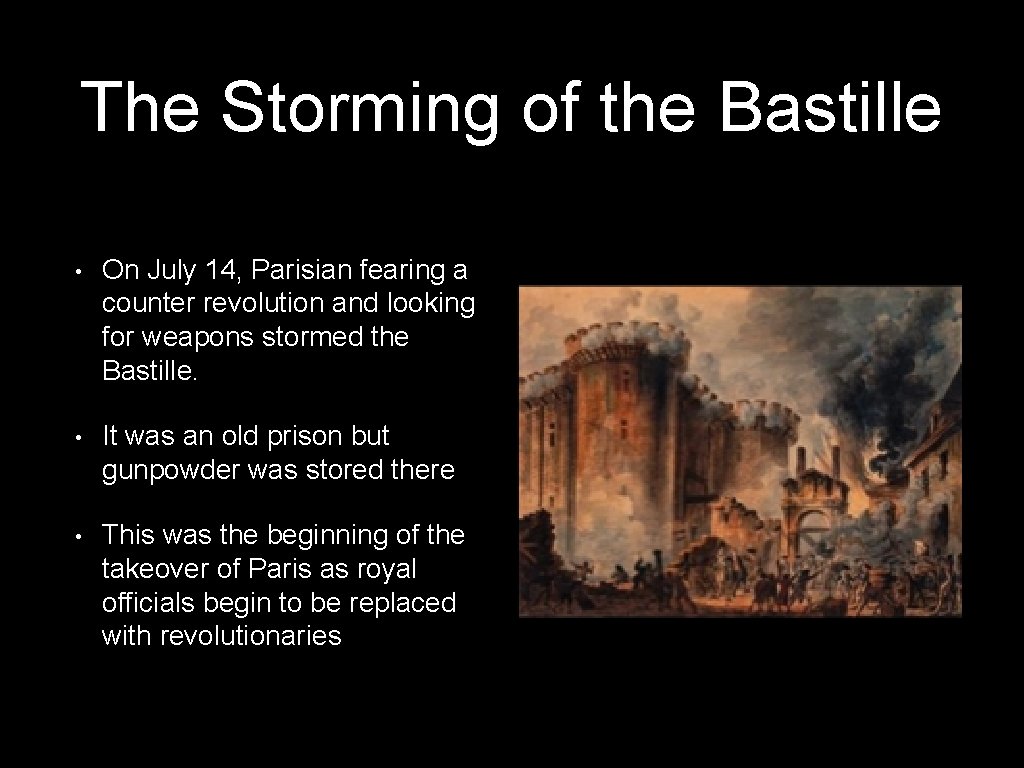
The Storming of the Bastille • On July 14, Parisian fearing a counter revolution and looking for weapons stormed the Bastille. • It was an old prison but gunpowder was stored there • This was the beginning of the takeover of Paris as royal officials begin to be replaced with revolutionaries
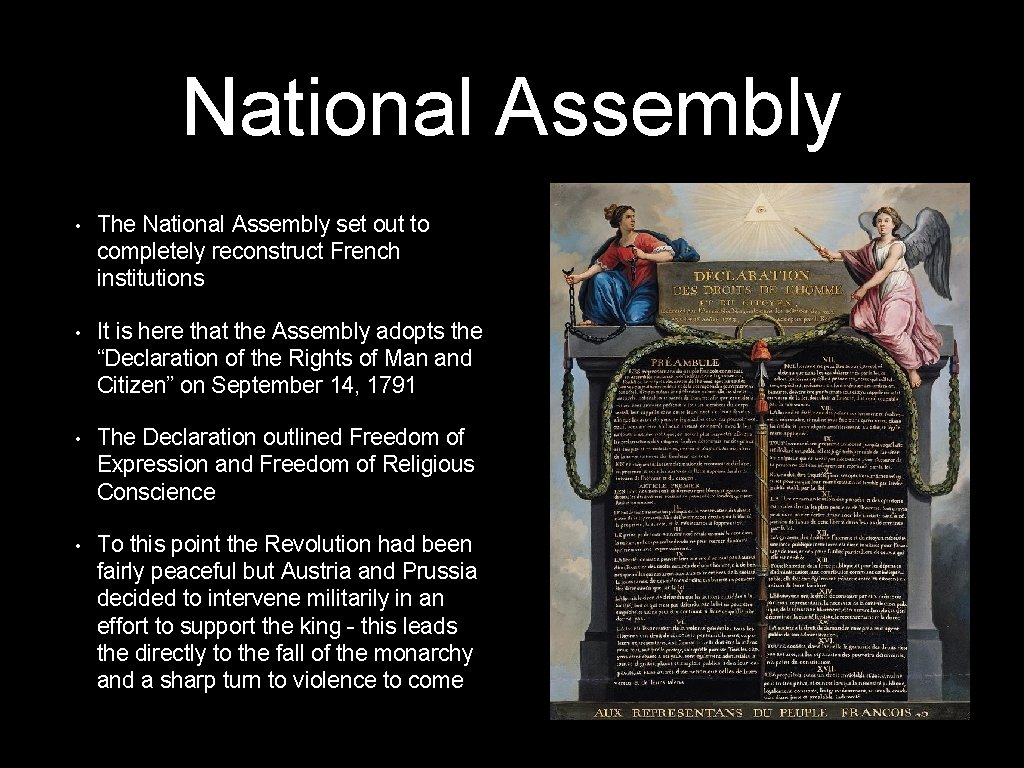
National Assembly • The National Assembly set out to completely reconstruct French institutions • It is here that the Assembly adopts the “Declaration of the Rights of Man and Citizen” on September 14, 1791 • The Declaration outlined Freedom of Expression and Freedom of Religious Conscience • To this point the Revolution had been fairly peaceful but Austria and Prussia decided to intervene militarily in an effort to support the king - this leads the directly to the fall of the monarchy and a sharp turn to violence to come
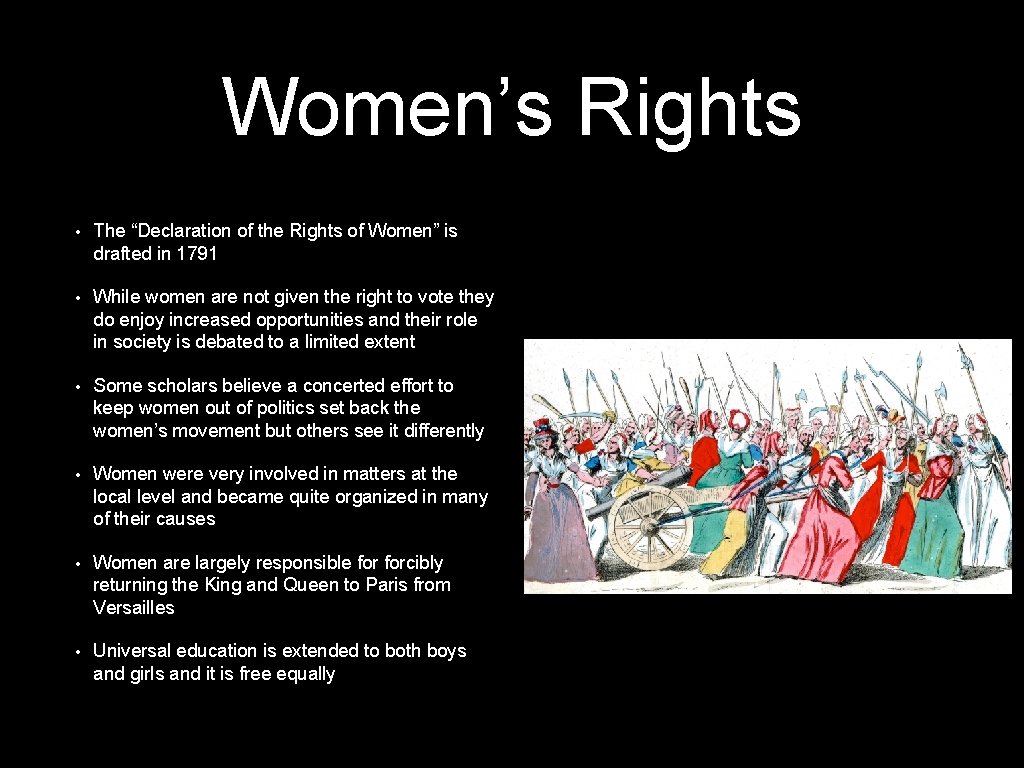
Women’s Rights • The “Declaration of the Rights of Women” is drafted in 1791 • While women are not given the right to vote they do enjoy increased opportunities and their role in society is debated to a limited extent • Some scholars believe a concerted effort to keep women out of politics set back the women’s movement but others see it differently • Women were very involved in matters at the local level and became quite organized in many of their causes • Women are largely responsible forcibly returning the King and Queen to Paris from Versailles • Universal education is extended to both boys and girls and it is free equally
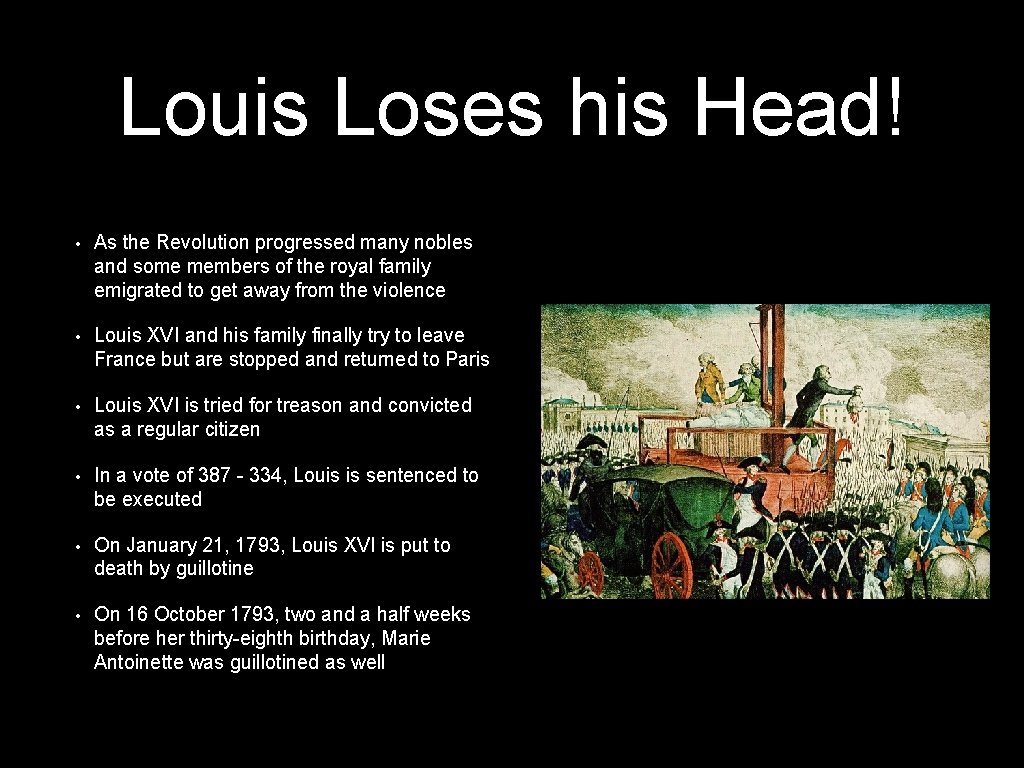
Louis Loses his Head! • As the Revolution progressed many nobles and some members of the royal family emigrated to get away from the violence • Louis XVI and his family finally try to leave France but are stopped and returned to Paris • Louis XVI is tried for treason and convicted as a regular citizen • In a vote of 387 - 334, Louis is sentenced to be executed • On January 21, 1793, Louis XVI is put to death by guillotine • On 16 October 1793, two and a half weeks before her thirty-eighth birthday, Marie Antoinette was guillotined as well
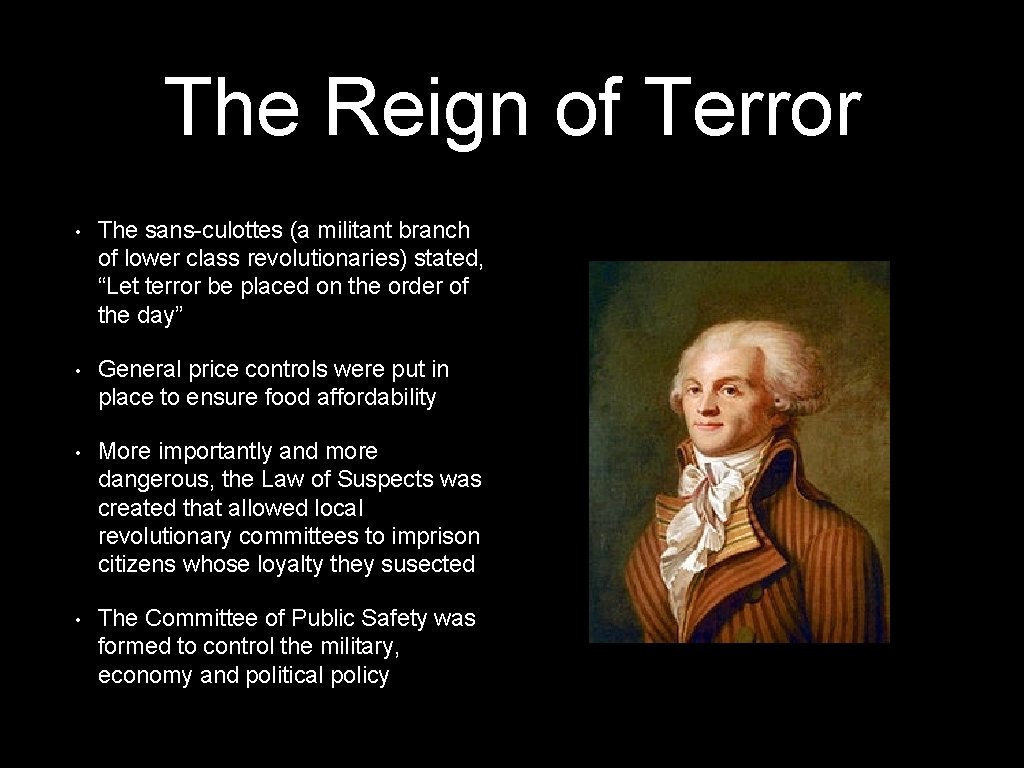
The Reign of Terror • The sans-culottes (a militant branch of lower class revolutionaries) stated, “Let terror be placed on the order of the day” • General price controls were put in place to ensure food affordability • More importantly and more dangerous, the Law of Suspects was created that allowed local revolutionary committees to imprison citizens whose loyalty they susected • The Committee of Public Safety was formed to control the military, economy and political policy
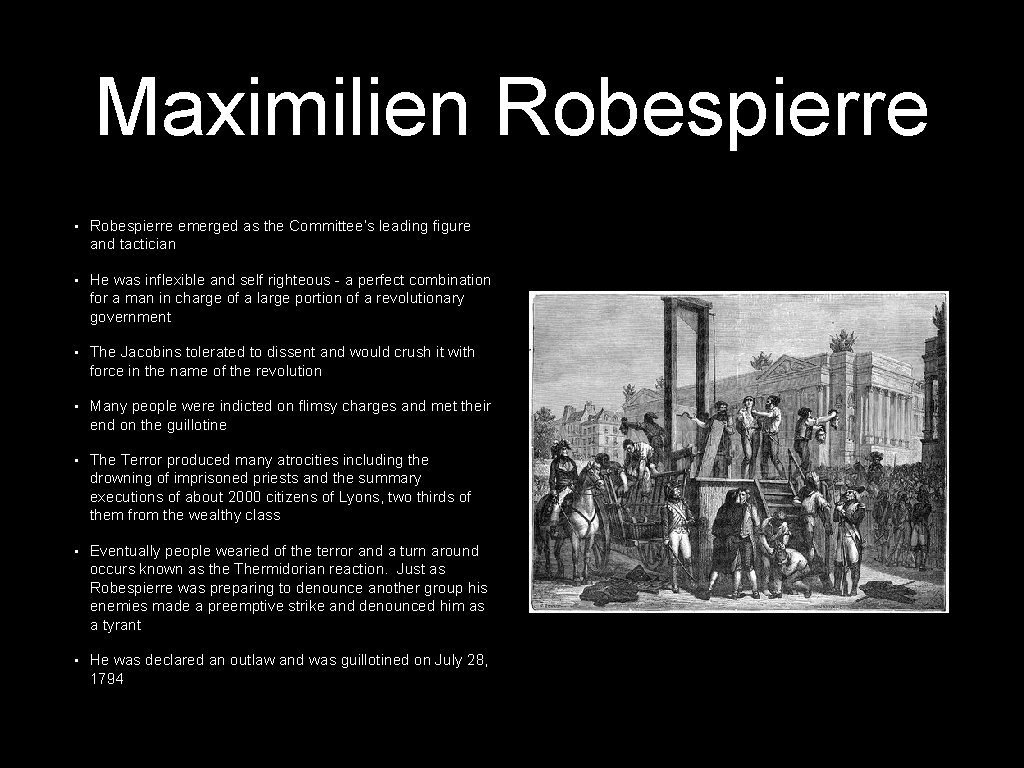
Maximilien Robespierre • Robespierre emerged as the Committee’s leading figure and tactician • He was inflexible and self righteous - a perfect combination for a man in charge of a large portion of a revolutionary government • The Jacobins tolerated to dissent and would crush it with force in the name of the revolution • Many people were indicted on flimsy charges and met their end on the guillotine • The Terror produced many atrocities including the drowning of imprisoned priests and the summary executions of about 2000 citizens of Lyons, two thirds of them from the wealthy class • Eventually people wearied of the terror and a turn around occurs known as the Thermidorian reaction. Just as Robespierre was preparing to denounce another group his enemies made a preemptive strike and denounced him as a tyrant • He was declared an outlaw and was guillotined on July 28, 1794
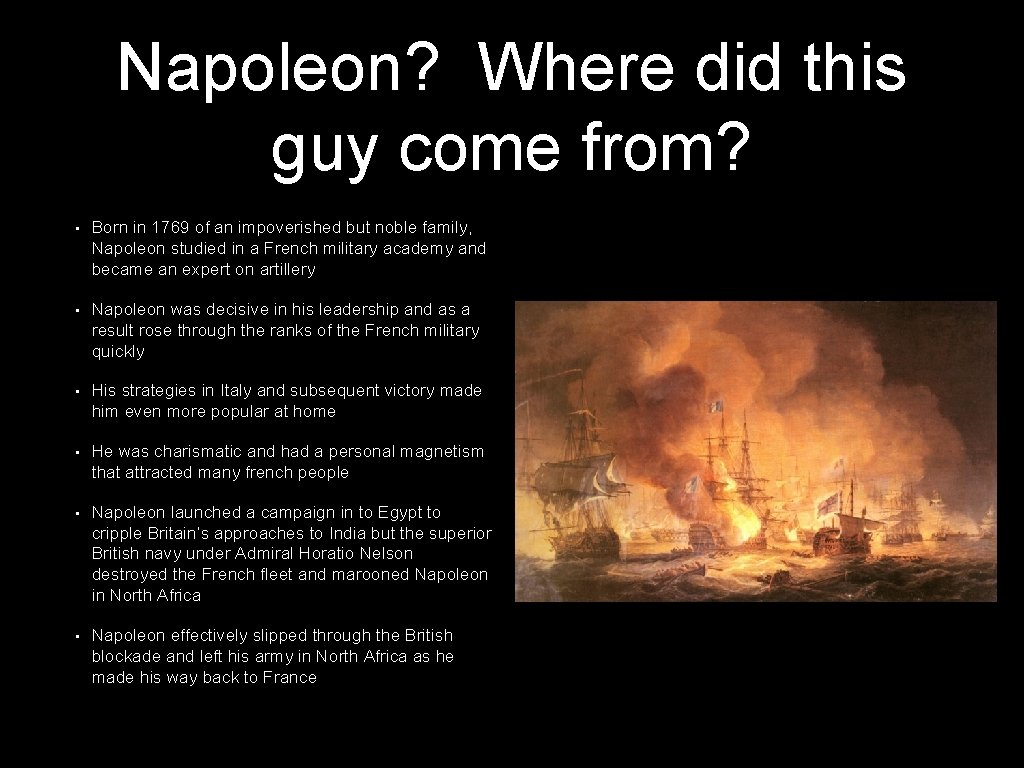
Napoleon? Where did this guy come from? • Born in 1769 of an impoverished but noble family, Napoleon studied in a French military academy and became an expert on artillery • Napoleon was decisive in his leadership and as a result rose through the ranks of the French military quickly • His strategies in Italy and subsequent victory made him even more popular at home • He was charismatic and had a personal magnetism that attracted many french people • Napoleon launched a campaign in to Egypt to cripple Britain’s approaches to India but the superior British navy under Admiral Horatio Nelson destroyed the French fleet and marooned Napoleon in North Africa • Napoleon effectively slipped through the British blockade and left his army in North Africa as he made his way back to France
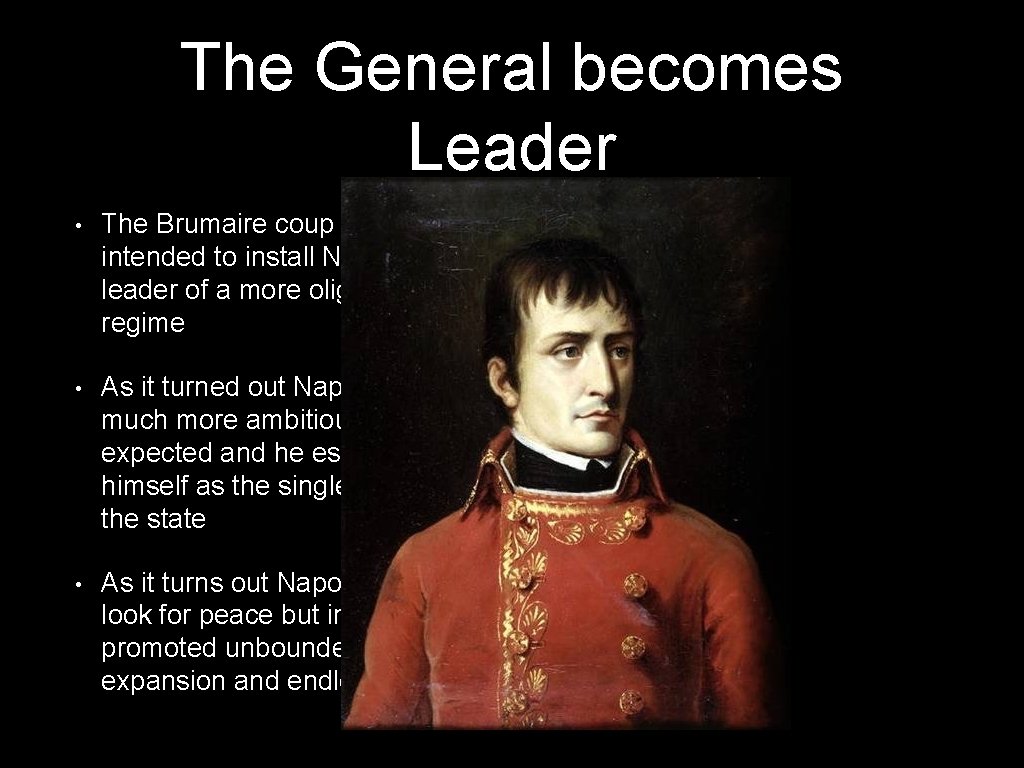
The General becomes Leader • The Brumaire coup was intended to install Napoleon as leader of a more oligarchic regime • As it turned out Napoleon was much more ambitious than they expected and he established himself as the single leader of the state • As it turns out Napoleon did not look for peace but instead he promoted unbounded expansion and endless warfare
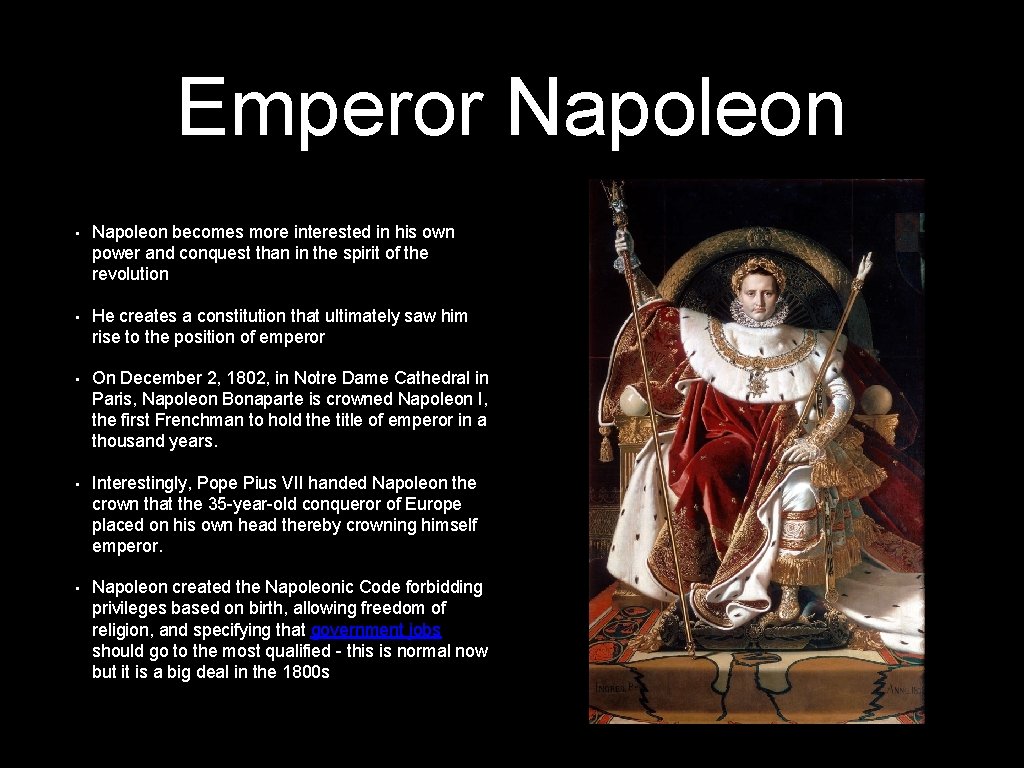
Emperor Napoleon • Napoleon becomes more interested in his own power and conquest than in the spirit of the revolution • He creates a constitution that ultimately saw him rise to the position of emperor • On December 2, 1802, in Notre Dame Cathedral in Paris, Napoleon Bonaparte is crowned Napoleon I, the first Frenchman to hold the title of emperor in a thousand years. • Interestingly, Pope Pius VII handed Napoleon the crown that the 35 -year-old conqueror of Europe placed on his own head thereby crowning himself emperor. • Napoleon created the Napoleonic Code forbidding privileges based on birth, allowing freedom of religion, and specifying that government jobs should go to the most qualified - this is normal now but it is a big deal in the 1800 s
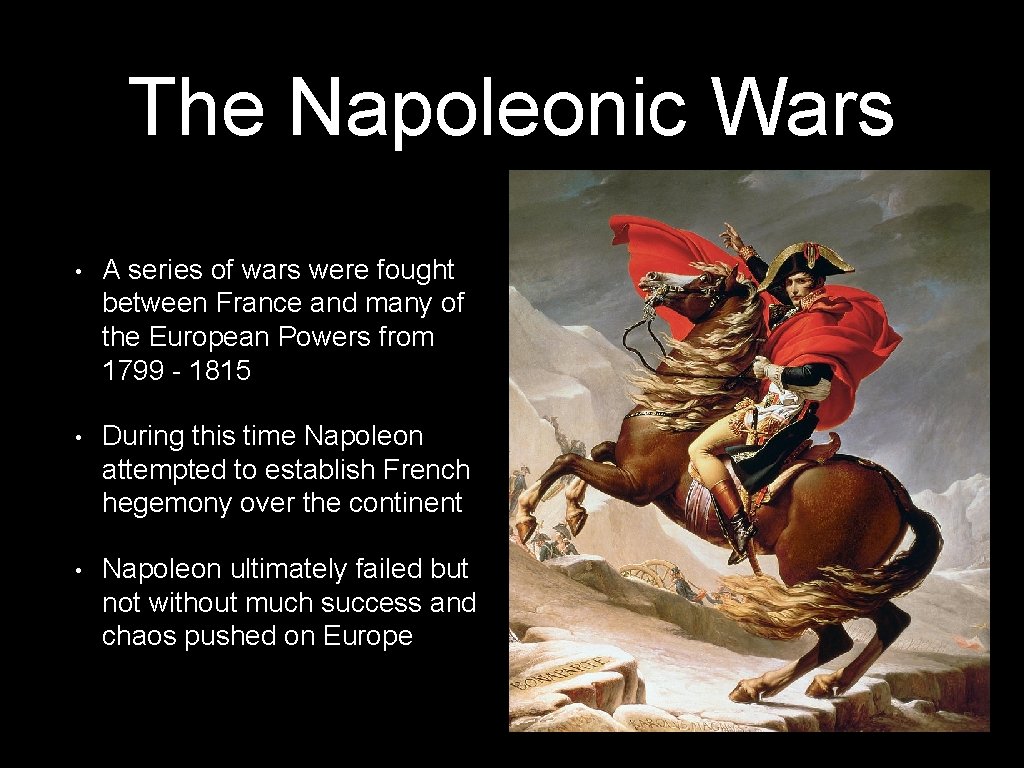
The Napoleonic Wars • A series of wars were fought between France and many of the European Powers from 1799 - 1815 • During this time Napoleon attempted to establish French hegemony over the continent • Napoleon ultimately failed but not without much success and chaos pushed on Europe
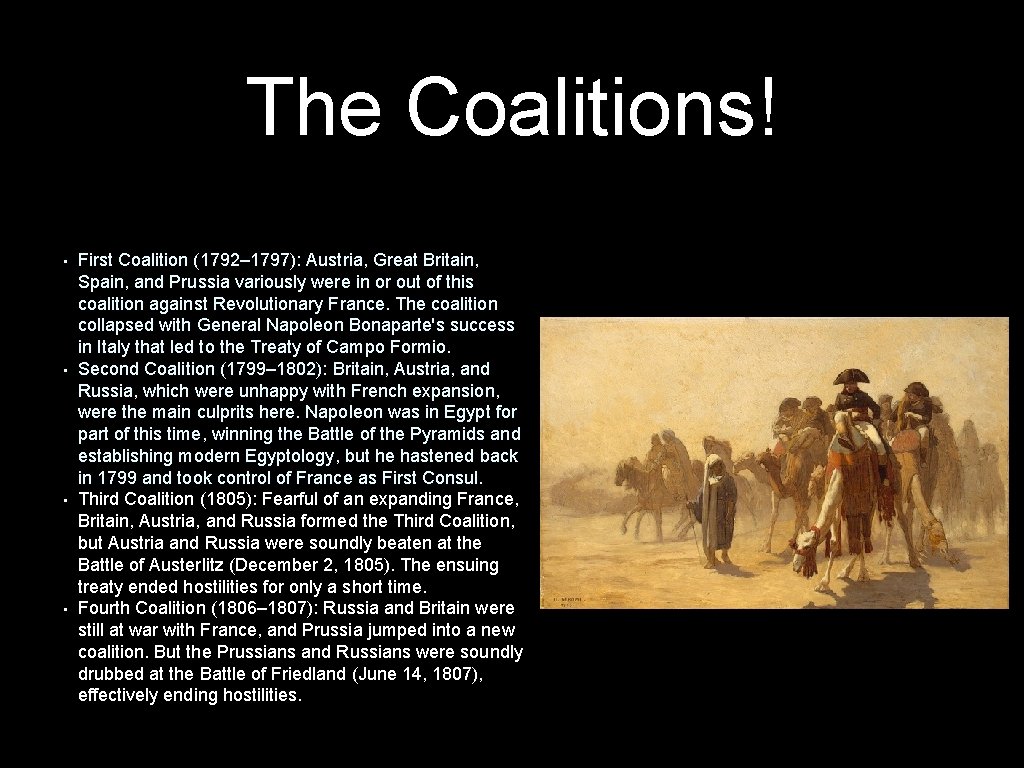
The Coalitions! • • First Coalition (1792– 1797): Austria, Great Britain, Spain, and Prussia variously were in or out of this coalition against Revolutionary France. The coalition collapsed with General Napoleon Bonaparte's success in Italy that led to the Treaty of Campo Formio. Second Coalition (1799– 1802): Britain, Austria, and Russia, which were unhappy with French expansion, were the main culprits here. Napoleon was in Egypt for part of this time, winning the Battle of the Pyramids and establishing modern Egyptology, but he hastened back in 1799 and took control of France as First Consul. Third Coalition (1805): Fearful of an expanding France, Britain, Austria, and Russia formed the Third Coalition, but Austria and Russia were soundly beaten at the Battle of Austerlitz (December 2, 1805). The ensuing treaty ended hostilities for only a short time. Fourth Coalition (1806– 1807): Russia and Britain were still at war with France, and Prussia jumped into a new coalition. But the Prussians and Russians were soundly drubbed at the Battle of Friedland (June 14, 1807), effectively ending hostilities.
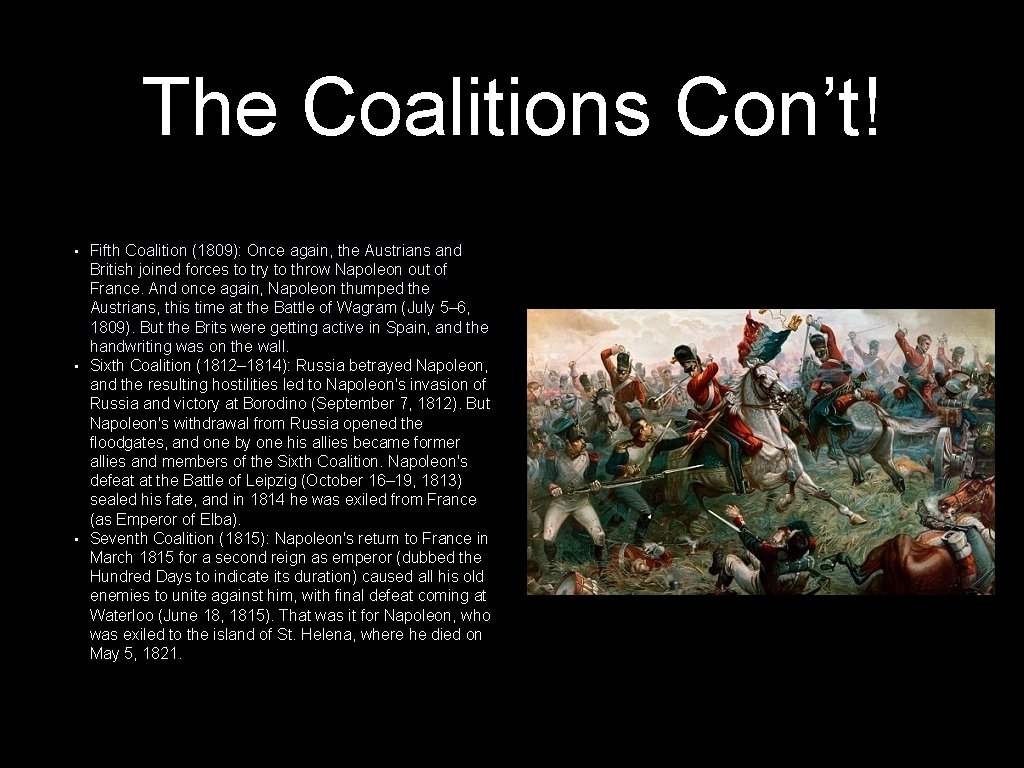
The Coalitions Con’t! • • • Fifth Coalition (1809): Once again, the Austrians and British joined forces to try to throw Napoleon out of France. And once again, Napoleon thumped the Austrians, this time at the Battle of Wagram (July 5– 6, 1809). But the Brits were getting active in Spain, and the handwriting was on the wall. Sixth Coalition (1812– 1814): Russia betrayed Napoleon, and the resulting hostilities led to Napoleon's invasion of Russia and victory at Borodino (September 7, 1812). But Napoleon's withdrawal from Russia opened the floodgates, and one by one his allies became former allies and members of the Sixth Coalition. Napoleon's defeat at the Battle of Leipzig (October 16– 19, 1813) sealed his fate, and in 1814 he was exiled from France (as Emperor of Elba). Seventh Coalition (1815): Napoleon's return to France in March 1815 for a second reign as emperor (dubbed the Hundred Days to indicate its duration) caused all his old enemies to unite against him, with final defeat coming at Waterloo (June 18, 1815). That was it for Napoleon, who was exiled to the island of St. Helena, where he died on May 5, 1821.
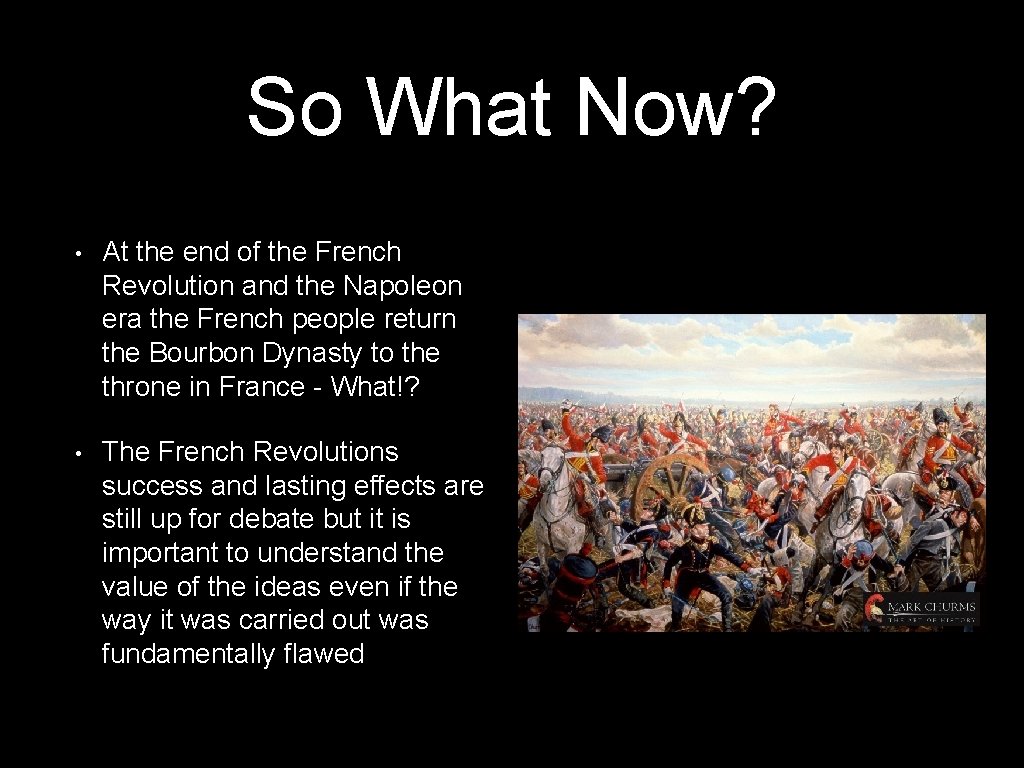
So What Now? • At the end of the French Revolution and the Napoleon era the French people return the Bourbon Dynasty to the throne in France - What!? • The French Revolutions success and lasting effects are still up for debate but it is important to understand the value of the ideas even if the way it was carried out was fundamentally flawed