
What is a Revolution Revolution A drastic sudden
- Slides: 34
What is a Revolution?
Revolution ‘A drastic, sudden substitution of one group in charge of a territorial political entity by another group hitherto not running that government. ’ (Crane Brinton, The Anatomy of Revolution, p. 4)
Revolution In other words… The (usually) violent attempt by many people to end the rule of one government and start a new one
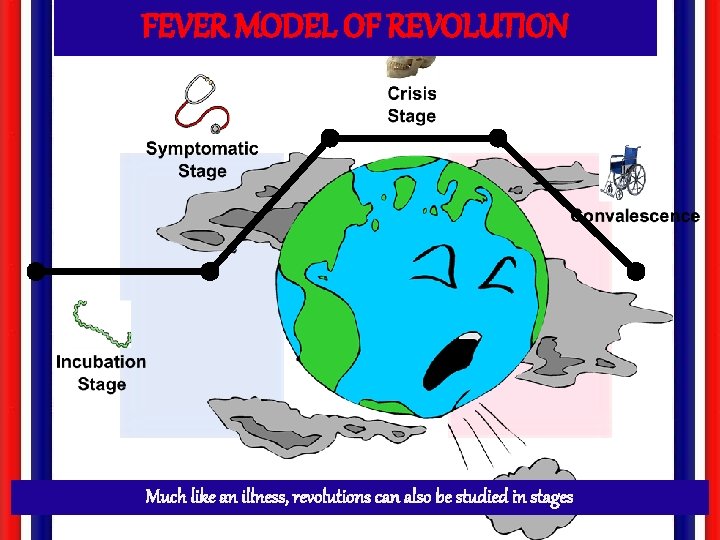
Crane Brinton’s Anatomy of a Revolution • He borrowed his terms from pathology. • Compares a revolution to a disease.
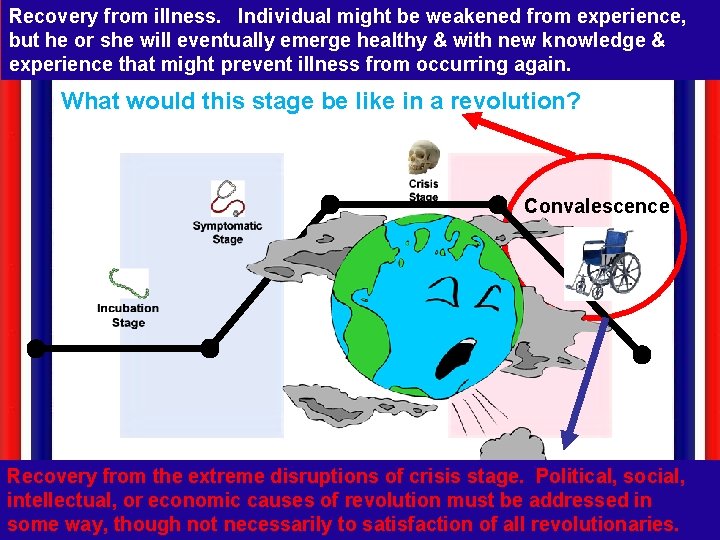
FEVER MODEL OF REVOLUTION Much like an illness, revolutions can also be studied in stages
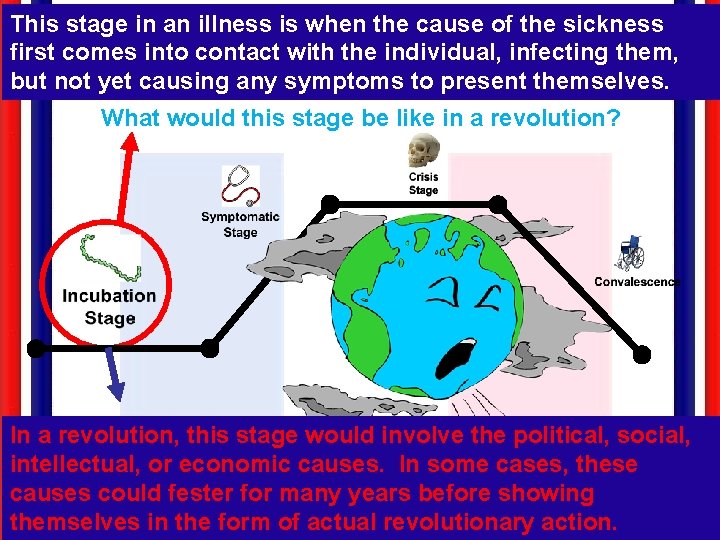
This stage in an illness is when the cause of the sickness first comes into contact with the individual, infecting them, but not yet causing any symptoms to present themselves. What would this stage be like in a revolution? In a revolution, this stage would involve the political, social, intellectual, or economic causes. In some cases, these causes could fester for many years before showing themselves in the form of actual revolutionary action.
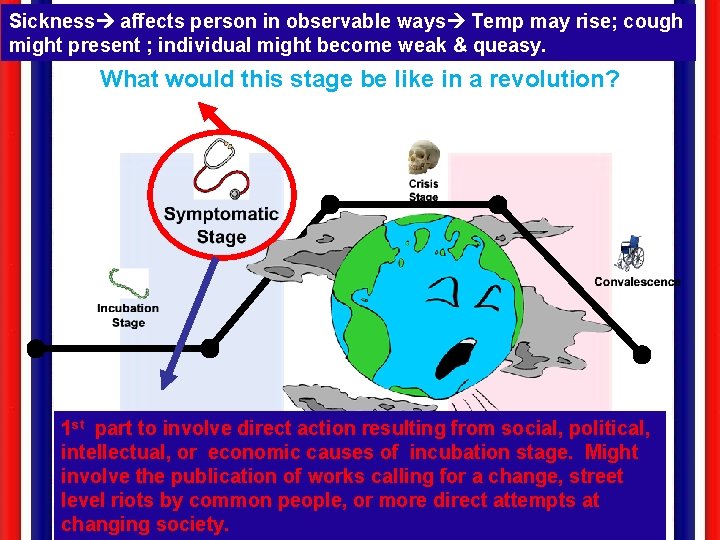
Sickness affects person in observable ways Temp may rise; cough might present ; individual might become weak & queasy. What would this stage be like in a revolution? 1 st part to involve direct action resulting from social, political, intellectual, or economic causes of incubation stage. Might involve the publication of works calling for a change, street level riots by common people, or more direct attempts at changing society.
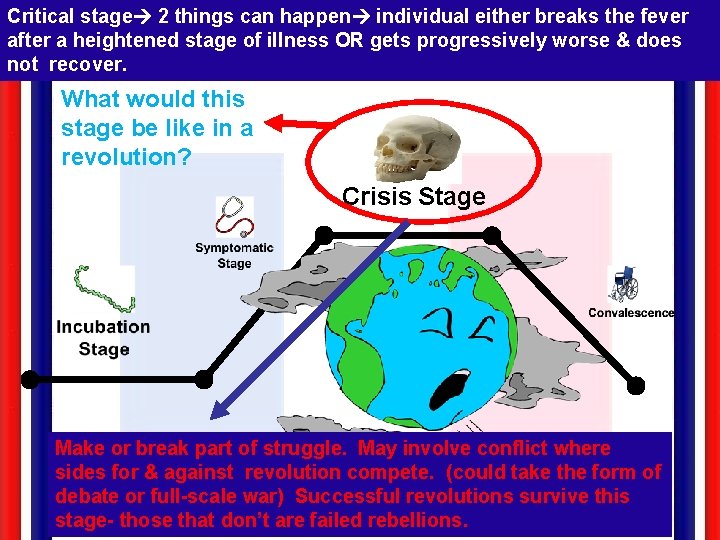
Critical stage 2 things can happen individual either breaks the fever after a heightened stage of illness OR gets progressively worse & does not recover. What would this stage be like in a revolution? Crisis Stage Make or break part of struggle. May involve conflict where sides for & against revolution compete. (could take the form of debate or full-scale war) Successful revolutions survive this stage- those that don’t are failed rebellions.
Recovery from illness. Individual might be weakened from experience, but he or she will eventually emerge healthy & with new knowledge & experience that might prevent illness from occurring again. What would this stage be like in a revolution? Convalescence Recovery from the extreme disruptions of crisis stage. Political, social, intellectual, or economic causes of revolution must be addressed in some way, though not necessarily to satisfaction of all revolutionaries.
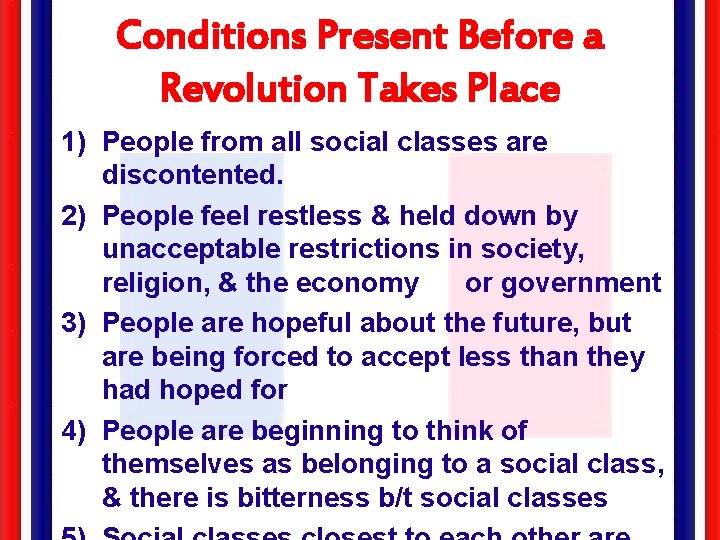
Conditions Present Before a Revolution Takes Place 1) People from all social classes are discontented. 2) People feel restless & held down by unacceptable restrictions in society, religion, & the economy or government 3) People are hopeful about the future, but are being forced to accept less than they had hoped for 4) People are beginning to think of themselves as belonging to a social class, & there is bitterness b/t social classes
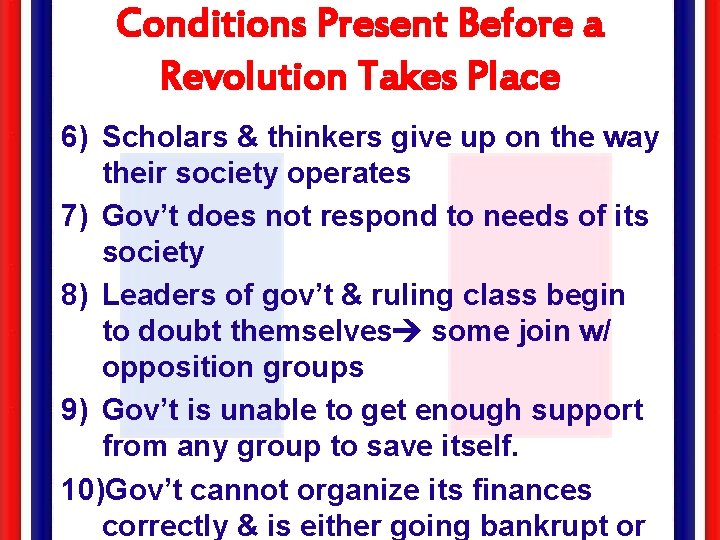
Conditions Present Before a Revolution Takes Place 6) Scholars & thinkers give up on the way their society operates 7) Gov’t does not respond to needs of its society 8) Leaders of gov’t & ruling class begin to doubt themselves some join w/ opposition groups 9) Gov’t is unable to get enough support from any group to save itself. 10)Gov’t cannot organize its finances correctly & is either going bankrupt or
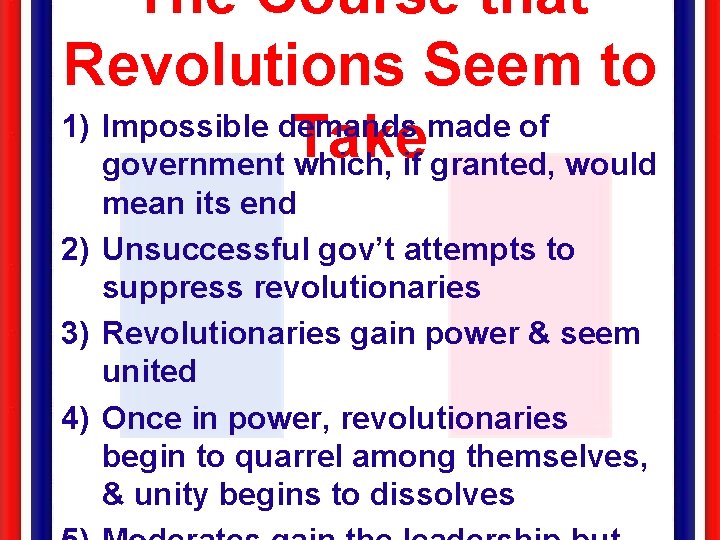
The Course that Revolutions Seem to 1) Impossible demands made of Take government which, if granted, would mean its end 2) Unsuccessful gov’t attempts to suppress revolutionaries 3) Revolutionaries gain power & seem united 4) Once in power, revolutionaries begin to quarrel among themselves, & unity begins to dissolves
The Course that Revolutions Seem to 6) Power is gained by progressively more Take radical groups until finally a lunatic fringe gains almost complete control 7) Strong man emerges & assumes great power 8) Extremists try to create a “heaven-onearth” by introducing their whole program & punishing all of their opponents 9) Period of terror or extreme violence occurs
The French Revolution Application of the Fever Model
Stage 1: Incubation (Causes)
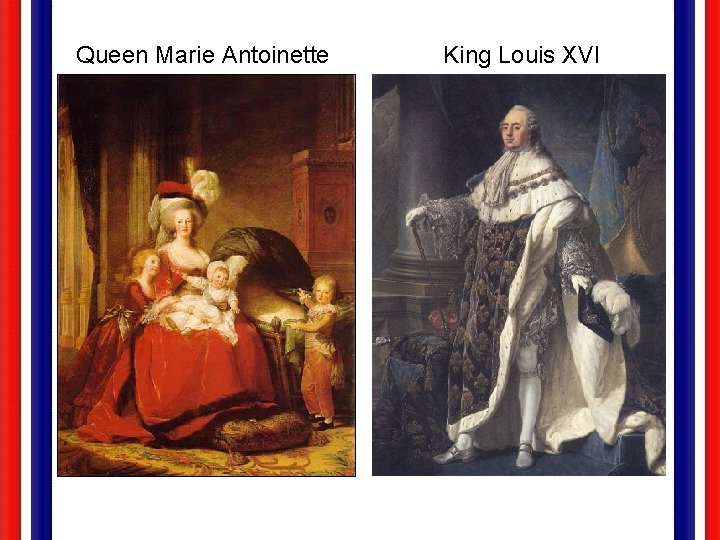
Incubation Stage (Causes) Absolute Monarchy (1) All power rests with one person… the King or Queen • King Louis XVI – Weak leader – Preferred personal interests, delegated authority – Incapable of decisive action
Queen Marie Antoinette King Louis XVI
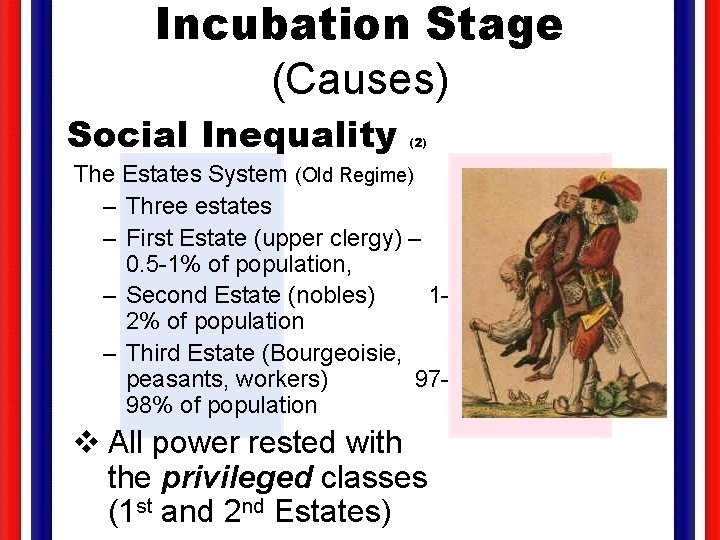
Incubation Stage (Causes) Social Inequality (2) The Estates System (Old Regime) – Three estates – First Estate (upper clergy) – 0. 5 -1% of population, – Second Estate (nobles) 12% of population – Third Estate (Bourgeoisie, peasants, workers) 9798% of population v All power rested with the privileged classes (1 st and 2 nd Estates)
Incubation Stage (Causes) • Economic Inequality (3) – 1 st and 2 nd Estates pay no taxes – 3 rd Estate pay all taxes. They paid between 50 -70% of income in taxes. The privileged classes refused to pay any taxes
Incubation Stage (Causes) Enlightenment Ideas (4) o John Locke –Natural Rights: Every person is entitled to Life, Liberty and Property. It is the Governments job to protect these rights and if they don’t, it is right and just to remove that gov’t o Montesquieu- Believed that when one person has absolute power that government will become corrupt. To ensure a good gov’t it must be split up into 3 branches: Executive (Monarch, President), Legislative (Congress, Parliament) and the Judicial (Independent Court system, Supreme Court). Each branch will be able to “Check” and “Balance” each other so one branch never has absolute power. o Voltaire- Freedom of Speech, Religion… Government must protect these and other individual liberties. o Rousseau- Believed in Direct Democracy and the Social Contract (whereas the people GIVE the power to govern and as long as they govern well, no problem. If they abuse power, vote them out!
Incubation Stage Other Revolutions (Causes) (5) American Revolution (1776 -1783) The French Government helped the colonists gain their Independence from Britain. Leaders in France were able to see Enlightenment ideas being put into place. Glorious Revolution- (1688– 1689) Struggle between the King (James II) and the representative of the people - the Parliament). Constitutional monarchy established in Britain. King ruled only as per the wishes and will of the people.
Stage 2: Symptomatic (Moderate Stage - Symptoms)
Symptomatic Stage (Moderate Stage - Symptoms) Economic Crisis – French economy bankrupt – Huge war debt-- Seven Years War, American War of Independence – Louis XVI’s extravagant lifestyle – Crop failures (famine) – Debt - 1/2 budget goes to interest alone – Bourgeoisie begin questioning King
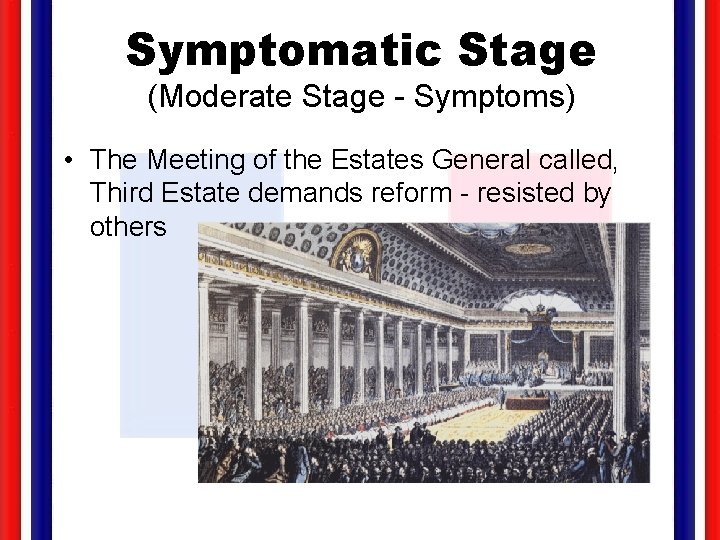
Symptomatic Stage (Moderate Stage - Symptoms) • The Meeting of the Estates General called, Third Estate demands reform - resisted by others
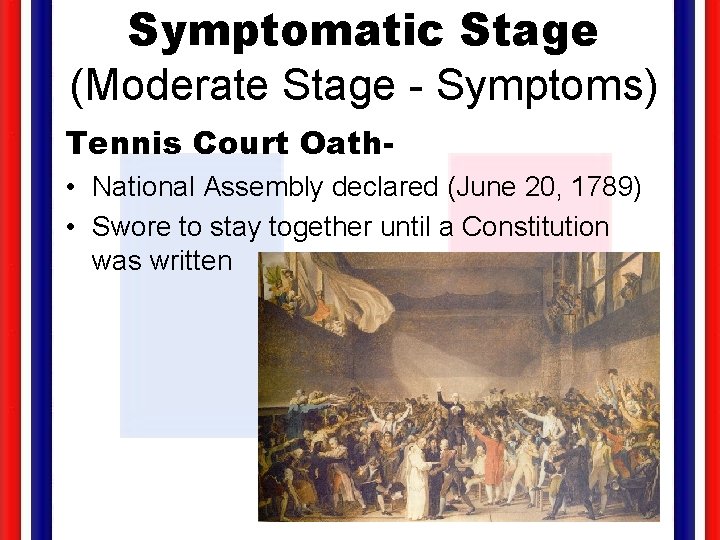
Symptomatic Stage (Moderate Stage - Symptoms) Tennis Court Oath • National Assembly declared (June 20, 1789) • Swore to stay together until a Constitution was written
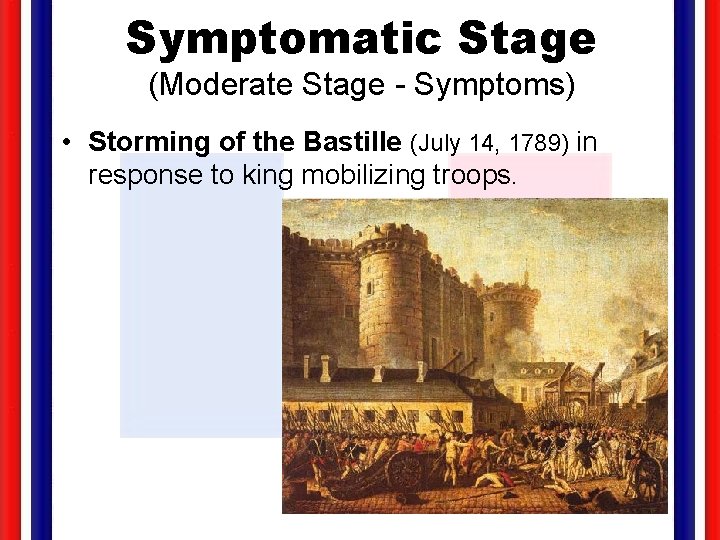
Symptomatic Stage (Moderate Stage - Symptoms) • Storming of the Bastille (July 14, 1789) in response to king mobilizing troops.
Symptomatic Stage (Moderate Stage - Symptoms) • Declaration of the Rights of Man and the Citizen (Aug. , 1789) – Influenced by America – Equality of all men, sovereignty resided in the people, and individual rights to liberty, prosperity, and security • Women’s March on Versailles (Oct. , 1789) – Food protests turn into March to Versailles – King forced to move to Paris
Symptomatic Stage (Moderate Stage - Symptoms) • Reforms of National Assembly – “Liberty, equality, fraternity” - motto – Dismantled feudal system – Seized Church lands – Abolished estates – Creates Constitution of 1791 - limits power of king (constitutional monarchy) – Men of property could vote
Stage 3: Crisis (Radical Stage- Conflict)
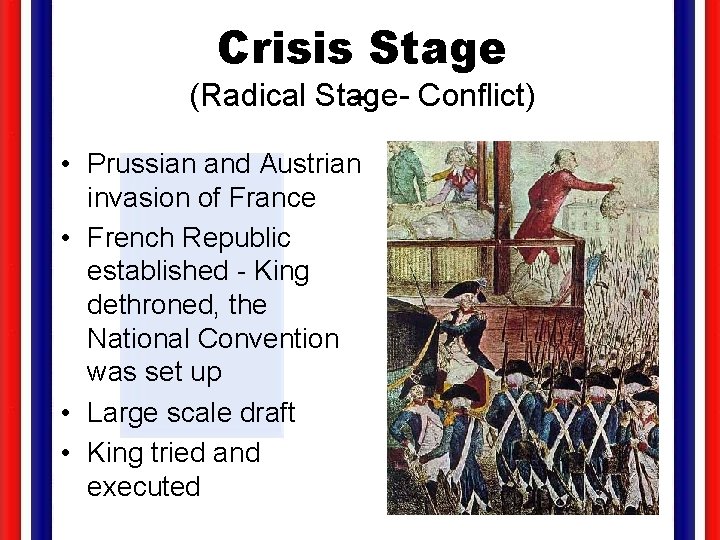
Crisis Stage (Radical Stage- Conflict) • Prussian and Austrian invasion of France • French Republic established - King dethroned, the National Convention was set up • Large scale draft • King tried and executed
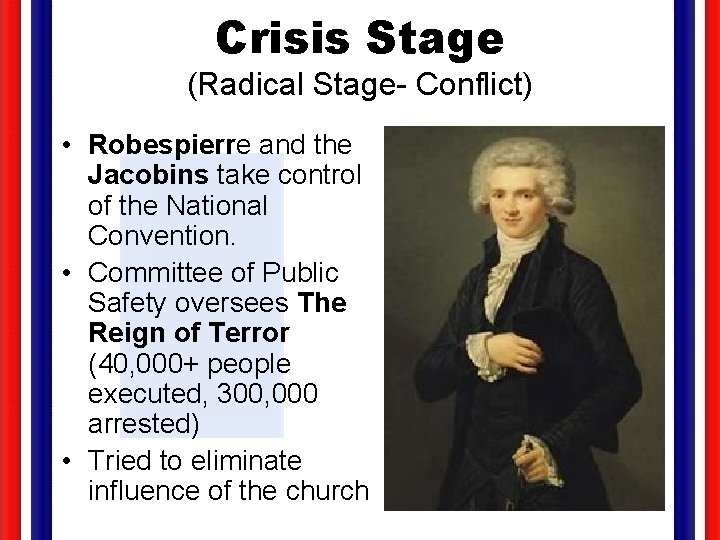
Crisis Stage (Radical Stage- Conflict) • Robespierre and the Jacobins take control of the National Convention. • Committee of Public Safety oversees The Reign of Terror (40, 000+ people executed, 300, 000 arrested) • Tried to eliminate influence of the church
Stage 4: Convalescence (Recovery)
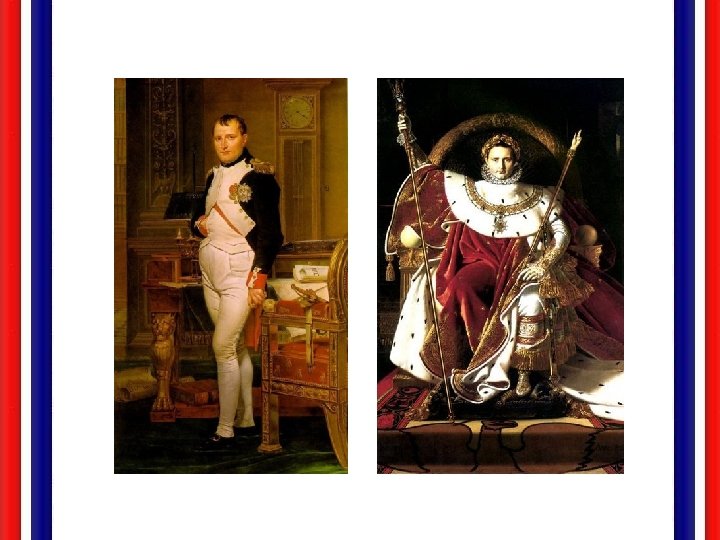
Convalescence Stage (Recovery) • National Convention arrests Robespierre executes him (July 1794) • The Directory takes over – Committee of five conservative men – Tries to find middle ground – Military successes outside of France (Rise of Napoleon) – Domestically, still many problems • Napoleon stages coup d’etat, imposes new constitution - declares himself first consul