The Evolution Functions and Characteristics of Money AP


- Slides: 14
The Evolution, Functions and Characteristics of Money AP Economics
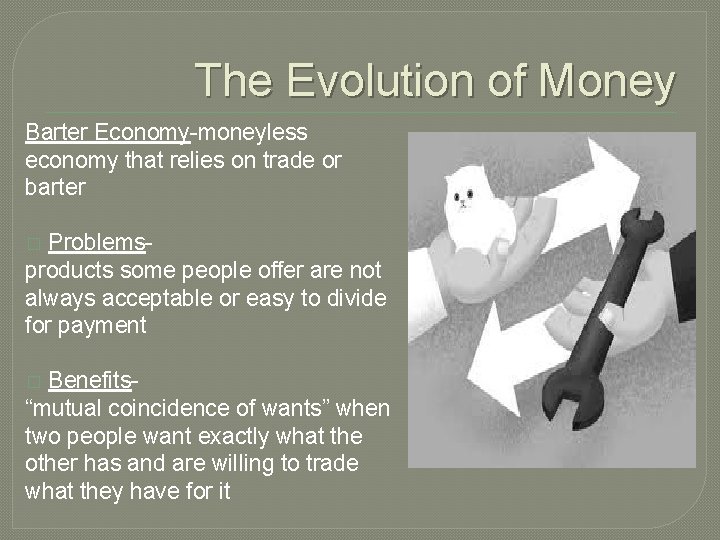
The Evolution of Money Barter Economy-moneyless economy that relies on trade or barter Problemsproducts some people offer are not always acceptable or easy to divide for payment � Benefits“mutual coincidence of wants” when two people want exactly what the other has and are willing to trade what they have for it �
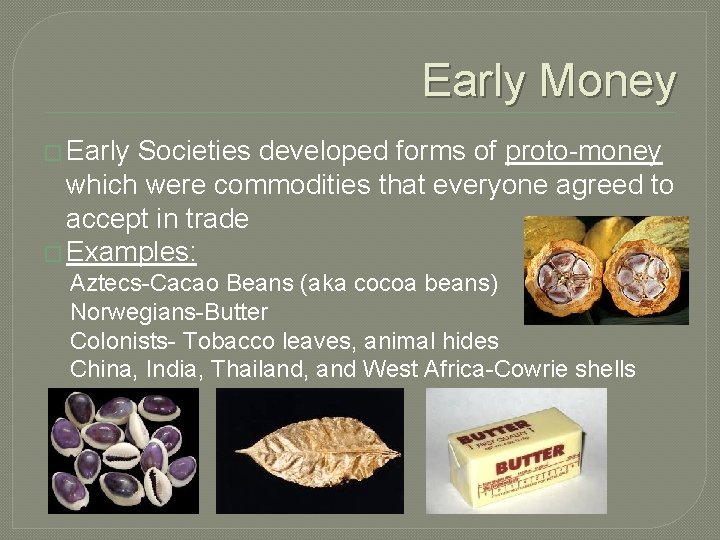
Early Money � Early Societies developed forms of proto-money which were commodities that everyone agreed to accept in trade � Examples: Aztecs-Cacao Beans (aka cocoa beans) Norwegians-Butter Colonists- Tobacco leaves, animal hides China, India, Thailand, and West Africa-Cowrie shells
What would you trade? �If we did not have U. S. currency today, what do you feel we as a society could trade as proto-money?
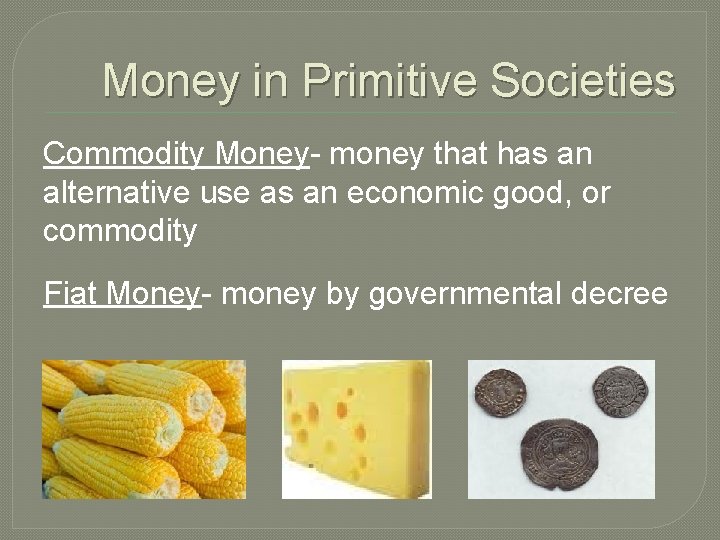
Money in Primitive Societies Commodity Money- money that has an alternative use as an economic good, or commodity Fiat Money- money by governmental decree
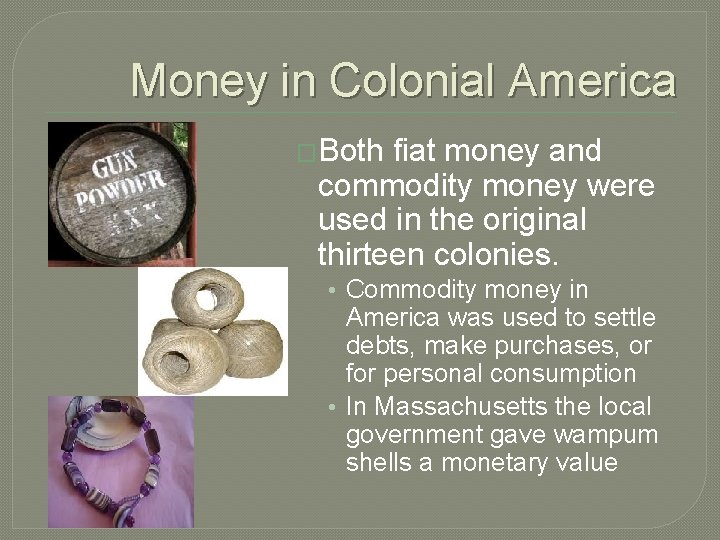
Money in Colonial America �Both fiat money and commodity money were used in the original thirteen colonies. • Commodity money in America was used to settle debts, make purchases, or for personal consumption • In Massachusetts the local government gave wampum shells a monetary value
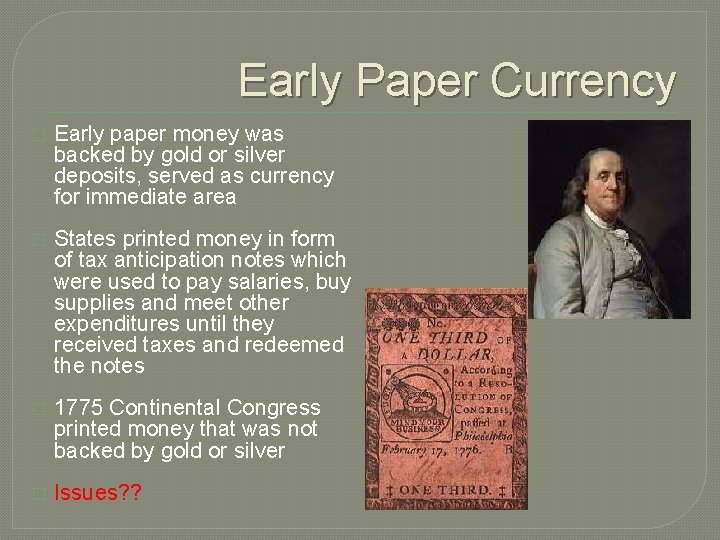
Early Paper Currency � Early paper money was backed by gold or silver deposits, served as currency for immediate area � States printed money in form of tax anticipation notes which were used to pay salaries, buy supplies and meet other expenditures until they received taxes and redeemed the notes � 1775 Continental Congress printed money that was not backed by gold or silver � Issues? ?
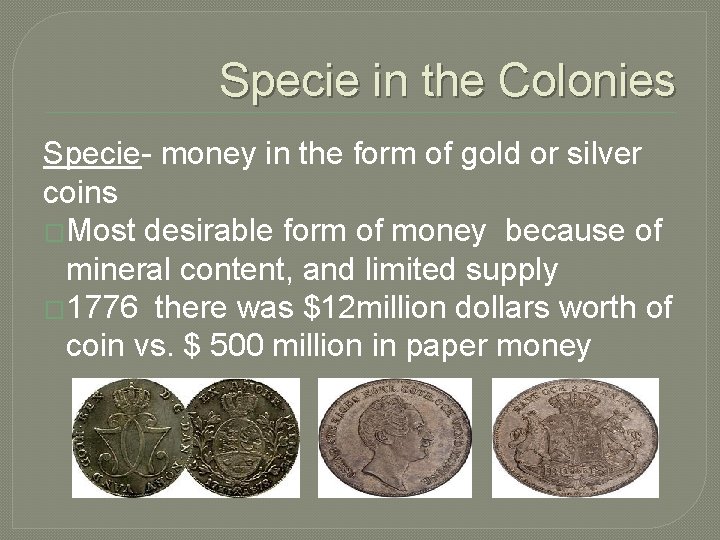
Specie in the Colonies Specie- money in the form of gold or silver coins �Most desirable form of money because of mineral content, and limited supply � 1776 there was $12 million dollars worth of coin vs. $ 500 million in paper money
The Four Characteristics of Money Portability- can be easily transferred from one person to another, and makes the exchange of money for products easier Durable- does not deteriorate when handled and can be easily replaced Divisible- should be able to be broken down into smaller units so that people can use only as much as needed for a transaction Limited Supply- can not have to much of something because then it becomes worthless
So does our money meet all the necessary requirements? Portabilitylight weight, convenient, easily transferable � Durable. Coins tend to last over 20 years, and paper currency lasts 18 months in circulation before being replaced � Divisible. Penny is small enough for almost all purchases, and can write checks for exact amounts � Limited Supply/Stability. Fluctuates, grew at a rate of 10 -12 percent a year in 1970’s, but for the most part there is a stable and limited supply �
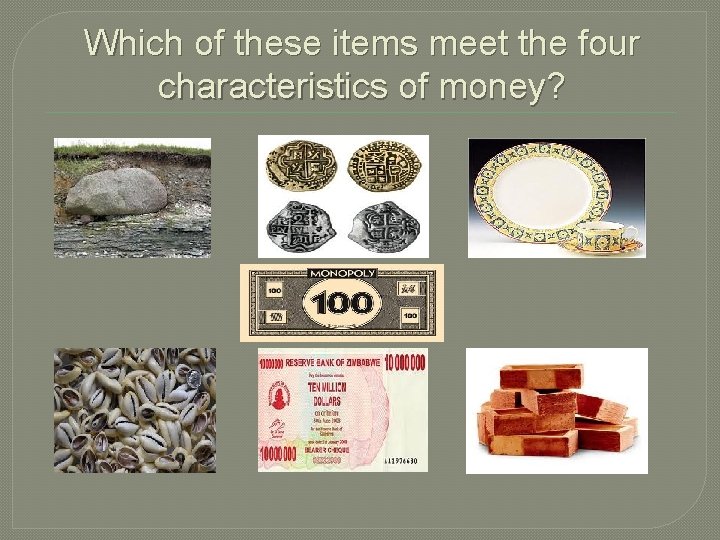
Which of these items meet the four characteristics of money?
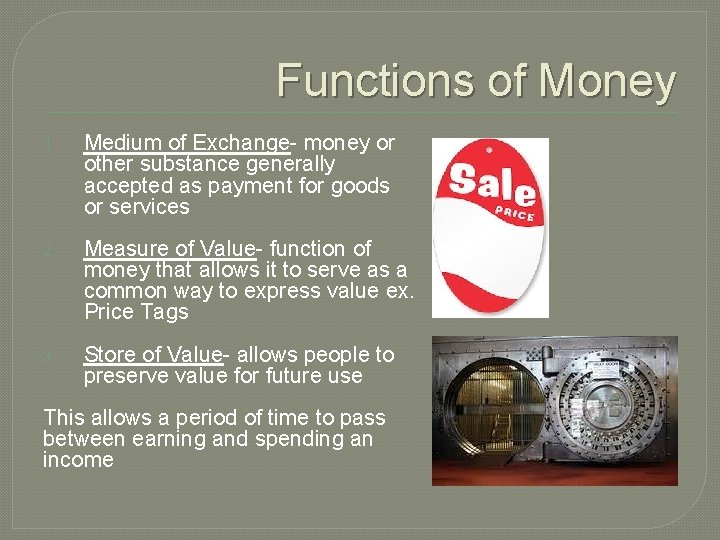
Functions of Money 1. Medium of Exchange- money or other substance generally accepted as payment for goods or services 2. Measure of Value- function of money that allows it to serve as a common way to express value ex. Price Tags 3. Store of Value- allows people to preserve value for future use This allows a period of time to pass between earning and spending an income
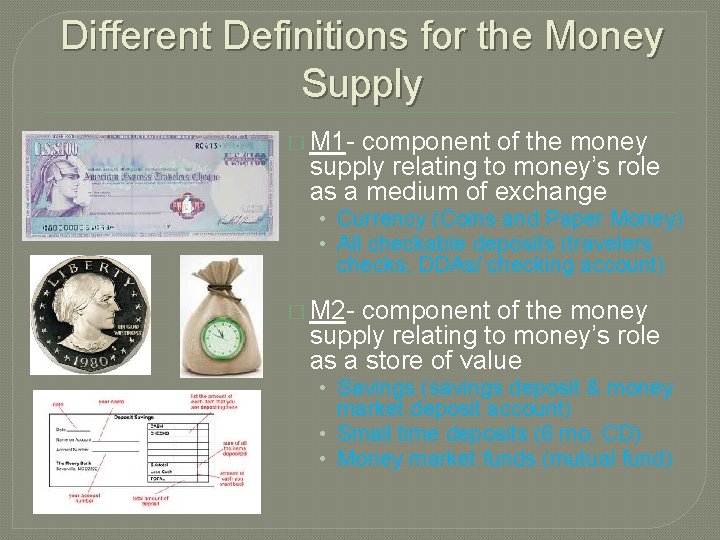
Different Definitions for the Money Supply � M 1 - component of the money supply relating to money’s role as a medium of exchange • Currency (Coins and Paper Money) • All checkable deposits (travelers checks, DDAs/ checking account) � M 2 - component of the money supply relating to money’s role as a store of value • Savings (savings deposit & money market deposit account) • Small time deposits (6 mo. CD) • Money market funds (mutual fund)
Today’s Money Prior Knowledge – what back’s today’s currency in the U. S. ? � It is not gold and silver!- Today, the GDP helps back our money & its relative scarcity (this is why counterfeiting currency is a federal offense for a fine of up to $250, 000 and a prison sentence of up to twenty years for the counterfeiting of U. S. obligations and securities (and no you can’t pay in counterfeited money you made) � The FDIC backs our deposits today up to $250, 000 (M 1 / M 2)