The Death of a Salesman Requiem and Conclusion



- Slides: 24
The Death of a Salesman Requiem and Conclusion
Outline p p Starting Questions The Requiem: n n p p Arthur Miller’s “Tragedy and the Common Man” Willy’s “tragedy”: n n n p p Different Views of Willy Loman The Survivors The Work of the Environment His Character Different Kinds of Success Critique of The American Dream The Play as an Example of Expressionism
Starting Questions 1. 2. 3. 4. 5. What do you think are the functions of Requiem? Is Willy Loman a tragic hero who acts and wins our esteem? Or is he a victim? A victim of his own character or of a system of exploitation and ruthless competition? How about the other Loman characters? Why is this play an example of Expressionism? And a critique of the American Dream?
Requiem –formal, somber, atemporal p Stage Direction: (the only transition from car crash to Requiem) n n n p Music: a frenzy of sound A single cello string a dead march; Lighting: leaves and daylight. Wall-line – crossed Flowers put “at the limit of the apron (a space for the past and Willy’s imagination). Characters: put on mourning dresses (no resistance; no surprise a sense of fatality) Requiem: a mass at which people honor and pray for a dead person Willy Seen from Different Perspectives //self-revelation
Willy and the Survivors Happy and Biff: 1) criticisms= reveal their own short-coming; 2) confirm, idealize the part of Willy themselves identify with. p. Happy – p n n n p defiant and angry, “had no right to do it. …We would’ve helped him. ” empty promise “He had a good dream. ” Happy promises to maintain Willy's dream and his fight. Happy is the last one to leave the stage with the flute music and images of apartment buildings. Biff – n n realistic: "He didn't know himself. “ Forgetting that the stoop was constructed from stolen materials, Biff muses fondly, "there's more of him in that front stoop than in all the sales he ever made. "
Willy and the Survivors (3) p Charley --generous? Or over-sentimental? "Nobody dast blame this man. [. . . ] And for a salesman, there is no rock bottom to the life. He don’t put a bolt to a nut, he don’t tell you the law or give you medicine. He’s a man way out there in the blue, riding on a smile and a shoeshine. And when they start not smiling back – that’s an earthquake. Nobody dast blame this man. A salesman is got to dream, boy. It comes with the territory. ” (1264) n Charley: 1) self-contradictory, both realistic about, and forgiving and generous to Willy. 2) Reveals the lack of foundation or substance to Willy’s dream and capitalism as a whole. (more later)
Willy and the Survivors (3) Linda – p ”I can’t understand it. ” p n p “I can’t cry. ” n p disagrees; cannot understand Willy’s need of self-dignity. disapproves of him; numbed after the first shock. “And there’ll be nobody home. We're free and clear, " she says to Willy, sobbingly. n free from mortgage & pressure; from family members.
Arthur Miller’s “Tragedy and the Common Man” p p p Background: tragedy = Greek tragedy Tragedy depicts the downfall of a noble hero or heroine, usually through some combination of hubris (pride), fate, and the will of the gods. The tragic hero's powerful wish to achieve some goal inevitably encounters limits, usually those of human frailty (flaws in reason, hubris, society), the gods (through oracles, prophets, fate), or nature. Aristotle says that the tragic hero should have a flaw and/or make some mistake (hamartia). Ending: The hero need not die at the end, but he / she must undergo a change in fortune. In addition, the tragic hero may achieve some revelation or recognition about human fate, destiny, and the will of the gods. Aristotle quite nicely terms this sort of recognition "a change from ignorance to awareness of a bond of love or hate. " (source) Audience’s response: pity and fear; catharsis
Arthur Miller’s “Tragedy and the Common Man” p p Background: tragedy = Greek tragedy Few tragedies nowadays due to n n (source) the paucity of heroes among us. the skepticism of science the common man is as apt a subject for tragedy in its highest sense as kings were. p Reasons: 1) In the light of modern psychiatry, the situations of Oedipus and Orestes can be applied to everyone in similar emotional situations. 2) The mental processes of kings shared by the lowly. 3) tragedy of the highbred character is remote from common people. p
Miller’s views of Modern Tragegy of the common man p p p Definition: “tragic feeling is evoked in us when we are in the presence of a character who is ready to lay down his life, if need be, to secure one thing-his sense of personal dignity. [. . . ] the underlying struggle is that of the individual attempting to gain his ‘rightful’ position in his society. ” The flaw: his inherent unwillingness to remain passive in the face of what he conceives to be a challenge to his dignity, his image of his rightful status. Terror –from this total examination of the "unchangeable" environment
Miller’s views of Modern Tragegy of the common man (2) In the tragic view the need of man to wholly realize himself is the only fixed star, and whatever it is that hedges his nature and lowers it is ripe for attack and examination. p Wrong concept of tragedy it implies more optimism p n n Tragedy requires a fine balance between what is possible and what is impossible. Optimism: perfectibility of man
Modern Tragedy Willy – circumstances & personality; p Different concepts of Success p Hope in Linda and Biff –resilience and improvement p
The circumstances p Willy's family background n n p Three models: Father Loman, Ben and Dave Singleman The lack of a father who is around. Ben’s opportunism Dave Singleman – a loner of the past American Capitalist/Industrial society and the American Dream n Willy outdated. Yet he tries hard to maintain his sense of dignity.
Personality Blind: Cannot face his own and his son shortcomings, nor their conflicts; p Cares a lot about the empty appearance and social connections; p Dignified: cannot “walk away, “ continues to fight for his position; cannot bend himself to work for Charley. p A loving father reconciles with Biff when he finds that Biff loves him. p
Kinds of Success (1) 1. In the business world: 1. 2. 3. p Charley’s – money in the pocket; growing up/becoming a man or adult; Bernard’s –passing the test ( education); lawyer; playing tennis; one friend with a tennis court at home; Howard – owns a company, with a variety of playthings (camera, handsaw, a recorder for only 150 dollars, children and wife recorded). Ben– go to far away places [e. g. the West, Alaska, Africa] for gold and diamonds
Kinds of Success (2) p Willy’s – both success in the biz world and on the field 1. The physical: p p Winning the football game; building things [e. g. what Willy does to his house-as Biff describes it in the Requiem] 2. Business world p p well-liked Earning money to pay for the mortgage 3. Pride and Idealism Mythic dimension: Biff as Adonis, Hercules 4. Family togetherness.
Critique of the American Dream p Americans dream of success which “should be” easy and quick “as long as” you work hard n Ben – easy and quick success n Materialism + Idealism –money + the world of Nature n Willy and Biff – their dreams of working on a ranch and planting. n Male aggression & expansionism n Women as target of possession, access to power and revenge (e. g. Willy and Happy) p wives – supportive but without subjectivity p
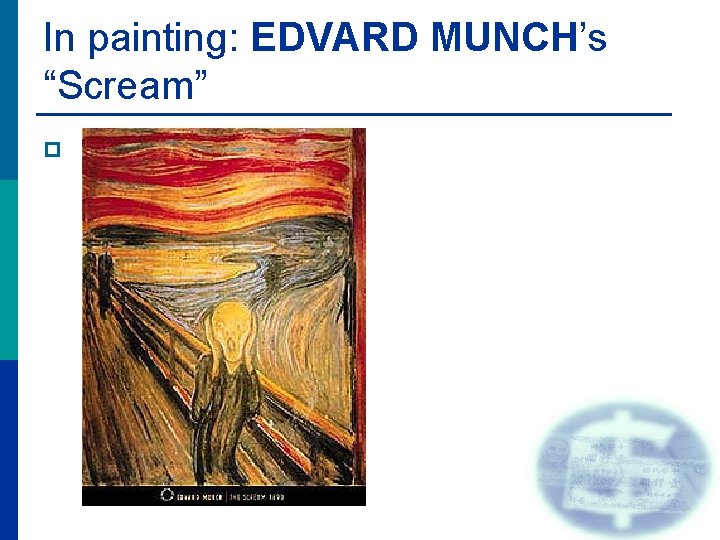
Expressionism p p p an artistic style in which the artist attempts to depict not objective reality but rather the subjective emotions and responses that objects and events arouse in him. Methods: through distortion, exaggeration, primitivism, and fantasy and through the vivid, jarring, violent, or dynamic application of formal elements (e. g. stage directions). one of the main currents of art in the later 19 th and the 20 th centuries, and its qualities of highly subjective, personal, spontaneous self-expression are typical of a wide range of modern artists and art movements. (source)
Symbols re. Willy’s Dream: A Review p p Willy’s house vs. apartment buildings, etc. [e. g. the first stage direction] Properties and Possessions: n n n p Nature and The West – n n p Football and the sneakers with U. of V on them. the house and the mortgage, Things {Fridge, car, vacuum cleaner ] that are broken/falling apart Linda's stockings Tennis of power and status: wire recorder and pen Seeds/plants/trees; light of green leaves Working with tools/one's hands [e. g. Willy's argument with Charley towards the end of Act I: : A man who can't handle tools is not a man. " "hammer a nail"] Roads -- [being on the road] Cars/boats/trains: [e. g. Willy's Red Chevvy; Willy compared to "alittle boat looking for a harbor" by Linda; Ben's taking the train. ]
In painting: EDVARD MUNCH’s “Scream” p
Symbols –in stage direction flute [Willy's father]– beginning of act 1, when Ben appears, p Willy’s theme (1255); p Other kinds of music--e. g. p n n jarring trumpet note (1249), Ben's theme (1236); the end of act II (1263) End of Requiem—a noble and elegiac ending.
Yourself The Lomans’ Dreams I. Willy A. n n n What is(are) his dream(s) and why does he fail to accomplish it (them)? Are you sympathetic with him? What roles do the Woman, Linda and Ben play in his pursuit of dream? Does Linda have a dream at the end? Is he a complete failure, a case of senile incompetence, or does he gain any self-knowledge, self-confirmation, and retain his sense of dignity? Is he a hero? II. Happy and Biff n n n What are their dreams? Do they fail? Why does Biff steal, and Happy womanize? How do they respond to their father differently?
Essay Questions B. The Lomans’ Dreams in the Capitalist Society 1) How do Charley and Bernard serve as a foil to Willy and Biff? p Why does Willy refuse to work for Charley? 2) What roles do Howard and Bill Oliver play as representatives of the business world? 3) Jobs: What does “being a salesman” mean? How is it different from being a shipping clerk or a lawyer?
Essay Questions C. Expressionism in Stage Directions and Symbols n n How do flashbacks happen in the play? What are their functions? Besides cars, flute and rubber tube, what symbolic meanings do the recorder, silk stockings and the fountain pen have? Please categorize these different objects (and many others in the play) and then discuss their symbolic meanings.