
Death of a Salesman An American Tragedy by
Death of a Salesman An American Tragedy by Arthur Miller Introduction
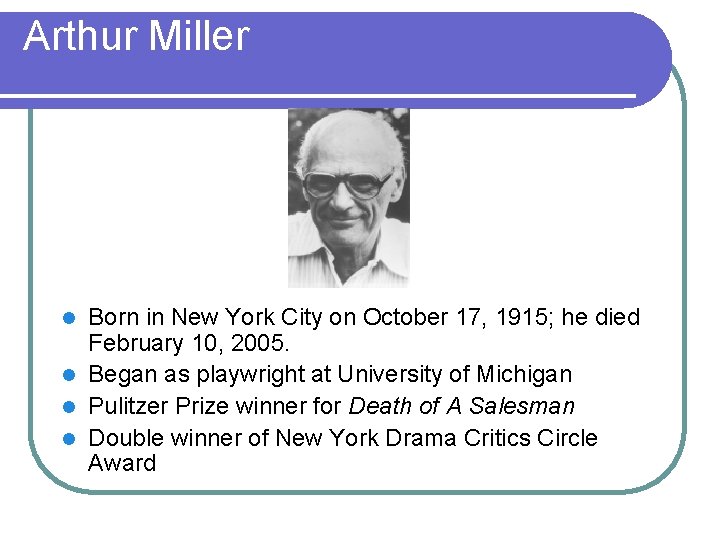
Arthur Miller Born in New York City on October 17, 1915; he died February 10, 2005. l Began as playwright at University of Michigan l Pulitzer Prize winner for Death of A Salesman l Double winner of New York Drama Critics Circle Award l
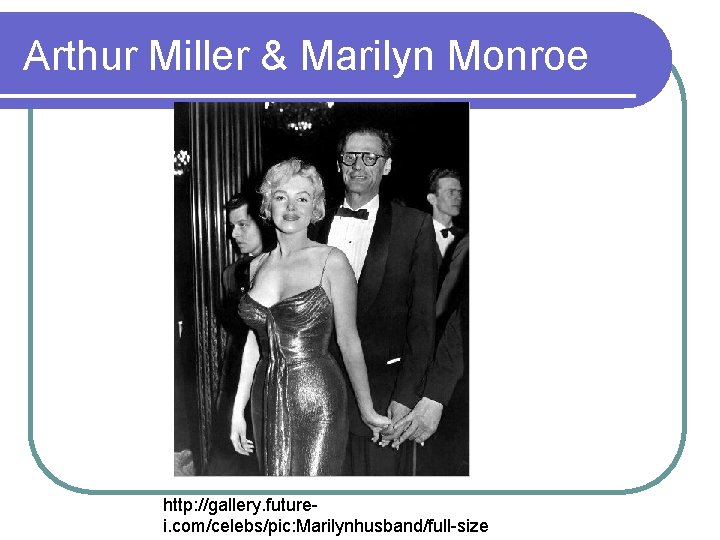
Arthur Miller & Marilyn Monroe http: //gallery. futurei. com/celebs/pic: Marilynhusband/full-size
Productions of Death of a Salesman l 1950 - first sound recording of Death of a Salesman l 1951 - 1 st film version l 1951 - 1952 - US Tour l 1954 - 1 st radio production l 1983 - Miller directs Death in China l 1985 - film version with Dustin Hoffman on CBS; 25 million see it!
Miller’s Legal Troubles l l l Suspected of being a Communist sympathizer Death of a Salesman was seen as un. American Miller has troubles with the HUAC/Mc. Carthy panel hearings 1953 - Miller denied a passport 1955 - HUAC pressures NYC not to allow Miller to make a film for them about juvenile delinquency
The Saga Continued. . . l 1957 - Miller convicted of contempt of Congress for refusing to names. And then. . . l 1958 - US Court of Appeals overturns his contempt conviction. But all of this could not deter the public from viewing and revering his work for generations!
The American Dream People have the right to a decent place to live, a fair reward for hard work and recognition of their worth as human beings. This play is similar to A Raisin in the Sun in that it asks the same basic questions: Has the American Dream become an unkept promise? Is it just a mirage?
The play l l l …addresses family conflict and ethics in post World War II America takes a close look at the price paid for the “American Dream. ” charges America with creating a capitalist materialism centered around a postwar economy. This materialism skewed the original view of the “American Dream” as envisioned by the founding fathers. Original Title – “The Inside of His Head”
Miller’s Assertions l Death of a Salesman is not a “document of pessimism. ” l Death of a Salesman is not un-American; it celebrates the life of Willy Loman. l Miller believes that tragedy is “inherently optimistic. ”
The Common Man as Hero Miller’s thoughts: l “Everyone knows Willy Loman. ” (allusion to the morality play, Everyman. ) l “The common man is suitable for a tragic hero. ” l Willy is meant to be seen as greater and better (at least in potential) than the society.
Miller’s Modern Tragedy l The hero is a common man. l The hero struggles against society. l The hero meets his downfall. l The downfall is a result of an incongruity between his own perception of the world and reality. l The hero achieves a kind of redemption in his downfall.
Tragic? Yes! Willy Loman is worthy of being viewed as a tragic hero because he “is ready to sacrifice his life to secure one thing--his sense of personal dignity. ” Arthur Miller
From Miller’s Essay “Tragedy and the Common Man” “ the tragic hero is intent upon claiming his whole due as a personality, and if this struggle must be total and without reservation, then it automatically demonstrates the indestructible will of man to achieve his humanity. The possibility of victory must be there in tragedy…
Characters l l l l Willy Loman Biff Loman Linda Loman Happy Loman Charley Bernard Ben l l l The Woman Howard Wagner Stanley Jenny Miss Forsythe and Letta
Willy Loman l l l Father, Husband Traveling salesman Believes in chasing the American Dream although he never achieves it Idolizes his brother, Ben Puts Biff on a pedestal because of his success in high school sports Becomes mentally ill when pressure of reality crushes his illusions
Linda Loman l Loving, devoted wife l Naïve and realistic of Willy’s hopes l Emotionally supportive of Willy l Turns a “blind eye” to Willy’s infidelity l Verbally abused by her husband l Willy’s strength until his tragic death
Biff Loman l Elder son, 34 years old l High school standout-football star, many male friends and female admirers l Academic failures lead to a life of kleptomania l Ideal career- to work outside w/hands l Fails to reconcile his father’s expectations
Happy Loman l Younger son, 32 years old l In Biff’s shadow all his life l Represents Willy’s sense of self importance and ambition l Often engages in bad business ethics l Dishonest
Charley l The Lomans’ next door neighbor l Successful businessman l Often gives Willy financial support l Described sadly as Willy’s only friend although Willy is jealous of Charley’s success
Bernard l Charley’s son l Successful l Often mocked by Willy for being studious l He cares more about Biff’s academic success than Willy does l Compared to Loman sons by Willy; they do not measure up to his success
Ben Loman l Willy’s deceased older brother l Independently wealthy l Appears to Willy in daydreams—but never gives Willy the answers to his questions about what it takes to become successful in life l Willy’s symbol of success that he desperately wants for his sons
The Woman l Willy’s mistress l Her admiration for Willy is an ego boost for him. l She makes Willy feel as though he is special when she says, “I picked you…” when the truth is that she probably picked up a lot of men along the way.
Howard Wagner l President of the Wagner Company l Successor to his father, Frank l Not sympathetic to the aging Willy Loman and his problems with mental health l Wrapped up in himself and his success, even though he never personally achieved it; he inherited his position with the company
- Slides: 23