The Culture of Ancient Greece Chapter 5 Section
- Slides: 46
The Culture of Ancient Greece Chapter 5, Section 1, page 154
Chapter 5, Section 1 Objectives • After this lesson, students will be able to: – explain how Greek poetry and fables taught Greek values. – describe how Greek art and architecture expressed Greek ideas of harmony and beauty.
Greek Mythology – page 155 • myth – a traditional story about gods and heroes – some created as a way to explain the unexplainable – fiction; but some have a real-world connection – real to the ancient Greeks; a part of their daily life and religion – again, religion is about keeping the gods happy so they don’t squash you
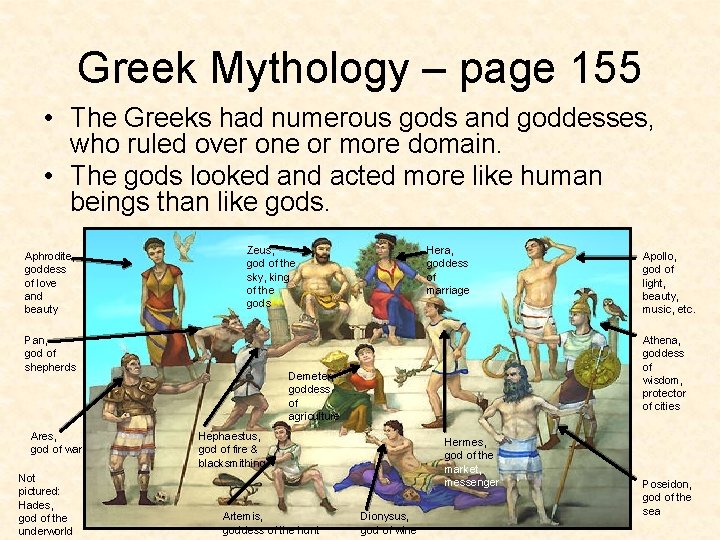
Greek Mythology – page 155 • The Greeks had numerous gods and goddesses, who ruled over one or more domain. • The gods looked and acted more like human beings than like gods. Aphrodite, goddess of love and beauty Zeus, god of the sky, king of the gods Pan, god of shepherds Ares, god of war Not pictured: Hades, god of the underworld Hera, goddess of marriage Athena, goddess of wisdom, protector of cities Demeter, goddess of agriculture Hephaestus, god of fire & blacksmithing Artemis, goddess of the hunt Apollo, god of light, beauty, music, etc. Hermes, god of the market, messenger Dionysus, god of wine Poseidon, god of the sea
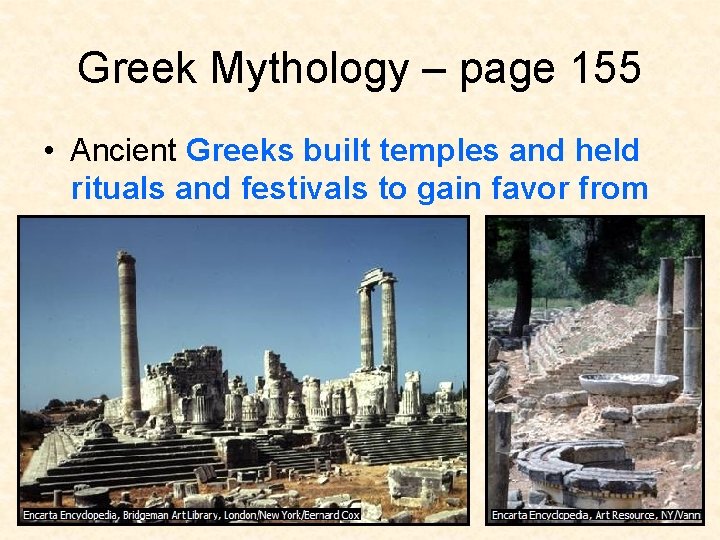
Greek Mythology – page 155 • Ancient Greeks built temples and held rituals and festivals to gain favor from the gods.
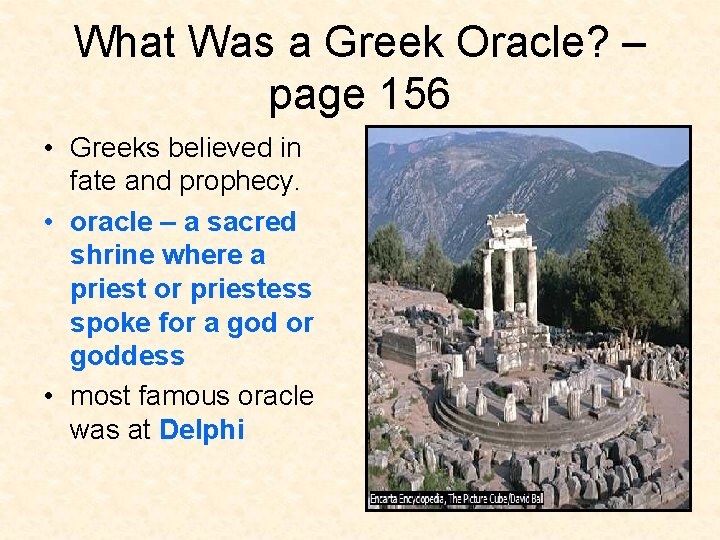
What Was a Greek Oracle? – page 156 • Greeks believed in fate and prophecy. • oracle – a sacred shrine where a priest or priestess spoke for a god or goddess • most famous oracle was at Delphi
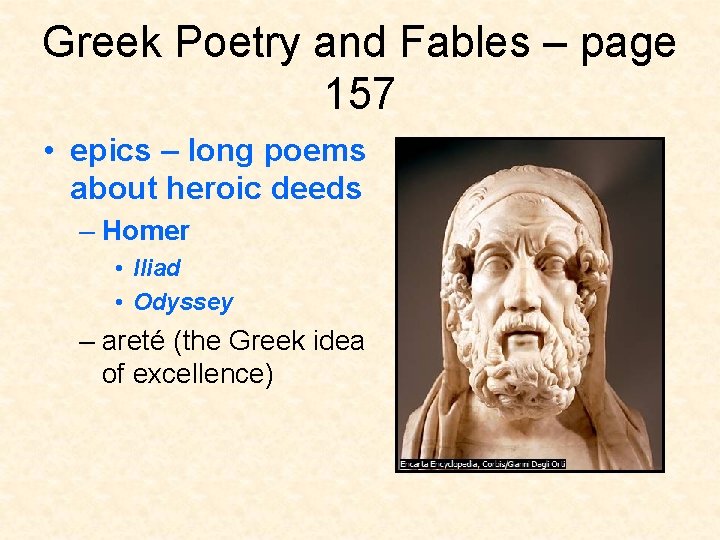
Greek Poetry and Fables – page 157 • epics – long poems about heroic deeds – Homer • Iliad • Odyssey – areté (the Greek idea of excellence)
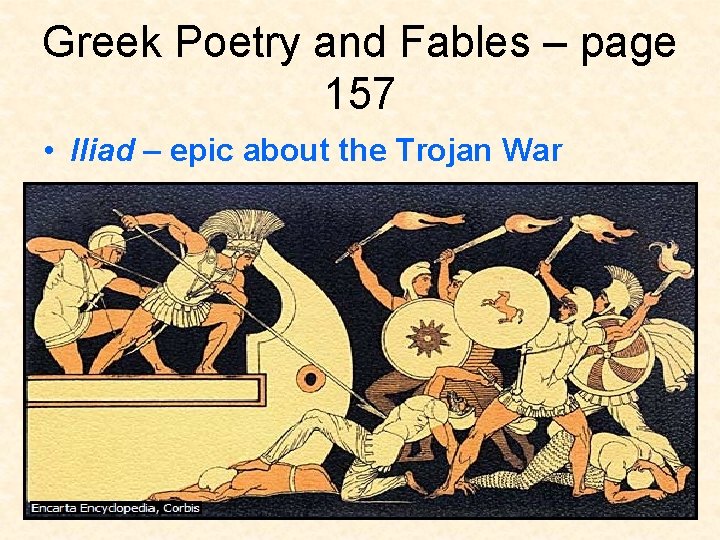
Greek Poetry and Fables – page 157 • Iliad – epic about the Trojan War
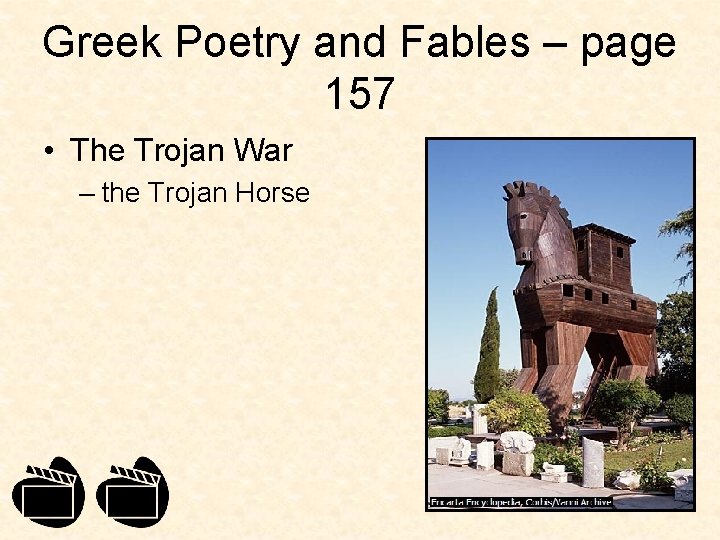
Greek Poetry and Fables – page 157 • The Trojan War – the Trojan Horse
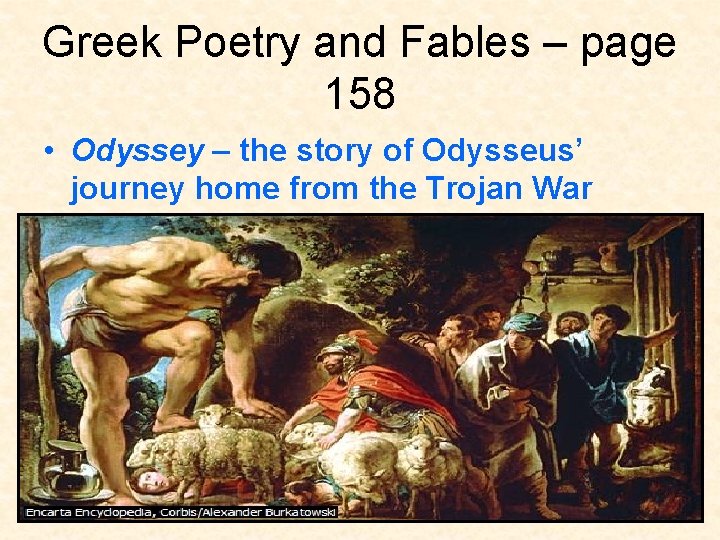
Greek Poetry and Fables – page 158 • Odyssey – the story of Odysseus’ journey home from the Trojan War
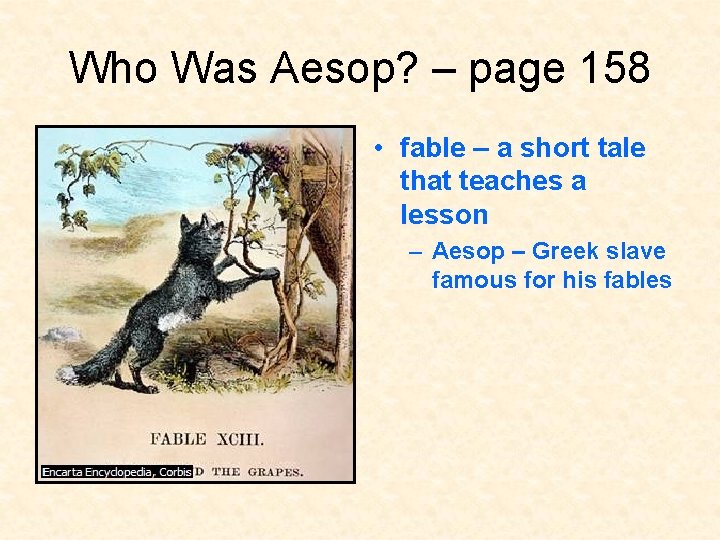
Who Was Aesop? – page 158 • fable – a short tale that teaches a lesson – Aesop – Greek slave famous for his fables
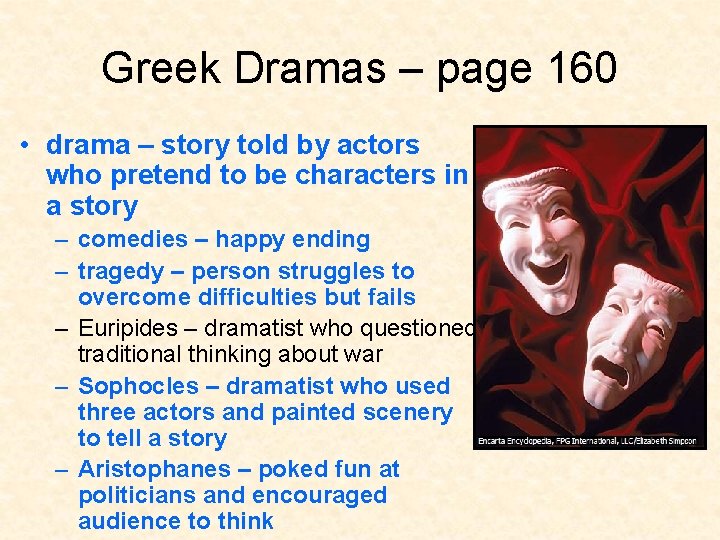
Greek Dramas – page 160 • drama – story told by actors who pretend to be characters in a story – comedies – happy ending – tragedy – person struggles to overcome difficulties but fails – Euripides – dramatist who questioned traditional thinking about war – Sophocles – dramatist who used three actors and painted scenery to tell a story – Aristophanes – poked fun at politicians and encouraged audience to think
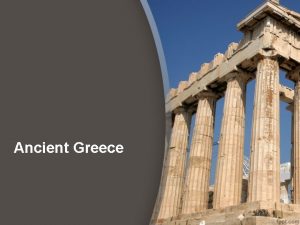
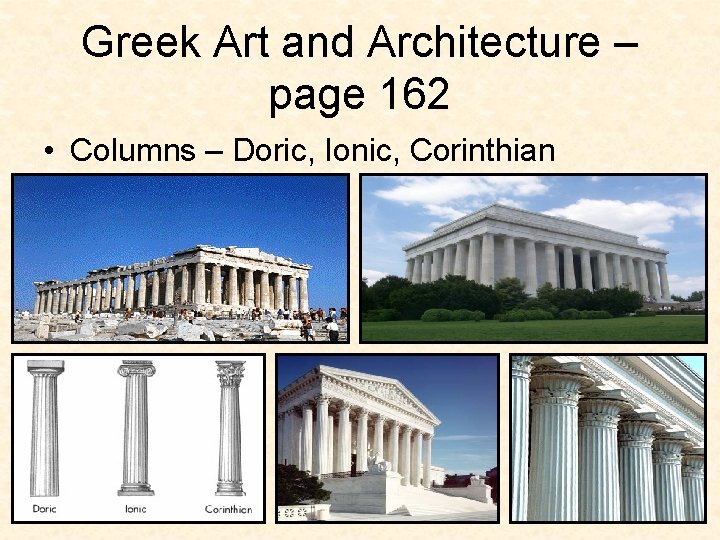
Greek Art and Architecture – page 162 • Columns – Doric, Ionic, Corinthian
Chapter 5, Section 1 Questions 1. How and why did the Greeks honor their gods and goddesses? 2. What was an oracle? 3. Who wrote the Iliad and Odyssey? 4. What is the subject matter of the Iliad? 5. What is the goal of a fable? 6. What is drama? 7. How do we readily see a Greek influence in today’s architecture?
Greek Philosophy and History Chapter 5, Section 2, page 168
Chapter 5, Section 2 Objectives • After this lesson, students will be able to: – list the kinds of ideas that Greek philosophers developed that are still used today. – explain that Greeks wrote the first real histories in Western civilization.
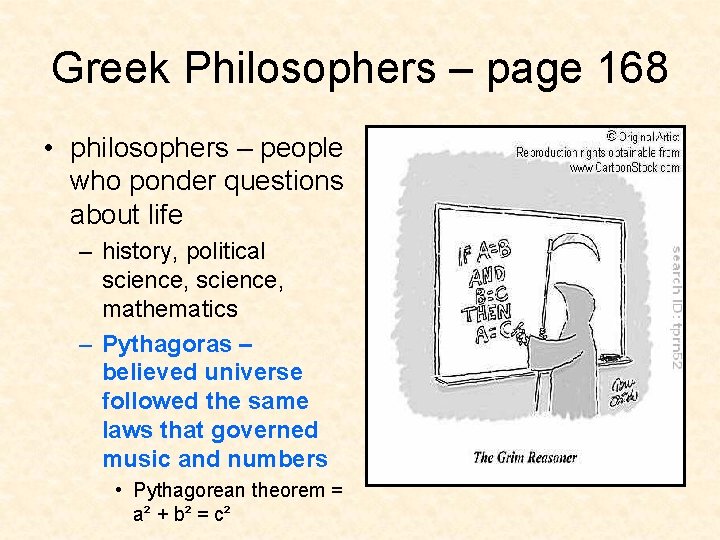
Greek Philosophers – page 168 • philosophers – people who ponder questions about life – history, political science, mathematics – Pythagoras – believed universe followed the same laws that governed music and numbers • Pythagorean theorem = a² + b² = c²
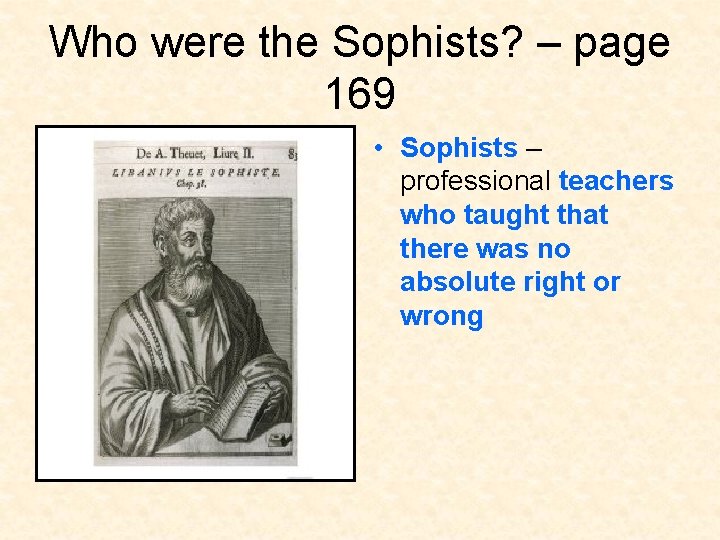
Who were the Sophists? – page 169 • Sophists – professional teachers who taught that there was no absolute right or wrong
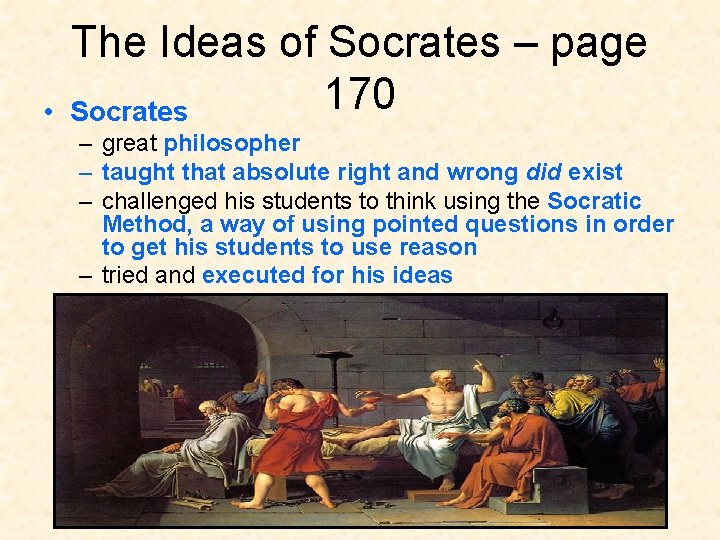
• The Ideas of Socrates – page 170 Socrates – great philosopher – taught that absolute right and wrong did exist – challenged his students to think using the Socratic Method, a way of using pointed questions in order to get his students to use reason – tried and executed for his ideas
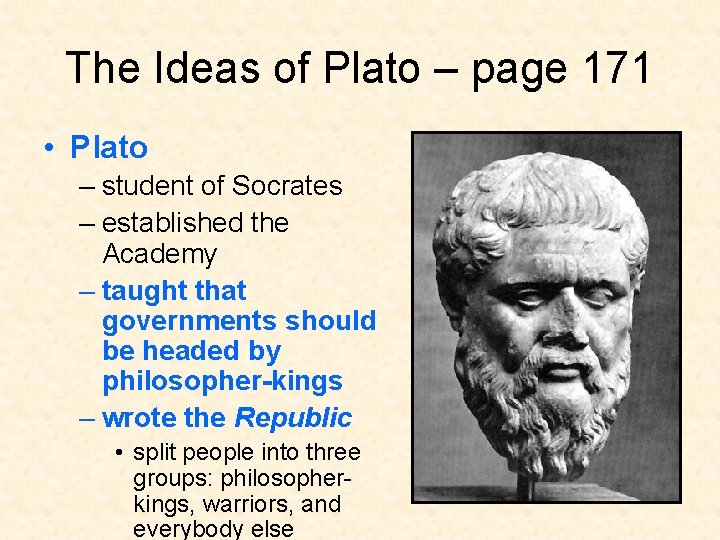
The Ideas of Plato – page 171 • Plato – student of Socrates – established the Academy – taught that governments should be headed by philosopher-kings – wrote the Republic • split people into three groups: philosopherkings, warriors, and everybody else
Who Was Aristotle? – page 171 • Aristotle – student of Plato – opened the Lyceum – taught the “golden mean” – a person should do nothing in excess – wrote Politics • divided governments into three types: government by one person, government by a few people, government by many people • a mixture is the best
Greek Historians – page 173 • Herodotus – the “father of history” – The Histories • Thucydides – considered by many to be the greatest historian of the ancient world – History of the Peloponnesian War • “Either I was present myself at the events which I have described or else I heard of them from eyewitnesses whose reports I have checked with as much thoroughness as possible. ” Thucydides, History of the Peloponnesian War
Chapter 5, Section 2 Questions 1. 2. 3. 4. 5. Who were the Sophists? What happened to Socrates? Name the school that Plato established. Who did Aristotle go on to teach? Name the two historians mentioned and the books each one wrote.
Alexander the Great Chapter 5, Section 3, page 174
Chapter 5, Section 3 Objectives • After this lesson, students will be able to: – describe how Philip of Macedonia united the Greek states under Macedonia. – explain how Alexander the Great conquered the Persian Empire.
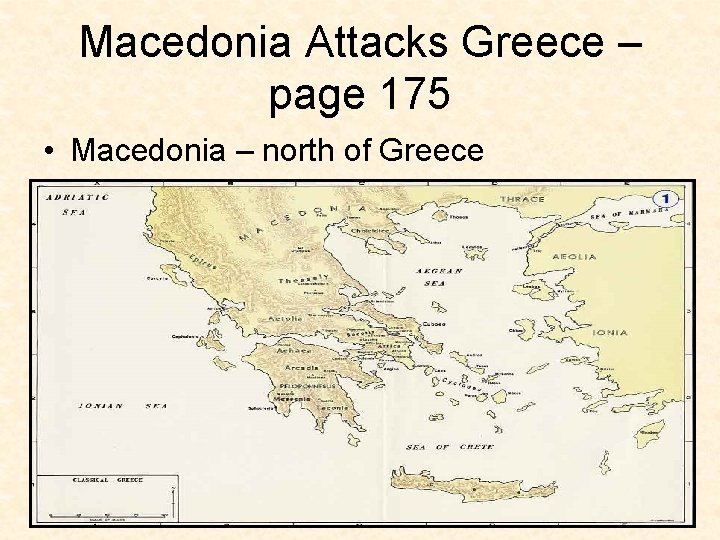
Macedonia Attacks Greece – page 175 • Macedonia – north of Greece
Macedonia Attacks Greece – page 175 • condition of Greece following the Peloponnesian War = poor • Demosthenes – tried to warn Athens about Phillip II • Phillip II – king of Macedonia; has dreams of uniting Greece under Macedonia and conquering Persia – conquered some Greeks, invited some to join him, bribed others – crushed the Greeks at the Battle of Chaeronea – assassinated in 336 B. C.
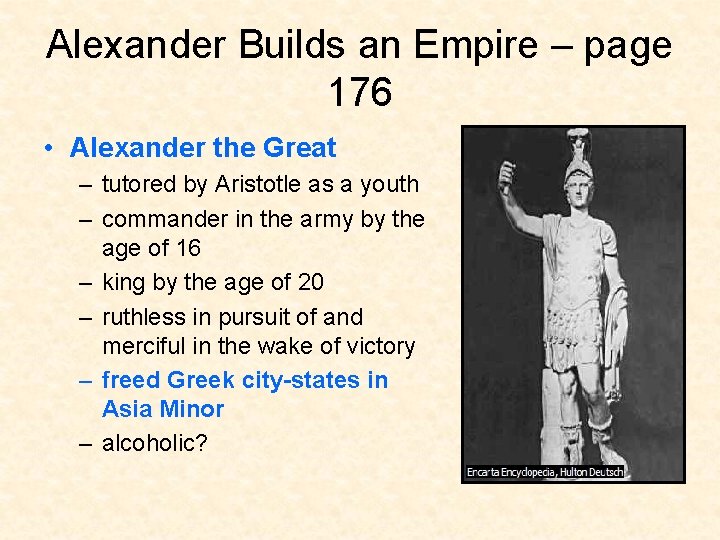
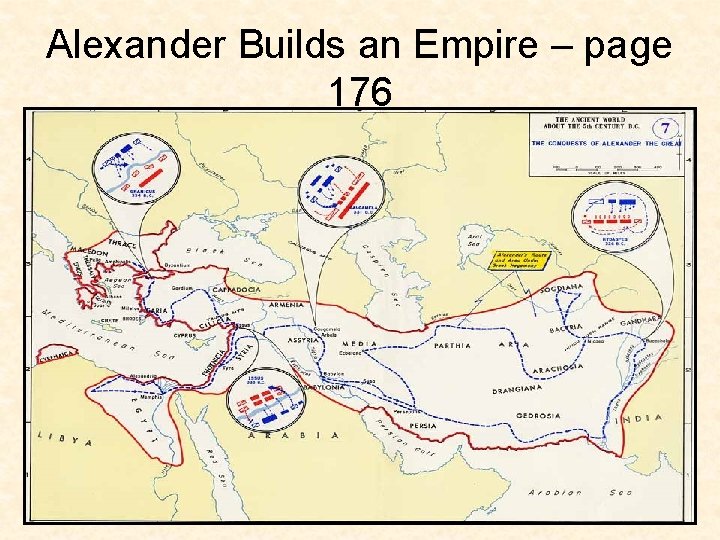
Alexander Builds an Empire – page 176 • Alexander the Great – tutored by Aristotle as a youth – commander in the army by the age of 16 – king by the age of 20 – ruthless in pursuit of and merciful in the wake of victory – freed Greek city-states in Asia Minor – alcoholic?
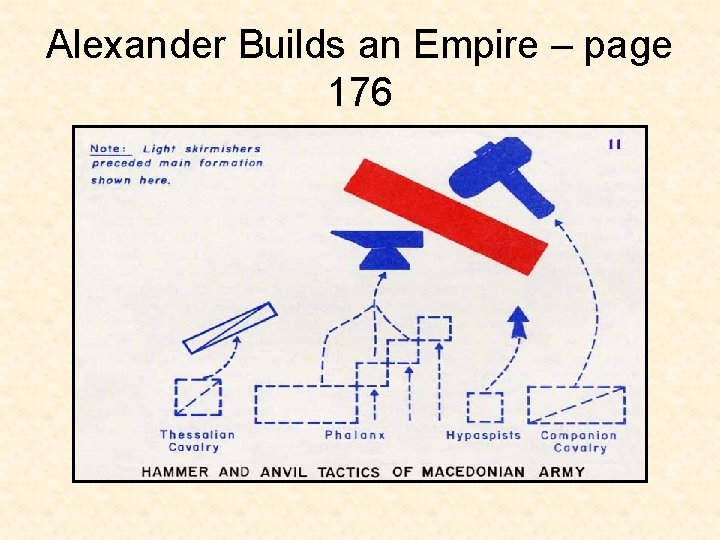
Alexander Builds an Empire – page 176 • Why was he so successful? – use of combined arms techniques – possessed the “coup d’oeil” – determination – leadership (fought at the front, endured the same hardships as his men)
Alexander Builds an Empire – page 176
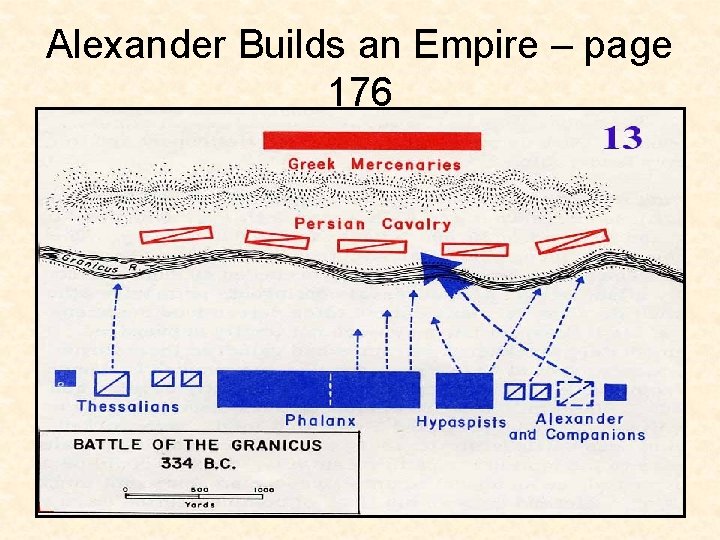
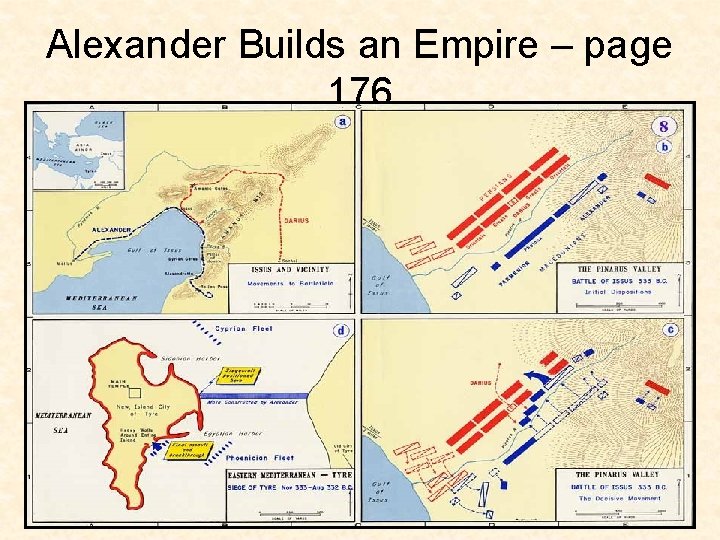
Alexander Builds an Empire – page 176 • Alexander’s Conquests – tightened his grip on Greece first (Thebes) – Battle of Granicus – Alexander was almost killed – Battle of Issus – Siege of Tyre – Egypt (Alexandria founded) – Battle of Gaugamela (250, 000 vs. 47, 000) – incursions into India
Alexander Builds an Empire – page 176
Alexander Builds an Empire – page 176
Alexander Builds an Empire – page 176
Alexander’s Legacy – page 178 • Alexander died at 32 from a fever (? ) • legacy – what a person leaves behind when he or she dies • Alexander’s legacy – spread and preserved Greek heritage – Hellenistic Era – time when Greek ideas and language spread to non-Greeks – Alexandria
The Empire Breaks Apart – page 178 • His empire was split among his top commanders. • They squabbled amongst themselves.
Chapter 5, Section 3 Questions 1. Who attempted to warn the Athenians that Phillip II was a threat? 2. What kind of strategies did Phillip use to gain control over Greece? 3. At what battle was Alexander almost killed? 4. What was Alexander’s legacy?
The Spread of Greek Culture Chapter 5, Section 4, page 182
Chapter 5, Section 4 Objectives • After this lesson, students will be able to: – describe how Hellenistic cities became centers of learning and culture. – list the major discoveries in math and science made by Hellenistic scientists.
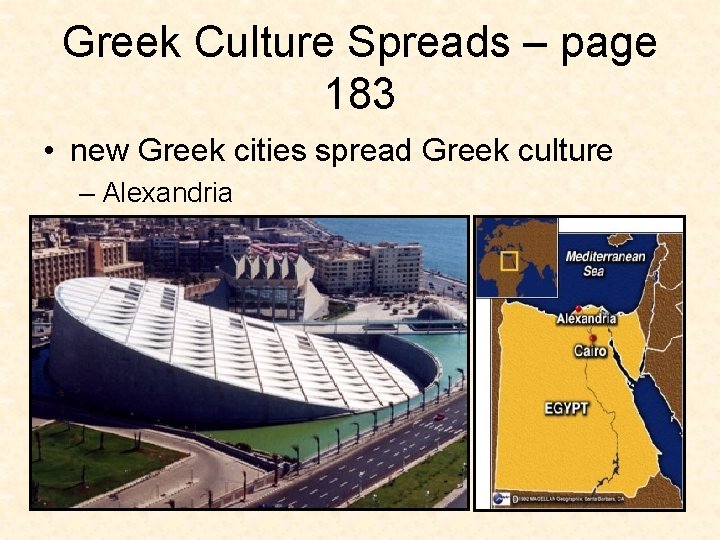
Greek Culture Spreads – page 183 • new Greek cities spread Greek culture – Alexandria
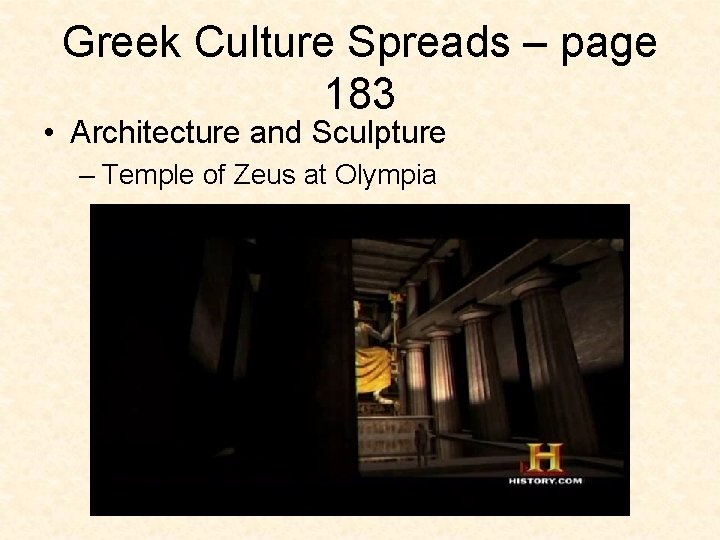
Greek Culture Spreads – page 183 • Architecture and Sculpture – Temple of Zeus at Olympia
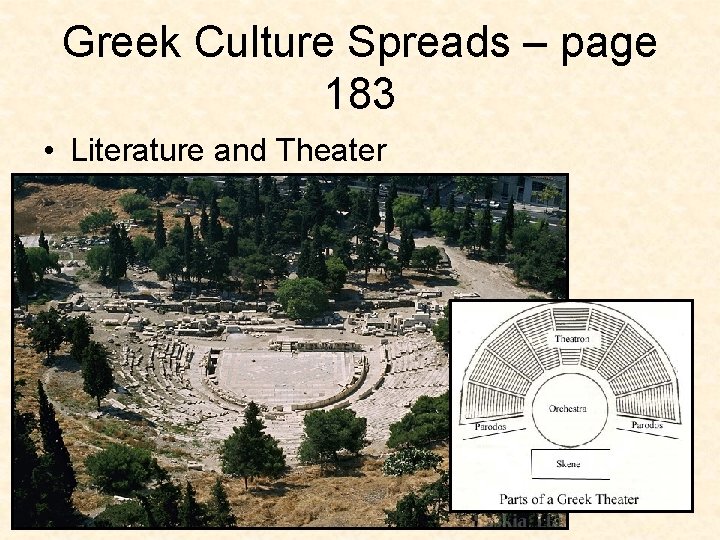
Greek Culture Spreads – page 183 • Literature and Theater
Philosophy – page 184 • Epicureanism – taught that happiness was the goal in life and the way to be happy was to seek out pleasure – avoided public service • Stoicism – founded by Zeno; taught from a stoa – taught that happiness came from following reason and doing one’s duty; public service important
Greek Science and Math – page 185
Greek Science and Math – page 185 • Aristarchus - established that Earth revolves around the sun • Eratosthenes – calculated Earth’s circumference • Euclid – developed plane geometry – how points, lines, angles, and planes relate to one another • Archimedes – probably most famous of the Greek scientists and mathematicians, calculated pi
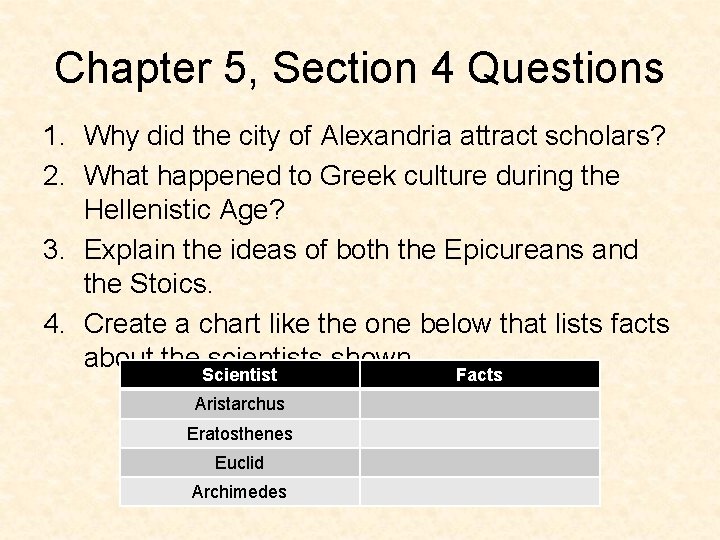
Chapter 5, Section 4 Questions 1. Why did the city of Alexandria attract scholars? 2. What happened to Greek culture during the Hellenistic Age? 3. Explain the ideas of both the Epicureans and the Stoics. 4. Create a chart like the one below that lists facts about the scientists shown. Scientist Aristarchus Eratosthenes Euclid Archimedes Facts