The Community Infrastructure Levy one authoritys experience Mark

- Slides: 11
The Community Infrastructure Levy: one authority’s experience Mark Behrendt
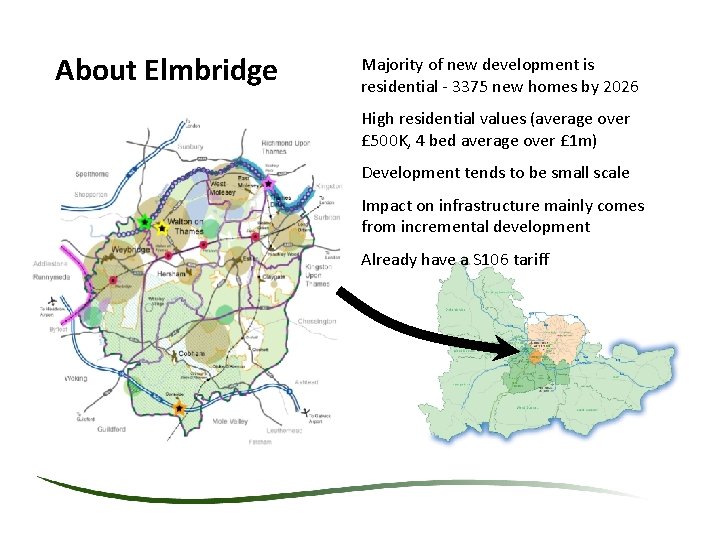
About Elmbridge Majority of new development is residential - 3375 new homes by 2026 High residential values (average over £ 500 K, 4 bed average over £ 1 m) Development tends to be small scale Impact on infrastructure mainly comes from incremental development Already have a S 106 tariff
CIL in Elmbridge • • • Phase two front runner Started development in May 2011 Submitted in September 2012 Examination in November 2012 Confirmation from PINs December 2012 Adoption February 2013 Implementation April 1 2013 Infrastructure gap of £ 41 m – 90% of gap County led services Charging rates: – £ 125 on residential development – £ 50 on retail – £ 0 on all other development. • Expecting to raise £ 20 m to £ 24 m over the next 10 years
What are the benefits of CIL for Elmbridge? Financial • • • CIL will secure existing funding streams from developers for local infrastructure priorities CIL ensures development makes a fair contribution Cost of developing CIL can be recouped – it is cost neutral to the authority Management • • • CIL provides up-front transparency, consistency & speed of negotiations Reduces developers’ risk Initial investment to create charging schedule can lead to reduced management costs for the Charging Authority going forward Delivery • • CIL supports a strategic approach to development management, investment and delivery cash flow Supports engagement with partners in delivering the goals set out in Core Strategies
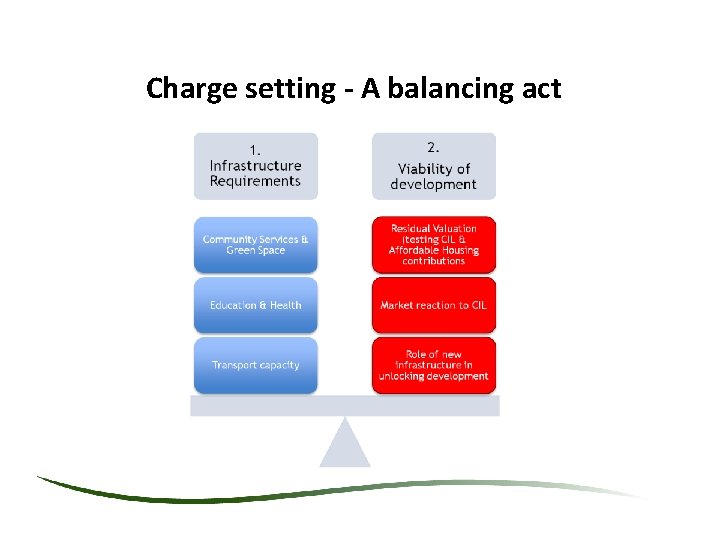
Charge setting - A balancing act
Charge setting - identifying the infrastructure funding gap • Incremental development makes it difficult to: – Assess the amount of infrastructure required and where it should be located – Identify the best solution – Need a housing delivery target • A lack of long term plans for infrastructure growth at a district level by all parties • Identifying indicative projects – where no specific projects were being taken forward, used indicative projects to identify the infrastructure gap • Identifying funding streams – not specific but identified allocated funding in these areas. Existing S 106, New Homes Bonus, Capital Programme • Partnership working – lots of explaining and briefing
Charge setting: viability – the key piece of the jigsaw • Likely to determine the level at which most CIL rates are set • Usually significantly lower then the rate required to meeting the infrastructure gap • What to test? – Worst case scenario for development (affordable housing, open space costs, no existing development etc) – Charge must not affect the viability of affordable housing – Development that is likely to occur • Who to involve? – local developers and agents
Charge Setting – To differentiate or not to differentiate? • No geographic differentiation but differentiated between uses • Removed an initial split between large and small retail stores • Difficult in Elmbridge to pin point specific differences in viability on anything other than development type • Simplicity over complexity • Further differentiation would not achieve any significant improvement in income or viability – sensitivity testing Remember: You can differentiate, but you don’t have to. There is no requirement to demonstrate why you have not differentiated
Consultation and Examination • Preliminary Draft Charging Schedule: – Building understanding - member briefing and developer briefing – 19 responses • Draft Charging Schedule – 16 representations – No real evidence against the charge presented – Challenges based on S 106 not CIL • Examination – 3 reps attended (1 cllr/local architect, 1 developer, 1 residents group) – 1 day – Regulations give the upper hand to the Local Authority Reps and examination indicated a poor understanding of CIL
Next steps - Administration • Based on our existing S 106 tariff collection • Implemented and monitored by S 106 Monitoring Officer • Clear guidance needed for officers and applicants • Calculator for all charges (including affordable housing) • Start early and involve legal, finance, registration, land charges • Needed to have the system in place a minimum of 13 weeks prior to adoption • Harder and more complex than setting the charge!
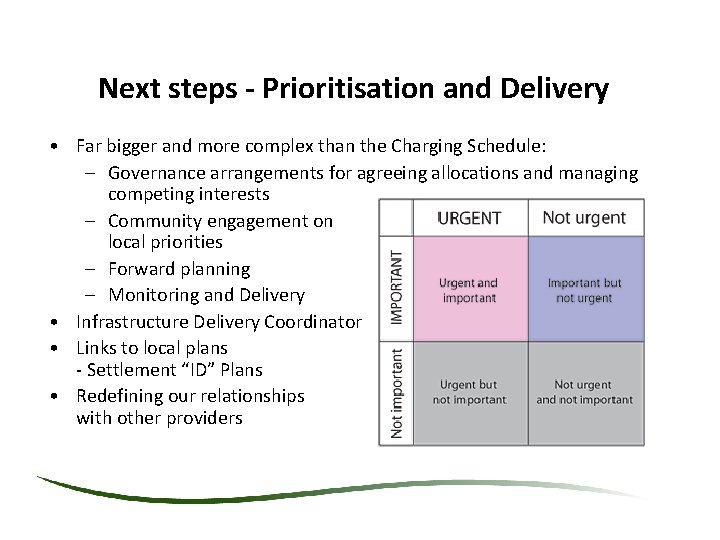
Next steps - Prioritisation and Delivery • Far bigger and more complex than the Charging Schedule: – Governance arrangements for agreeing allocations and managing competing interests – Community engagement on local priorities – Forward planning – Monitoring and Delivery • Infrastructure Delivery Coordinator • Links to local plans - Settlement “ID” Plans • Redefining our relationships with other providers