The close reading An inquiry approach Jennifer Shand
- Slides: 37
The close reading An inquiry approach Jennifer Shand
Our job is not to produce ‘readings’ for our students, but to give them the tools for producing their own’ (Scholes, 1985, p. 24).
The plan for today • A very brief overview of some recent and older ideas and research on the close reading (I promise) • Framing of the close reading in the new syllabus document • The close reading in the examination • A model to work with • A practice with poetry and drama • Over to you (if time permits) • Questions
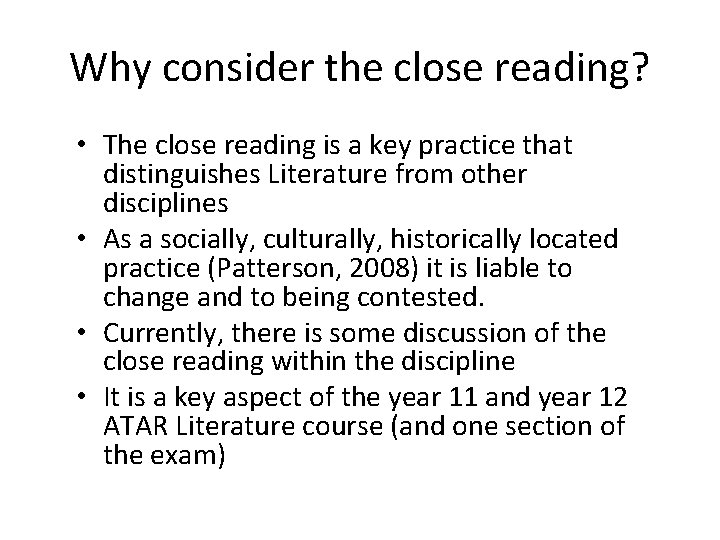
Why consider the close reading? • The close reading is a key practice that distinguishes Literature from other disciplines • As a socially, culturally, historically located practice (Patterson, 2008) it is liable to change and to being contested. • Currently, there is some discussion of the close reading within the discipline • It is a key aspect of the year 11 and year 12 ATAR Literature course (and one section of the exam)
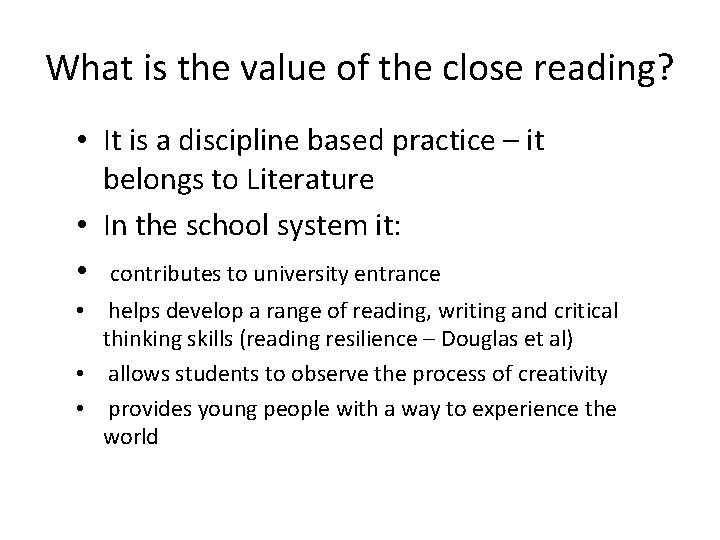
What is the value of the close reading? • It is a discipline based practice – it belongs to Literature • In the school system it: • contributes to university entrance • helps develop a range of reading, writing and critical thinking skills (reading resilience – Douglas et al) • allows students to observe the process of creativity • provides young people with a way to experience the world
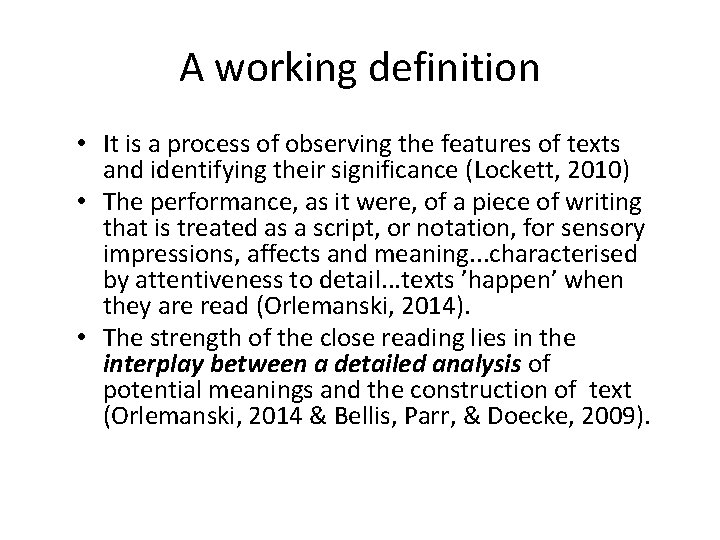
A working definition • It is a process of observing the features of texts and identifying their significance (Lockett, 2010) • The performance, as it were, of a piece of writing that is treated as a script, or notation, for sensory impressions, affects and meaning. . . characterised by attentiveness to detail. . . texts ’happen’ when they are read (Orlemanski, 2014). • The strength of the close reading lies in the interplay between a detailed analysis of potential meanings and the construction of text (Orlemanski, 2014 & Bellis, Parr, & Doecke, 2009).
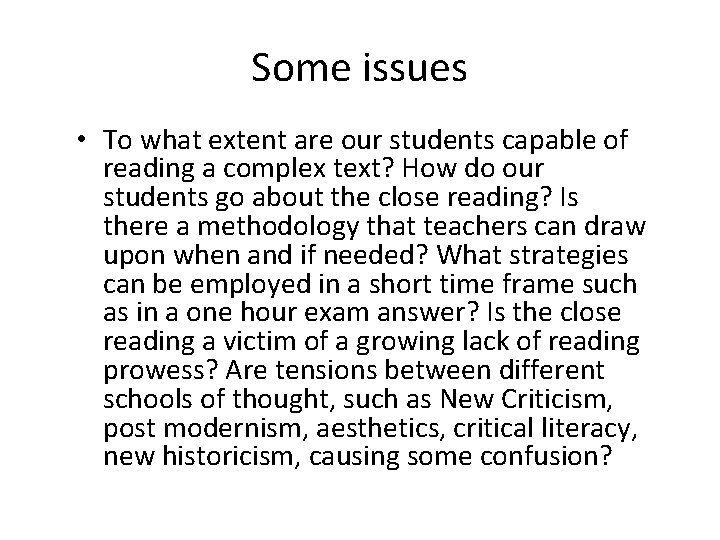
Some issues • To what extent are our students capable of reading a complex text? How do our students go about the close reading? Is there a methodology that teachers can draw upon when and if needed? What strategies can be employed in a short time frame such as in a one hour exam answer? Is the close reading a victim of a growing lack of reading prowess? Are tensions between different schools of thought, such as New Criticism, post modernism, aesthetics, critical literacy, new historicism, causing some confusion?
How does the new course define our students? • The Literature ATAR course focuses on the study of literary texts and developing students as independent, innovative and creative learners and thinkers who appreciate the aesthetic use of language; evaluate perspectives and evidence; and challenge ideas and interpretations.
In this subject, students actively participate in the dialogue of literary analysis.
How is the close reading framed in year 11 units? Unit 1 • Knowledge and understanding of different ways of reading • Knowledge and understanding of different literary conventions • The significance of ideas • The distinctive qualities of texts analysed through detailed textual knowledge • Specific features of literary texts ‘text structures’, ‘approaches to characterisation’, ‘narrative approaches’, ‘figurative language’ and ‘sound and visual devices’.
Unit 2 • Knowledge and understanding of intertextuality • Drawing on a range of language and literary experiences • Compare and evaluate form, language and content • Intertextuality framed theoretically – adaptations, appropriation, transformation, parody and imitation
Why does that matter? Unit 3 and Unit 4 are underpinned by the understandings of the content of Unit 1 and Unit 2; candidates are therefore advised that terminology used in Unit 1 and Unit 2 may be used in Year 12 WACE examination questions.
What does it look like in Year 12? Unit 3 • Relationship between language, culture and identity • Representation of ideas, events, people, values and attitudes • Critical analysis and evaluation
Unit 4 • Appreciation of significance of literary study • Close critical analysis of literary texts • ‘Appreciation of the significance of literary study through close critical analysis of literary texts drawn from a range of forms, genres and styles. The unit focuses on the dynamic nature of literary interpretation and considers the insights texts offer, their use of literary conventions and aesthetic appeal’.
The close reading in the examination • • 30% of total examination One question A suggested working time 60 minutes One main genre
Feedback from examiners and markers Ø Time management – doing section one last may mean that some students run out of time Ø Students need to allow some time to think about the text and show that they have comprehended and understood the text Ø Strong close readings go beyond description of text Ø Strong answers engage with the construction of text
Ø Strong answers show that students understand recognise literary conventions and literary devices and can use the appropriate literary terminology Ø Strong answers show the relationship between meaning whether as ideas, ideologies, values and attitudes, representations and techniques and conventions Ø Strong answers show that students have an understanding of genre – at level of drama, prose and poetry. Drama as performance script is important.
What have I learned from the process of teaching, marking and researching Ø Students need to practise a lot during their Literature classes, at home, in the library – build the close reading as an everyday Literature activities Ø Students need a process – somewhere to start Ø They need to recognise and understand the use of conventions and techniques Ø They need to practice explaining what they achieve – their creative impact
Ø They need to take the time to interrogate the text Ø They need frameworks for theories if they are going to apply them well Ø They need a structure or framework for writing a close reading Ø They need to be able to choose the best way to go about the close reading, that is, they need a few options Ø I need a model or framework by which to base my teaching of the close reading (I’m a bit like that)
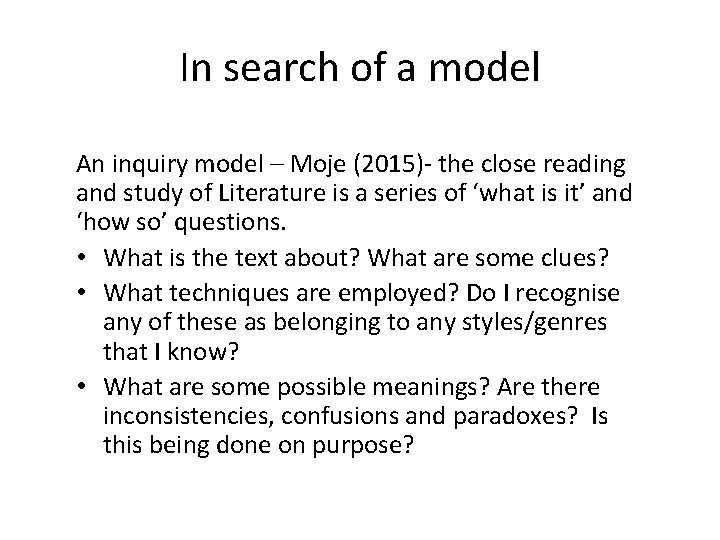
In search of a model An inquiry model – Moje (2015)- the close reading and study of Literature is a series of ‘what is it’ and ‘how so’ questions. • What is the text about? What are some clues? • What techniques are employed? Do I recognise any of these as belonging to any styles/genres that I know? • What are some possible meanings? Are there inconsistencies, confusions and paradoxes? Is this being done on purpose?
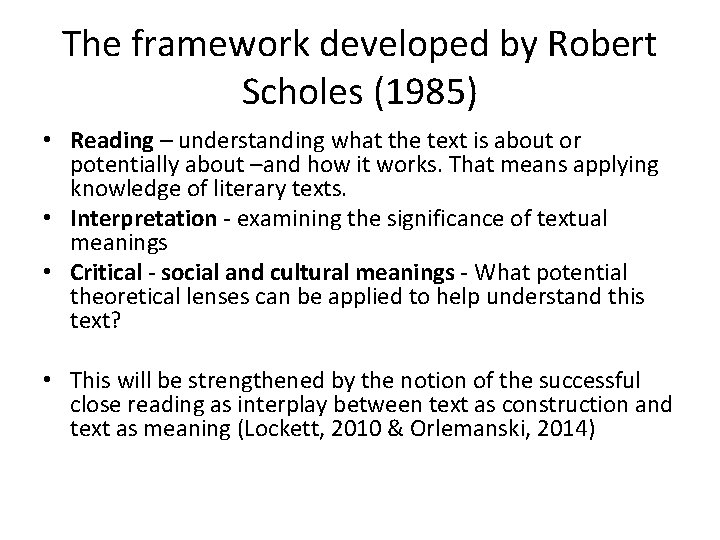
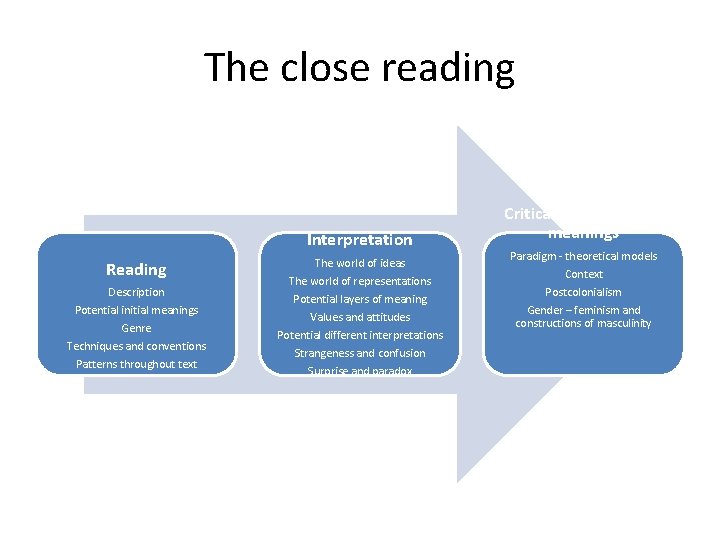
The framework developed by Robert Scholes (1985) • Reading – understanding what the text is about or potentially about –and how it works. That means applying knowledge of literary texts. • Interpretation - examining the significance of textual meanings • Critical - social and cultural meanings - What potential theoretical lenses can be applied to help understand this text? • This will be strengthened by the notion of the successful close reading as interplay between text as construction and text as meaning (Lockett, 2010 & Orlemanski, 2014)
The close reading Interpretation Reading Description Potential initial meanings Genre Techniques and conventions Patterns throughout text The world of ideas The world of representations Potential layers of meaning Values and attitudes Potential different interpretations Strangeness and confusion Surprise and paradox Critical social cultural meanings Paradigm - theoretical models Context Postcolonialism Gender – feminism and constructions of masculinity
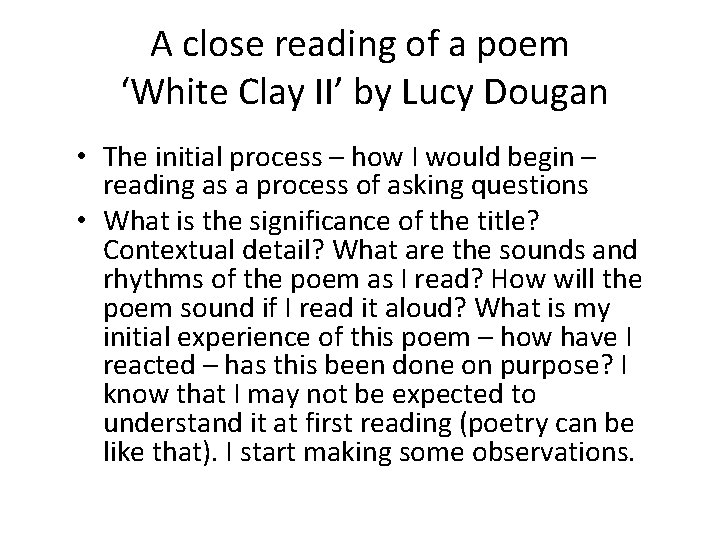
A close reading of a poem ‘White Clay II’ by Lucy Dougan • The initial process – how I would begin – reading as a process of asking questions • What is the significance of the title? Contextual detail? What are the sounds and rhythms of the poem as I read? How will the poem sound if I read it aloud? What is my initial experience of this poem – how have I reacted – has this been done on purpose? I know that I may not be expected to understand it at first reading (poetry can be like that). I start making some observations.
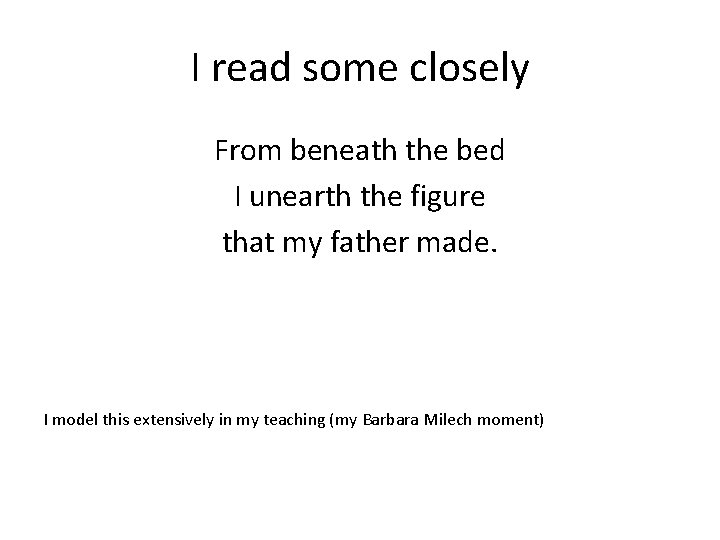
I read some closely From beneath the bed I unearth the figure that my father made. I model this extensively in my teaching (my Barbara Milech moment)
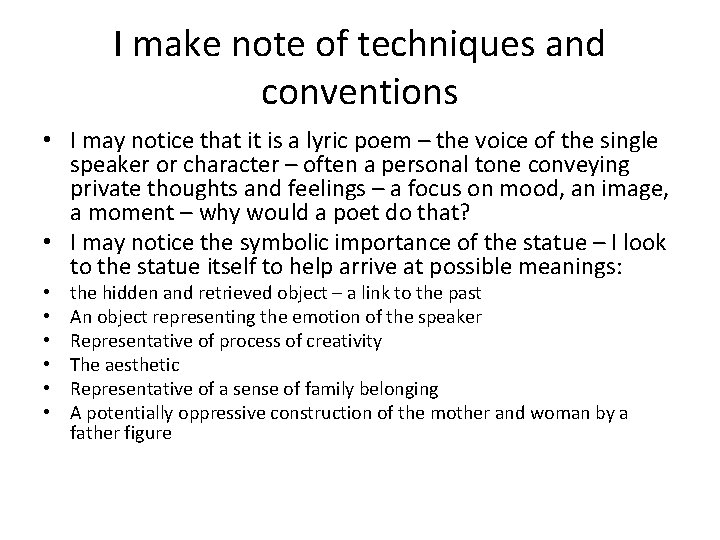
I make note of techniques and conventions • I may notice that it is a lyric poem – the voice of the single speaker or character – often a personal tone conveying private thoughts and feelings – a focus on mood, an image, a moment – why would a poet do that? • I may notice the symbolic importance of the statue – I look to the statue itself to help arrive at possible meanings: • • • the hidden and retrieved object – a link to the past An object representing the emotion of the speaker Representative of process of creativity The aesthetic Representative of a sense of family belonging A potentially oppressive construction of the mother and woman by a father figure
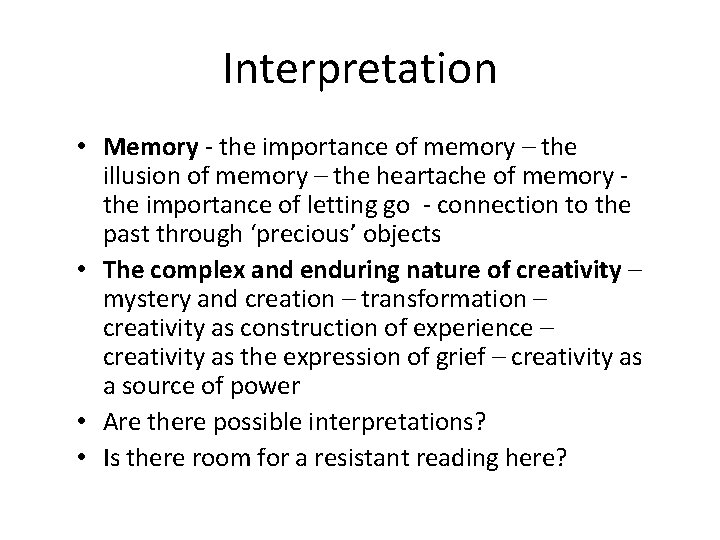
Interpretation • Memory - the importance of memory – the illusion of memory – the heartache of memory - the importance of letting go - connection to the past through ‘precious’ objects • The complex and enduring nature of creativity – mystery and creation – transformation – creativity as construction of experience – creativity as the expression of grief – creativity as a source of power • Are there possible interpretations? • Is there room for a resistant reading here?
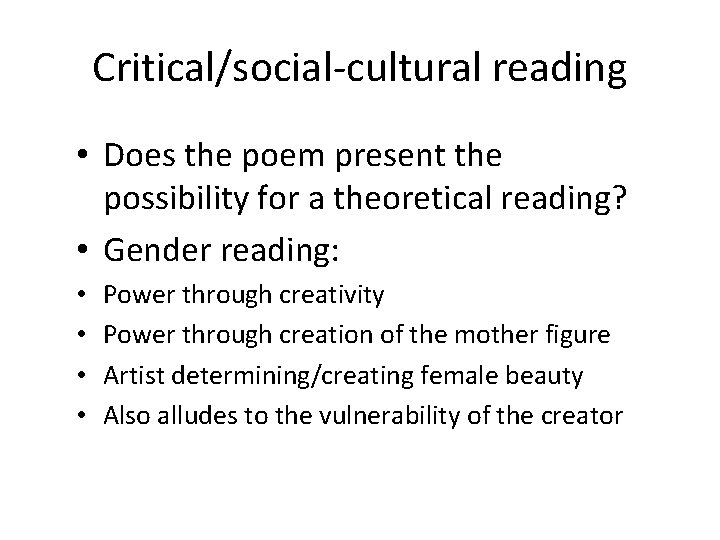
Critical/social-cultural reading • Does the poem present the possibility for a theoretical reading? • Gender reading: • • Power through creativity Power through creation of the mother figure Artist determining/creating female beauty Also alludes to the vulnerability of the creator
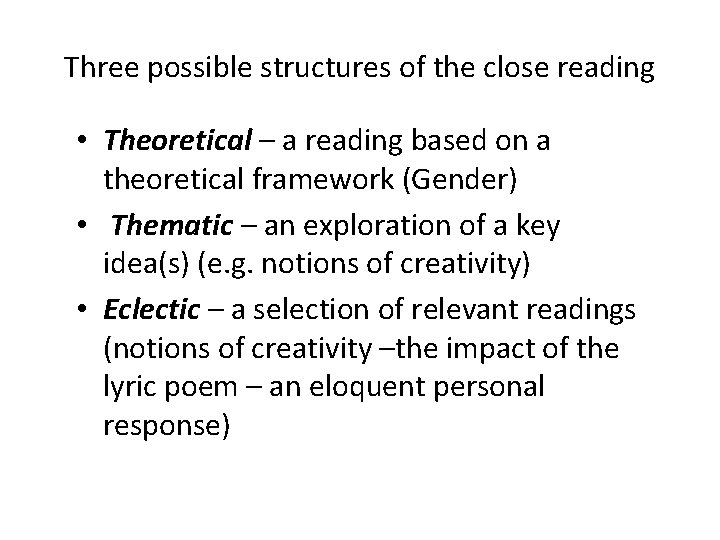
Three possible structures of the close reading • Theoretical – a reading based on a theoretical framework (Gender) • Thematic – an exploration of a key idea(s) (e. g. notions of creativity) • Eclectic – a selection of relevant readings (notions of creativity –the impact of the lyric poem – an eloquent personal response)
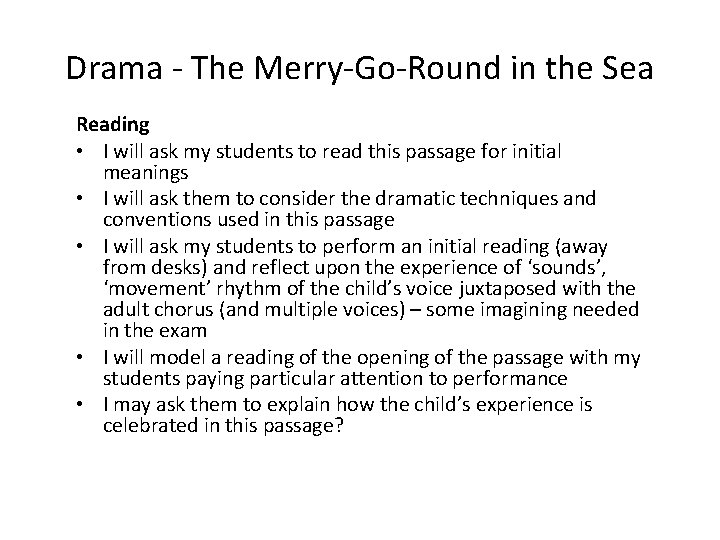
Drama - The Merry-Go-Round in the Sea Reading • I will ask my students to read this passage for initial meanings • I will ask them to consider the dramatic techniques and conventions used in this passage • I will ask my students to perform an initial reading (away from desks) and reflect upon the experience of ‘sounds’, ‘movement’ rhythm of the child’s voice juxtaposed with the adult chorus (and multiple voices) – some imagining needed in the exam • I will model a reading of the opening of the passage with my students paying particular attention to performance • I may ask them to explain how the child’s experience is celebrated in this passage?
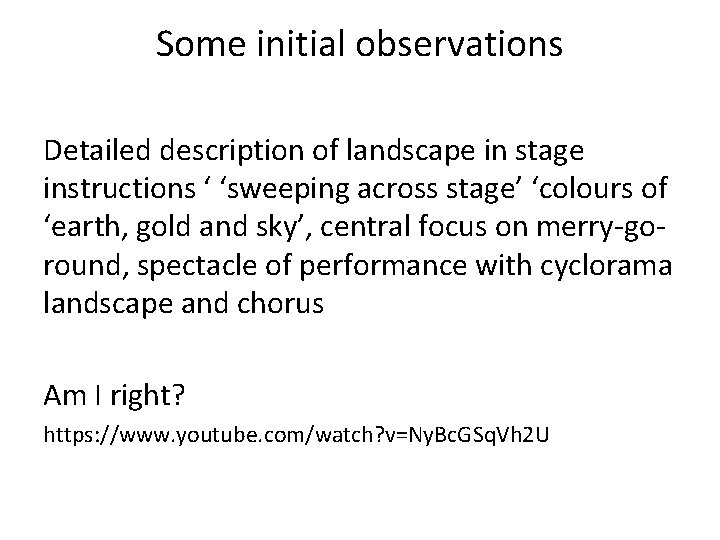
Some initial observations Detailed description of landscape in stage instructions ‘ ‘sweeping across stage’ ‘colours of ‘earth, gold and sky’, central focus on merry-goround, spectacle of performance with cyclorama landscape and chorus Am I right? https: //www. youtube. com/watch? v=Ny. Bc. GSq. Vh 2 U
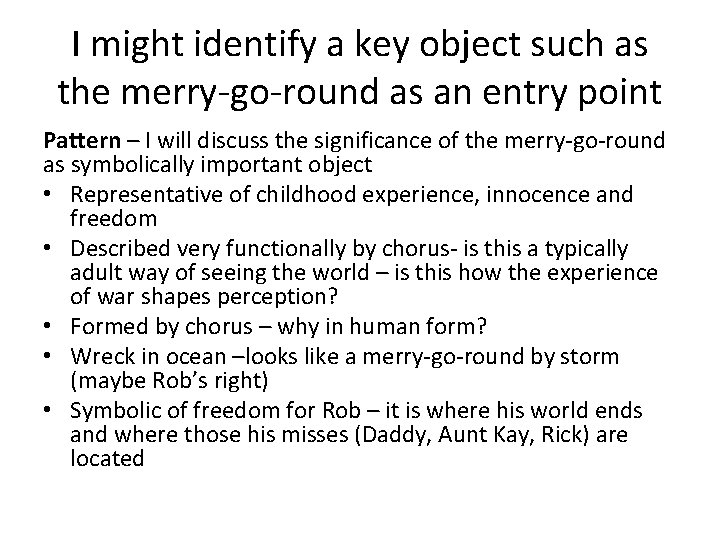
I might identify a key object such as the merry-go-round as an entry point Pattern – I will discuss the significance of the merry-go-round as symbolically important object • Representative of childhood experience, innocence and freedom • Described very functionally by chorus- is this a typically adult way of seeing the world – is this how the experience of war shapes perception? • Formed by chorus – why in human form? • Wreck in ocean –looks like a merry-go-round by storm (maybe Rob’s right) • Symbolic of freedom for Rob – it is where his world ends and where those his misses (Daddy, Aunt Kay, Rick) are located
• • • Interpretation Naivety and wisdom the child’s perspective (paradox) Changed(ing) nature of world at war Fears in times of change Lack of stability and security in world (confusion) I will ask my students to take one possible interpretation and explain making sure that they use at least one example of narrative convention such as characterisation of the child, repetition, and at least one example of how drama techniques and conventions are used to construct this particular idea.
Critical socio cultural readings • Class and elements of a Marxist reading • Rights/experiences of the child (I may draw some parallels with current experiences for children in the world today) • Shaping of national identity • Identity shaped by war experience (militarisation) • Representation of change and compromise during war • Resilience, stoicism and Australian character (Anzac tradition family strength) • Absence of family • Encroachment of international/global events • Resistance to this shaping/version of national identity – child’s perspective – significance of landscape – it may all disappear
Application prose Paperbark Shoe What models might you use?
References • • Bellis, N. , Parr, G. & Doecke, B. (2009). The Making of Literature: A Continuing Conversation. Changing English: Studies in Culture and Education, 16(2), 165 -179. • Dougan, L. (2008). White Clay II. White Clay, Artarmon, New South Wales: Giramondo Poets, 65 -66. • Douglas, K. , Barnett, T. , Poletti, A. , Seaboyer, J. & Kennedy, R. (2015). Building reading resilience: re-thinking reading for the literary studies classroom. Higher Education research and development, (34) 1 -13. • Joy, B. (2013). The Merry-Go-Round in the Sea: Trailer for GRADS production of The Merry-Go-Round in the Sea [Videofile]. Retrieved from https: //www. youtube. com/watch? v=Ny. Bc. GSq. Vh 2 U. • Lockett, M. (2010). Close Reading: A Synergistic Approach to the (Post)Modern Divide. Changing English: Studies in Culture and Education, 17(4), 399 -409. • Moje, E. B. (2015). Doing and teaching disciplinary literacy with adolescent learners: A social and cultural enterprise. Harvard Educational Review, 85(2), 254 -278. • Orlemanski, J. (2014). Scales of reading. Examplaria: Medieval, early modern, theory, 2(3), 215 -233. • Patterson, A. (2008). Teaching Literature in Australia: Examining and Reviewing Senior English. Changing English: Studies in Culture and Education, 15(3), 311 -322 • Scholes, R. (1985). Textual Power: Literary Theory and the Teaching of English. New Haven: Yale University Press.
Inquiries • Paula Beck Principal Consultant Literature • School Curriculum and Standards Authority • Street address: 303 Sevenoaks St Cannington WA 6107 | Postal address: PO Box 816 Cannington WA 6987 • Paula. Beck@scsa. wa. edu. au
Copyright • • • © School Curriculum and Standards Authority, 2014 This document – apart from any third party copyright material contained in it – may be freely copied, or communicated on an intranet, for non-commercial purposes in educational institutions, provided that the School Curriculum and Standards Authority is acknowledged as the copyright owner, and that the Authority’s moral rights are not infringed. Copying or communication for any other purpose can be done only within the terms of the Copyright Act 1968 or with prior written permission of the School Curriculum and Standards Authority. Copying or communication of any third party copyright material can be done only within the terms of the Copyright Act 1968 or with permission of the copyright owners. Any content in this document that has been derived from the Australian Curriculum may be used under the terms of the Creative Commons Attribution-Non. Commercial 3. 0 Australia licence Disclaimer Any resources such as texts, websites and so on that may be referred to in this document are provided as examples of resources that teachers can use to support their learning programs. Their inclusion does not imply that they are mandatory or that they are the only resources relevant to the course.