Thats schoolified Curriculum pedagogy and assessment shaping English
- Slides: 18
“That’s schoolified”: Curriculum, pedagogy and assessment shaping English poetry for Black learners in Johannesburg Adam Cooper Education and Skills Development Human Sciences Research Council
South African Poetry Project: ZAPP • A loose collective of poet activists, academics, educators and others • Began with a Cambridge University funded Centre for Commonwealth Education project • Now linked to an NRF Indigenous Knowledge Systems funded project
This (part of) the project: • Does English poetry help South African learners to communicate their ideas, expose them to new ones and enrich their sense of themselves and the world they live in? Research question: • How do the curriculum, pedagogy and assessment practices shape the educational potential of poetry in subject English for Black high school learners in Johannesburg?
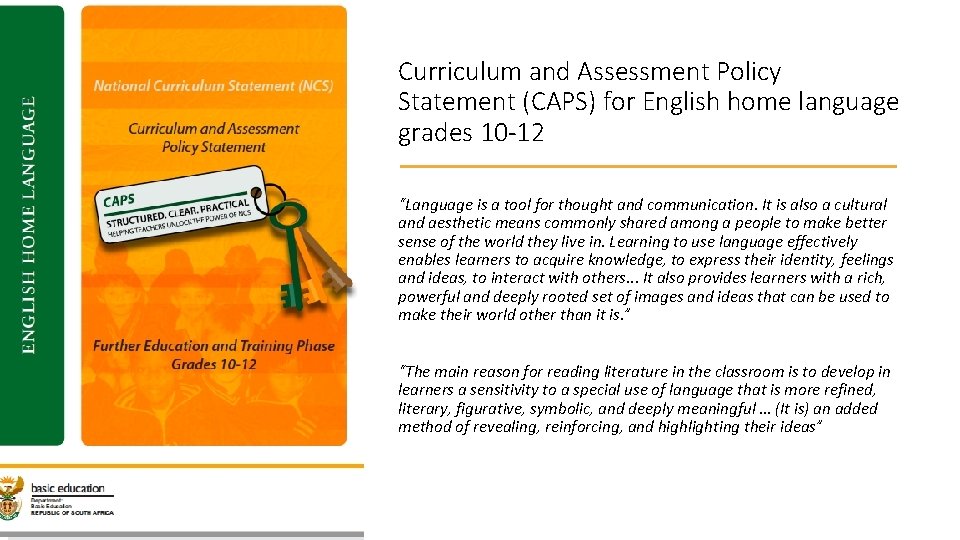
Curriculum and Assessment Policy Statement (CAPS) for English home language grades 10 -12 “Language is a tool for thought and communication. It is also a cultural and aesthetic means commonly shared among a people to make better sense of the world they live in. Learning to use language effectively enables learners to acquire knowledge, to express their identity, feelings and ideas, to interact with others. . . It also provides learners with a rich, powerful and deeply rooted set of images and ideas that can be used to make their world other than it is. ” “The main reason for reading literature in the classroom is to develop in learners a sensitivity to a special use of language that is more refined, literary, figurative, symbolic, and deeply meaningful … (It is) an added method of revealing, reinforcing, and highlighting their ideas”
International research on teaching poetry: contextualizing the issues • Some international research on poetry teaching found: - difficult and potentially alienating literary form for learners - teachers: say difficult to teach, some say poetry ‘elitist’ (Benton, 1999; Linaberger, 2005; Doug, 2011) • Other research: -educators endorse poetry • -helpful bridge for learners’ every day and school worlds; bridge for cognitive and emotional development; poetry brings emotional resonance and real-life topics to classroom discussions; catalyses imaginative inquiry; encourages forms of multi-model learning (Wilson, 2013; Young, 2016; Dykmore, 2012 ). • These paradoxical findings: may be linked to the curriculum and pedagogy- the poems chosen and the ways they are taught- that impact on whether or not learners and educators experience this genre as filled with educational potential or as alienating in other words, as RELEVANT OR NOT • Culturally relevant poetry (Ladson-Billings, 1995; Moll, Amanti, Neff & Gonzalez, 1992). • This project therefore addresses the timely issue in SA linked to decolonization/transformation of knowledge and pedagogy: lingering colonial practices and knowledges, experienced as alienating and uncomfortable • Poetry may be considered a foreign genre with colonial connotations, linked to its classic forms as practiced in Europe, a large body of local poetry and poetic practices exist, from different groups in the population • Poetry as a form of Indigenous knowledge: not African essentialism but an acute awareness that this knowledge is place based and Africa-centred, historically forged but fluid and changing; a form of living archive of colonial, apartheid and post-apartheid society
“poetry holds rich educational potential to connect with learners’ everyday lives in meaningful ways and to engage them by transcending purely rational and cognitive forms of inquiry, delving into emotional domains through multi-modal methods of teaching and learning. This is particularly relevant in a society with traumatic circumstances and histories, like South Africa. Despite this fertile potential for poetry in the classroom, some research has found this genre to be experienced as elitist, unfamiliar and alienating, with educators struggling to teach it as a literary form. It is therefore important for poetry educators to utilize forms of Culturally Relevant Pedagogy that draw connections between learners’ life worlds and the classroom, simultaneously prioritizing their academic success and socio-political consciousness. This is particularly so in South Africa, a country where the rumblings of discontent have already tremoured through higher education institutions, with students dismissing curricula and teaching as underpinned by colonialism, rather than familiar cultural reference points and practices that may precipitate enriching educational experiences. I explore how this may be achieved by looking at the poetry curricula choices, as well as educators’ teaching and assessment practices in two high schools in Johannesburg. ”
Research contexts, interviews with educators and analysis • Schools recruited through teachers in the ZAPP network • Teachers then introduced us to their colleagues and we explained the research • 2 schools: a former model C, a Soweto school; Exclusively Black learners. • 9 interviews with English department teachers, lasting approximately 1 hour • Interviews quite open-ended; explored where teachers have studied, heard and read poetry (inside and outside formal educational spaces), which poems they find rewarding, challenging or unpleasant to teach, their aims, experiences and methods in teaching poetry and which poems they think that students enjoy the most.
Theme 1 “The moment there is something they can relate to it opens up the conversation”: curriculum choices • The concept of “relevance” appeared repeatedly in the interviews • Related to the language used, the contexts and identities of the poetry/poets
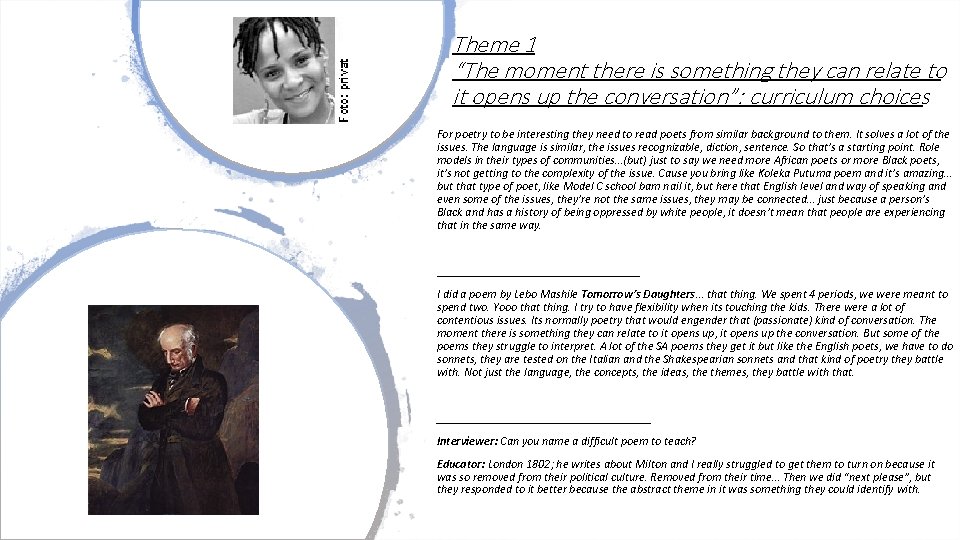
Theme 1 “The moment there is something they can relate to it opens up the conversation”: curriculum choices For poetry to be interesting they need to read poets from similar background to them. It solves a lot of the issues. The language is similar, the issues recognizable, diction, sentence. So that’s a starting point. Role models in their types of communities…(but) just to say we need more African poets or more Black poets, it’s not getting to the complexity of the issue. Cause you bring like Koleka Putuma poem and it’s amazing… but that type of poet, like Model C school bam nail it, but here that English level and way of speaking and even some of the issues, they’re not the same issues, they may be connected… just because a person’s Black and has a history of being oppressed by white people, it doesn’t mean that people are experiencing that in the same way. _________________ I did a poem by Lebo Mashile Tomorrow’s Daughters… that thing. We spent 4 periods, we were meant to spend two. Yooo that thing. I try to have flexibility when its touching the kids. There were a lot of contentious issues. Its normally poetry that would engender that (passionate) kind of conversation. The moment there is something they can relate to it opens up, it opens up the conversation. But some of the poems they struggle to interpret. A lot of the SA poems they get it but like the English poets, we have to do sonnets, they are tested on the Italian and the Shakespearian sonnets and that kind of poetry they battle with. Not just the language, the concepts, the ideas, themes, they battle with that. __________________ Interviewer: Can you name a difficult poem to teach? Educator: London 1802; he writes about Milton and I really struggled to get them to turn on because it was so removed from their political culture. Removed from their time… Then we did “next please”, but they responded to it better because the abstract theme in it was something they could identify with.
Theme 1 “The moment there is something they can relate to it opens up the conversation”: curriculum choices “What made poetry ‘relevant’ for learners was therefore a complex issue, related both to individual poems, but also the body of poetry that was presented to learners as a whole. The accessibility of the language clearly impacted on relevance, as second or third language speakers not comprehending the vocabulary of the poem, or the genre, resulted in alienation. Writers from similar backgrounds, with common race or class-based identities, helped make the poetry relevant but was no guarantee that learners would relate to these poets, people that may have left the township and no longer exclusively focus on its cultural reference points. Teachers were aware that African and South African poetry was more likely to resonate with learners but stressed that it was good for them to experience other cultures and perspectives, expanding their horizons, often with positive outcomes. ”
Theme 2 Grasping at figures of speech: poetry pedagogy • Poetry class an intimidating experience both for learners and educators. • Many teachers retreated to the safety of figures of speech, literary devices and a line by line analysis of the poems You start with giving learners background of the poem and you need to ensure they have knowledge of literary devices. If they don’t know figures of speech it’s going to be difficult for them to engage with a poem at a base level. Poetic devices and figures of speech we do at grade 8 so that as they go up its like scaffolding. So as they reach grade 12 its easier to understand. Then we go to the lines in the poem; what is the implication, what is the message, what is the poet trying to teach us. _________________ They have to number their lines. I read through the poem or one of them reads through it first. Then we’ll do the structure of the poem, what is the line structure what is the stanza structure. We have a little structure bubble. Some of them come to class with their numbered lines and little structure bubbles. We discuss the vocabulary. Then we do a line by line breakdown. Line 1 what figures of speech, literary techniques.
Theme 2 Grasping at figures of speech: poetry pedagogy Some teachers critical of this approach: Interviewee: figures of speech…is not a poem. It’s a tickable term that’s going to be tested in the exam. Who the hell writes a poem for great examples of metaphors? What poetry is in the school context is totally divorced from the real nature of that thing. Poetry is an artistic expression, is a social behavior, social event. It is a social practice, it’s creative. But what it is in school is reading texts that doesn’t really say much to you often and then being forced to answer fairly abstract, opaque questions Interviewer: why is it that way in school? Interviewee: Because of the way the education system is. At some point people decided… English teachers in schools decided that poetry was a good thing to have in it. But so few of those people have ever been exposed or interested in real poetry, or been to poetry recitals or heard poets speak. So they don’t know actually poetry is that. You’ll often hear teachers say we need to know the figures of speech. That’s like you make a system into it. That’s schoolified. School needs to take things in the world and like make points on them. Cut them up or make techniques or points or pieces of information or characteristics that you can things that repeat themselves. Which is fine, it’s part of understanding the world and school is supposed to break the world up into its constituent parts so that you can understand the world better. But the irony is you just learn the constituent parts, but you don’t put them into the whole again.
Theme 3 “There are some teachers who won’t teach if they don’t have a memo”: assessment • Some intentions to teach poetry through experiencing poems and different interpretations of their meaning…however, assessment shaped pedagogical practices • Matric exam a huge influence and obstacle • Educators wanted to support learners to excel • Beyond the matric examination: the ‘memorandum’ created for all school tests and examinations. • Acceptable responses predetermined, limiting learner agency
Theme 3 “There are some teachers who won’t teach if they don’t have a memo”: assessment Educator: With the matrics you have to prepare them for the final exam, so it’s out of our control, although we know more or less what they will ask. That’s also something I try not to do. Interviewer: Teach to the test? Educator : You do that with your matriculants. You know what questions they’re going to ask. There won’t be questions outside of the parameters of the study guide. _____________________________ There are some teachers who won’t teach if they don’t have a memo. So they going to want to have a feeling of what the answers would be to the questions, obviously so that they can go through them for their classes. _____________________________ We have a memo meeting and I’ll say this is also another way of looking at it and the child has responded. Very often we can’t accept that second answer. So if we gonna teach the children ‘be open minded, its open to your interpretation’, then we need to include that in the memo. In our memo discussions we are a bit too rigid in terms of what we expect.
“Finding the poetry in poetry”: some thoughts • English language poetry could connect to these learners’ everyday lives, but this not true across the poetry curriculum or both schools • Difficult vocabulary for learners studying in a language they didn’t speak at home, • Topics and contexts that the poems engaged with and the origins of the authors • Writers from similar backgrounds helped relevance but no guarantee; authors originating from unfamiliar contexts did not occlude the relevance of their work for South African learners • Balance required: substantial body of South African and African poetry but careful not to create a binary between foreign poetry =‘universal issues’ and South African poetry =‘local politics’.
“Finding the poetry in poetry”: some thoughts • Certain South African poets: fertile, Culturally Relevant Pedagogy. Eg Lebo Mashile’s Tomorrow’s daughters • Young Black South African woman; issue of young Black women becoming poets; racism, sexism, norms about bodies, who speaks and who is recognized. • Exemplified for learners: people like them can become creators of school textbook knowledge, highlighting relevant issues in a creative way, provoking socio-political consciousness • But the poem also links with other contexts, eg Emily Dickinson in Nineteenth century America: CRP not necessarily insulated, only addressing learners’ cultural practices and reference points. Holds potential to expand their worlds and transport them to new places. • Curriculum choices should not be separated from teaching and assessment methods: Many teachers not confident teaching poetry; sought refuge in figures of speech and individual lines. • Teachers honest- these practices not only for learners, but also for themselves. • Acknowledged teaching underpinned by study guides and assessment dominated by memoranda are problematic, but educators feared they would disadvantage their students if didn’t give them ‘knowledge’ to pass examinations. • High stakes testing: neoliberal ideology and values into education systems in South Africa and elsewhere: challenges to teaching poetry that’s meaningful and empowering. • Similar findings elsewhere. Standardized assessment in the UK and New Zealand restricts space for teaching poetry • Educators and students collude: imagine poetry as obscure genre and employ conventional analytical methods rather than experiencing “the poetry of poetry” • Not necessarily because they lack effort but due to insecurities around teaching poetry and their fears that they will not prepare students adequately.
“Finding the poetry in poetry”: some thoughts • Curriculum, pedagogy and assessment need to be focused on collectively, if teaching poetry is to become relevant • Potentially empowering poems ineffective if engaged with and assessed in ways that are unable to connect with learners’ lives…teaching and assessment require a body of poems that speak to the issues and worlds inhabited by learners. • Poems with great potential to engage and stimulate learners will have little effect if they are only taught by analyzing figures of speech in a ‘line by line’ fashion. Similarly, methods of teaching that allow learners to experience “the poetry of poetry”, are unlikely to engage learners if the poems chosen are irrelevant to their worlds. • If the sole intention of educators is to prepare learners for standardized examinations, it is also unlikely that the educational potential of poetry will be realized. • Examinations not irrelevant to learners, key to social mobility therefore need both to expose learners to the poetry of poetry and aid in their academic success, whilst being mindful of the local and broader, global contexts in which education systems play out.
It’s as if the English curriculum is structured around teaching them the facts. English has become like a study subject like history. You get the poem, you get the notes. You study those notes, write the test. Instead of feeling the language on your mouth and watching it on paper and becoming comfortable in that skin or in that tongue, to speak in that tongue. I struggle. I really struggle. One thing I enjoyed about varsity is that I felt like this is for you and the world. It was enrichment. If you want to pass, tell me why it’s a good poem. Not tell me ABC.