Teaching History in the Soviet Union memories of
- Slides: 10
Teaching History in the Soviet Union – memories of the intrusion of power n “It’s not my view that makes you nervous; it’s memory that makes you nervous. ” Sue Campell (2008) Aija Abens, M. Ed.
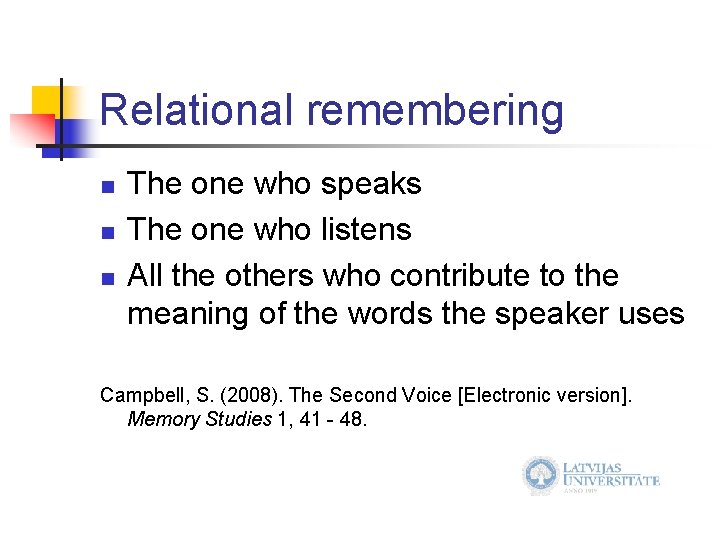
Relational remembering n n n The one who speaks The one who listens All the others who contribute to the meaning of the words the speaker uses Campbell, S. (2008). The Second Voice [Electronic version]. Memory Studies 1, 41 - 48.
Teacher profile n n 10 teachers All Latvian All but one born in Latvia All taught in Latvian
Power associated with the regime visible in four aspects of education: n n curriculum evaluation interactions with students family history as determiner of success
Teacher education and curriculum n n n Soviet education system highly centralized with unified curriculum, teaching materials, and methodological requirements highly politicized Latvian history teaching – a political “hot potato”
Evaluation n ideological nature of history required frequent monitoring student achievement stressed form over content rote learning and poor understanding of material
Interactions with students n n inability to counter student challenges on certain topics generally open and friendly
Family history as a determiner of success n n family pedigree cornerstone to success fear of repercussions
Forgetting as a failure n n n Repressive erasure Prescriptive forgetting Forgetting as humiliated science Connerton, P. (2008). Seven types of forgetting [Electronic version]. Memory Studies, 1, 59 - 71.
Thank you!