Supporting Students of Concern Ilene Rosenstein Ph D

- Slides: 10
Supporting Students of Concern Ilene Rosenstein, Ph. D. Director, Student Counseling Services Assistant Professor, CHLA College Health Lynette Merriman, Ed. D. Assistant Provost for Student Affairs Support and Advocacy Assistant Professor of Clinical Education, Rossier
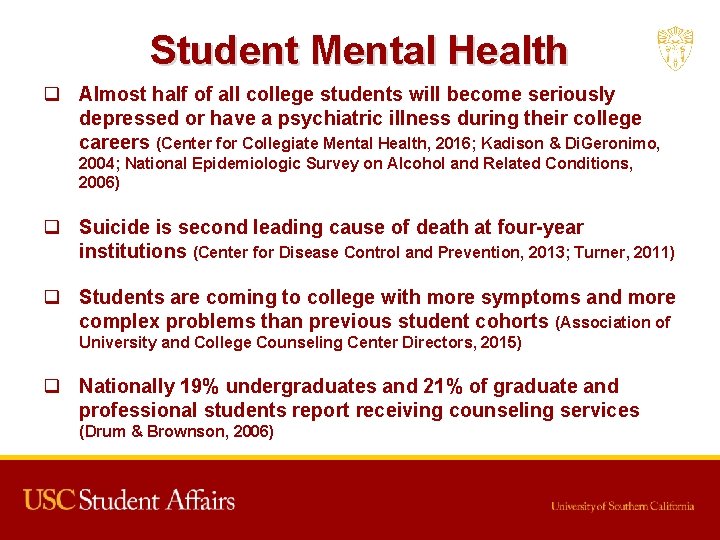
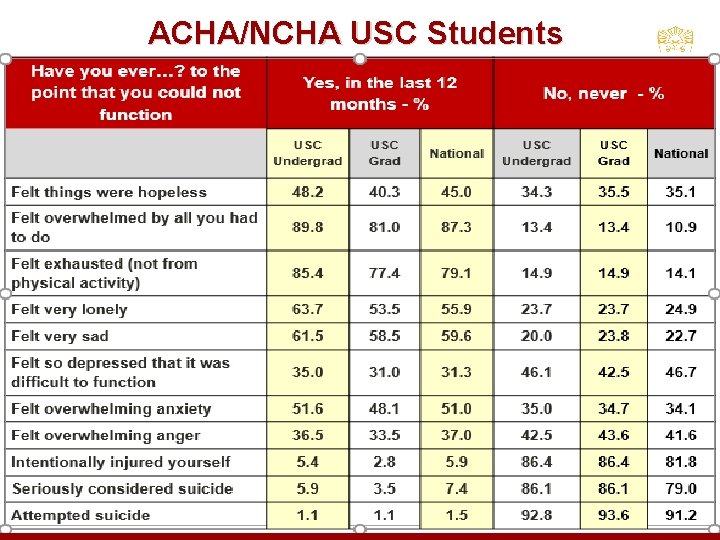
Student Mental Health q Almost half of all college students will become seriously depressed or have a psychiatric illness during their college careers (Center for Collegiate Mental Health, 2016; Kadison & Di. Geronimo, 2004; National Epidemiologic Survey on Alcohol and Related Conditions, 2006) q Suicide is second leading cause of death at four-year institutions (Center for Disease Control and Prevention, 2013; Turner, 2011) q Students are coming to college with more symptoms and more complex problems than previous student cohorts (Association of University and College Counseling Center Directors, 2015) q Nationally 19% undergraduates and 21% of graduate and professional students report receiving counseling services (Drum & Brownson, 2006) 2
ACHA/NCHA USC Students
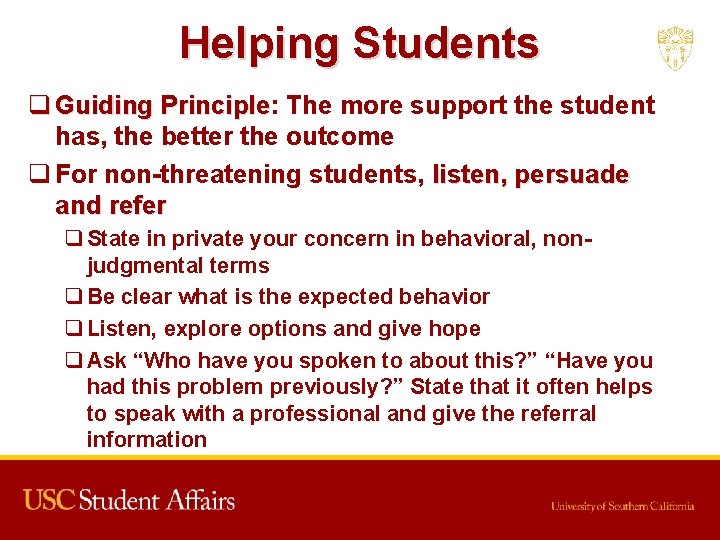
Helping Students q Guiding Principle: Principle The more support the student has, the better the outcome q For non-threatening students, listen, persuade and refer q State in private your concern in behavioral, nonjudgmental terms q Be clear what is the expected behavior q Listen, explore options and give hope q Ask “Who have you spoken to about this? ” “Have you had this problem previously? ” State that it often helps to speak with a professional and give the referral information
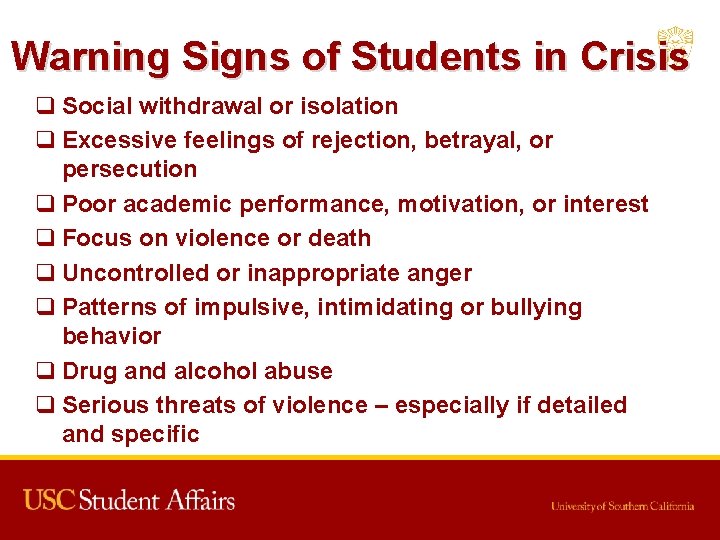
Warning Signs of Students in Crisis q Social withdrawal or isolation q Excessive feelings of rejection, betrayal, or persecution q Poor academic performance, motivation, or interest q Focus on violence or death q Uncontrolled or inappropriate anger q Patterns of impulsive, intimidating or bullying behavior q Drug and alcohol abuse q Serious threats of violence – especially if detailed and specific
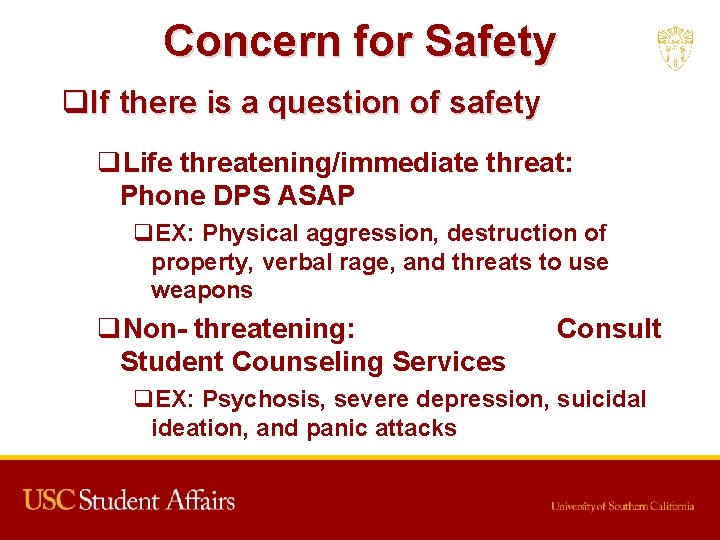
Concern for Safety q. If there is a question of safety q. Life threatening/immediate threat: Phone DPS ASAP q. EX: Physical aggression, destruction of property, verbal rage, and threats to use weapons q. Non- threatening: Student Counseling Services Consult q. EX: Psychosis, severe depression, suicidal ideation, and panic attacks
Contacting Student Counseling q Students may call the Student Counseling Services (SCS) at 213 -740 -7711 q Give the SCS brochure or website q If students feel that they must see a counselor immediately, Student Counseling Services offers walk-ins between 8: 30 am and 5: 00 pm q If the faculty member feels the student must be seen immediately, call and consult with the on-call counselor who might recommend: q. Student being walked over to SCS q SCS staff comes to the faculty to help q Workshop or training for department q A clinician is always available on-call 24/7
Campus Interventions q Team Approach q. Student Affairs Student Concerns committee q. Student Support and Advocacy (SSA) q. USC Threat Assessment Team q. Contact parents, outside mental health providers, and/or campus administrators q. Wellness checks q. Medical leaves of absences q. Hospitalizations q. SJACS or Title IX
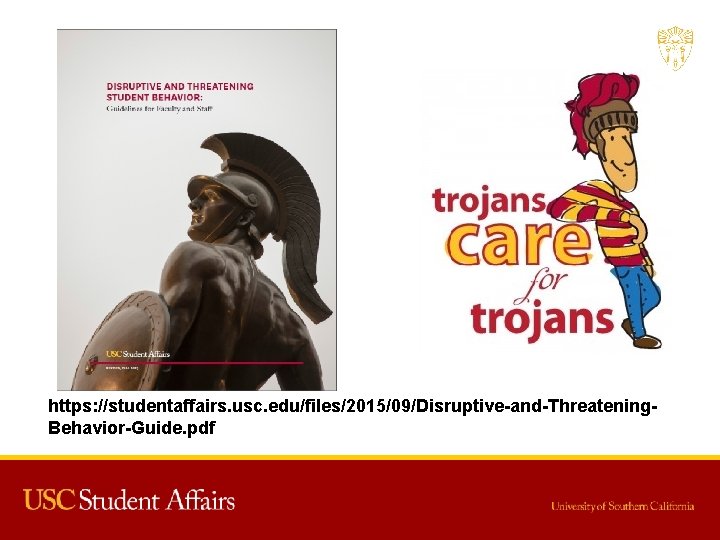
https: //studentaffairs. usc. edu/files/2015/09/Disruptive-and-Threatening. Behavior-Guide. pdf
Resources q. Student Counseling Servicces (SCS) – 213. 740. 7711 q. Relationship and Sexual Violence Prevention and Services (RSVP) – 213. 740. 4900 q. Student Support and Advocacy (SSA) 213. 821. 4710