
Growth Within Differentiating and Engaging Learners Dr Ilene


- Slides: 12
Growth Within, Differentiating and Engaging Learners Dr. Ilene Foster Claremont Graduate University Teacher Education
By: Jasmine Ochoa High School Algebra 1 student May your happiness be multiplied… May your worries be divided… May your blessings be added… And may your struggles be subtracted… May the blessings in your life be exponential…
Differentiated Instruction Defined “Differentiated instruction is a teaching philosophy based on the premise that teachers should adapt instruction to student differences. Rather than marching students through the curriculum lockstep, teachers should modify their instruction to meet students’ varying readiness levels, learning preferences, and interests. Therefore, the teacher proactively plans a variety of ways to ‘get at’ and express learning. ” Carol Ann Tomlinson
Differentiation is responsive teaching rather than one-size-fitsall teaching.
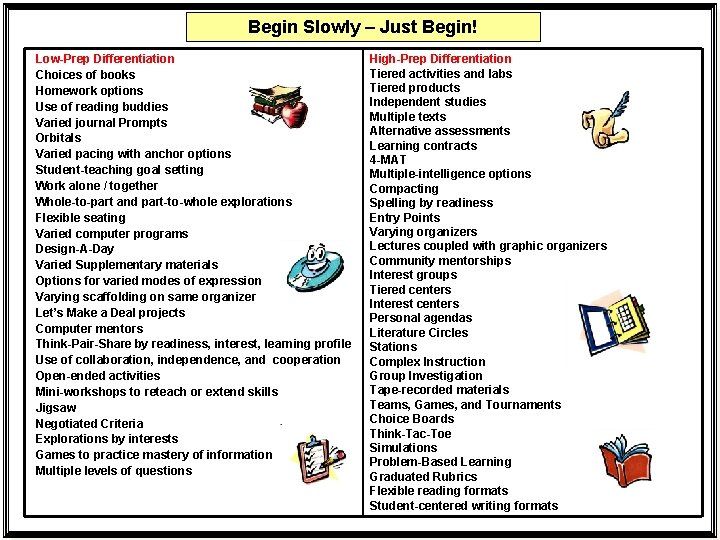
Begin Slowly – Just Begin! Low-Prep Differentiation Choices of books Homework options Use of reading buddies Varied journal Prompts Orbitals Varied pacing with anchor options Student-teaching goal setting Work alone / together Whole-to-part and part-to-whole explorations Flexible seating Varied computer programs Design-A-Day Varied Supplementary materials Options for varied modes of expression Varying scaffolding on same organizer Let’s Make a Deal projects Computer mentors Think-Pair-Share by readiness, interest, learning profile Use of collaboration, independence, and cooperation Open-ended activities Mini-workshops to reteach or extend skills Jigsaw Negotiated Criteria Explorations by interests Games to practice mastery of information Multiple levels of questions High-Prep Differentiation Tiered activities and labs Tiered products Independent studies Multiple texts Alternative assessments Learning contracts 4 -MAT Multiple-intelligence options Compacting Spelling by readiness Entry Points Varying organizers Lectures coupled with graphic organizers Community mentorships Interest groups Tiered centers Interest centers Personal agendas Literature Circles Stations Complex Instruction Group Investigation Tape-recorded materials Teams, Games, and Tournaments Choice Boards Think-Tac-Toe Simulations Problem-Based Learning Graduated Rubrics Flexible reading formats Student-centered writing formats
Engaging Students in Learning If one component can claim to be the most important, it is student engagement. All the rest of the Framework is in the service of student engagement.
Nothing happening… “It is possible to have a smoothly functioning, lively classroom where all the students appear happily occupied with worthwhile tasks and yet no mental acts conducive to learning are taking place. ” Graham Nuthall, 2005
Nothing happening… “It is possible to have a smoothly functioning, lively classroom where all the students appear happily occupied with worthwhile tasks and yet no mental acts conducive to learning are taking place. ” Graham Nuthall, 2005
Nothing happening… “It is possible to have a smoothly functioning, lively classroom where all the students appear happily occupied with worthwhile tasks and yet no mental acts conducive to learning are taking place. ” Graham Nuthall, 2005
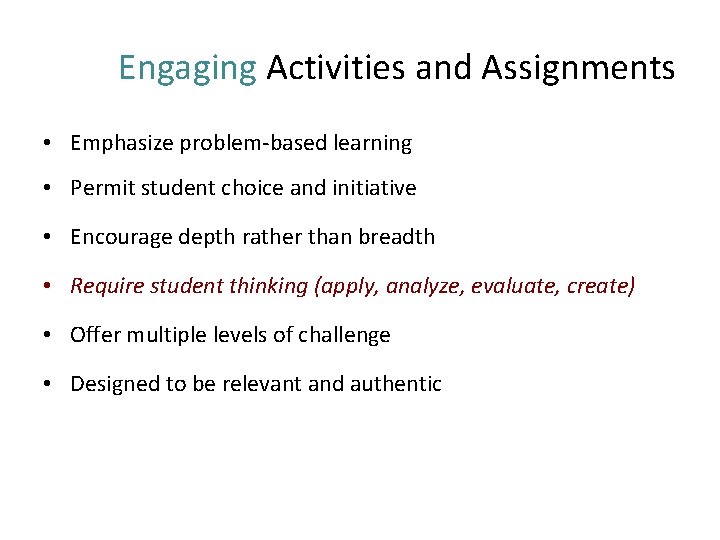
Engaging Activities and Assignments • Emphasize problem-based learning • Permit student choice and initiative • Encourage depth rather than breadth • Require student thinking (apply, analyze, evaluate, create) • Offer multiple levels of challenge • Designed to be relevant and authentic
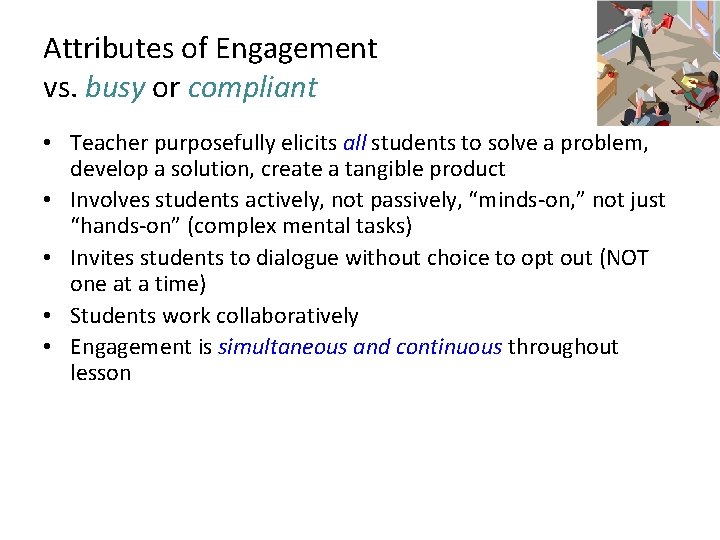
Attributes of Engagement vs. busy or compliant • Teacher purposefully elicits all students to solve a problem, develop a solution, create a tangible product • Involves students actively, not passively, “minds-on, ” not just “hands-on” (complex mental tasks) • Invites students to dialogue without choice to opt out (NOT one at a time) • Students work collaboratively • Engagement is simultaneous and continuous throughout lesson
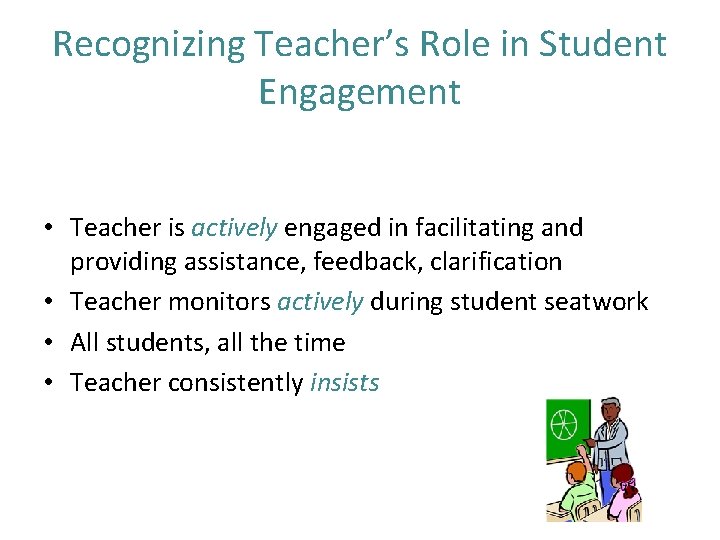
Recognizing Teacher’s Role in Student Engagement • Teacher is actively engaged in facilitating and providing assistance, feedback, clarification • Teacher monitors actively during student seatwork • All students, all the time • Teacher consistently insists