SUMA LSS To help countries and organizations in
- Slides: 30
SUMA & LSS To help countries and organizations in the management of humanitarian assistance and emergency supplies. The Logistics Support System (LSS) has been possible thanks to the active participation of the following agencies: WHO, PAHO, UNICEF, WFP, OCHA, and UNHCR. Counts with the participation of the principal NGOs and others humanitarian actors to help countries and organizations in the management of humanitarian assistance and emergency supplies. This recognition extends to the countries that have contributed their logistical experience in disaster management and the following organizations who participated with their time and personnel in the technical meetings and workshops on the logistical management of humanitarian supplies: CARE, World Economic Forum, MSF, OXFAM UK, FICR, HAP, AHA, Fritz Institute, All Russian Disaster Medicine Centers, World Bank, VOICE, Interaction, CICR, BIOFORCE, USD Defense Logistic Agency, Zacshta Center. Additionally, FUNDESUMA and UNJLC have contributed to the design and development of the software and technical documentation. The following development agencies have contributed with financial support: the Swedish international development cooperation agency (SIDA), the United Kingdom’s Department for International Development (DFID), the Office for Foreign Disaster Assistance of the United States of America (OFDA/USAID), the Division of Humanitarian Assistance, Peace and Security of the Canadian International Development Agency (CIDA), the European Union Directorate General for Humanitarian Aid (ECHO) and the Ministry of Foreign Affairs of the Dutch Government.
LSS Project Agreement between UN agencies To develop an integrated system to improve coordination
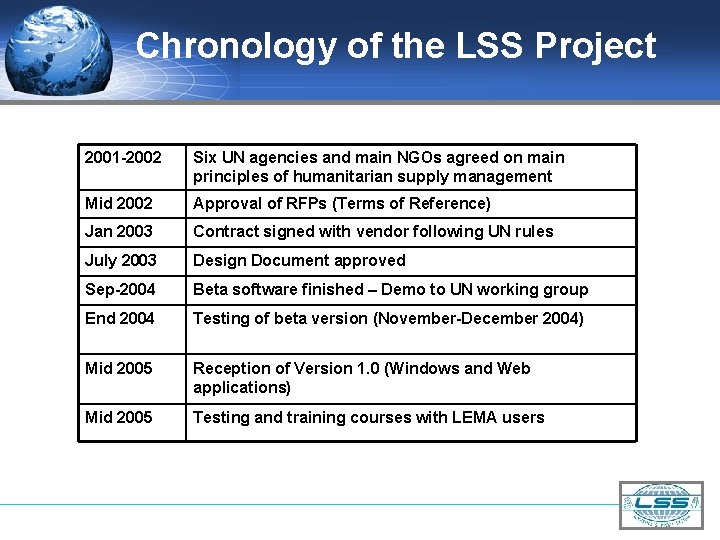
Chronology of the LSS Project 2001 -2002 Six UN agencies and main NGOs agreed on main principles of humanitarian supply management Mid 2002 Approval of RFPs (Terms of Reference) Jan 2003 Contract signed with vendor following UN rules July 2003 Design Document approved Sep-2004 Beta software finished – Demo to UN working group End 2004 Testing of beta version (November-December 2004) Mid 2005 Reception of Version 1. 0 (Windows and Web applications) Mid 2005 Testing and training courses with LEMA users
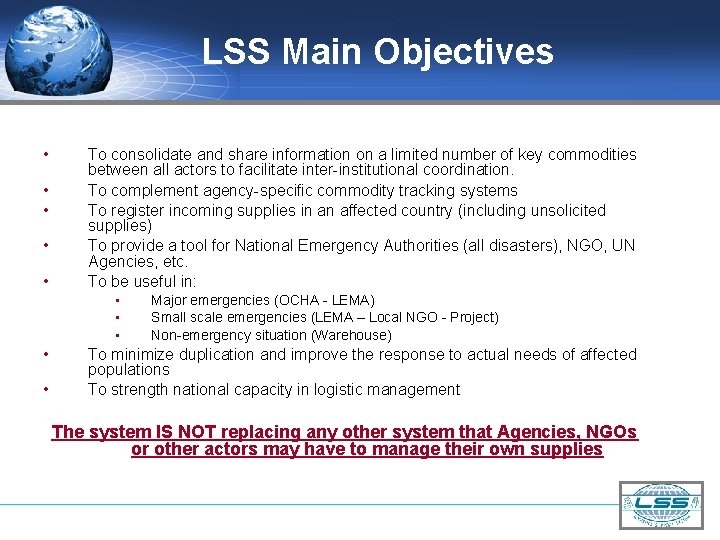
LSS Main Objectives • • • To consolidate and share information on a limited number of key commodities between all actors to facilitate inter-institutional coordination. To complement agency-specific commodity tracking systems To register incoming supplies in an affected country (including unsolicited supplies) To provide a tool for National Emergency Authorities (all disasters), NGO, UN Agencies, etc. To be useful in: • • • Major emergencies (OCHA - LEMA) Small scale emergencies (LEMA – Local NGO - Project) Non-emergency situation (Warehouse) To minimize duplication and improve the response to actual needs of affected populations To strength national capacity in logistic management The system IS NOT replacing any other system that Agencies, NGOs or other actors may have to manage their own supplies
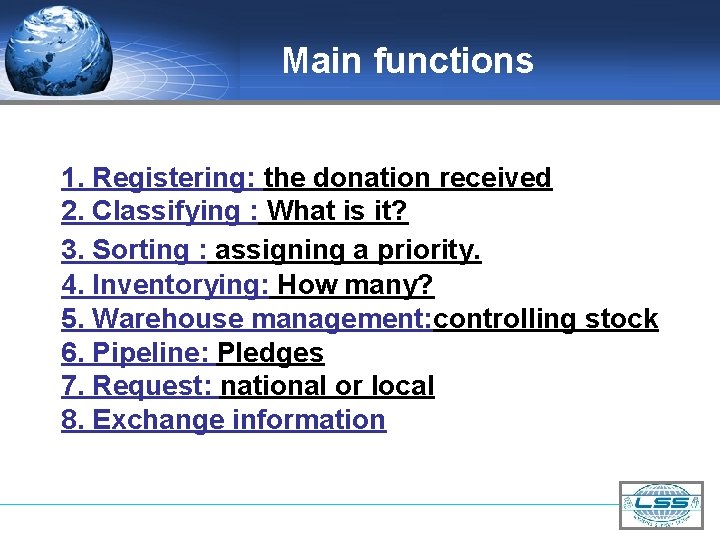
Main functions 1. Registering: the donation received 2. Classifying : What is it? 3. Sorting : assigning a priority. 4. Inventorying: How many? 5. Warehouse management: controlling stock 6. Pipeline: Pledges 7. Request: national or local 8. Exchange information
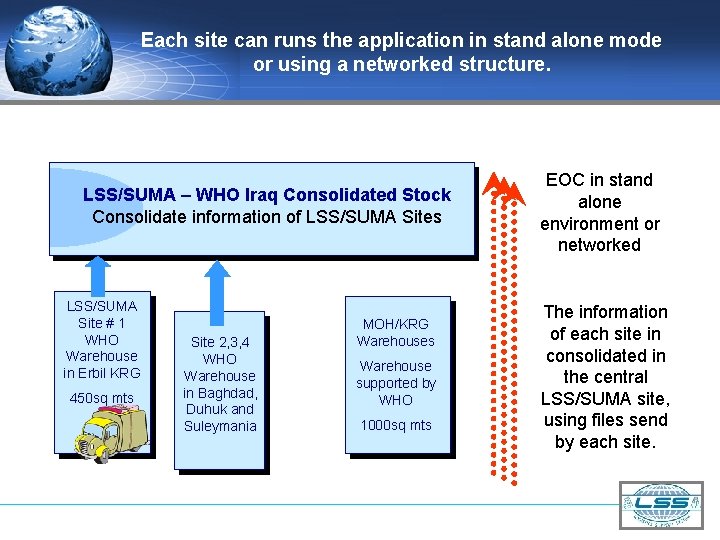
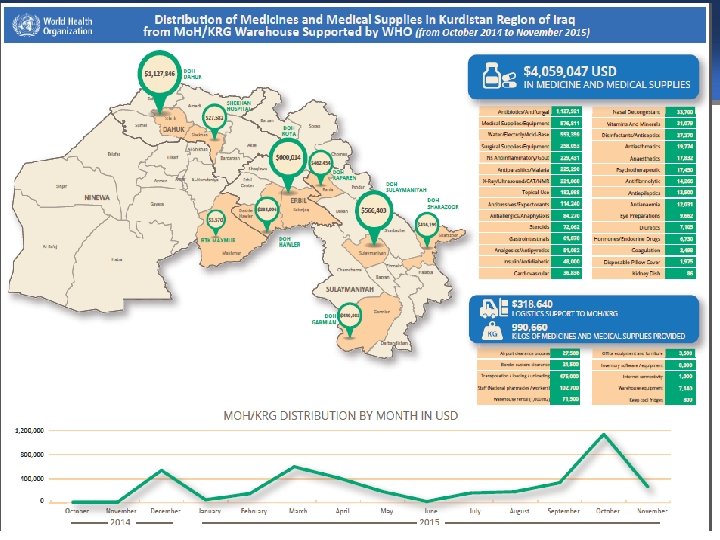
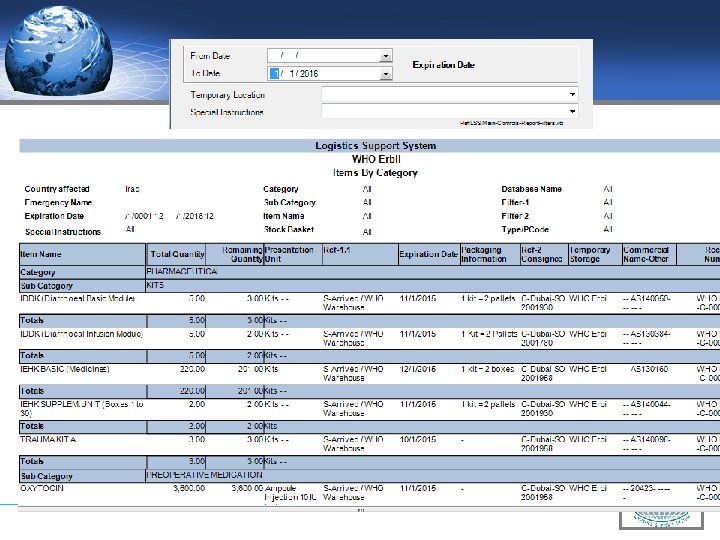
Each site can runs the application in stand alone mode or using a networked structure. LSS/SUMA – WHO Iraq Consolidated Stock Consolidate information of LSS/SUMA Sites LSS/SUMA Site # 1 WHO Warehouse in Erbil KRG 450 sq mts Site 2, 3, 4 WHO Warehouse in Baghdad, Duhuk and Suleymania MOH/KRG Warehouses Warehouse supported by WHO 1000 sq mts EOC in stand alone environment or networked The information of each site in consolidated in the central LSS/SUMA site, using files send by each site.
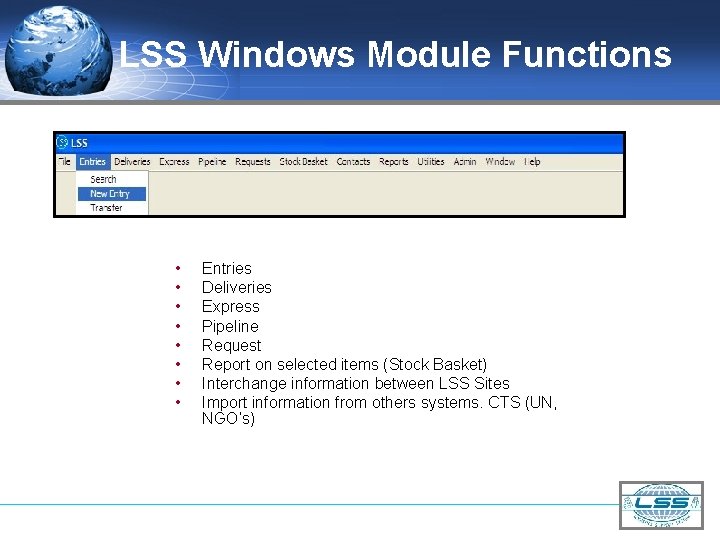
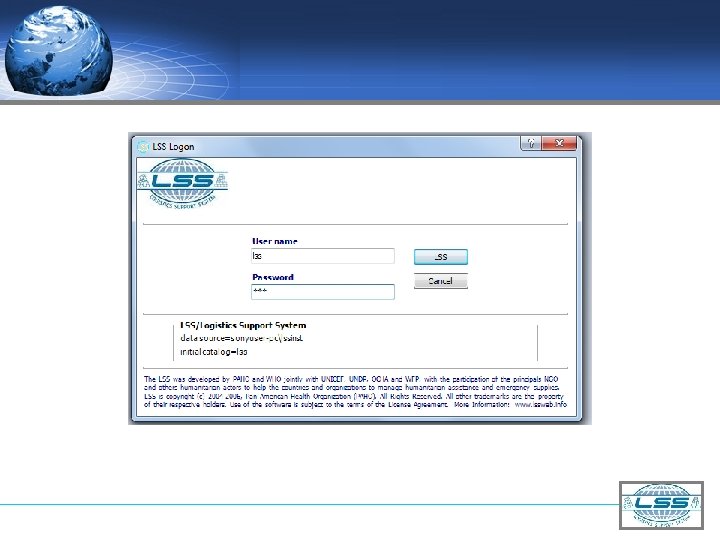
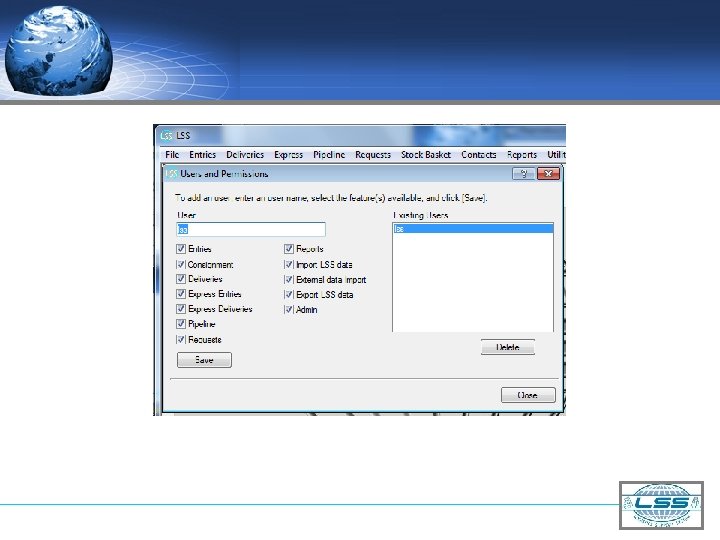
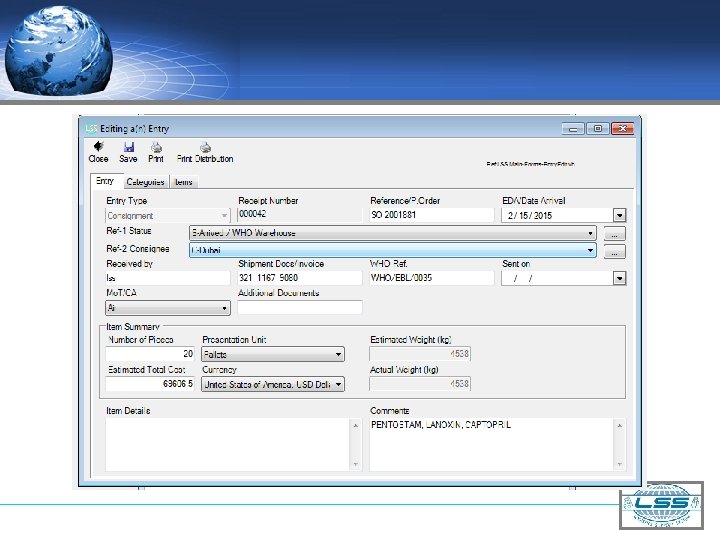
LSS Windows Module Functions • • Entries Deliveries Express Pipeline Request Report on selected items (Stock Basket) Interchange information between LSS Sites Import information from others systems. CTS (UN, NGO’s)
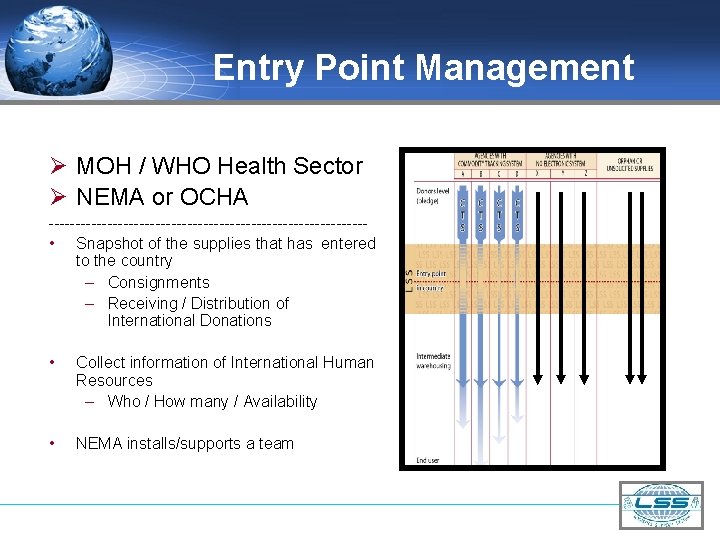
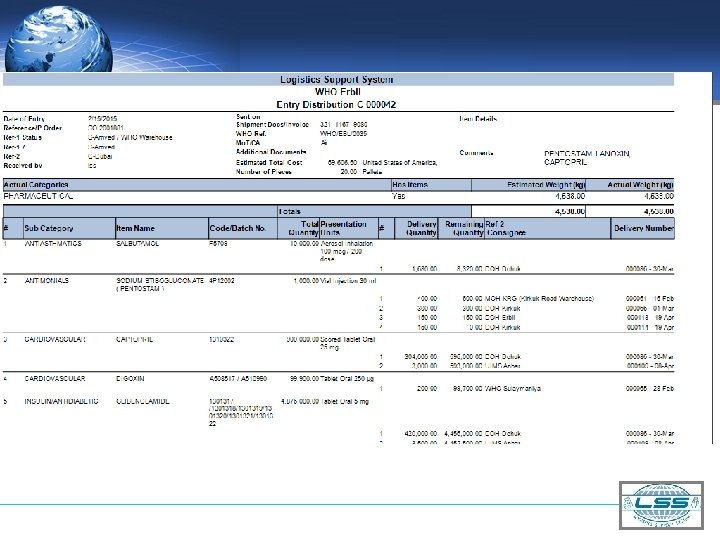
Entry Point Management Ø MOH / WHO Health Sector Ø NEMA or OCHA ------------------------------ • Snapshot of the supplies that has entered to the country – Consignments – Receiving / Distribution of International Donations • Collect information of International Human Resources – Who / How many / Availability • NEMA installs/supports a team
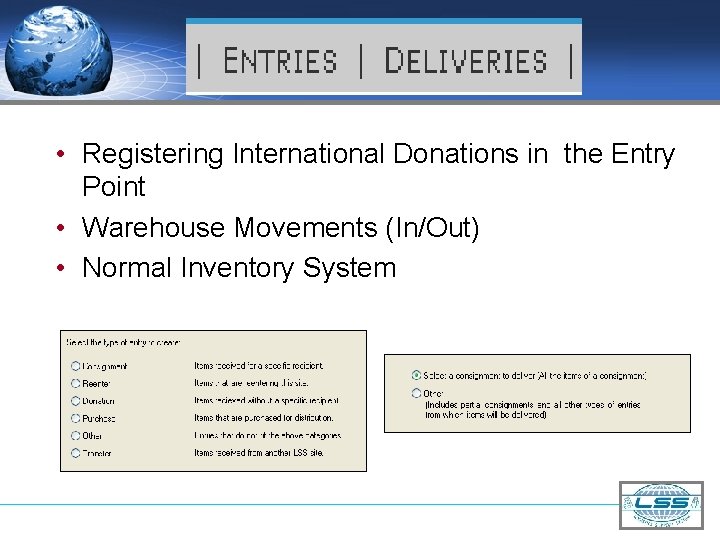
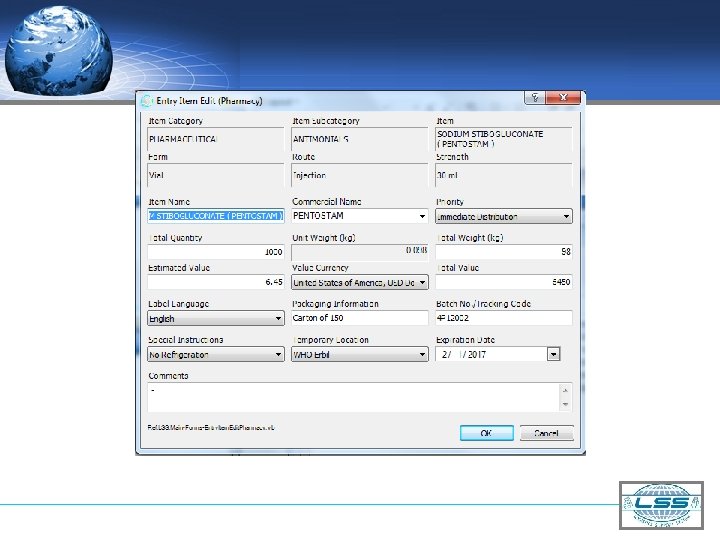
• Registering International Donations in the Entry Point • Warehouse Movements (In/Out) • Normal Inventory System
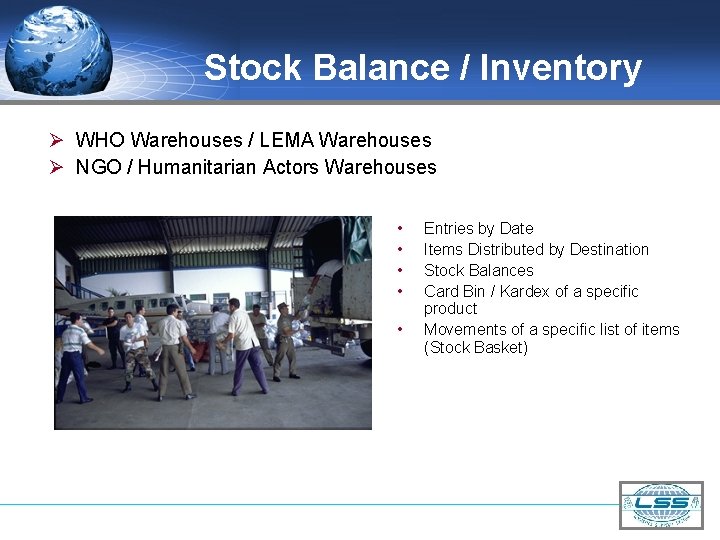
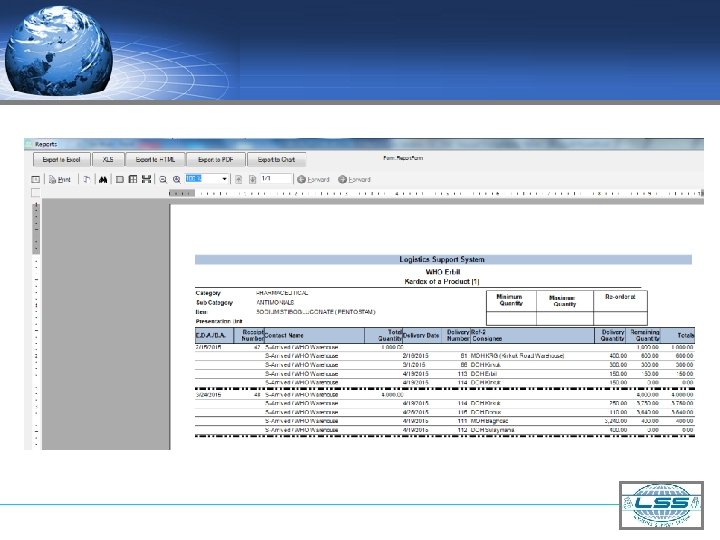
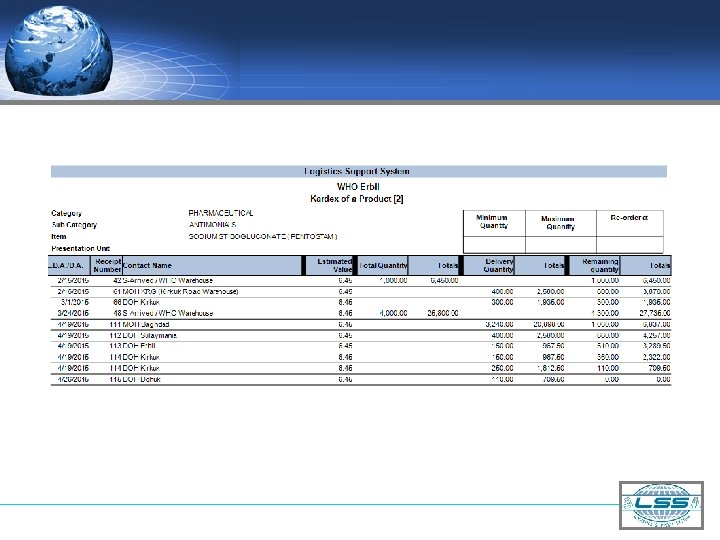
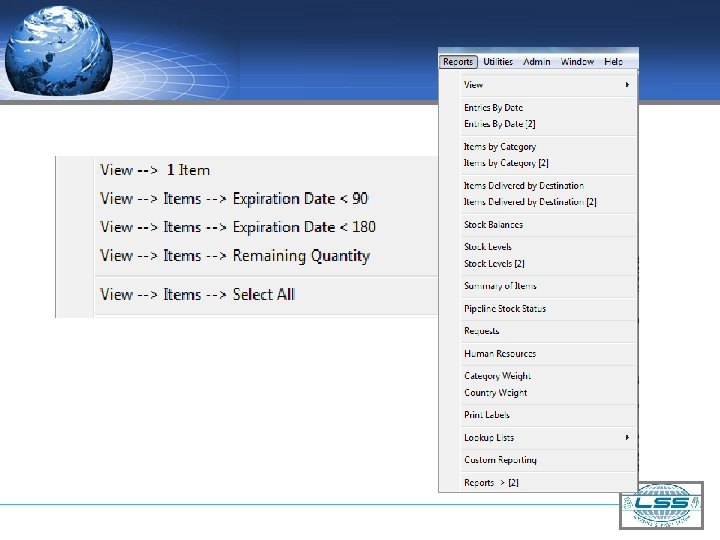
Stock Balance / Inventory Ø WHO Warehouses / LEMA Warehouses Ø NGO / Humanitarian Actors Warehouses • • • Entries by Date Items Distributed by Destination Stock Balances Card Bin / Kardex of a specific product Movements of a specific list of items (Stock Basket)
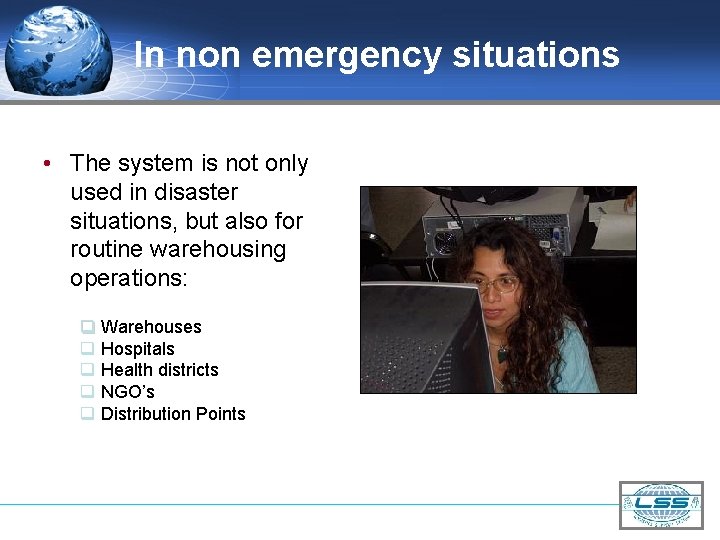
In non emergency situations • The system is not only used in disaster situations, but also for routine warehousing operations: q Warehouses q Hospitals q Health districts q NGO’s q Distribution Points
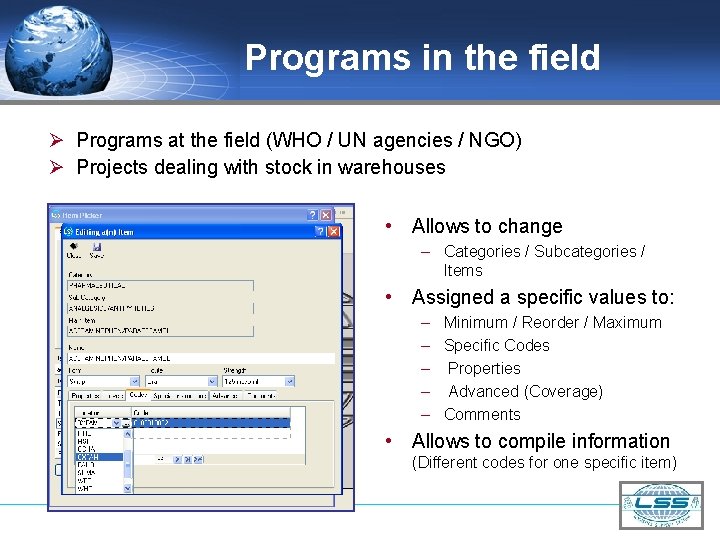
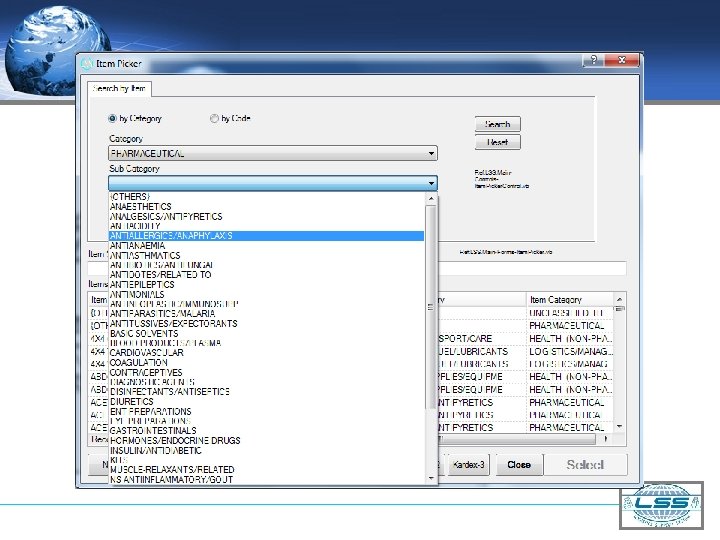
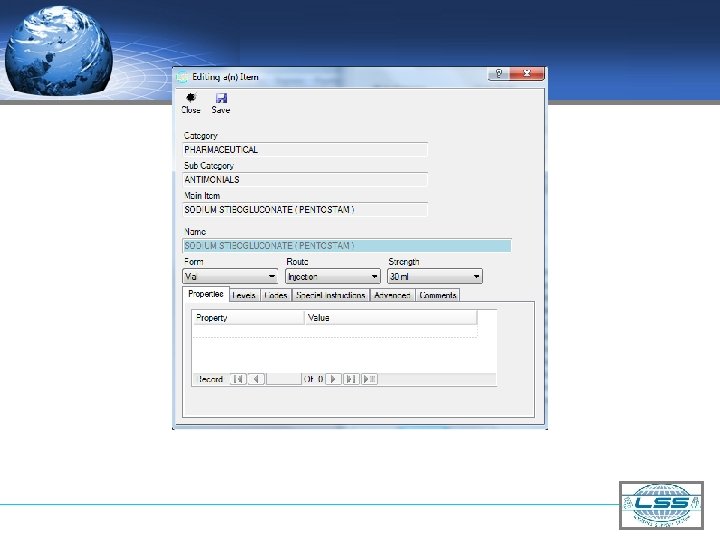
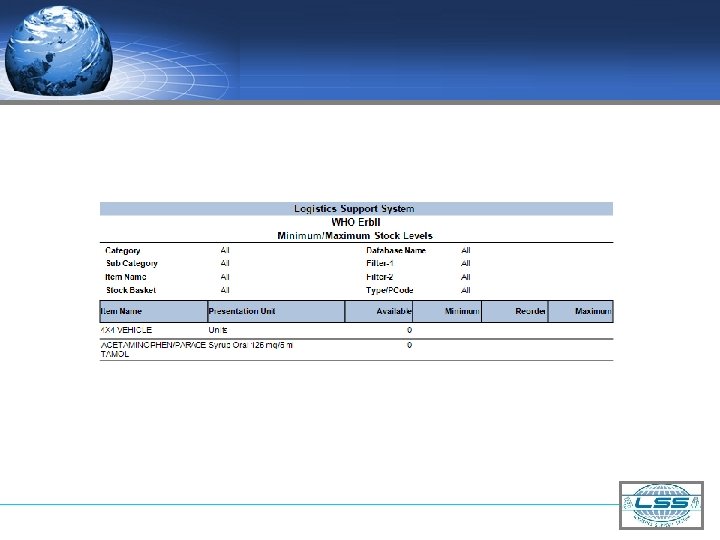
Programs in the field Ø Programs at the field (WHO / UN agencies / NGO) Ø Projects dealing with stock in warehouses • Allows to change – Categories / Subcategories / Items • Assigned a specific values to: – – – Minimum / Reorder / Maximum Specific Codes Properties Advanced (Coverage) Comments • Allows to compile information (Different codes for one specific item)
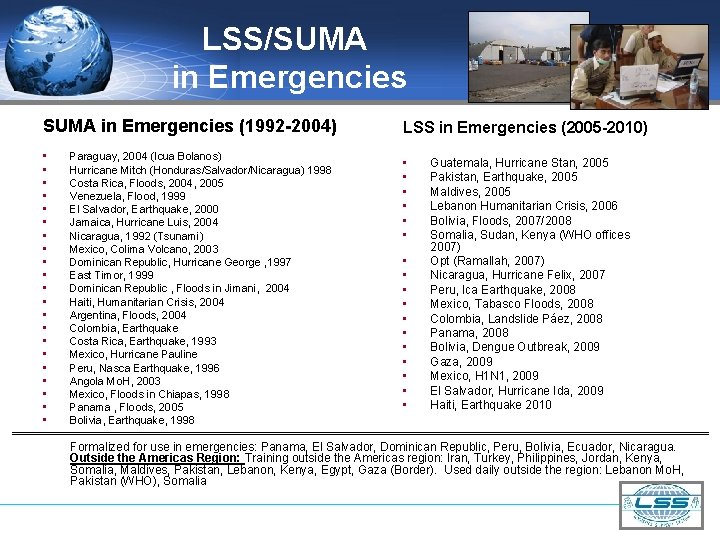
LSS/SUMA in Emergencies (1992 -2004) LSS in Emergencies (2005 -2010) • • • • • • • Paraguay, 2004 (Icua Bolanos) Hurricane Mitch (Honduras/Salvador/Nicaragua) 1998 Costa Rica, Floods, 2004, 2005 Venezuela, Flood, 1999 El Salvador, Earthquake, 2000 Jamaica, Hurricane Luis, 2004 Nicaragua, 1992 (Tsunami) Mexico, Colima Volcano, 2003 Dominican Republic, Hurricane George , 1997 East Timor, 1999 Dominican Republic , Floods in Jimani, 2004 Haiti, Humanitarian Crisis, 2004 Argentina, Floods, 2004 Colombia, Earthquake Costa Rica, Earthquake, 1993 Mexico, Hurricane Pauline Peru, Nasca Earthquake, 1996 Angola Mo. H, 2003 Mexico, Floods in Chiapas, 1998 Panama , Floods, 2005 Bolivia, Earthquake, 1998 • • • Guatemala, Hurricane Stan, 2005 Pakistan, Earthquake, 2005 Maldives, 2005 Lebanon Humanitarian Crisis, 2006 Bolivia, Floods, 2007/2008 Somalia, Sudan, Kenya (WHO offices 2007) Opt (Ramallah, 2007) Nicaragua, Hurricane Felix, 2007 Peru, Ica Earthquake, 2008 Mexico, Tabasco Floods, 2008 Colombia, Landslide Páez, 2008 Panama, 2008 Bolivia, Dengue Outbreak, 2009 Gaza, 2009 Mexico, H 1 N 1, 2009 El Salvador, Hurricane Ida, 2009 Haiti, Earthquake 2010 Formalized for use in emergencies: Panama, El Salvador, Dominican Republic, Peru, Bolivia, Ecuador, Nicaragua. Outside the Americas Region: Training outside the Americas region: Iran, Turkey, Philippines, Jordan, Kenya, Somalia, Maldives, Pakistan, Lebanon, Kenya, Egypt, Gaza (Border). Used daily outside the region: Lebanon Mo. H, Pakistan (WHO), Somalia
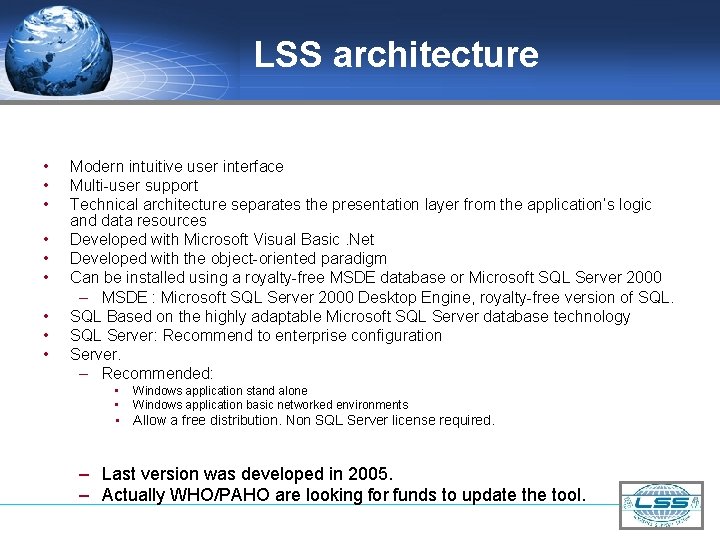
LSS architecture • • • Modern intuitive user interface Multi-user support Technical architecture separates the presentation layer from the application’s logic and data resources Developed with Microsoft Visual Basic. Net Developed with the object-oriented paradigm Can be installed using a royalty-free MSDE database or Microsoft SQL Server 2000 – MSDE : Microsoft SQL Server 2000 Desktop Engine, royalty-free version of SQL Based on the highly adaptable Microsoft SQL Server database technology SQL Server: Recommend to enterprise configuration Server. – Recommended: • • Windows application stand alone Windows application basic networked environments • Allow a free distribution. Non SQL Server license required. – Last version was developed in 2005. – Actually WHO/PAHO are looking for funds to update the tool.
Thanks Victor Martinez WHO/Iraq More Information www. lssweb. net Jeronimo Venegas venegasj@paho. org
Acknowledgments The Logistics Support System (LSS) has been possible thanks to the active participation of the following agencies: WHO, PAHO, UNICEF, WFP, OCHA, and UNHCR. This recognition extends to the countries that have contributed their logistical experience in disaster management and the following organizations who participated with their time and personnel in the technical meetings and workshops on the logistical management of humanitarian supplies: CARE, World Economic Forum, MSF, OXFAM UK, FICR, HAP, AHA, Fritz Institute, All Russian Disaster Medicine Centers, World Bank, VOICE, Interaction, CICR, BIOFORCE, USD Defense Logistic Agency, Zacshta Center. Additionally, FUNDESUMA and UNJLC have contributed to the design and development of the software and technical documentation. The following development agencies have contributed with financial support: the Swedish international development cooperation agency (SIDA), the United Kingdom’s Department for International Development (DFID), the Office for Foreign Disaster Assistance of the United States of America (OFDA/USAID), the Division of Humanitarian Assistance, Peace and Security of the Canadian International Development Agency (CIDA), the European Union Directorate General for Humanitarian Aid (ECHO) and the Ministry of Foreign Affairs of the Dutch Government.