Suggested Exercise 4 Questions and Short Answers Question
- Slides: 24
Suggested Exercise 4 Questions and Short Answers
Question #1 • What are the differences between semaphores and monitors?
Question #1 (Answers found in Session 10) • Sempahores increment and decrement – P() and V() – Never go below zero • Monitors only work inside of a lock – Uses signal, broadcast, and wait
Question #1 (Answers found in Session 10) • Condition variables have no history, but semaphores have – Signal() with an empty queue does nothing • A subsequent Wait() will wait – V() increments semaphore • A subsequent P() will not wait
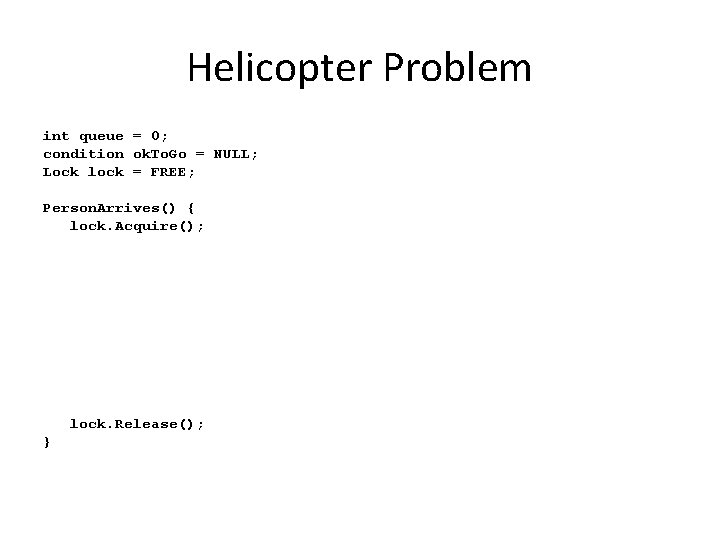
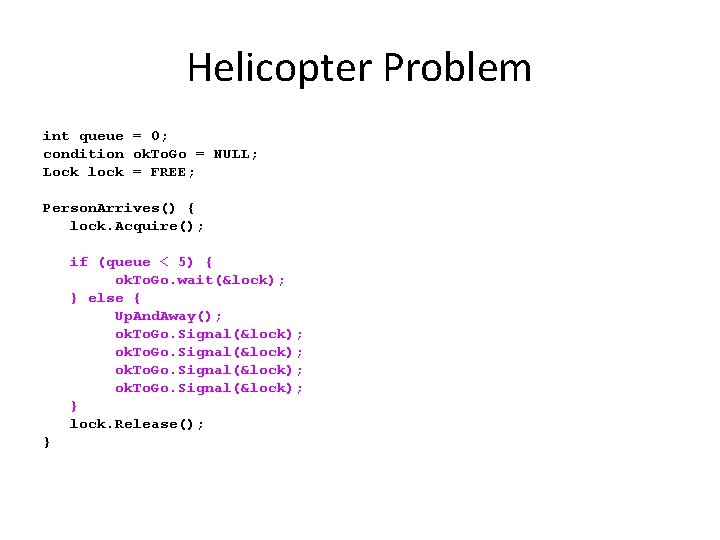
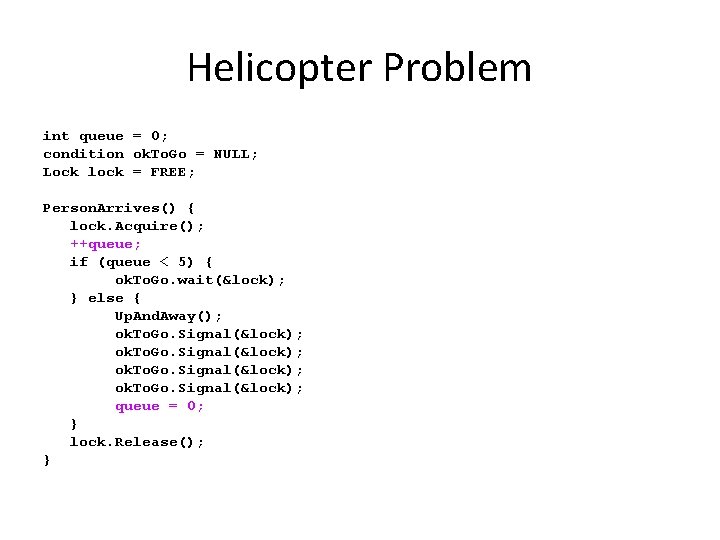
Question #2: Helicopter Problem • A helicopter ride has five seats, and it always carries a full load. • Use lock(s) and condition variable(s) to write a procedure Person. Arrives(), which is called whenever a person (thread) arrives. • Once the load is full, one person (thread) should call Up. And. Away(), and five threads should return from Person. Arrives(). – There should be no undue waiting: the helicopter should depart as soon as it has a full load.
Helicopter Problem int queue = 0; condition ok. To. Go = NULL; Lock lock = FREE; Person. Arrives() { lock. Acquire(); ++queue; if (queue < 4) { ok. To. Go. wait(&lock); } else { Go. Go(); queue = 0; ok. To. Go. Signal(&lock); } lock. Release(); }
Helicopter Problem int queue = 0; condition ok. To. Go = NULL; Lock lock = FREE; Person. Arrives() { lock. Acquire(); ++queue; if (queue < 5) { ok. To. Go. wait(&lock); } else { Up. And. Away(); = 0; ok. To. Go. Signal(&lock); } lock. Release(); }
Helicopter Problem int queue = 0; condition ok. To. Go = NULL; Lock lock = FREE; Person. Arrives() { lock. Acquire(); ++queue; if (queue < 5) { ok. To. Go. wait(&lock); } else { Up. And. Away(); ok. To. Go. Signal(&lock); queue = 0; } lock. Release(); }
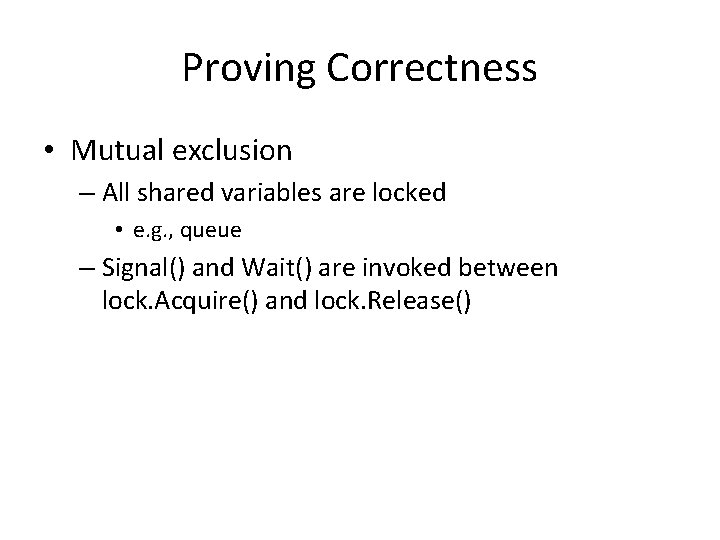
Proving Correctness • Mutual exclusion – All shared variables are locked • e. g. , queue – Signal() and Wait() are invoked between lock. Acquire() and lock. Release()
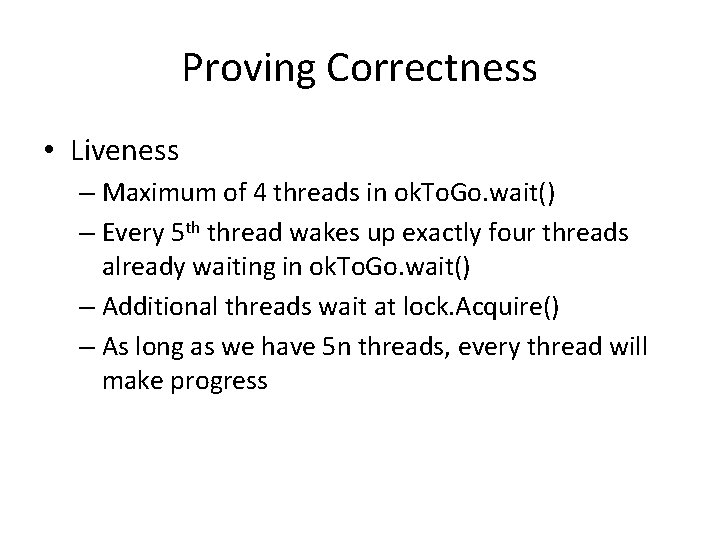
Proving Correctness • Liveness – Maximum of 4 threads in ok. To. Go. wait() – Every 5 th thread wakes up exactly four threads already waiting in ok. To. Go. wait() – Additional threads wait at lock. Acquire() – As long as we have 5 n threads, every thread will make progress
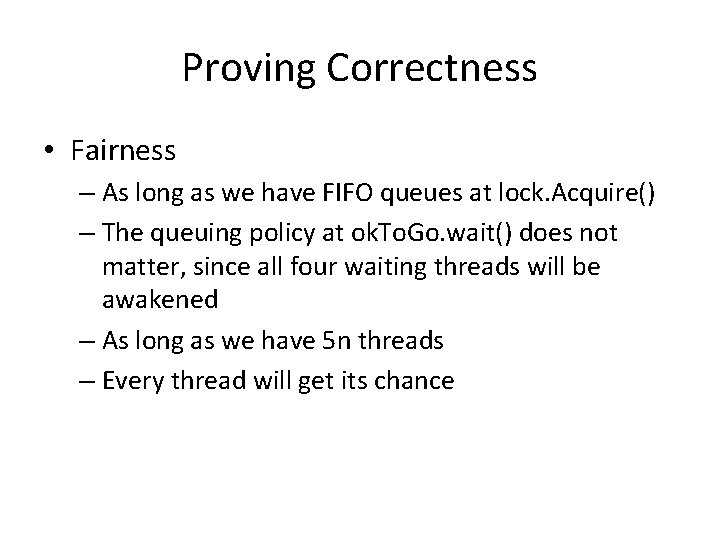
Proving Correctness • Fairness – As long as we have FIFO queues at lock. Acquire() – The queuing policy at ok. To. Go. wait() does not matter, since all four waiting threads will be awakened – As long as we have 5 n threads – Every thread will get its chance
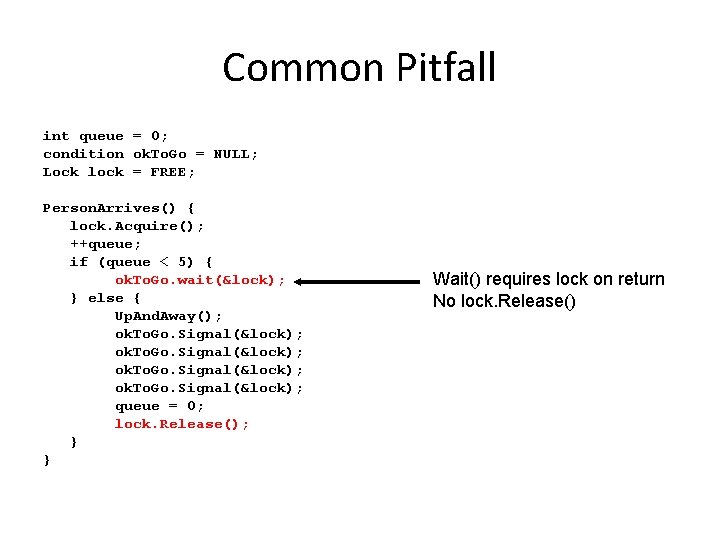
Common Pitfall int queue = 0; condition ok. To. Go = NULL; Lock lock = FREE; Person. Arrives() { lock. Acquire(); ++queue; if (queue < 5) { ok. To. Go. wait(&lock); } else { Up. And. Away(); ok. To. Go. Signal(&lock); queue = 0; lock. Release(); } } Wait() requires lock on return No lock. Release()
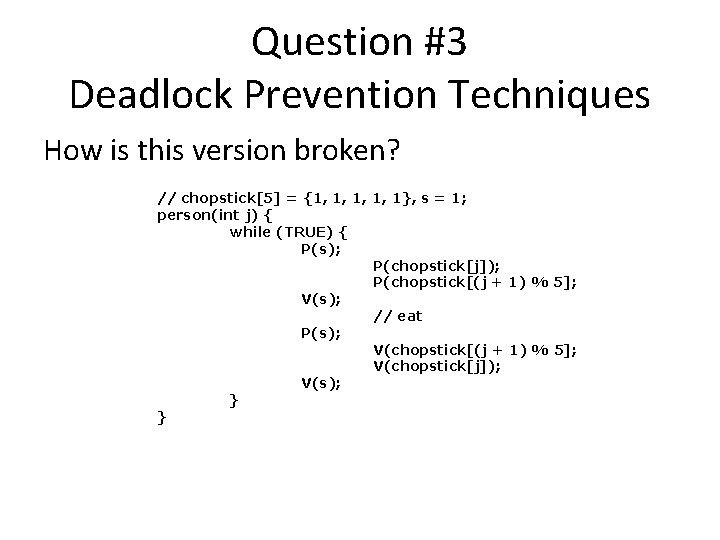
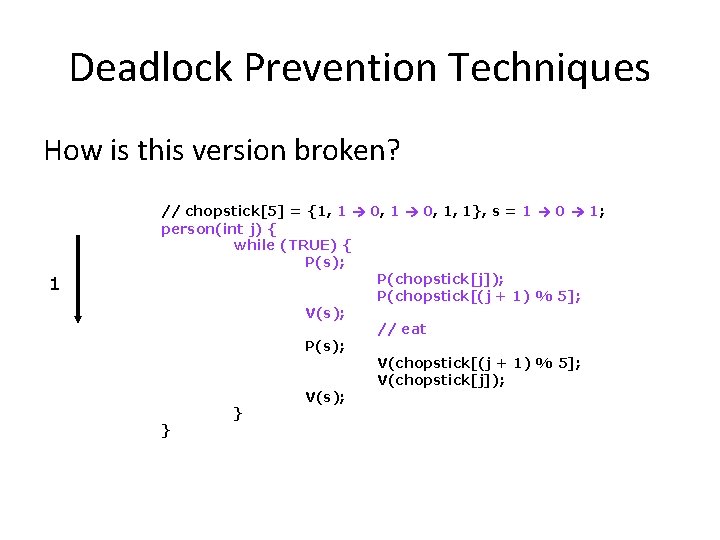
Question #3 Deadlock Prevention Techniques How is this version broken? // chopstick[5] = {1, 1, 1}, s = 1; person(int j) { while (TRUE) { P(s); P(chopstick[j]); P(chopstick[(j + 1) % 5]; V(s); // eat P(s); V(chopstick[(j + 1) % 5]; V(chopstick[j]); V(s); } }
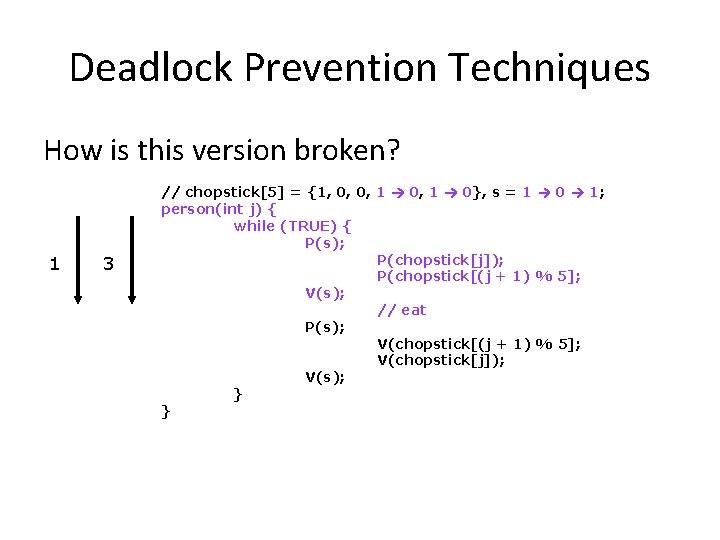
Deadlock Prevention Techniques How is this version broken? 1 // chopstick[5] = {1, 1 0, 1, 1}, s = 1 0 1; person(int j) { while (TRUE) { P(s); P(chopstick[j]); P(chopstick[(j + 1) % 5]; V(s); // eat P(s); V(chopstick[(j + 1) % 5]; V(chopstick[j]); V(s); } }
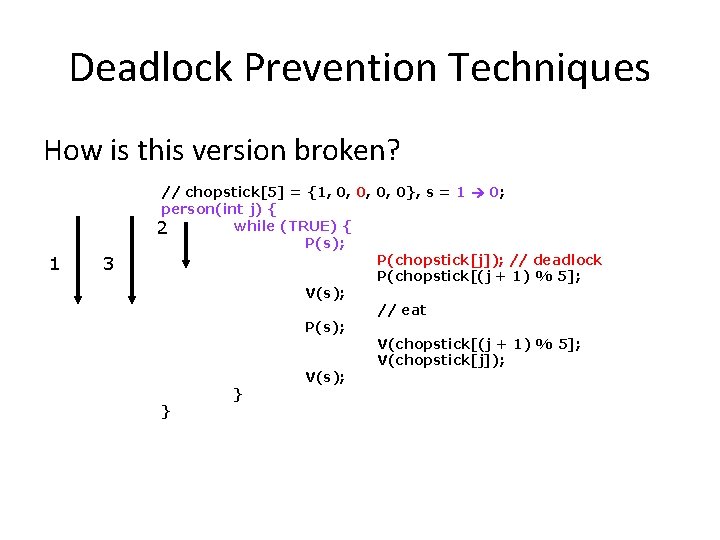
Deadlock Prevention Techniques How is this version broken? 1 3 // chopstick[5] = {1, 0, 0, 1 0}, s = 1 0 1; person(int j) { while (TRUE) { P(s); P(chopstick[j]); P(chopstick[(j + 1) % 5]; V(s); // eat P(s); V(chopstick[(j + 1) % 5]; V(chopstick[j]); V(s); } }
Deadlock Prevention Techniques How is this version broken? 1 3 // chopstick[5] = {1, 0, 0}, s = 1 0; person(int j) { while (TRUE) { 2 P(s); P(chopstick[j]); // deadlock P(chopstick[(j + 1) % 5]; V(s); // eat P(s); V(chopstick[(j + 1) % 5]; V(chopstick[j]); V(s); } }
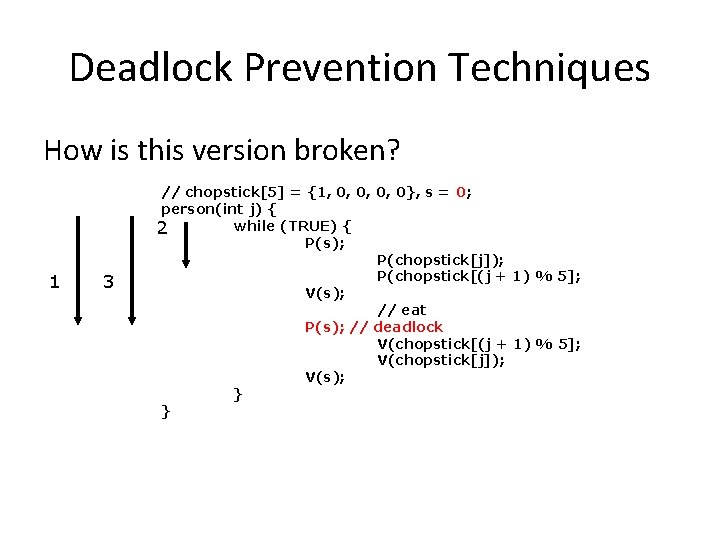
Deadlock Prevention Techniques How is this version broken? 1 3 // chopstick[5] = {1, 0, 0}, s = 0; person(int j) { while (TRUE) { 2 P(s); P(chopstick[j]); P(chopstick[(j + 1) % 5]; V(s); // eat P(s); // deadlock V(chopstick[(j + 1) % 5]; V(chopstick[j]); V(s); } }
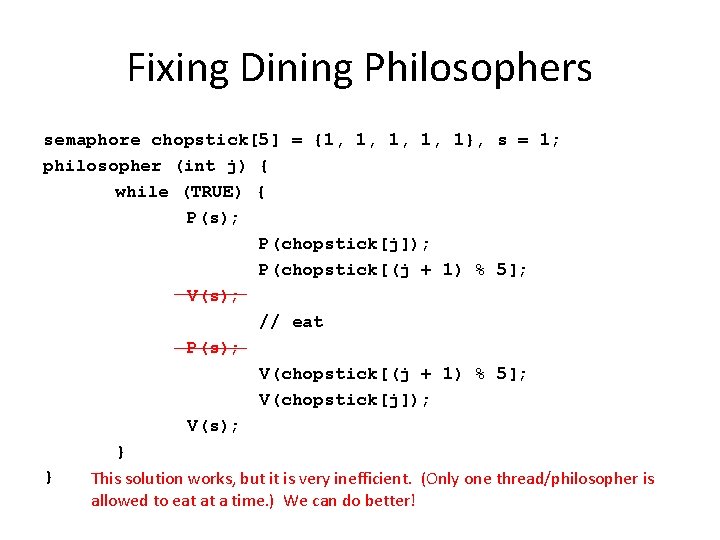
Fixing Dining Philosophers semaphore chopstick[5] = {1, 1, 1}, s = 1; philosopher (int j) { while (TRUE) { P(s); P(chopstick[j]); P(chopstick[(j + 1) % 5]; V(s); // eat P(s); V(chopstick[(j + 1) % 5]; V(chopstick[j]); V(s); } } This solution works, but it is very inefficient. (Only one thread/philosopher is allowed to eat at a time. ) We can do better!
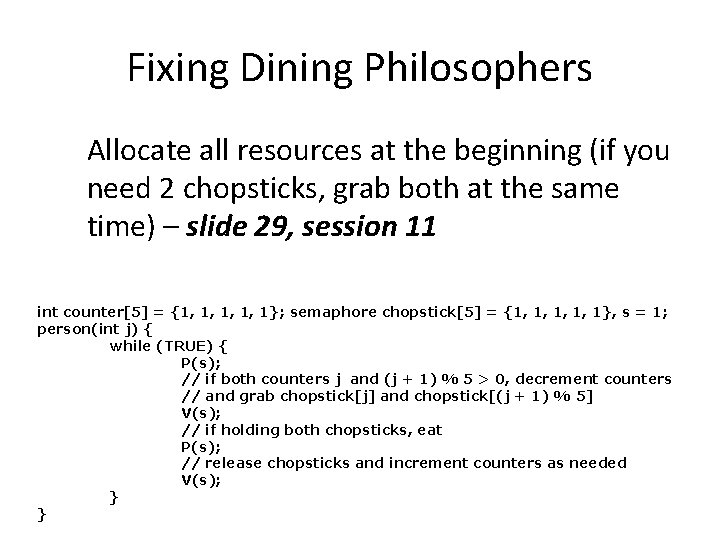
Fixing Dining Philosophers Allocate all resources at the beginning (if you need 2 chopsticks, grab both at the same time) – slide 29, session 11 int counter[5] = {1, 1, 1}; semaphore chopstick[5] = {1, 1, 1}, s = 1; person(int j) { while (TRUE) { P(s); // if both counters j and (j + 1) % 5 > 0, decrement counters // and grab chopstick[j] and chopstick[(j + 1) % 5] V(s); // if holding both chopsticks, eat P(s); // release chopsticks and increment counters as needed V(s); } }
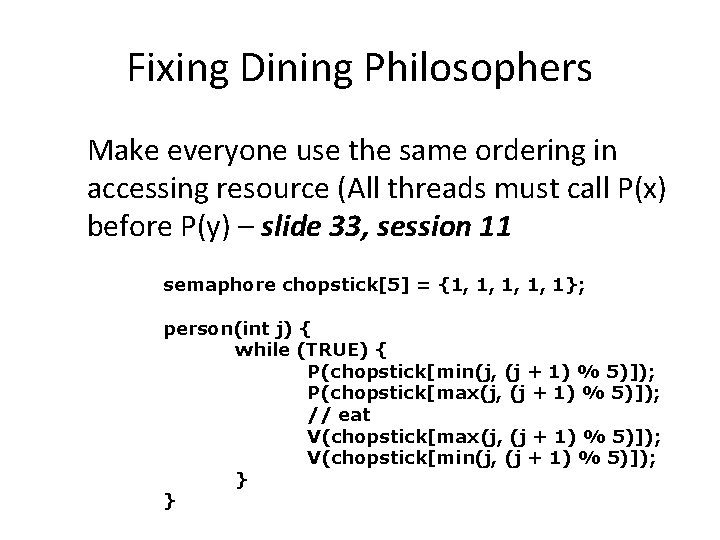
Fixing Dining Philosophers Make everyone use the same ordering in accessing resource (All threads must call P(x) before P(y) – slide 33, session 11 semaphore chopstick[5] = {1, 1, 1}; person(int j) { while (TRUE) { P(chopstick[min(j, (j + 1) % 5)]); P(chopstick[max(j, (j + 1) % 5)]); // eat V(chopstick[max(j, (j + 1) % 5)]); V(chopstick[min(j, (j + 1) % 5)]); } }
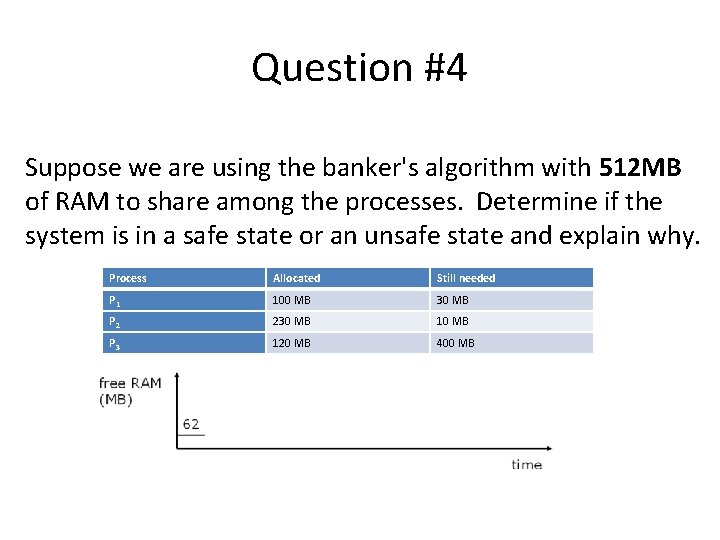
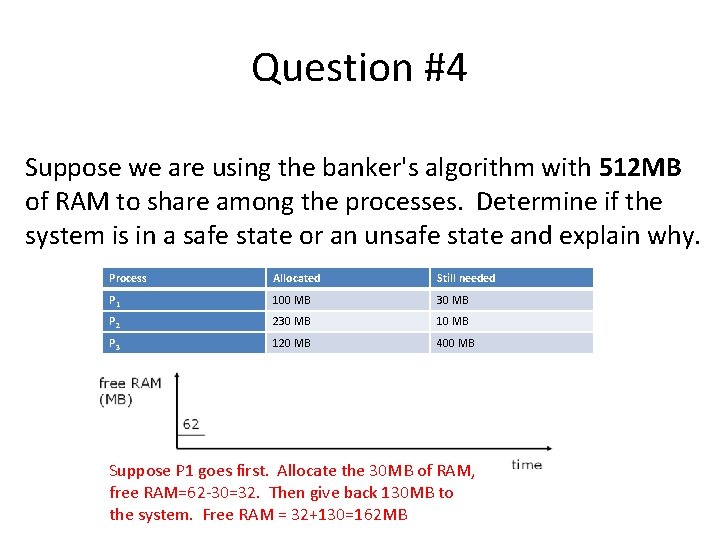
Question #4 Suppose we are using the banker's algorithm with 512 MB of RAM to share among the processes. Determine if the system is in a safe state or an unsafe state and explain why. Process Allocated Still needed P 1 100 MB 30 MB P 2 230 MB 10 MB P 3 120 MB 400 MB
Question #4 Suppose we are using the banker's algorithm with 512 MB of RAM to share among the processes. Determine if the system is in a safe state or an unsafe state and explain why. Process Allocated Still needed P 1 100 MB 30 MB P 2 230 MB 10 MB P 3 120 MB 400 MB Suppose P 1 goes first. Allocate the 30 MB of RAM, free RAM=62 -30=32. Then give back 130 MB to the system. Free RAM = 32+130=162 MB
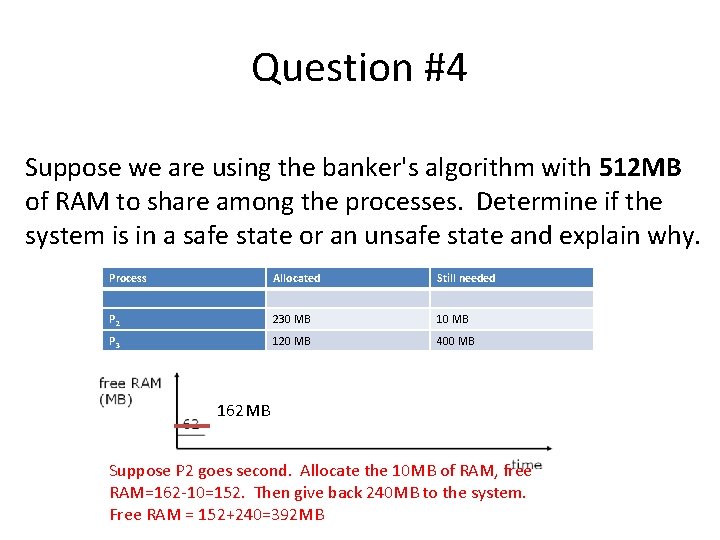
Question #4 Suppose we are using the banker's algorithm with 512 MB of RAM to share among the processes. Determine if the system is in a safe state or an unsafe state and explain why. Process Allocated Still needed P 2 230 MB 10 MB P 3 120 MB 400 MB 162 MB Suppose P 2 goes second. Allocate the 10 MB of RAM, free RAM=162 -10=152. Then give back 240 MB to the system. Free RAM = 152+240=392 MB
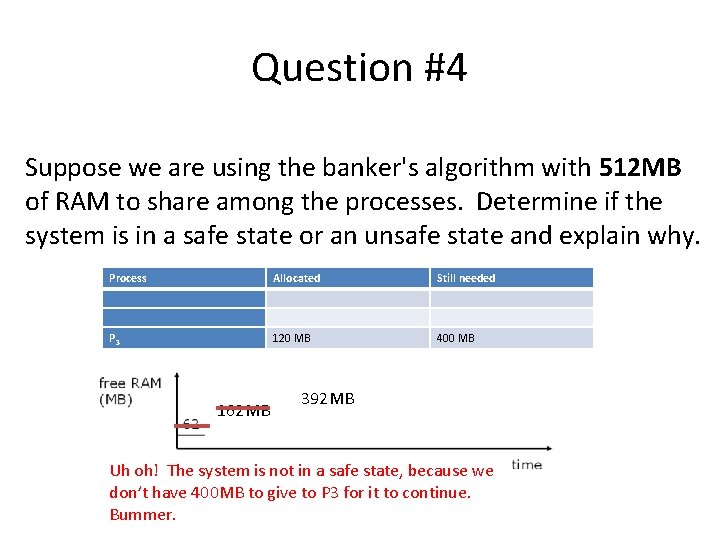
Question #4 Suppose we are using the banker's algorithm with 512 MB of RAM to share among the processes. Determine if the system is in a safe state or an unsafe state and explain why. Process Allocated Still needed P 3 120 MB 400 MB 162 MB 392 MB Uh oh! The system is not in a safe state, because we don’t have 400 MB to give to P 3 for it to continue. Bummer.