StudentMentor Relationships Helen C Harton Professor of Psychology
- Slides: 10
Student-Mentor Relationships Helen C. Harton Professor of Psychology harton@uni. edu
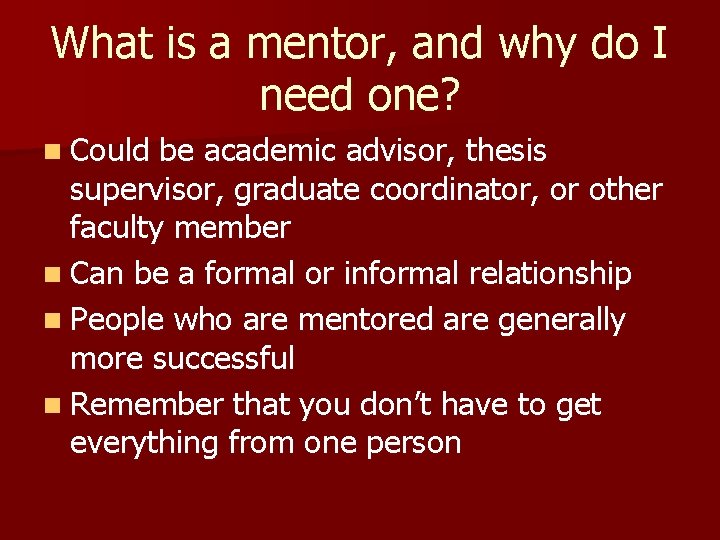
What is a mentor, and why do I need one? n Could be academic advisor, thesis supervisor, graduate coordinator, or other faculty member n Can be a formal or informal relationship n People who are mentored are generally more successful n Remember that you don’t have to get everything from one person
A good mentor should… n Spend time with you n Provide you with feedback n Provide you with information/resources n Support you and be willing to go to bat for you n Help you find useful experiences/colleagues
How should you choose a mentor? n Things to consider about yourself – Research/scholarly interests – Current level of knowledge/skills – Timetable – What and how much support you need
n Things to consider about the mentor – Availability – Reputation – Track record – Personality n Talk to advanced students about potential mentors n Fit is everything!
How can you be a good mentee? n Communicate clearly about expectations n Be respectful of their time n Be respectful of their feedback n Trust that they know more than you, at least about some things n Know what their pet peeves are n Come with solutions, not problems
n Admit your mistakes n Don’t assume they can read your mind n Be pleasant to work with n Be independent but not too independent n Plan on revisions n Realize faculty are human and have outside lives too
What should you do if it’s not working n Be open and communicate with the mentor first n Be careful with email (though it can be helpful in documentation) n Don’t escalate n Check with others to make sure you’re seeing things accurately
If it’s still bad… n Exploitation n Harassment n Talk to someone you trust (e. g. , grad coordinator, department head) and if that person doesn’t listen, find someone else n Keep in mind that some faculty are obligated to report sexual harassment
Remember n You don’t HAVE to have a mentor n Your ideal mentor may actually be outside your department or a peer n Don’t get discouraged—there are people out there who’d love to help you succeed and are a good fit for your needs and interests.