String Matching Q detecting the occurrence of a
- Slides: 13
String Matching Q detecting the occurrence of a particular substring (pattern) in another string (text) • A straightforward Solution • The Knuth-Morris-Pratt Algorithm • The Boyer-Moore Algorithm TECH Computer Science
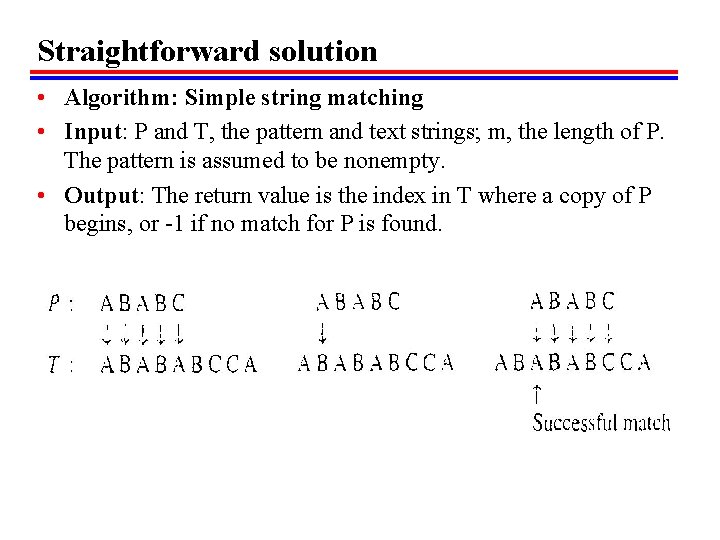
Straightforward solution • Algorithm: Simple string matching • Input: P and T, the pattern and text strings; m, the length of P. The pattern is assumed to be nonempty. • Output: The return value is the index in T where a copy of P begins, or -1 if no match for P is found.
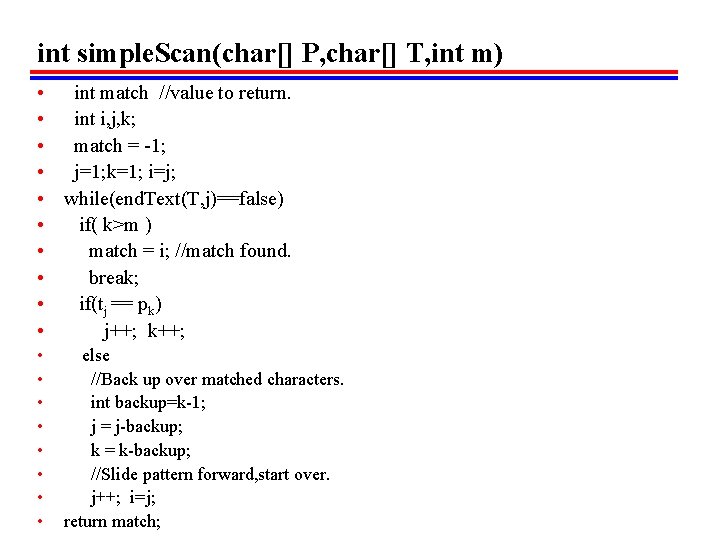
int simple. Scan(char[] P, char[] T, int m) • int match //value to return. • int i, j, k; • match = -1; • j=1; k=1; i=j; • while(end. Text(T, j)==false) • if( k>m ) • match = i; //match found. • break; • if(tj == pk) • j++; k++; • • else //Back up over matched characters. int backup=k-1; j = j-backup; k = k-backup; //Slide pattern forward, start over. j++; i=j; return match;
Analysis • Worst-case complexity is in (mn) • Need to back up. • Works quite well on average for natural language.
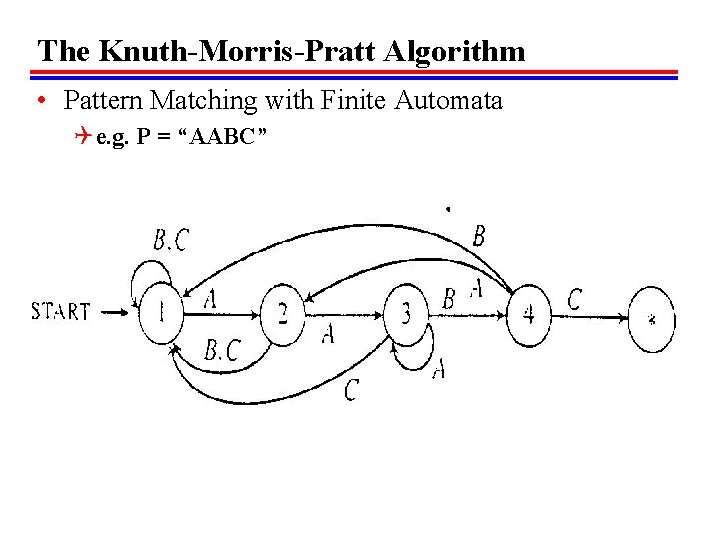
The Knuth-Morris-Pratt Algorithm • Pattern Matching with Finite Automata Q e. g. P = “AABC”
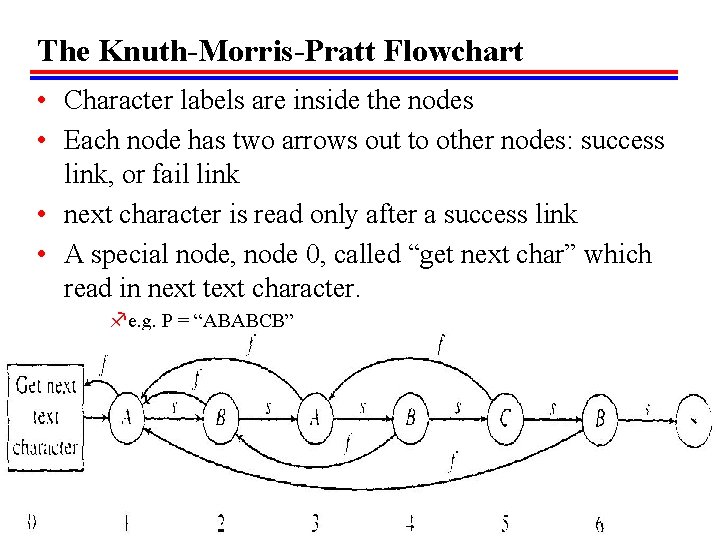
The Knuth-Morris-Pratt Flowchart • Character labels are inside the nodes • Each node has two arrows out to other nodes: success link, or fail link • next character is read only after a success link • A special node, node 0, called “get next char” which read in next text character. fe. g. P = “ABABCB”
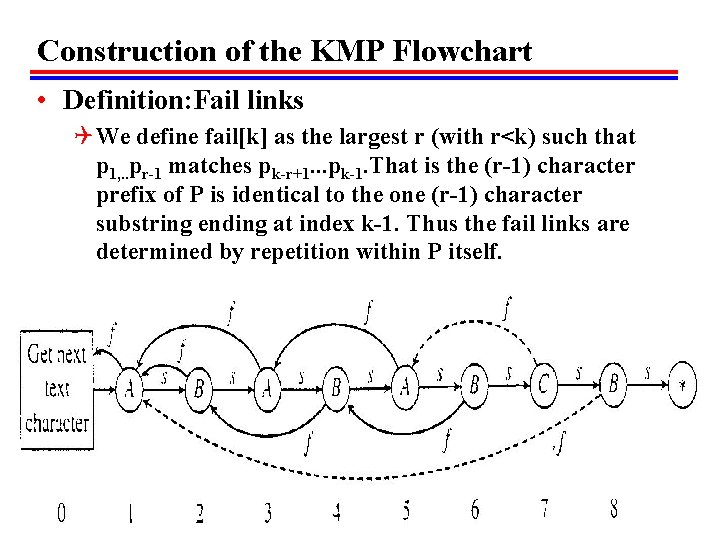
Construction of the KMP Flowchart • Definition: Fail links Q We define fail[k] as the largest r (with r<k) such that p 1, . . pr-1 matches pk-r+1. . . pk-1. That is the (r-1) character prefix of P is identical to the one (r-1) character substring ending at index k-1. Thus the fail links are determined by repetition within P itself.
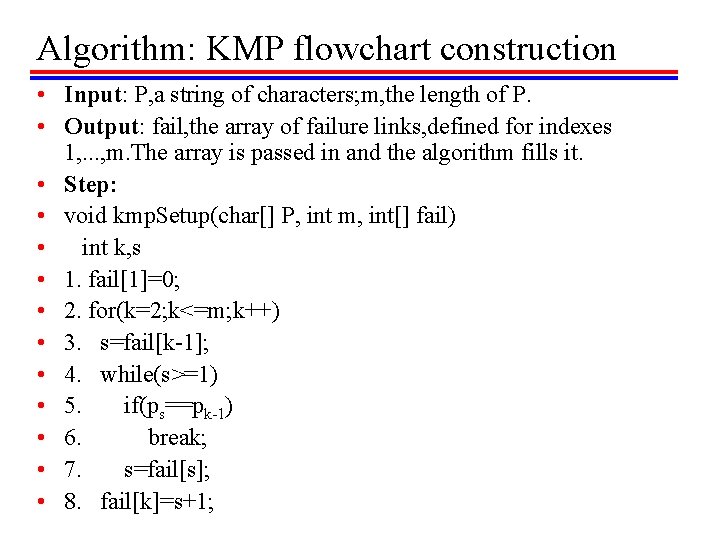
Algorithm: KMP flowchart construction • Input: P, a string of characters; m, the length of P. • Output: fail, the array of failure links, defined for indexes 1, . . . , m. The array is passed in and the algorithm fills it. • Step: • void kmp. Setup(char[] P, int m, int[] fail) • int k, s • 1. fail[1]=0; • 2. for(k=2; k<=m; k++) • 3. s=fail[k-1]; • 4. while(s>=1) • 5. if(ps==pk-1) • 6. break; • 7. s=fail[s]; • 8. fail[k]=s+1;
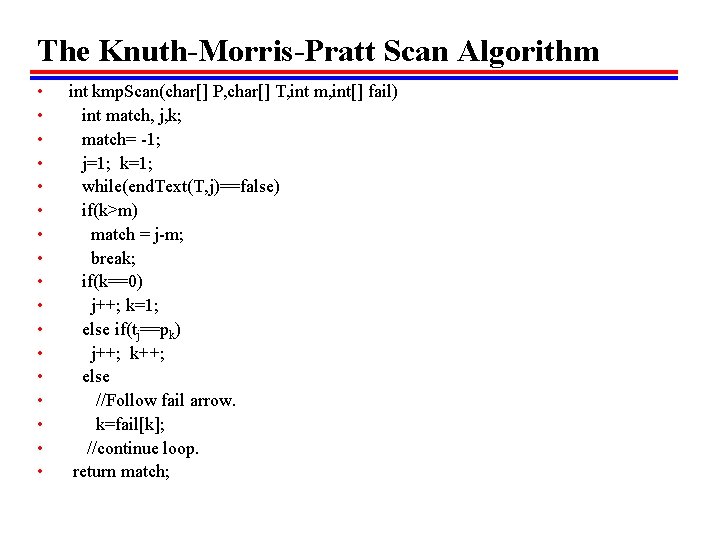
The Knuth-Morris-Pratt Scan Algorithm • • • • • int kmp. Scan(char[] P, char[] T, int m, int[] fail) int match, j, k; match= -1; j=1; k=1; while(end. Text(T, j)==false) if(k>m) match = j-m; break; if(k==0) j++; k=1; else if(tj==pk) j++; k++; else //Follow fail arrow. k=fail[k]; //continue loop. return match;
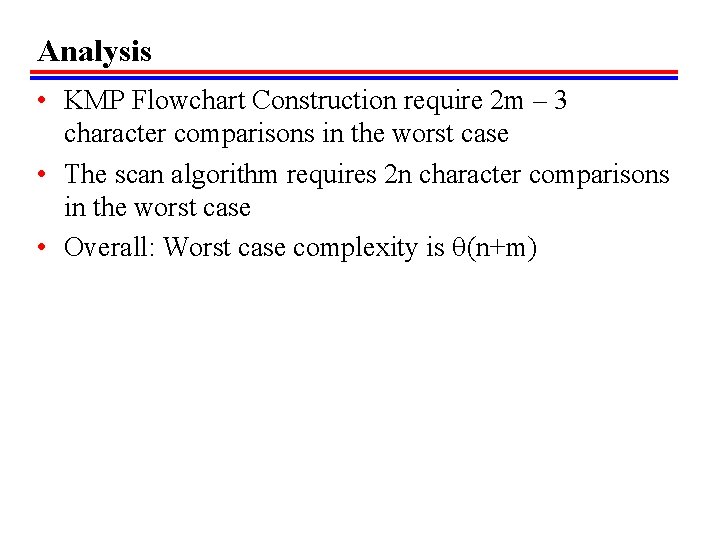
Analysis • KMP Flowchart Construction require 2 m – 3 character comparisons in the worst case • The scan algorithm requires 2 n character comparisons in the worst case • Overall: Worst case complexity is (n+m)
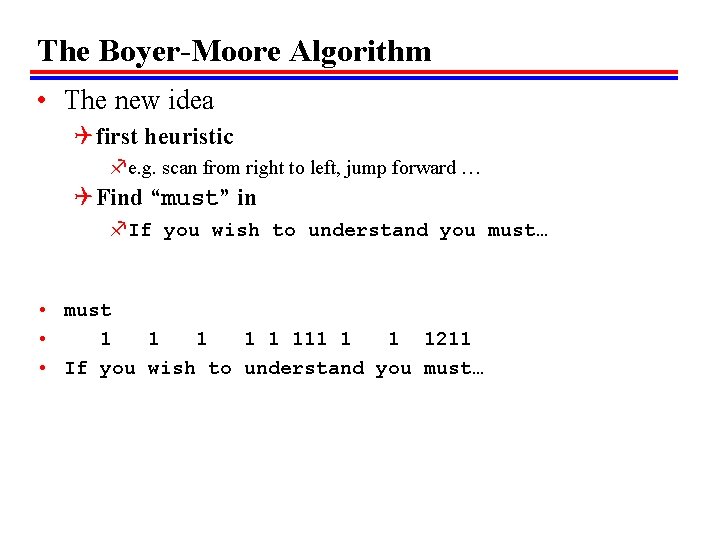
The Boyer-Moore Algorithm • The new idea Q first heuristic fe. g. scan from right to left, jump forward … Q Find “must” in f. If you wish to understand you must… • must • 1 1 111 1 1 1211 • If you wish to understand you must…
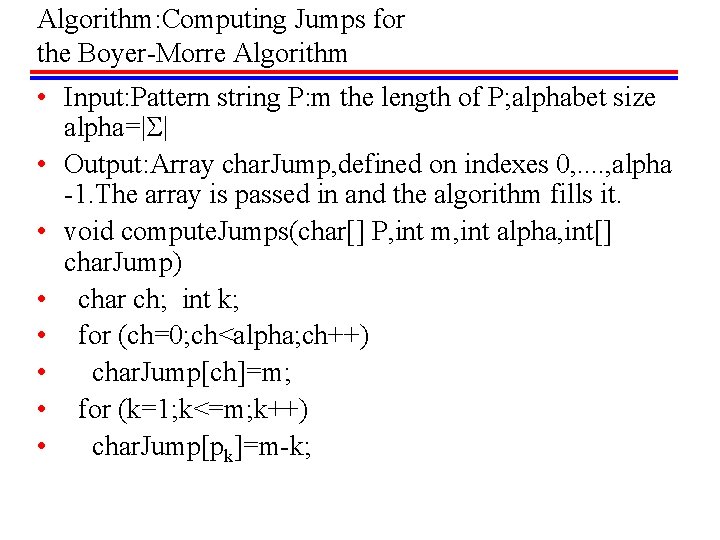
Algorithm: Computing Jumps for the Boyer-Morre Algorithm • Input: Pattern string P: m the length of P; alphabet size alpha=| | • Output: Array char. Jump, defined on indexes 0, . . , alpha -1. The array is passed in and the algorithm fills it. • void compute. Jumps(char[] P, int m, int alpha, int[] char. Jump) • char ch; int k; • for (ch=0; ch<alpha; ch++) • char. Jump[ch]=m; • for (k=1; k<=m; k++) • char. Jump[pk]=m-k;
If you wish to understand you must • …