STARTUP NY Is it starting up NY A

- Slides: 12
STARTUP NY Is it starting up NY? A POST-KEYNESIAN ANALYSIS LYNN SNARR HAL SNARR DANIEL FRIESNER
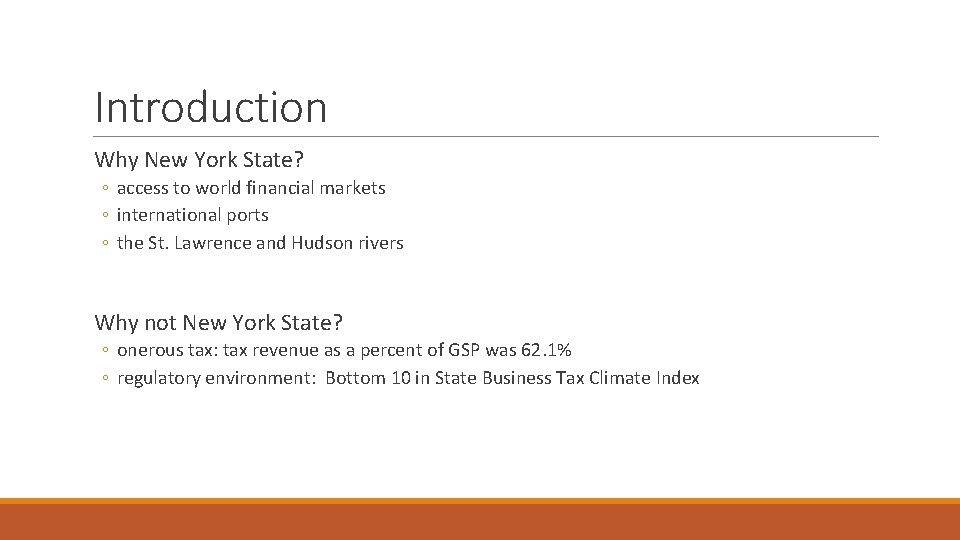
Introduction Why New York State? ◦ access to world financial markets ◦ international ports ◦ the St. Lawrence and Hudson rivers Why not New York State? ◦ onerous tax: tax revenue as a percent of GSP was 62. 1% ◦ regulatory environment: Bottom 10 in State Business Tax Climate Index
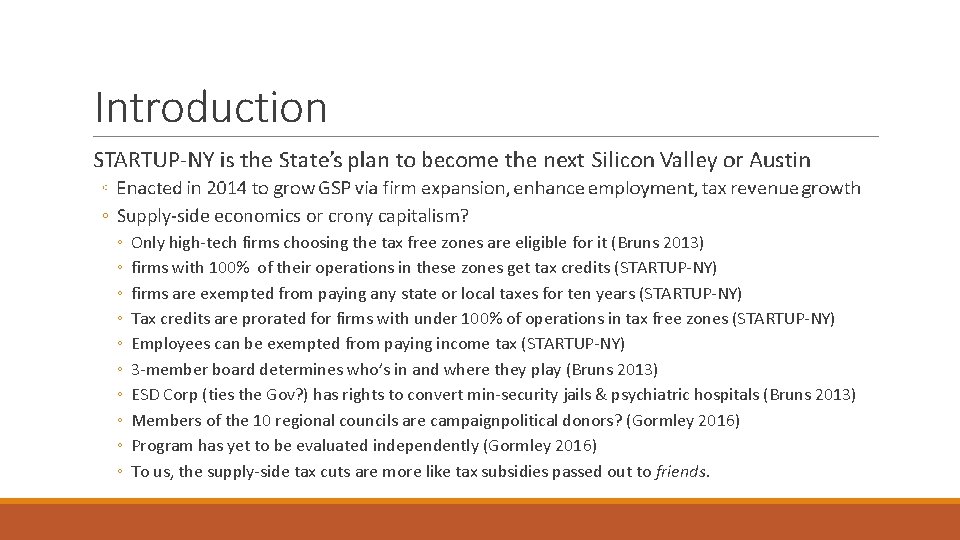
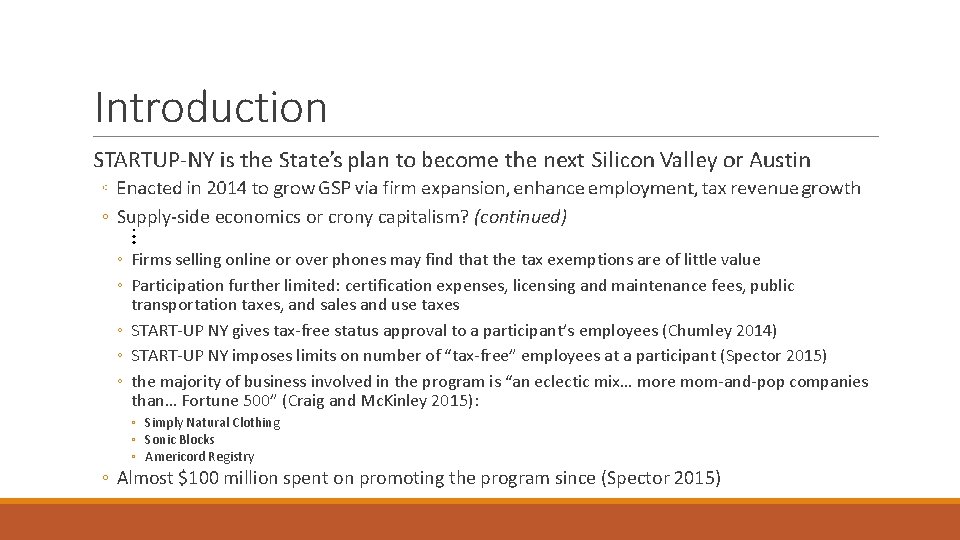
Introduction STARTUP-NY is the State’s plan to become the next Silicon Valley or Austin ◦ Enacted in 2014 to grow GSP via firm expansion, enhance employment, tax revenue growth ◦ Supply-side economics or crony capitalism? ◦ ◦ ◦ ◦ ◦ Only high-tech firms choosing the tax free zones are eligible for it (Bruns 2013) firms with 100% of their operations in these zones get tax credits (STARTUP-NY) firms are exempted from paying any state or local taxes for ten years (STARTUP-NY) Tax credits are prorated for firms with under 100% of operations in tax free zones (STARTUP-NY) Employees can be exempted from paying income tax (STARTUP-NY) 3 -member board determines who’s in and where they play (Bruns 2013) ESD Corp (ties the Gov? ) has rights to convert min-security jails & psychiatric hospitals (Bruns 2013) Members of the 10 regional councils are campaignpolitical donors? (Gormley 2016) Program has yet to be evaluated independently (Gormley 2016) To us, the supply-side tax cuts are more like tax subsidies passed out to friends.
Introduction ◦ Supply-side economics or crony capitalism? (continued) ◦ Firms selling online or over phones may find that the tax exemptions are of little value ◦ Participation further limited: certification expenses, licensing and maintenance fees, public transportation taxes, and sales and use taxes ◦ START-UP NY gives tax-free status approval to a participant’s employees (Chumley 2014) ◦ START-UP NY imposes limits on number of “tax-free” employees at a participant (Spector 2015) ◦ the majority of business involved in the program is “an eclectic mix… more mom-and-pop companies than… Fortune 500” (Craig and Mc. Kinley 2015): ◦ Simply Natural Clothing ◦ Sonic Blocks ◦ Americord Registry ◦ Almost $100 million spent on promoting the program since (Spector 2015)
Introduction
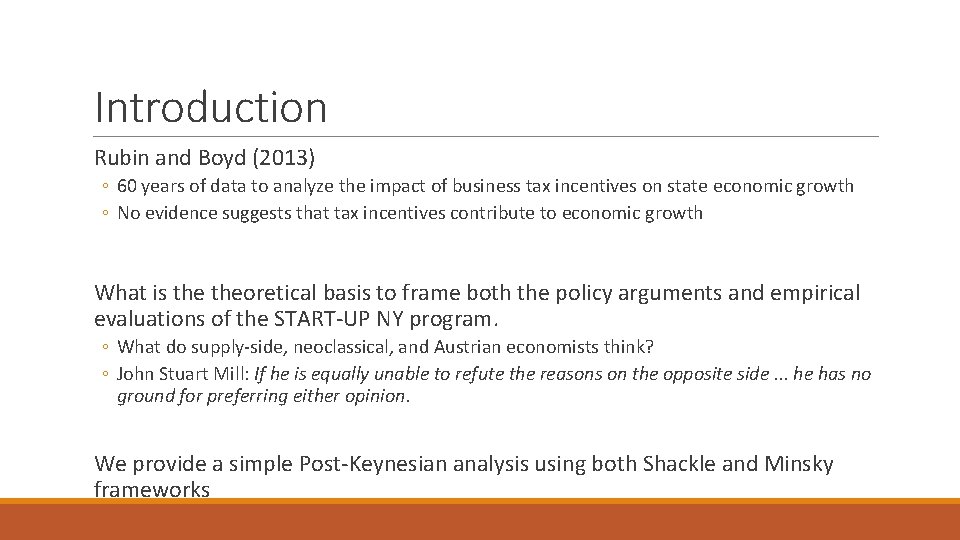
Introduction Rubin and Boyd (2013) ◦ 60 years of data to analyze the impact of business tax incentives on state economic growth ◦ No evidence suggests that tax incentives contribute to economic growth What is theoretical basis to frame both the policy arguments and empirical evaluations of the START-UP NY program. ◦ What do supply-side, neoclassical, and Austrian economists think? ◦ John Stuart Mill: If he is equally unable to refute the reasons on the opposite side. . . he has no ground for preferring either opinion. We provide a simple Post-Keynesian analysis using both Shackle and Minsky frameworks
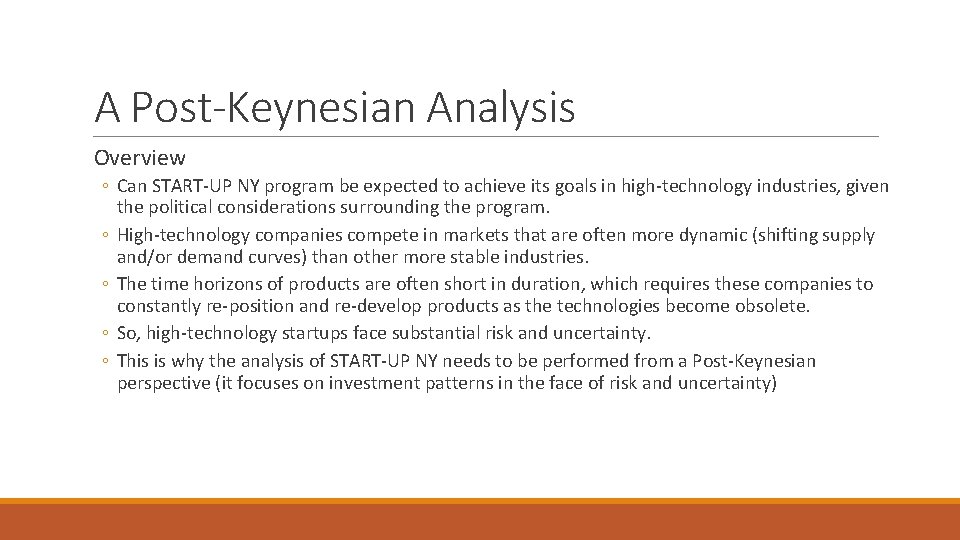
A Post-Keynesian Analysis Overview ◦ Can START-UP NY program be expected to achieve its goals in high-technology industries, given the political considerations surrounding the program. ◦ High-technology companies compete in markets that are often more dynamic (shifting supply and/or demand curves) than other more stable industries. ◦ The time horizons of products are often short in duration, which requires these companies to constantly re-position and re-develop products as the technologies become obsolete. ◦ So, high-technology startups face substantial risk and uncertainty. ◦ This is why the analysis of START-UP NY needs to be performed from a Post-Keynesian perspective (it focuses on investment patterns in the face of risk and uncertainty)
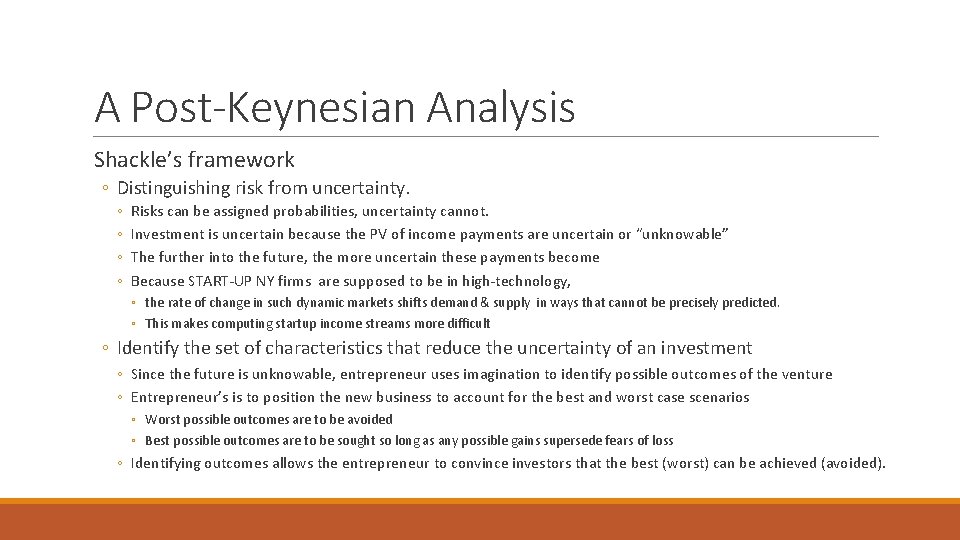
A Post-Keynesian Analysis Shackle’s framework ◦ Distinguishing risk from uncertainty. ◦ ◦ Risks can be assigned probabilities, uncertainty cannot. Investment is uncertain because the PV of income payments are uncertain or “unknowable” The further into the future, the more uncertain these payments become Because START-UP NY firms are supposed to be in high-technology, ◦ the rate of change in such dynamic markets shifts demand & supply in ways that cannot be precisely predicted. ◦ This makes computing startup income streams more difficult ◦ Identify the set of characteristics that reduce the uncertainty of an investment ◦ Since the future is unknowable, entrepreneur uses imagination to identify possible outcomes of the venture ◦ Entrepreneur’s is to position the new business to account for the best and worst case scenarios ◦ Worst possible outcomes are to be avoided ◦ Best possible outcomes are to be sought so long as any possible gains supersede fears of loss ◦ Identifying outcomes allows the entrepreneur to convince investors that the best (worst) can be achieved (avoided).
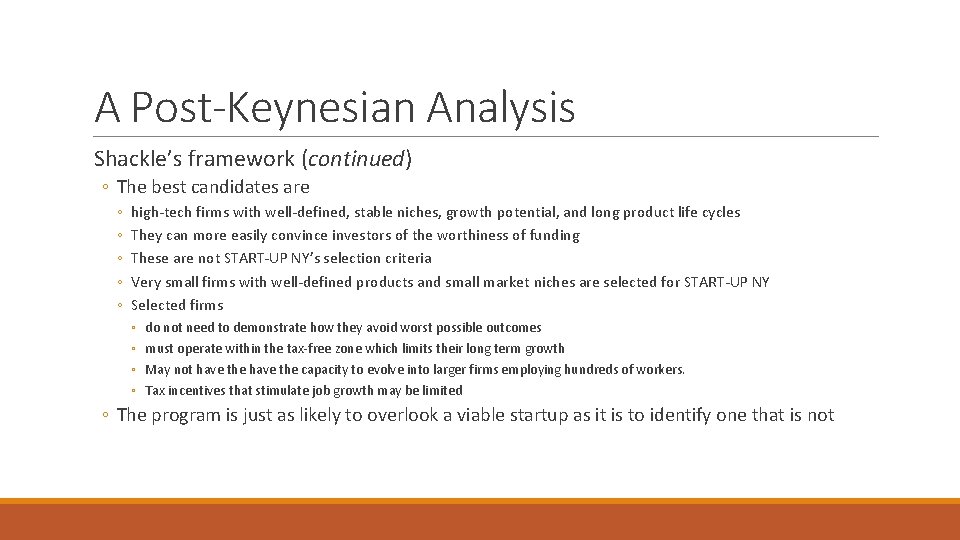
A Post-Keynesian Analysis Shackle’s framework (continued) ◦ The best candidates are ◦ ◦ ◦ high-tech firms with well-defined, stable niches, growth potential, and long product life cycles They can more easily convince investors of the worthiness of funding These are not START-UP NY’s selection criteria Very small firms with well-defined products and small market niches are selected for START-UP NY Selected firms ◦ ◦ do not need to demonstrate how they avoid worst possible outcomes must operate within the tax-free zone which limits their long term growth May not have the capacity to evolve into larger firms employing hundreds of workers. Tax incentives that stimulate job growth may be limited ◦ The program is just as likely to overlook a viable startup as it is to identify one that is not
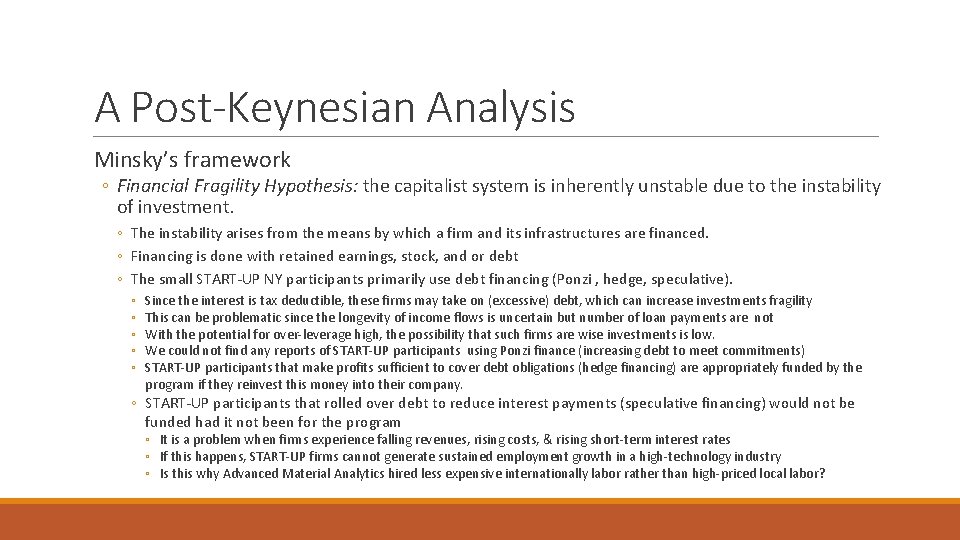
A Post-Keynesian Analysis Minsky’s framework ◦ Financial Fragility Hypothesis: the capitalist system is inherently unstable due to the instability of investment. ◦ The instability arises from the means by which a firm and its infrastructures are financed. ◦ Financing is done with retained earnings, stock, and or debt ◦ The small START-UP NY participants primarily use debt financing (Ponzi , hedge, speculative). ◦ ◦ ◦ Since the interest is tax deductible, these firms may take on (excessive) debt, which can increase investments fragility This can be problematic since the longevity of income flows is uncertain but number of loan payments are not With the potential for over-leverage high, the possibility that such firms are wise investments is low. We could not find any reports of START-UP participants using Ponzi finance (increasing debt to meet commitments) START-UP participants that make profits sufficient to cover debt obligations (hedge financing) are appropriately funded by the program if they reinvest this money into their company. ◦ START-UP participants that rolled over debt to reduce interest payments (speculative financing) would not be funded had it not been for the program ◦ It is a problem when firms experience falling revenues, rising costs, & rising short-term interest rates ◦ If this happens, START-UP firms cannot generate sustained employment growth in a high-technology industry ◦ Is this why Advanced Material Analytics hired less expensive internationally labor rather than high-priced local labor?
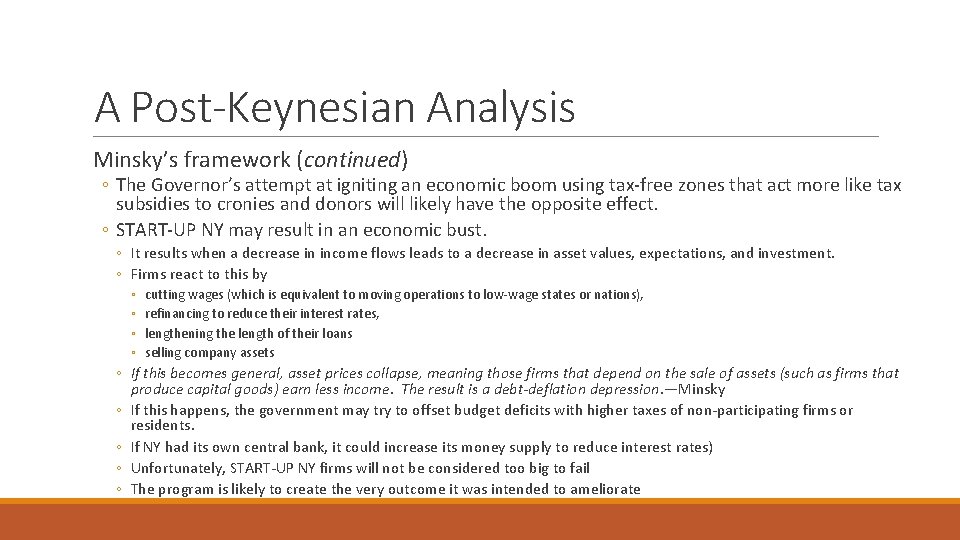
A Post-Keynesian Analysis Minsky’s framework (continued) ◦ The Governor’s attempt at igniting an economic boom using tax-free zones that act more like tax subsidies to cronies and donors will likely have the opposite effect. ◦ START-UP NY may result in an economic bust. ◦ It results when a decrease in income flows leads to a decrease in asset values, expectations, and investment. ◦ Firms react to this by ◦ ◦ cutting wages (which is equivalent to moving operations to low-wage states or nations), refinancing to reduce their interest rates, lengthening the length of their loans selling company assets ◦ If this becomes general, asset prices collapse, meaning those firms that depend on the sale of assets (such as firms that produce capital goods) earn less income. The result is a debt-deflation depression. —Minsky ◦ If this happens, the government may try to offset budget deficits with higher taxes of non-participating firms or residents. ◦ If NY had its own central bank, it could increase its money supply to reduce interest rates) ◦ Unfortunately, START-UP NY firms will not be considered too big to fail ◦ The program is likely to create the very outcome it was intended to ameliorate
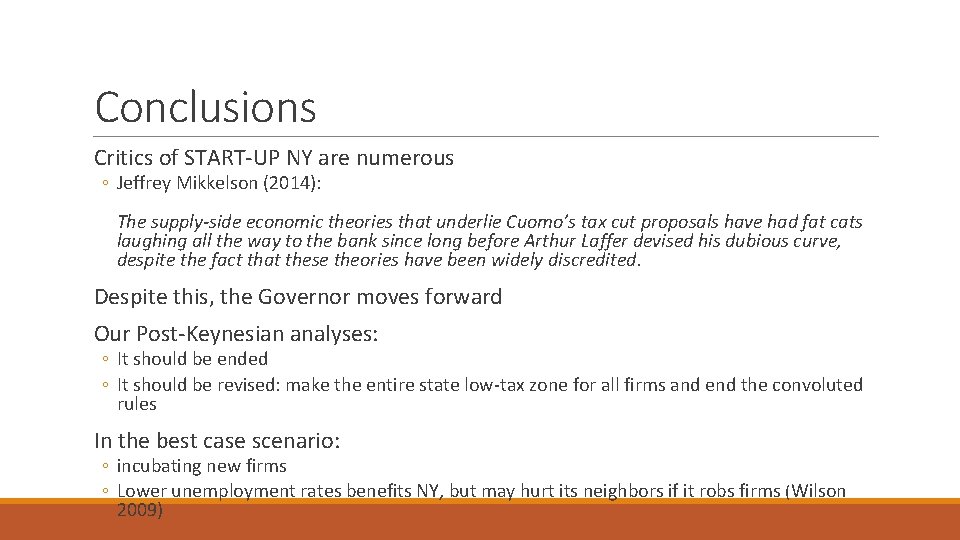
Conclusions Critics of START-UP NY are numerous ◦ Jeffrey Mikkelson (2014): The supply-side economic theories that underlie Cuomo’s tax cut proposals have had fat cats laughing all the way to the bank since long before Arthur Laffer devised his dubious curve, despite the fact that these theories have been widely discredited. Despite this, the Governor moves forward Our Post-Keynesian analyses: ◦ It should be ended ◦ It should be revised: make the entire state low-tax zone for all firms and end the convoluted rules In the best case scenario: ◦ incubating new firms ◦ Lower unemployment rates benefits NY, but may hurt its neighbors if it robs firms (Wilson 2009)