STARK WIDTHS OF SPECTRAL LINES OF NEUTRAL NEON

- Slides: 6
STARK WIDTHS OF SPECTRAL LINES OF NEUTRAL NEON • Milan S. Dimitrijević, • Zoran Simić, • Andjelka Kovačević, • Sylvie Sahal-Bréchot
• The data on Stark broadening of spectral lines of interest for diagnostics, modelling and investigations of stellar atmospheres and other various plasmas in astrophysics, laboratory, technology and fusion research, obtained by us using semiclassical perturbation method, are organized in the STARK-B database (http: //starkb. obspm. fr/). We note as well that this database is a part of Virtual Atomic and Molecular Data Center (VAMDC - http: //vamdc. org/, Dubernet et al. , 2010), supported by EU in the framework of the FP 7 "Research Infrastructures - INFRA-2008 -1. 2. 2 - Scientific Data Infrastructures" initiative.
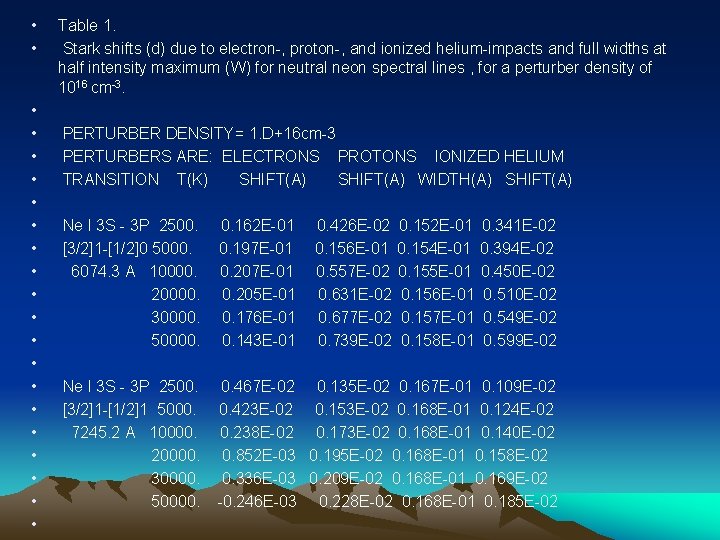
• In Milosavljević et al. (2004) we determined, within the frame of the semiclassical perturbation approach, Stark widths due to collisions with electrons and protons for 25 spectral lines of neutral neon. In order to complete Stark broadening data for Ne I spectral lines, needed for analysis of stellar atmospheres and laboratory and technological plasmas analysis, modeling and diagnostics, we determined here, using the same semiclassical perturbation method, the missing Stark shifts and Stark widths for the broadening by collisions with ionized helium, for these 25 spectral lines of neutral neon. The obtained data will be included in the STARK-B database, a part of the Virtual Atomic and Molecular Data Center. • Here in Table 1, we present a sample of obtained results
• • • • • • Table 1. Stark shifts (d) due to electron-, proton-, and ionized helium-impacts and full widths at half intensity maximum (W) for neutral neon spectral lines , for a perturber density of 1016 cm-3. PERTURBER DENSITY= 1. D+16 cm-3 PERTURBERS ARE: ELECTRONS PROTONS IONIZED HELIUM TRANSITION T(K) SHIFT(A) WIDTH(A) SHIFT(A) Ne I 3 S - 3 P 2500. 0. 162 E-01 0. 426 E-02 0. 152 E-01 0. 341 E-02 [3/2]1 -[1/2]0 5000. 0. 197 E-01 0. 156 E-01 0. 154 E-01 0. 394 E-02 6074. 3 A 10000. 0. 207 E-01 0. 557 E-02 0. 155 E-01 0. 450 E-02 20000. 0. 205 E-01 0. 631 E-02 0. 156 E-01 0. 510 E-02 30000. 0. 176 E-01 0. 677 E-02 0. 157 E-01 0. 549 E-02 50000. 0. 143 E-01 0. 739 E-02 0. 158 E-01 0. 599 E-02 Ne I 3 S - 3 P 2500. 0. 467 E-02 0. 135 E-02 0. 167 E-01 0. 109 E-02 [3/2]1 -[1/2]1 5000. 0. 423 E-02 0. 153 E-02 0. 168 E-01 0. 124 E-02 7245. 2 A 10000. 0. 238 E-02 0. 173 E-02 0. 168 E-01 0. 140 E-02 20000. 0. 852 E-03 0. 195 E-02 0. 168 E-01 0. 158 E-02 30000. 0. 336 E-03 0. 209 E-02 0. 168 E-01 0. 169 E-02 50000. -0. 246 E-03 0. 228 E-02 0. 168 E-01 0. 185 E-02
• Due to the high abundance of neon in stellar atmospheres, we hope that the obtained results will be of interest for stellar spectra interpretation and synthesis and for a number of other investigations in astrophysics, physics and plasma technologies. • • References • • Dubernet, M. L. et al. : 2010, J. Quant. Spectrosc. Radiat. Transfer, 111, 2151. • Milosavljević, V. , Djeniže, S. , Dimitrijević, M. S. : 2004, J. Phys. B: At. Mol. Opt. Phys. , 37, 2713. • •
THANK YOU FOR ATTENTION