Sponges Cnidarians Flatworms Roundworms Chapter 6 Section 2
- Slides: 9
Sponges, Cnidarians, Flatworms, & Roundworms Chapter 6 Section 2
Sponges �Fun Fact: For a long time, scientists thought sponges were plants, not animals. �Adult sponges are sessileremain attached to one place
Sponges- Filter Feeders �Most sponges live in oceans, but some live in freshwater. �Filter food out of water that flows through body �Microscopic organisms and oxygen are carried into central cavity through pores of sponge �Flagella keep water moving though sponge
Sponges- Body Support & Defense �Soft bodies supported by sharp, glasslike structures called spicules �Some have material called spongin - similar to foam rubber, making bodies elastic and soft �Some have both.
Cnidarians �Have tentacles surrounding mouth (ex. Jellyfish, coral, sea anemones) �Tentacles shoot out stinging cells, called, nematocysts, to catch prey �Have radial symmetry, can locate food that floats by from any direction
Cnidarians- Body Forms � 2 different body forms ◦Vase-shaped called polyp ◦bell-shaped body called medusa
Flatworms �Search for food �Invertebrates with long, flattened bodies �Bilateral symmetry �Soft bodies with 3 layers of tissue �Plnaraians- free-living flatworms with digestive system with one opening �Parasites- live in or on their hosts
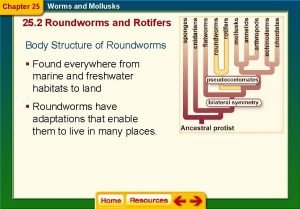
Roundworms �Most widespread animal on Earth �Body like a tube within a tube, with a fluid-filled cavity between two tubes �Digestive tract has two openings �Some are decomposers, some predators
Exit Ticket �Pick one question and answer in a complete sentence. �Why would spongin and spicules discourage predators from eating sponges? �What are three characteristics of flatworms and roundworms.