Speech Generation and Perception 1 Speech Generation and

- Slides: 29
Speech Generation and Perception 1
Speech Generation and Perception : n The study of the anatomy of the organs of speech is required as a background for articulatory and acoustic phonetics. n An understanding of hearing and perception is needed in the field of both speech synthesis and speech enhancement and is useful in the field of automatic speech recognition. 2
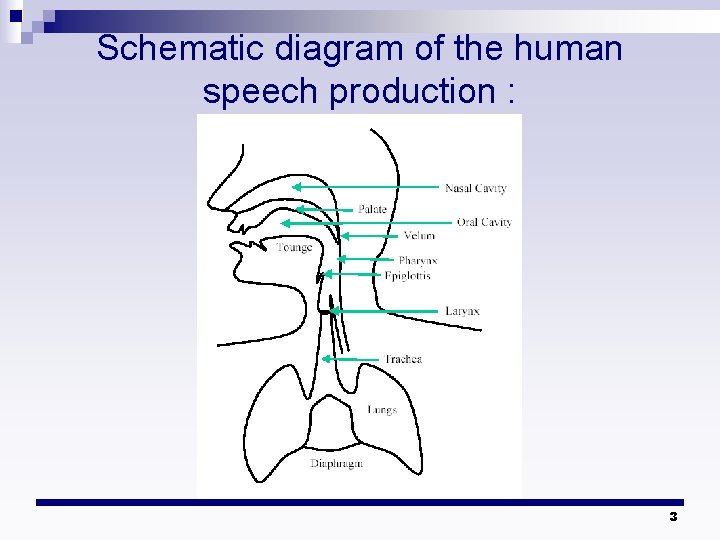
Schematic diagram of the human speech production : 3
Organs of Speech: n Lungs and trachea : ¨ source of air during speech. ¨ The vocal organs work by using compressed air; this is supplied by the lungs and delivered to the system by way of the trachea. ¨ These organs also control the loudness of the resulting speech. ¨ The trachea and lungs together constitute the pulmonary tract. 4
Organs of Speech: n The Larynx : ¨ This is a complicated system of cartilages and muscle containing and controlling the vocal cords. Principle parts are : Cricoid cartilage n Thyroid cartilage n Arytenoid cartilage n Vocal cords n ¨ The place where the vocal folds come together is called the glottis. 5
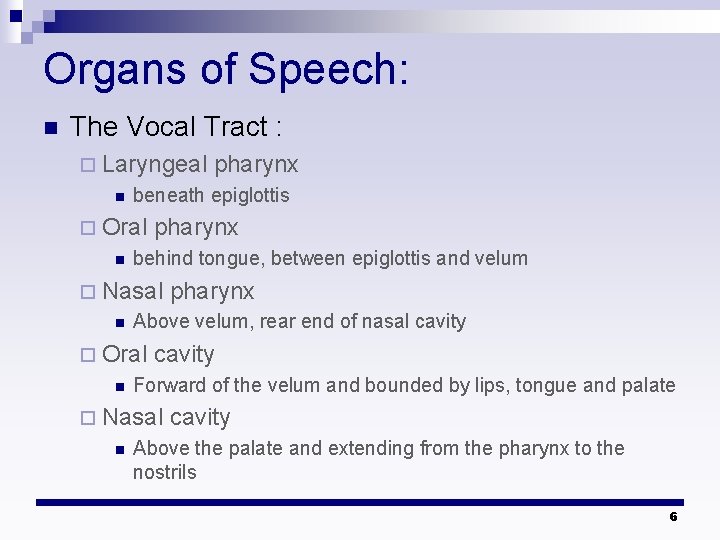
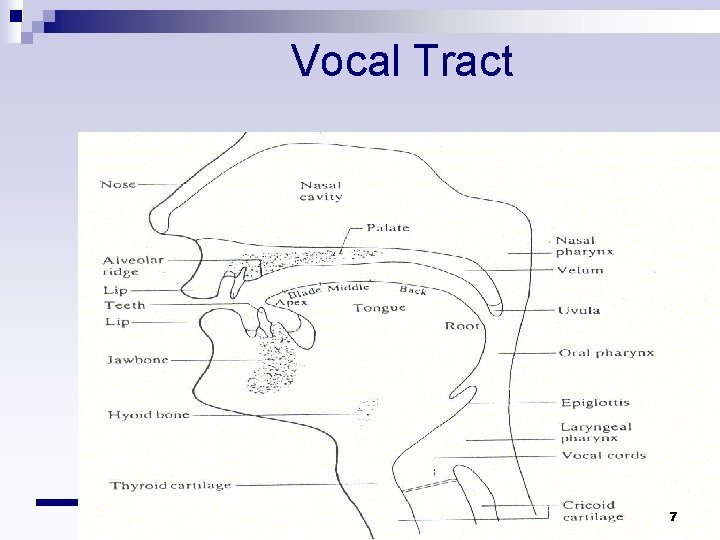
Organs of Speech: n The Vocal Tract : ¨ Laryngeal n beneath epiglottis ¨ Oral n pharynx behind tongue, between epiglottis and velum ¨ Nasal n cavity Forward of the velum and bounded by lips, tongue and palate ¨ Nasal n pharynx Above velum, rear end of nasal cavity ¨ Oral n pharynx cavity Above the palate and extending from the pharynx to the nostrils 6
Vocal Tract 7
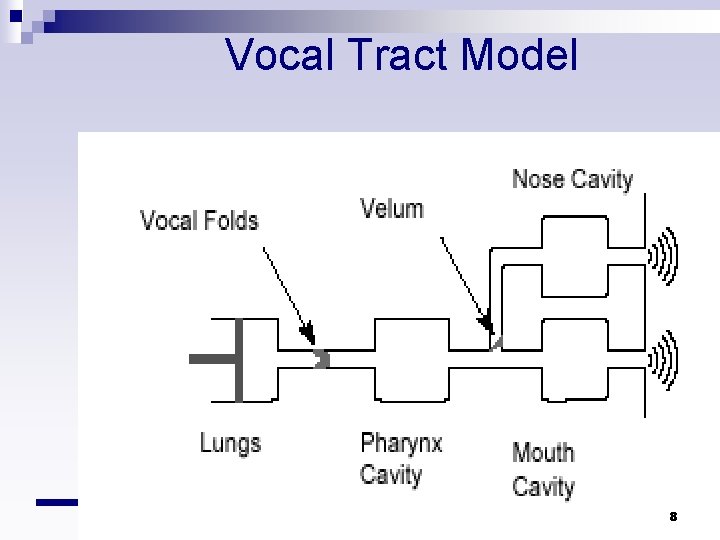
Vocal Tract Model 8
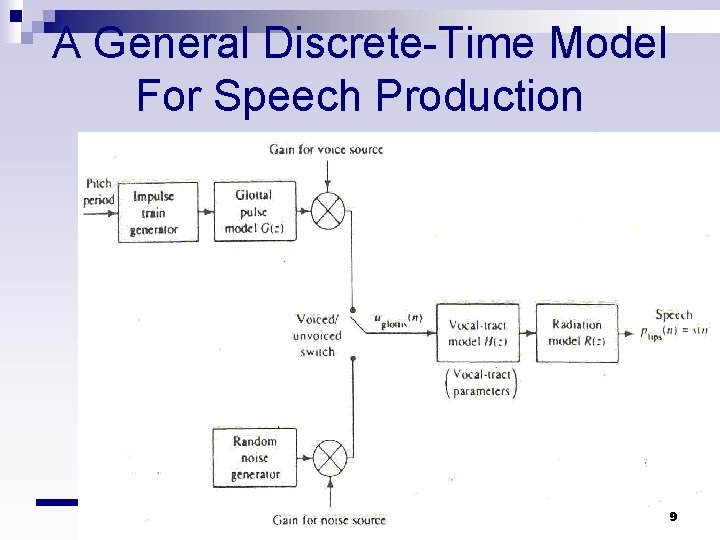
A General Discrete-Time Model For Speech Production 9
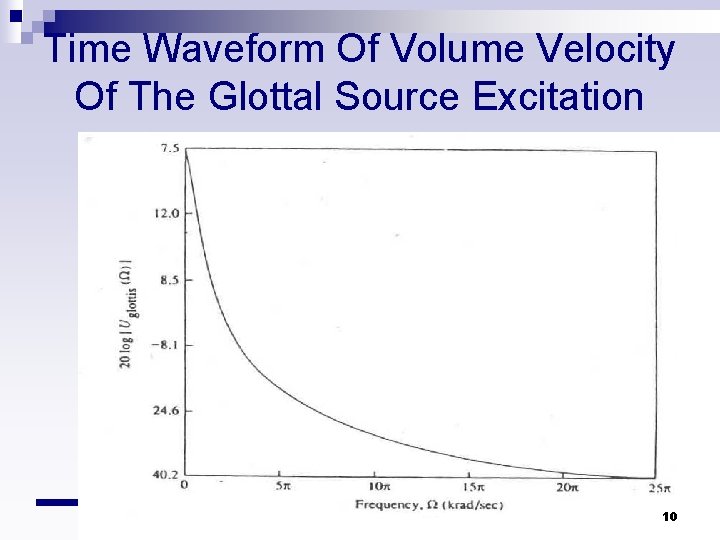
Time Waveform Of Volume Velocity Of The Glottal Source Excitation 10
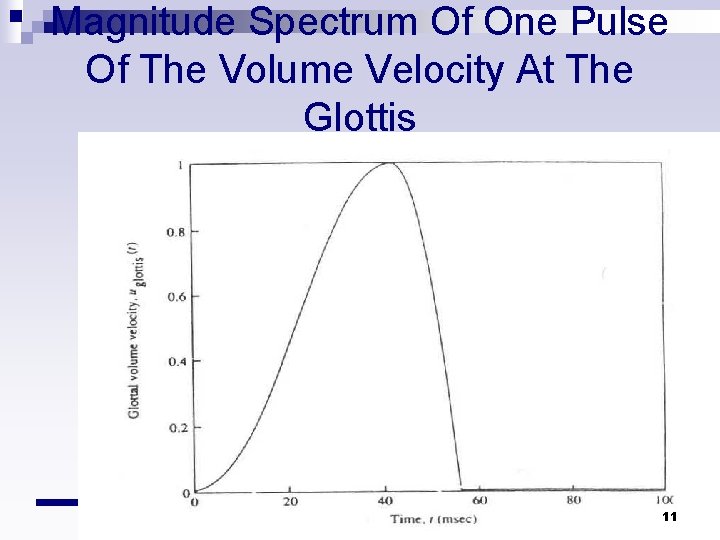
Magnitude Spectrum Of One Pulse Of The Volume Velocity At The Glottis 11
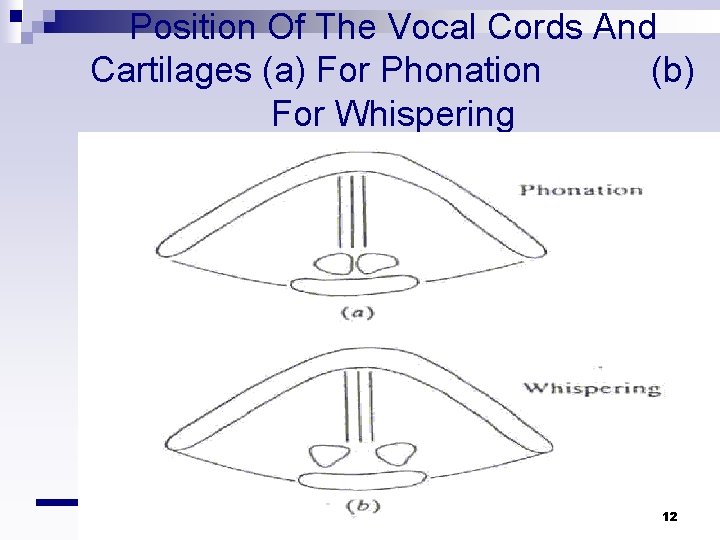
Position Of The Vocal Cords And Cartilages (a) For Phonation (b) For Whispering 12
13
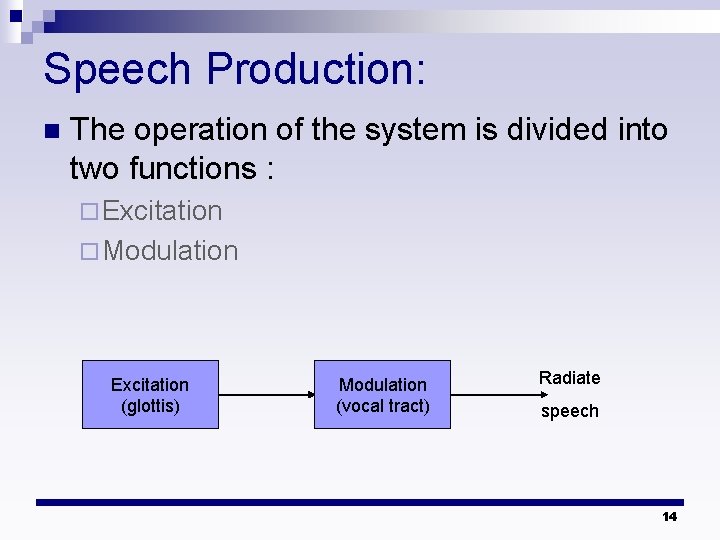
Speech Production: n The operation of the system is divided into two functions : ¨ Excitation ¨ Modulation Excitation (glottis) Modulation (vocal tract) Radiate speech 14
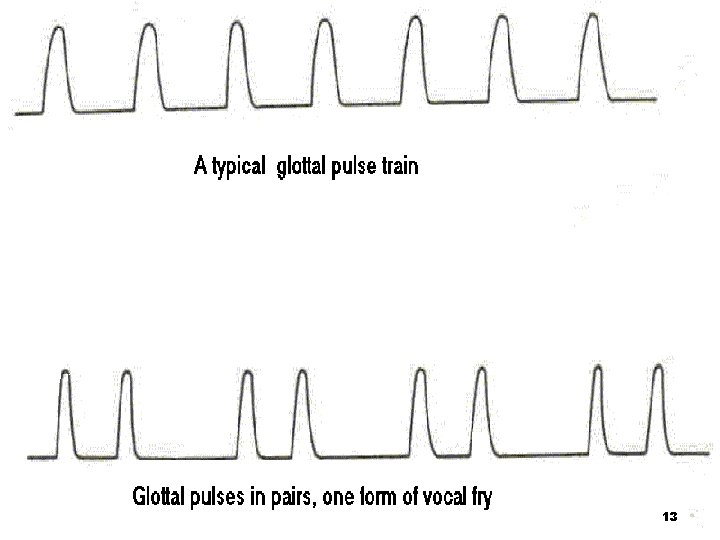
Speech Production: n Excitation : is done in several ways ¨ Phonation (making of a voiced sound) n This is the oscillation of the vocal cords n The arytenoid cartilages close and stretch the vocal cords n When air forced through the vocal, they vibrate n The opening and closing of the cords breaks the airstream up into pulses 15
Speech Production: ¨ n The repetition rate of the pulses is termed pitch. n At low levels of air pressure oscillation may become irregular, this irregularities are known as “vocal fry”. n Speech sounds accompanied by phonation are called voiced; others, unvoiced or mute. Whispering (speak softly) n The vocal cord are drawn together, but with small triangular opening between arytenoid cartilages 16
Speech Production: ¨ Frication n Frication can occur with or without phonation ¨ Compression n If the release is abrupt and clean, the sound is a stop or plosive n If gradual and turbulent, the sound can pass into the related fricative and is termed an affricative 17
Speech Production: ¨ Vibration n n If air is forced through a closure other than the vocal cords, vibrations may be set up Modulation ¨ This is what we do to impose information on the glottal output n Articulatory phonetics: how the organs of speech are positioned to produce any given speech sound n Acoustic phonetics: what the measurable acoustical correlates of any given speech sound are and how acoustical features in general correspond to phonetic and articulatory ones 18
Hearing and perception: n Hearing is a process which sound is received and convert into nerve impulse n Perception is the post-processing within the brain by which the sounds heard are interpreted and given meaning 19
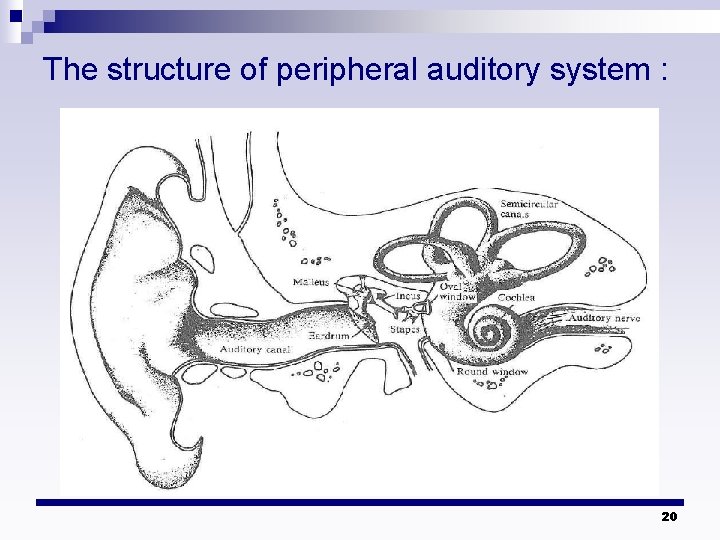
The structure of peripheral auditory system : 20
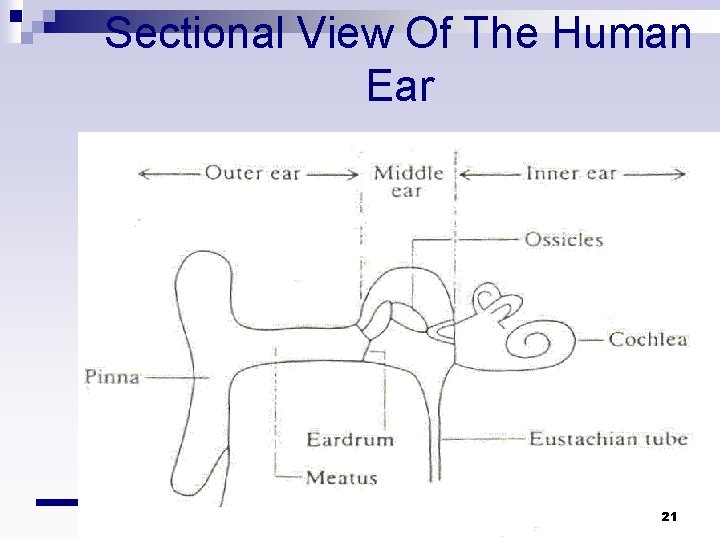
Sectional View Of The Human Ear 21
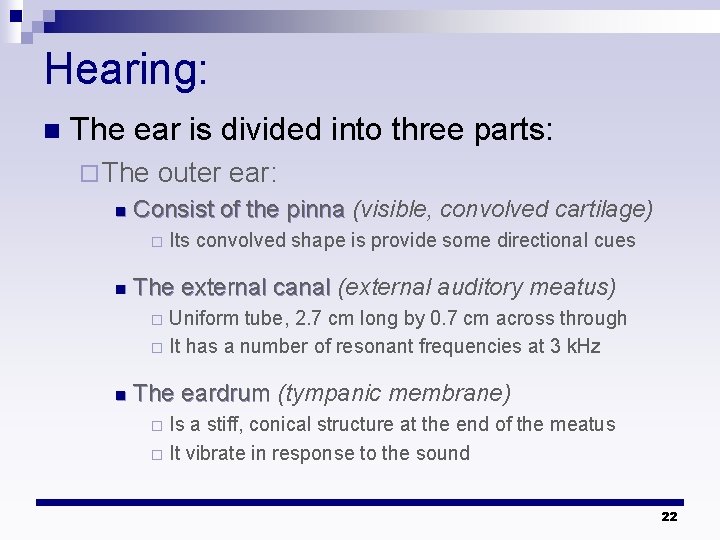
Hearing: n The ear is divided into three parts: ¨ The n outer ear: Consist of the pinna (visible, convolved cartilage) ¨ n Its convolved shape is provide some directional cues The external canal (external auditory meatus) Uniform tube, 2. 7 cm long by 0. 7 cm across through ¨ It has a number of resonant frequencies at 3 k. Hz ¨ n The eardrum (tympanic membrane) Is a stiff, conical structure at the end of the meatus ¨ It vibrate in response to the sound ¨ 22
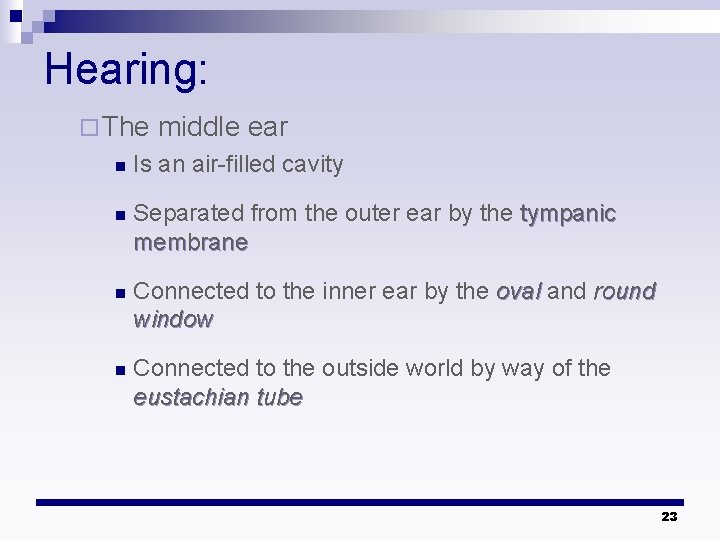
Hearing: ¨ The middle ear n Is an air-filled cavity n Separated from the outer ear by the tympanic membrane n Connected to the inner ear by the oval and round window n Connected to the outside world by way of the eustachian tube 23
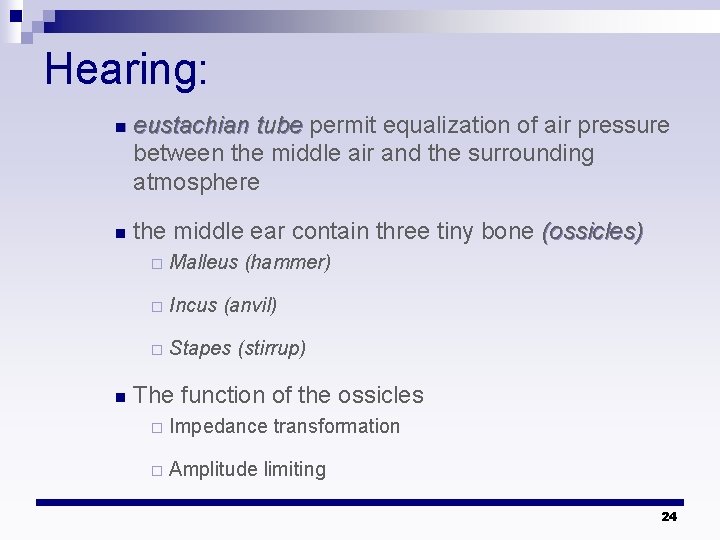
Hearing: n eustachian tube permit equalization of air pressure between the middle air and the surrounding atmosphere n the middle ear contain three tiny bone (ossicles) n ¨ Malleus (hammer) ¨ Incus (anvil) ¨ Stapes (stirrup) The function of the ossicles ¨ Impedance transformation ¨ Amplitude limiting 24
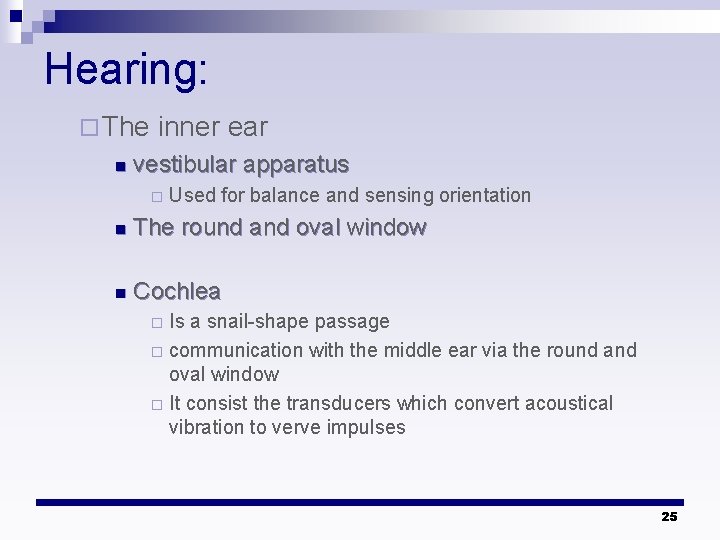
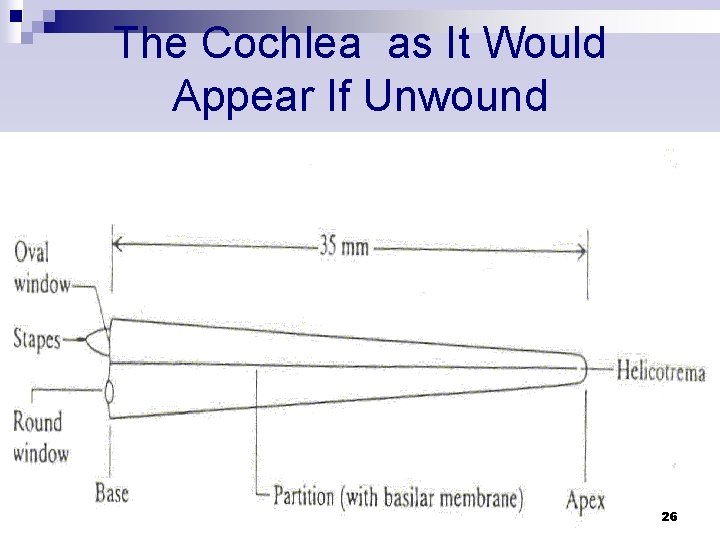
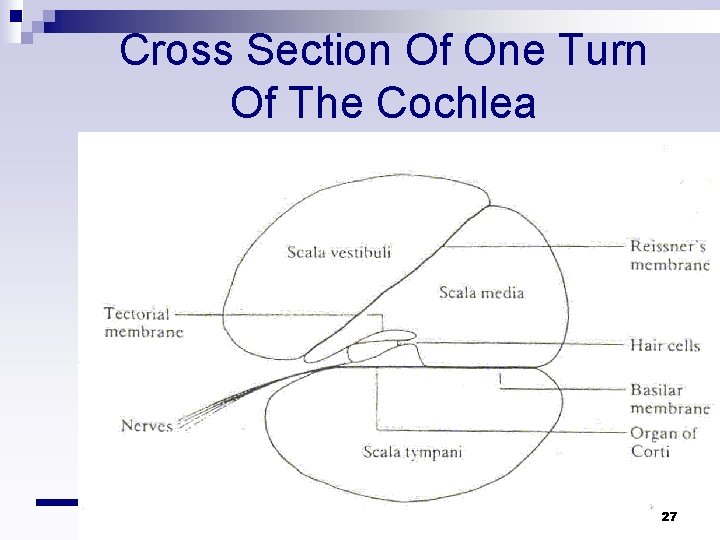
Hearing: ¨ The n inner ear vestibular apparatus ¨ Used for balance and sensing orientation n The round and oval window n Cochlea Is a snail-shape passage ¨ communication with the middle ear via the round and oval window ¨ It consist the transducers which convert acoustical vibration to verve impulses ¨ 25
The Cochlea as It Would Appear If Unwound 26
Cross Section Of One Turn Of The Cochlea 27
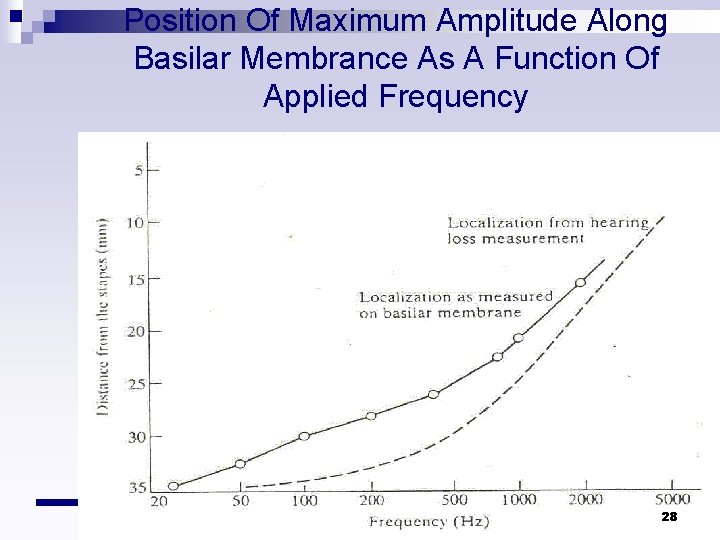
Position Of Maximum Amplitude Along Basilar Membrance As A Function Of Applied Frequency 28
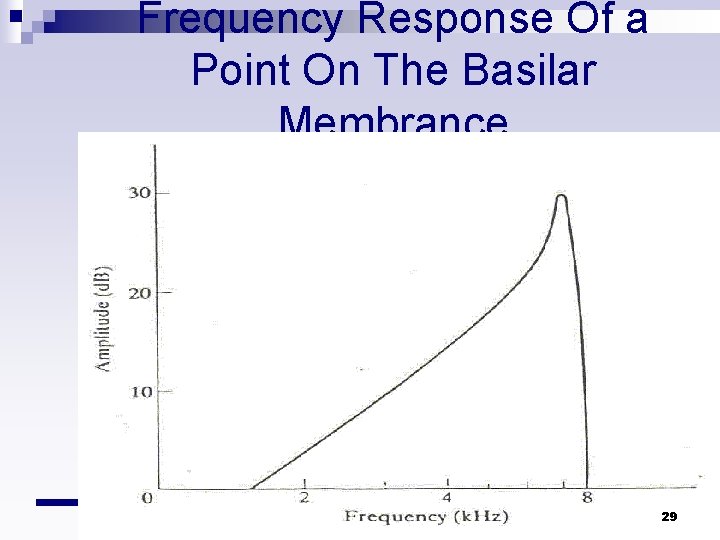
Frequency Response Of a Point On The Basilar Membrance 29