Space Environment Solar Physics Sun it is a
- Slides: 11
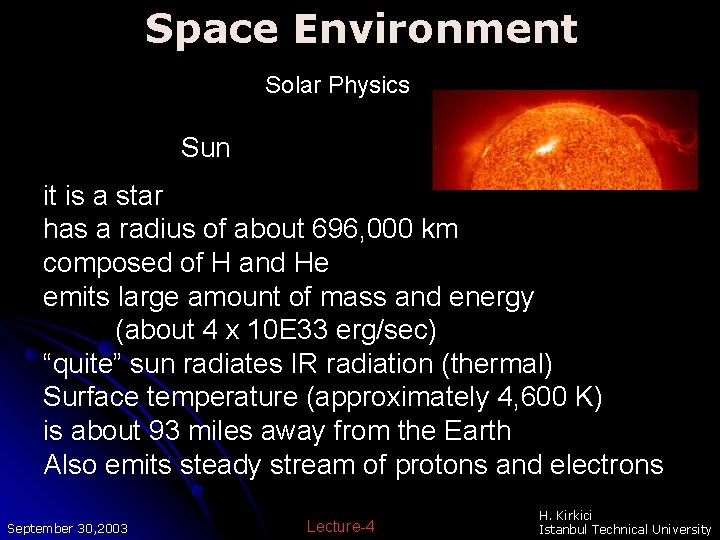
Space Environment Solar Physics Sun it is a star has a radius of about 696, 000 km composed of H and He emits large amount of mass and energy (about 4 x 10 E 33 erg/sec) “quite” sun radiates IR radiation (thermal) Surface temperature (approximately 4, 600 K) is about 93 miles away from the Earth Also emits steady stream of protons and electrons September 30, 2003 Lecture-4 H. Kirkici Istanbul Technical University
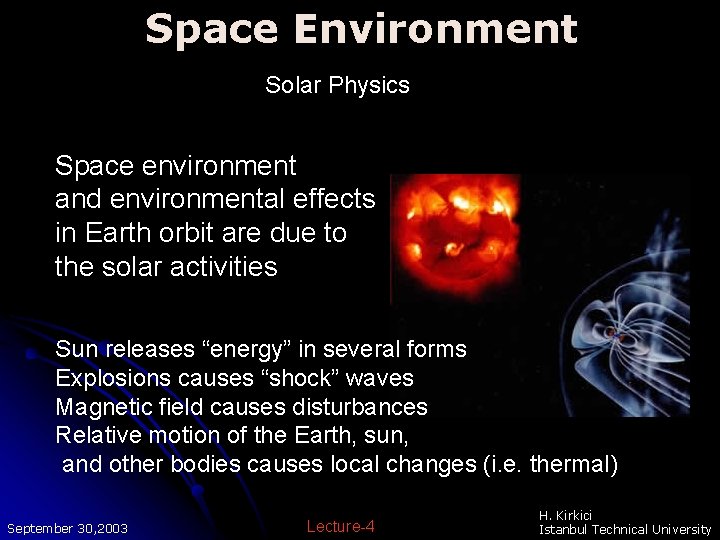
Space Environment Solar Physics Space environment and environmental effects in Earth orbit are due to the solar activities Sun releases “energy” in several forms Explosions causes “shock” waves Magnetic field causes disturbances Relative motion of the Earth, sun, and other bodies causes local changes (i. e. thermal) September 30, 2003 Lecture-4 H. Kirkici Istanbul Technical University
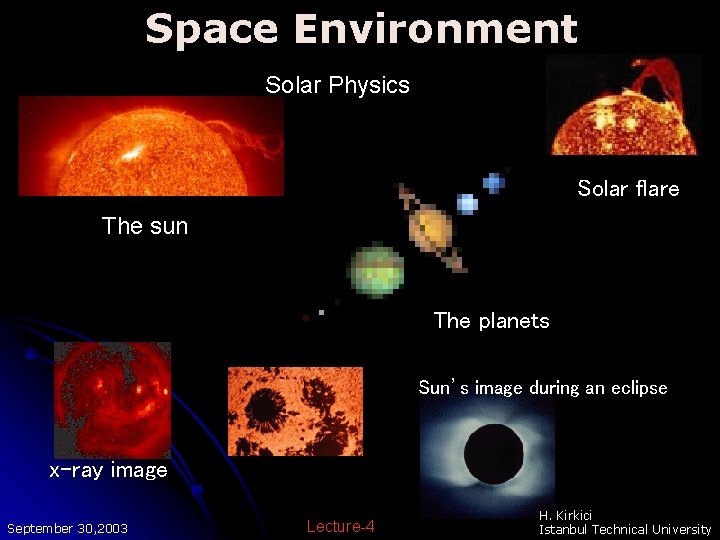
Space Environment Solar Physics Solar flare The sun The planets Sun’s image during an eclipse x-ray image September 30, 2003 Lecture-4 H. Kirkici Istanbul Technical University
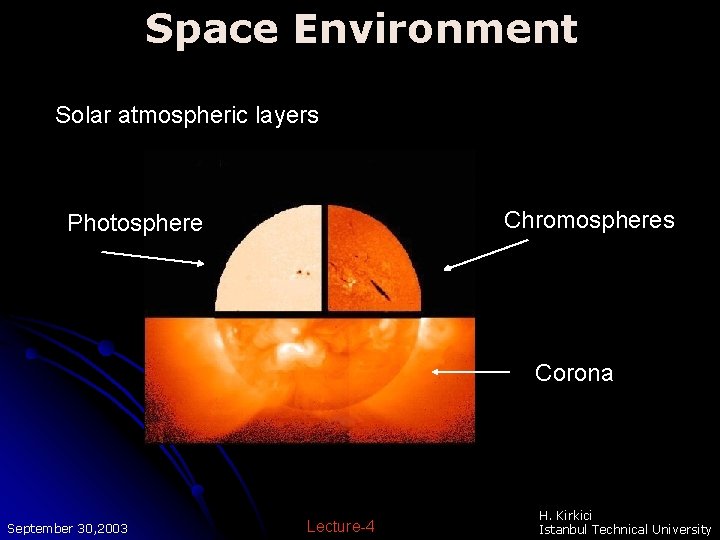
Space Environment Solar atmospheric layers Chromospheres Photosphere Corona September 30, 2003 Lecture-4 H. Kirkici Istanbul Technical University
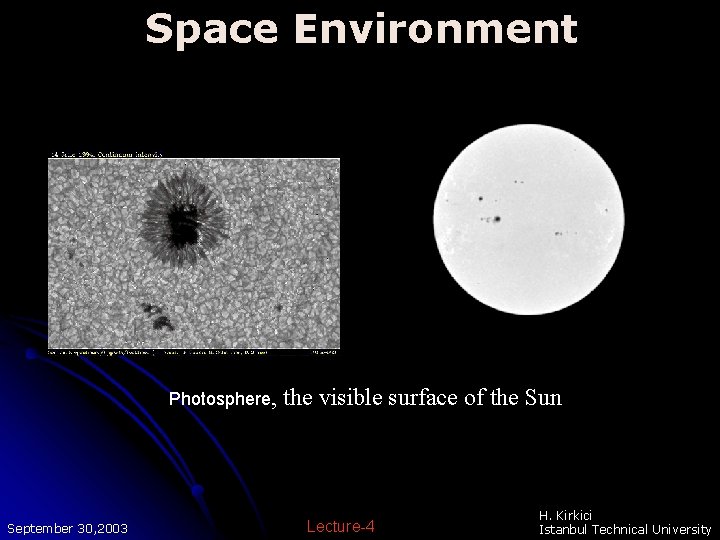
Space Environment Photosphere, September 30, 2003 the visible surface of the Sun Lecture-4 H. Kirkici Istanbul Technical University
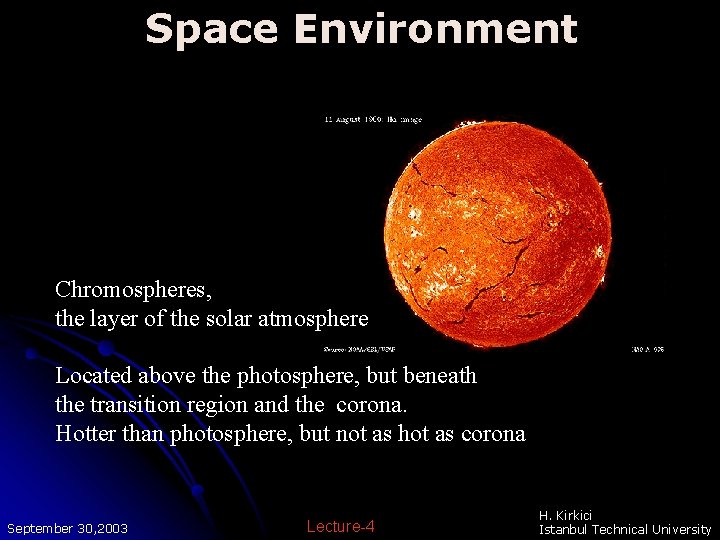
Space Environment Chromospheres, the layer of the solar atmosphere Located above the photosphere, but beneath the transition region and the corona. Hotter than photosphere, but not as hot as corona September 30, 2003 Lecture-4 H. Kirkici Istanbul Technical University
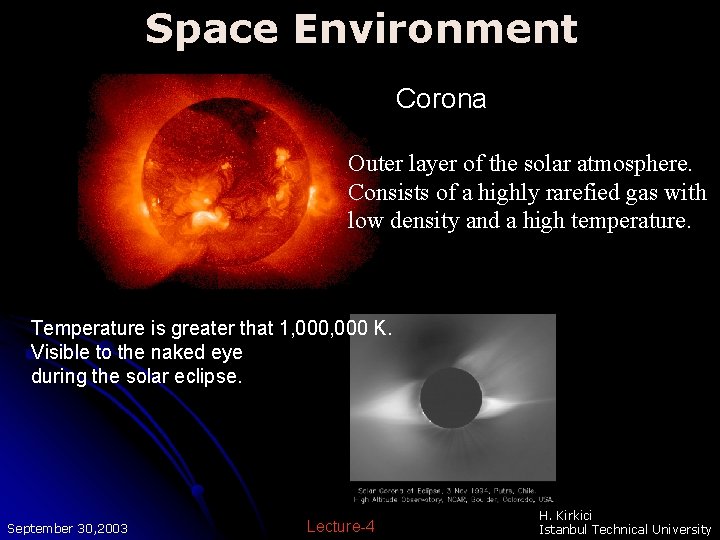
Space Environment Corona Outer layer of the solar atmosphere. Consists of a highly rarefied gas with low density and a high temperature. Temperature is greater that 1, 000 K. Visible to the naked eye during the solar eclipse. September 30, 2003 Lecture-4 H. Kirkici Istanbul Technical University
Space Environment Solar Physics and its influence on the formation of the Earths atmosphere and near earth space environments will be covered by Prof. Dr. Yurdanur Tulunay September 30, 2003 Lecture-4 H. Kirkici Istanbul Technical University
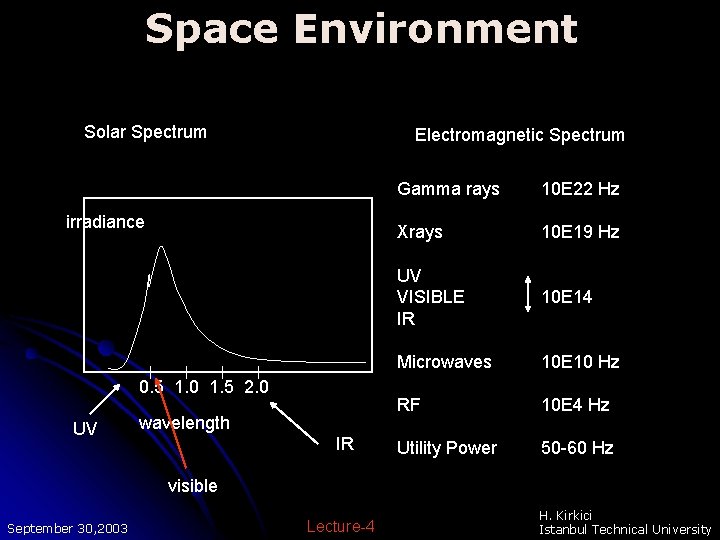
Space Environment Solar Spectrum Electromagnetic Spectrum irradiance 0. 5 1. 0 1. 5 2. 0 UV wavelength IR Gamma rays 10 E 22 Hz Xrays 10 E 19 Hz UV VISIBLE IR 10 E 14 Microwaves 10 E 10 Hz RF 10 E 4 Hz Utility Power 50 -60 Hz visible September 30, 2003 Lecture-4 H. Kirkici Istanbul Technical University
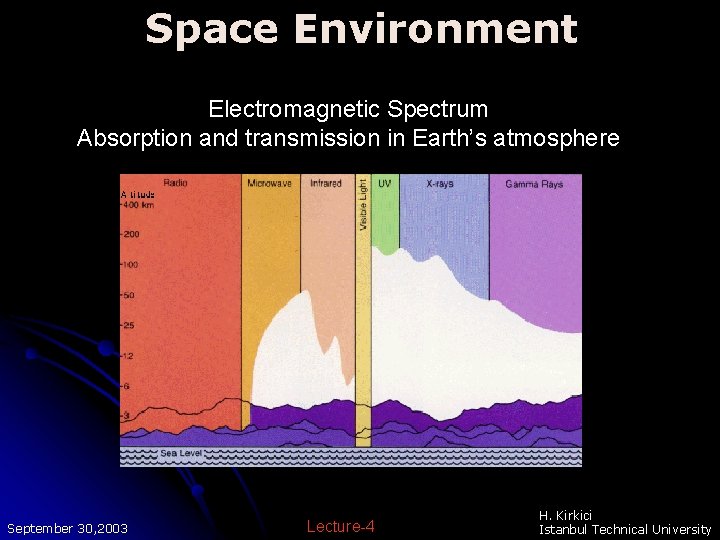
Space Environment Electromagnetic Spectrum Absorption and transmission in Earth’s atmosphere September 30, 2003 Lecture-4 H. Kirkici Istanbul Technical University
Space Environment Questions? . . . September 30, 2003 Lecture-4 H. Kirkici Istanbul Technical University