Sonnet 19 Lady Mary Wroth Lady Mary Wroth



- Slides: 10
Sonnet 19 Lady Mary Wroth
Lady Mary Wroth Though she withdrew from court after her affair with the Earl of Pembroke, a favorite of the court, Lady Wroth remained interested in political affairs. Plagued with financial troubles, she sold much of her land. Considered a woman who overstepped acceptable female boundaries with the publication of Urania, Wroth remained withdrawn from public.
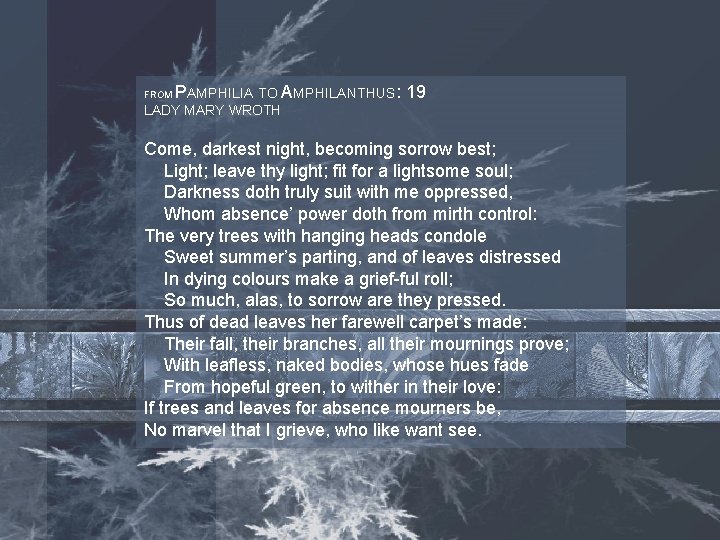
FROM PAMPHILIA TO AMPHILANTHUS: 19 LADY MARY WROTH Come, darkest night, becoming sorrow best; Light; leave thy light; fit for a lightsome soul; Darkness doth truly suit with me oppressed, Whom absence’ power doth from mirth control: The very trees with hanging heads condole Sweet summer’s parting, and of leaves distressed In dying colours make a grief-ful roll; So much, alas, to sorrow are they pressed. Thus of dead leaves her farewell carpet’s made: Their fall, their branches, all their mournings prove; With leafless, naked bodies, whose hues fade From hopeful green, to wither in their love: If trees and leaves for absence mourners be, No marvel that I grieve, who like want see.
Content PAMPHILIA TO AMPHILANTHUS u The sonnet sequence concerns Pamphilia, queen of the island kingdom of Pamphilia, and the man she loves—Amphilanthus— who is inconstant in his affections. The queen, however, is virtuous, something that her lover will not be until he attains honor. u Many believe this sequence reflects Wroth’s love for the fickle Pembroke and his relationship with Queen Elizabeth I.
Structure This sonnet is comprised of four stanzas that focus on nature’s reaction to the departing summer. The final couplet is the volta, or shift where the speaker relates nature’s change with her own emotions. The rhyme scheme is nontraditional—ABABBA BACDCDEE—much like the relationship described in the poem.
Speaker employs apostrophe by calling forth “night, ” which suits “sorrow” best. “Night” also symbolizes death, and this poem is riddled with images of death. “Sorrow, ” “soul, ” and “darkness” are images of death. Come, darkest night, becoming sorrow best; Light; leave thy light; fit for a lightsome soul; Darkness doth truly suit with me oppressed, Whom absence’ power doth from mirth control: Alliteration of the “l” creates a soft sound that reinforces the banishment of summer. Caesura in lines 1 and 2 reflect imperative tone of the speaker. Speaker associates with “darkness” because she feels “oppressed. ” This oppression removes “mirth, ” or happiness, from her life.
“Trees” and “summer” are personified to show that the speaker’s feelings are common throughout nature. Stanza utilizes sibilance as a negative sound, almost a hiss, to reflect the dark tone of the poem. The very trees with hanging heads condole Sweet summer’s parting, and of leaves distressed In dying colours make a grief-ful roll; So much, alas, to sorrow are they pressed. The enjambment in lines 5 -7 create a sense of inevitability as the cycle of grief/darkness never ceases. Images of death continue with choice of diction: “condole, ” “dying, ” “grief, ’ and “sorrow. ”
The “trees” continue in this stanza as an extended metaphor for the speaker’s loss. In stanza three, the trees leave their leaves and sit barren with “leafless, naked bodies. ” This loss of life is compared to a lost love for they “wither in their love. ” “Fall, ” “branches, ” and “mournings” are puns that link a lost love to the end of the season. Thus of dead leaves her farewell carpet’s made: Their fall, their branches, all their mournings prove; With leafless, naked bodies, whose hues fade From hopeful green, to wither in their love: The abundance of caesura emphasizes the inevitability of death as the pauses demonstrate a methodical approach. Enjambment allows the subordinate clause to to pick up the pace only to be followed by another pause, one that focuses on the end of the season and of love.
The volta implies that if nature can grieve the absence of its leaves, then the speaker may also suffer from loss. Also, since the volta fails to provide a solution, the line suggests that no solution exists. If trees and leaves for absence mourners be, No marvel that I grieve, who like want see. Inverted syntax in line 13 forces emphasis on the word “mourners” in order to stress the loss. Tone remains grim and stresses a lack of hope. The continued sibilance aids that tone.
Works Cited http: //aspoetryanalysis. weebly. com/index. html http: //pages. uoregon. edu/rbear/mary. html http: //www. english. cam. ac. uk/wroth/biography. htm