Solid Waste Collection and Disposal Summary City of
- Slides: 26
Solid Waste Collection and Disposal Summary City of Jacksonville Special Committee on Solid Waste
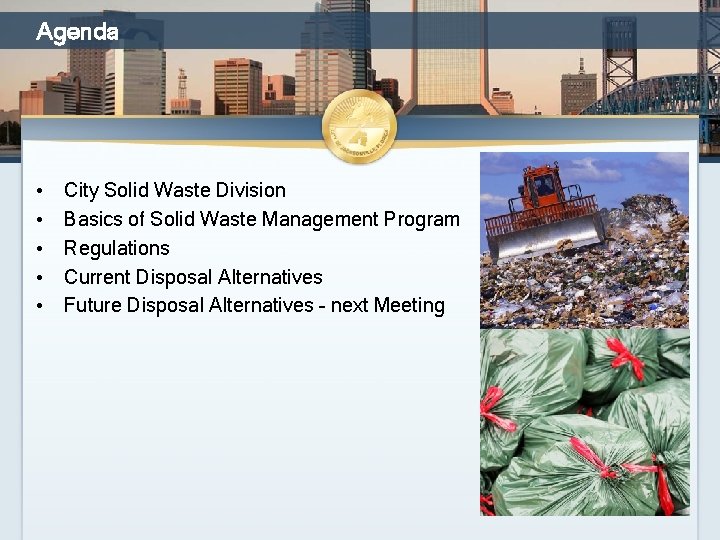
Agenda • • • City Solid Waste Division Basics of Solid Waste Management Program Regulations Current Disposal Alternatives Future Disposal Alternatives – next Meeting
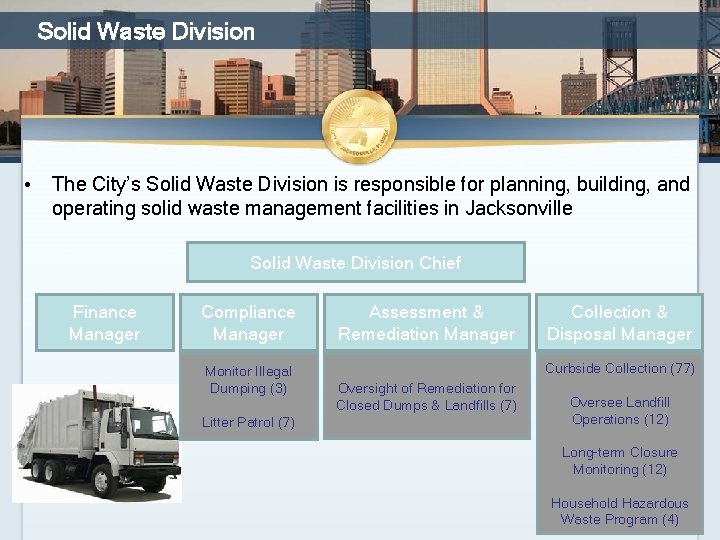
Solid Waste Division • The City’s Solid Waste Division is responsible for planning, building, and operating solid waste management facilities in Jacksonville Solid Waste Division Chief Finance Manager Compliance Manager Monitor Illegal Dumping (3) Litter Patrol (7) Assessment & Remediation Manager Collection & Disposal Manager Curbside Collection (77) Oversight of Remediation for Closed Dumps & Landfills (7) Oversee Landfill Operations (12) Long-term Closure Monitoring (12) Household Hazardous Waste Program (4)
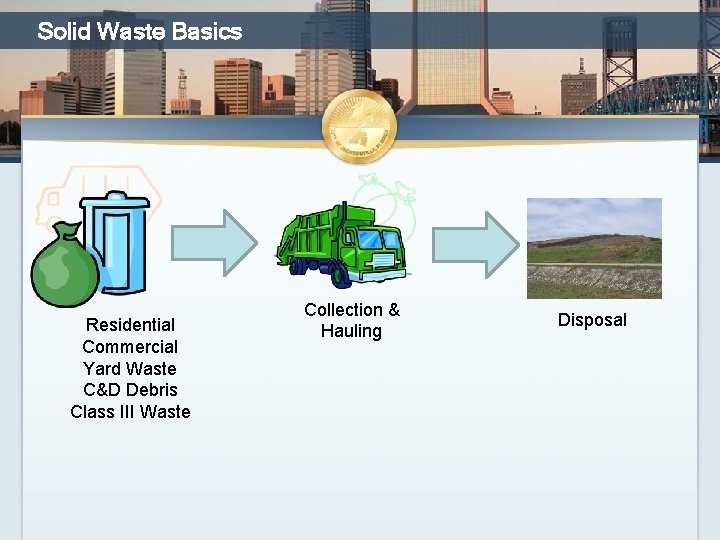
Solid Waste Basics Residential Commercial Yard Waste C&D Debris Class III Waste Collection & Hauling Disposal
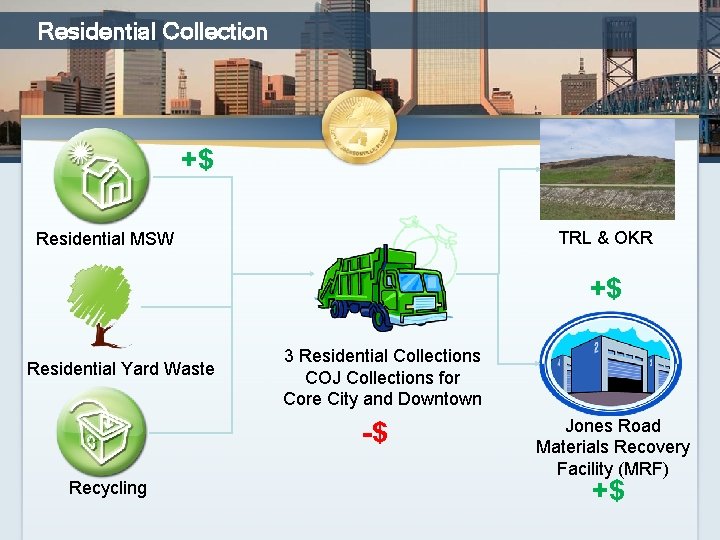
Residential Collection +$ TRL & OKR Residential MSW +$ Residential Yard Waste 3 Residential Collections COJ Collections for Core City and Downtown -$ Recycling Jones Road Materials Recovery Facility (MRF) +$
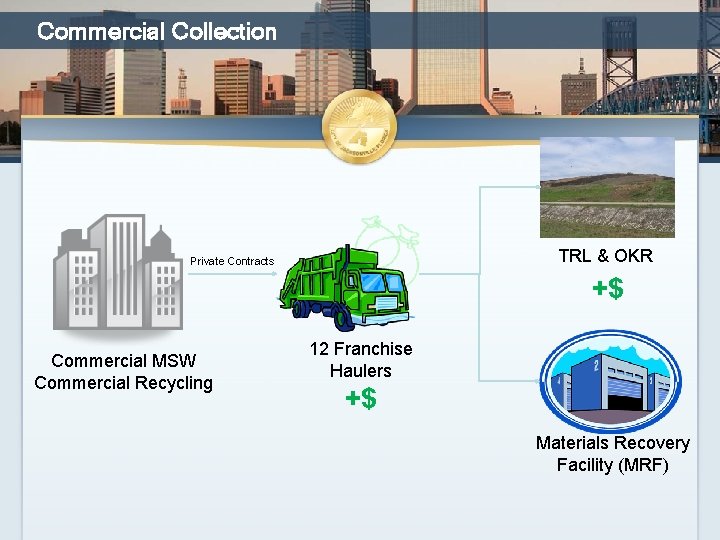
Commercial Collection TRL & OKR Private Contracts +$ Commercial MSW Commercial Recycling 12 Franchise Haulers +$ Materials Recovery Facility (MRF)
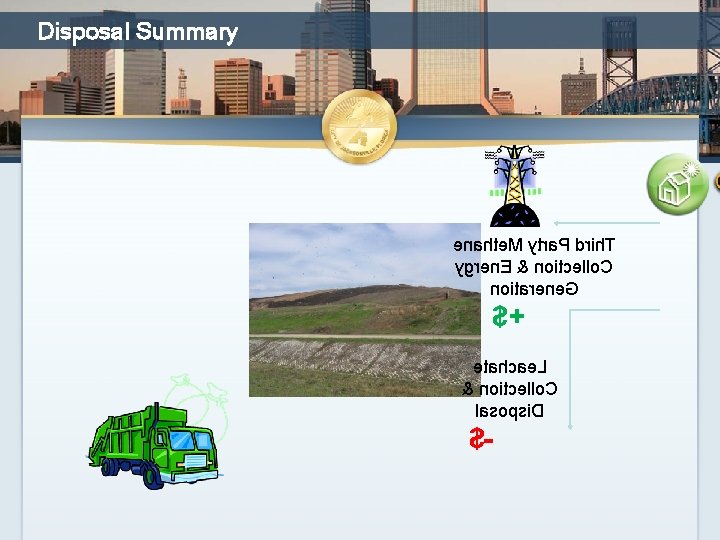
Disposal Summary enahte. M ytra. P drih. T ygren. E & noitcello. C noitarene. G $+ etahcae. L & noitcello. C lasopsi. D $-
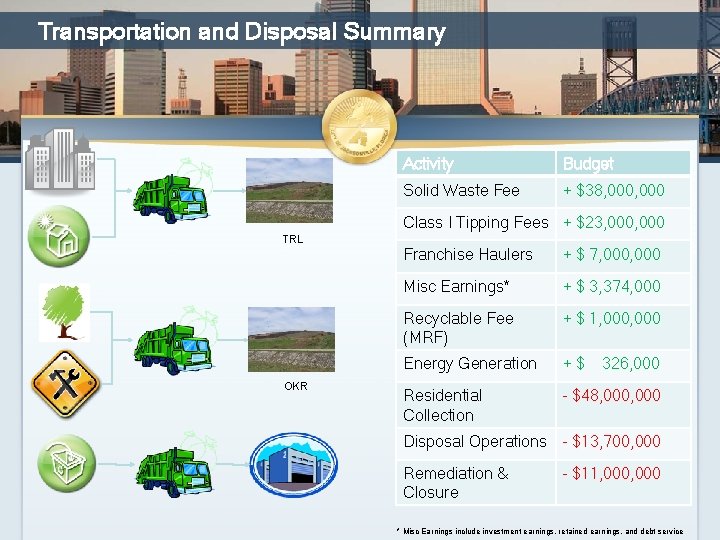
Transportation and Disposal Summary Activity Budget Solid Waste Fee + $38, 000 Class I Tipping Fees + $23, 000 TRL OKR Franchise Haulers + $ 7, 000 Misc Earnings* + $ 3, 374, 000 Recyclable Fee (MRF) + $ 1, 000 Energy Generation +$ Residential Collection - $48, 000 326, 000 Disposal Operations - $13, 700, 000 Remediation & Closure - $11, 000 * Misc Earnings include investment earnings, retained earnings, and debt service
Permitting Requirements for Solid Waste Disposal Facilities • Solid Waste is one of the most heavily regulated services provided by Municipalities • Solid Waste Regulations (FAC 62 -701) • Environmental Resource Permitting (ERP) • Title V Air Permitting • National Pollutant Discharge Elimination System – Industrial Discharge
Solid Waste Collection and Disposal is Regulated by FDEP • Chapter 62 -701. 300 Prohibitions • Chapter 62 -701. 320 Solid Waste Management Facility Permit Requirements • Chapter 62 -701. 330 Landfill Permit Requirements • Chapter 62 -701. 400 Landfill Construction Requirements • Minimum Design Standards • Liner Requirements • Leachate collection requirements • Chapter 62 -701. 500 Landfill Operation Requirements • Chapter 62 -701. 510 Water Quality Monitoring Requirements • Chapter 62 -701. 600 Landfill Closure Requirements
Solid Waste Collection and Disposal is Regulated by FDEP • Chapter 62 -701 Waste Processing Facilities • Material Recovery Facilities (MRF) • Transfer Stations • Chapter 62 -701. 730 Construction and Demolition Debris Disposal and Recycling • Chapter 62 -701. 803 Off-site Disposal of Yard Trash • Chapter 62 -296. 320 Fugitive Air Emissions • Chapter 62 -296 or 62 -256 Solid Waste Combustors or Incinerators • Chapter 62 -702 Solid Waste Combustor Ash Management • Chapter 62 -709 Organics Processing and Recycling Facilities
Disposal Options Currently in Duval County • Trail Ridge Landfill • Class I Landfill • Only Class I landfill in Nassau, Baker, Duval, Clay, and St Johns Counties • No Class III Landfills in Duval County • TRL Accepts Class I, Class III, and Commercial MSW • 2500 -3000 tons/day processed at TRL • Permitted 5, 000 tons/day • Old Kings Road Landfill, Otis Road Landfill, Jones Road Landfill • Private facilities • C&D disposal facilities • Accept C&D and yard waste
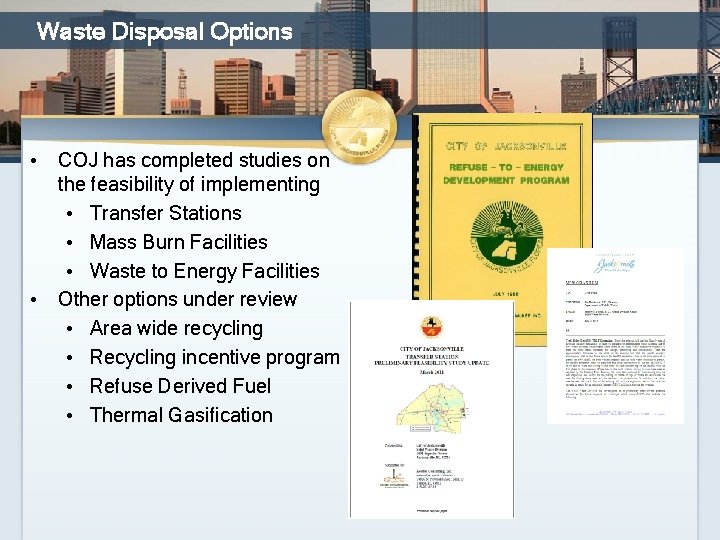
Waste Disposal Options • COJ has completed studies on the feasibility of implementing • Transfer Stations • Mass Burn Facilities • Waste to Energy Facilities • Other options under review • Area wide recycling • Recycling incentive program • Refuse Derived Fuel • Thermal Gasification
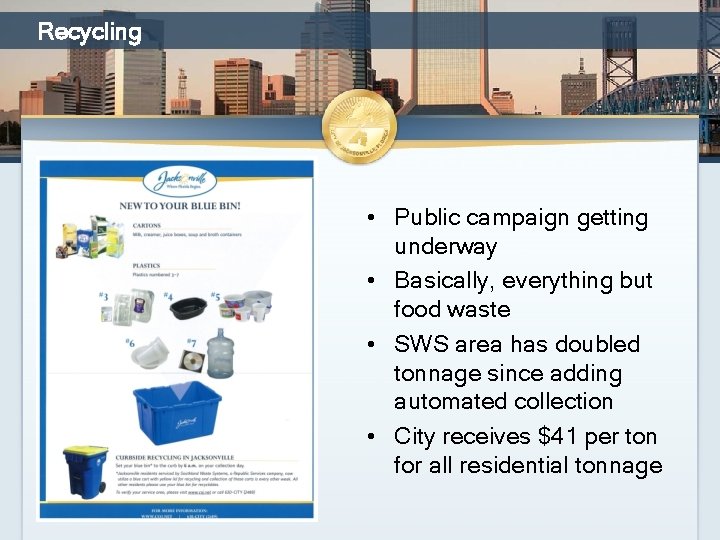
Recycling • Public campaign getting underway • Basically, everything but food waste • SWS area has doubled tonnage since adding automated collection • City receives $41 per ton for all residential tonnage
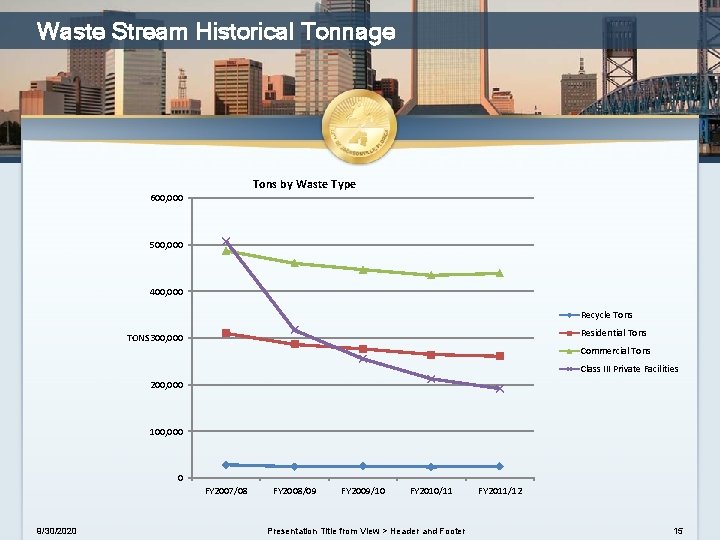
Waste Stream Historical Tonnage Tons by Waste Type 600, 000 500, 000 400, 000 Recycle Tons Residential Tons TONS 300, 000 Commercial Tons Class III Private Facilities 200, 000 100, 000 0 FY 2007/08 9/30/2020 FY 2008/09 FY 2009/10 FY 2010/11 Presentation Title from View > Header and Footer FY 2011/12 15
9/30/2020 Presentation Title from View > Header and Footer 16
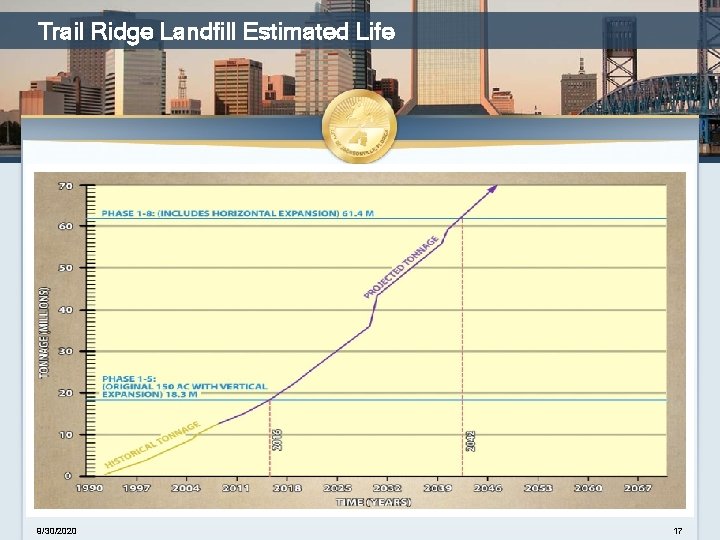
Trail Ridge Landfill Estimated Life 9/30/2020 17
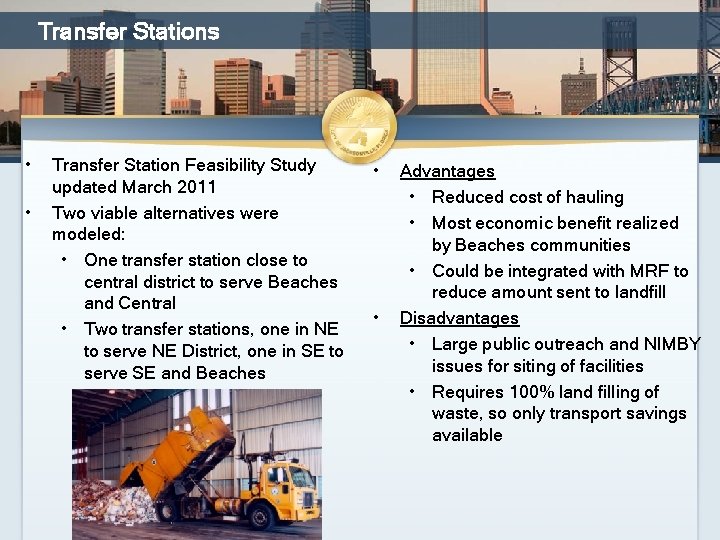
Transfer Stations • • Transfer Station Feasibility Study updated March 2011 Two viable alternatives were modeled: • One transfer station close to central district to serve Beaches and Central • Two transfer stations, one in NE to serve NE District, one in SE to serve SE and Beaches • • Advantages • Reduced cost of hauling • Most economic benefit realized by Beaches communities • Could be integrated with MRF to reduce amount sent to landfill Disadvantages • Large public outreach and NIMBY issues for siting of facilities • Requires 100% land filling of waste, so only transport savings available
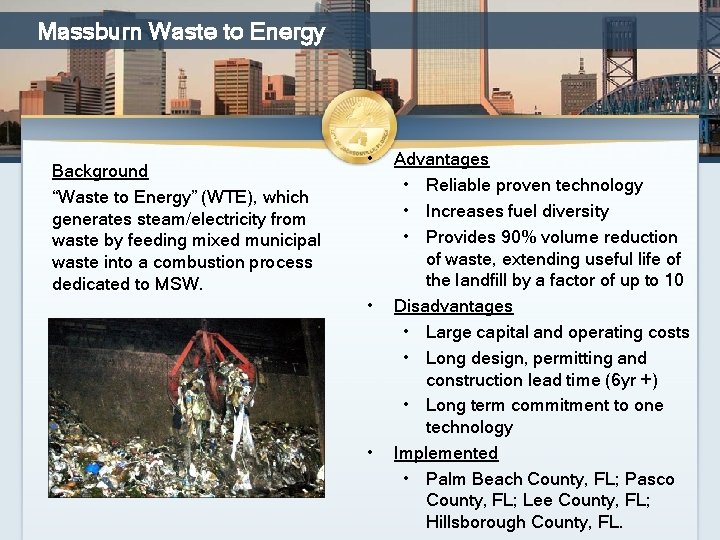
Massburn Waste to Energy Background “Waste to Energy” (WTE), which generates steam/electricity from waste by feeding mixed municipal waste into a combustion process dedicated to MSW. • • • Advantages • Reliable proven technology • Increases fuel diversity • Provides 90% volume reduction of waste, extending useful life of the landfill by a factor of up to 10 Disadvantages • Large capital and operating costs • Long design, permitting and construction lead time (6 yr +) • Long term commitment to one technology Implemented • Palm Beach County, FL; Pasco County, FL; Lee County, FL; Hillsborough County, FL.
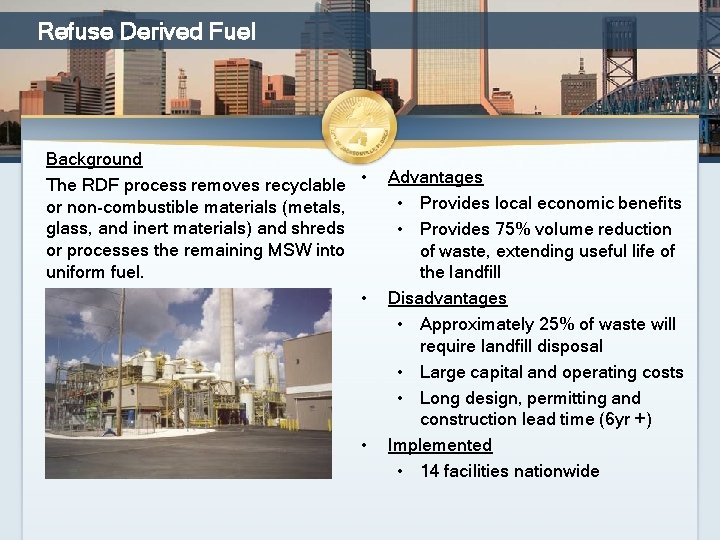
Refuse Derived Fuel Background The RDF process removes recyclable • or non-combustible materials (metals, glass, and inert materials) and shreds or processes the remaining MSW into uniform fuel. • • Advantages • Provides local economic benefits • Provides 75% volume reduction of waste, extending useful life of the landfill Disadvantages • Approximately 25% of waste will require landfill disposal • Large capital and operating costs • Long design, permitting and construction lead time (6 yr +) Implemented • 14 facilities nationwide
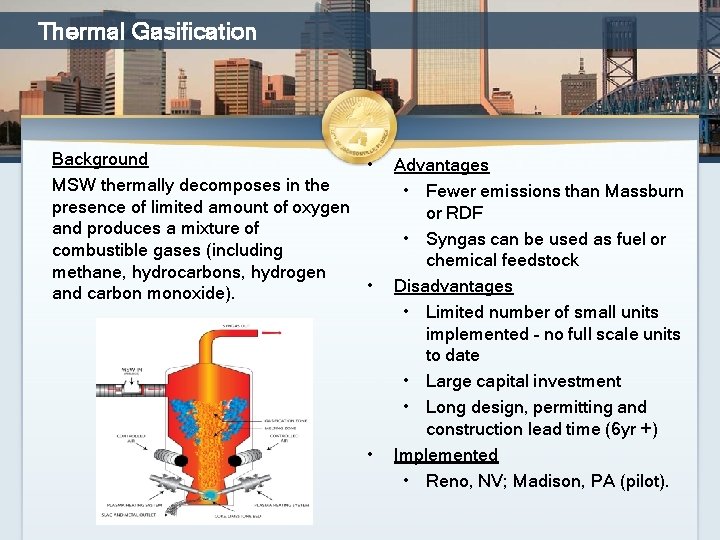
Thermal Gasification Background • MSW thermally decomposes in the presence of limited amount of oxygen and produces a mixture of combustible gases (including methane, hydrocarbons, hydrogen • and carbon monoxide). • Advantages • Fewer emissions than Massburn or RDF • Syngas can be used as fuel or chemical feedstock Disadvantages • Limited number of small units implemented – no full scale units to date • Large capital investment • Long design, permitting and construction lead time (6 yr +) Implemented • Reno, NV; Madison, PA (pilot).
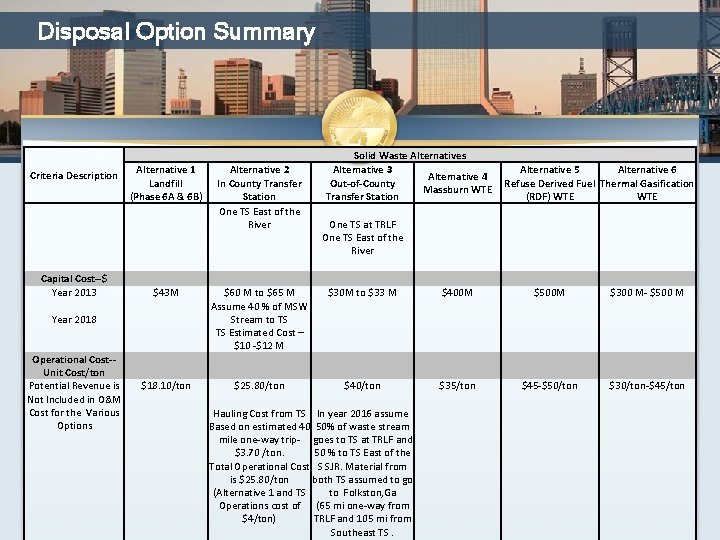
Disposal Option Summary Alternative 1 Alternative 2 Landfill In County Transfer (Phase 6 A & 6 B) Station One TS East of the River Criteria Description Operational Cost-Unit Cost/ton Potential Revenue is Not Included in O&M Cost for the Various Options $18. 10/ton $25. 80/ton Alternative 5 Alternative 6 Refuse Derived Fuel Thermal Gasification (RDF) WTE $30 M to $33 M $400 M $500 M $300 M- $500 M $40/ton $35/ton $45 -$50/ton $30/ton-$45/ton $60 M to $65 M Assume 40 % of MSW Stream to TS TS Estimated Cost – $10 -$12 M $43 M Year 2018 One TS at TRLF One TS East of the River Capital Cost--$ Year 2013 Solid Waste Alternatives Alternative 3 Alternative 4 Out-of-County Massburn WTE Transfer Station Hauling Cost from TS In year 2016 assume Based on estimated 40 50% of waste stream mile one-way trip- goes to TS at TRLF and $3. 70 /ton. 50 % to TS East of the Total Operational Cost S SJR. Material from is $25. 80/ton both TS assumed to go (Alternative 1 and TS to Folkston, Ga Operations cost of (65 mi one-way from $4/ton) TRLF and 105 mi from Southeast TS.
Trail Ridge Landfill Historical Permitting • 1986 Sunbeam Road Landfill closed, 1988 Girvin Road Landfill Closed • Southeast Landfill proposed in southern Duval County (1986 -87) • Lawsuit filed to halt development of Southeast Landfill (1988) • COJ reopened East Landfill temporarily (1989) • TRL site identified and plans for TRL begun (1989) • FDEP granted North Landfill one year additional capacity while the County dealt with development issues (1990) • Surrounding Counties drop opposition to TRL (1991) • FDEP grants COJ special emergency permit to expedite permitting of TRL (1991) • Ground broken on TRL (January 1992) • First trash placed at TRL (March 1992)
Trail Ridge Landfill Expansion Permitting • Solid Waste Permit • Geotechnical Report • Gas Management Plan • Leachate Management Plan • Financial Responsibility Plan • Solid Waste Design • Closure Plan • FAA Notification • Environmental Resource Permit • Wetlands Mitigation • Stormwater Management • Title V Permit • SWPPP Permit • NPDES Permit
TRL Expansion Timeline • • Feb 2012 Dec 2012 Aug 2013 Sep 2013 Apr 2014 Sep 2014 Nov 2014 Jun 2016 ERP and Solid Waste Pre Application Meeting ERP Submittal Solid Waste Permit Submittal (80% Design) 100% Design FDEP Notice of Intent Bidding Begin construction of Cells 6 A & 6 B Complete construction of Cells 6 A & 6 B
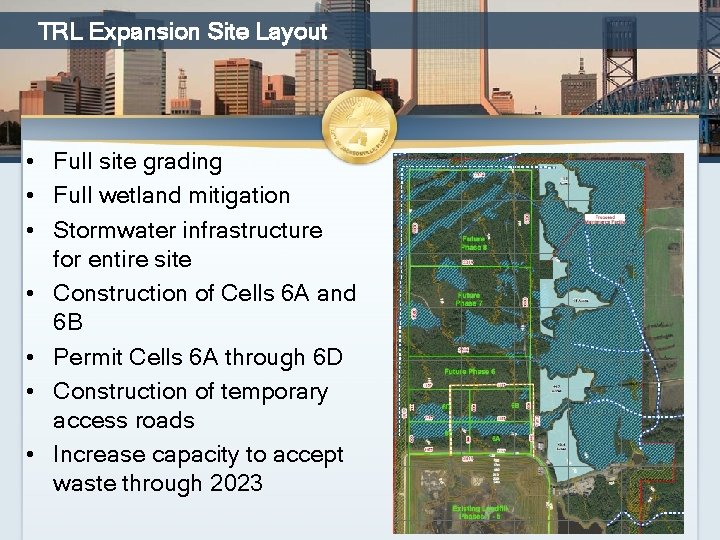
TRL Expansion Site Layout • Full site grading • Full wetland mitigation • Stormwater infrastructure for entire site • Construction of Cells 6 A and 6 B • Permit Cells 6 A through 6 D • Construction of temporary access roads • Increase capacity to accept waste through 2023