Social Status Evolutionary Psychology Spring 2020 Dr Chapman
- Slides: 16
Social Status Evolutionary Psychology Spring 2020 Dr Chapman 1
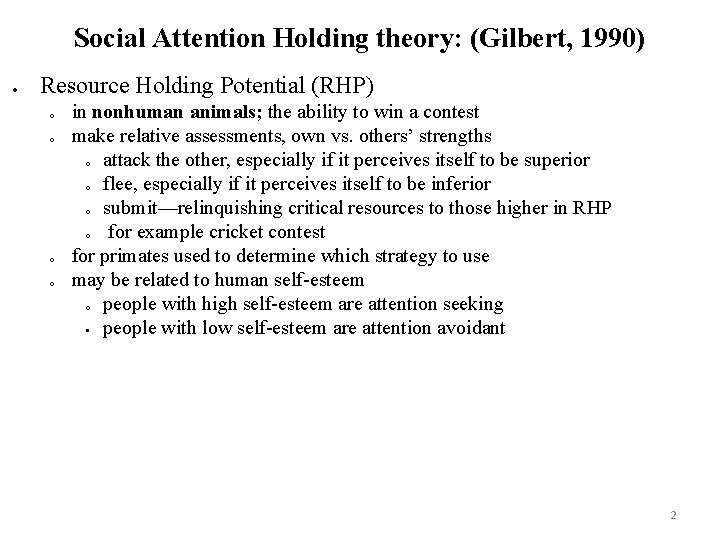
Social Attention Holding theory: (Gilbert, 1990) Resource Holding Potential (RHP) o o in nonhuman animals; the ability to win a contest make relative assessments, own vs. others’ strengths o attack the other, especially if it perceives itself to be superior o flee, especially if it perceives itself to be inferior o submit—relinquishing critical resources to those higher in RHP o for example cricket contest for primates used to determine which strategy to use may be related to human self-esteem o people with high self-esteem are attention seeking people with low self-esteem are attention avoidant 2
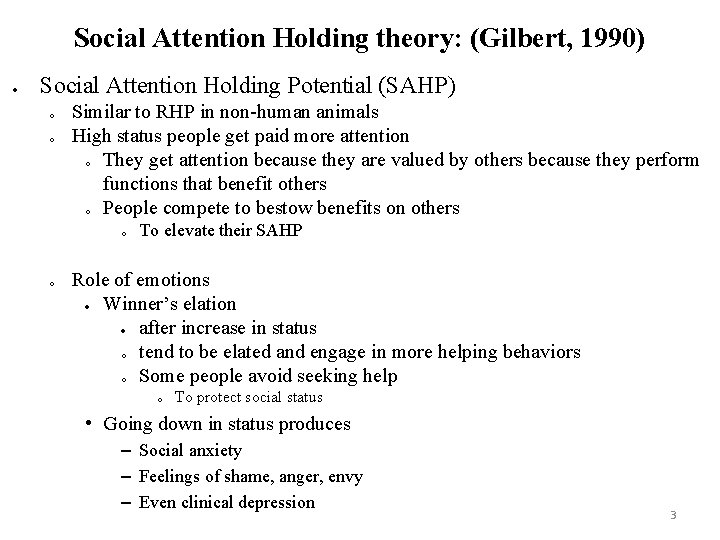
Social Attention Holding theory: (Gilbert, 1990) Social Attention Holding Potential (SAHP) o o Similar to RHP in non-human animals High status people get paid more attention o They get attention because they are valued by others because they perform functions that benefit others o People compete to bestow benefits on others o o To elevate their SAHP Role of emotions Winner’s elation after increase in status o tend to be elated and engage in more helping behaviors o Some people avoid seeking help o To protect social status • Going down in status produces – Social anxiety – Feelings of shame, anger, envy – Even clinical depression 3
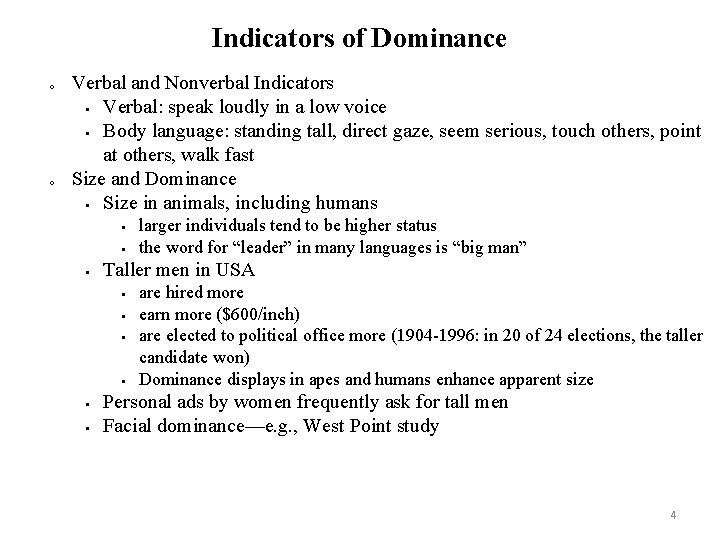
Indicators of Dominance o o Verbal and Nonverbal Indicators Verbal: speak loudly in a low voice Body language: standing tall, direct gaze, seem serious, touch others, point at others, walk fast Size and Dominance Size in animals, including humans Taller men in USA larger individuals tend to be higher status the word for “leader” in many languages is “big man” are hired more earn more ($600/inch) are elected to political office more (1904 -1996: in 20 of 24 elections, the taller candidate won) Dominance displays in apes and humans enhance apparent size Personal ads by women frequently ask for tall men Facial dominance—e. g. , West Point study 4
Testosterone and Dominance o Testosterone: cause or effect? in nonhuman animal studies injections of testosterone produce an elevation in dominance Increased levels produces more impulsivity, see serotonin below levels increase prior to competition o levels remain elevated in winners levels go down in losers encourages winners by increased self-confidence apparent higher status Testosterone's effects on behavior related to increased use of aggression use of aggressive behavior can increase dominance level but it is context dependent associated with dominance when hierarchies are unstable anti-social behavior is dominance toward authority figures Testosterone levels are positively correlated with use of dominance but they are not related to prestige 5
Testosterone and Dominance o Testosterone levels are associated with dominance—behaviors intended to gain or maintain high status positively associated with social rank and dominant behaviors in a variety of species including humans Has more importance during periods of social instability o When there is a stable hierarchy Testosterone and dominant behavior are unrelated. high Testosterone levels motivate individuals to seek out higher status when social status is uncertain Testosterone changes vigilance for signs of competition increases vigilance toward dominance cues such as anger decreases vigilance toward submissive cues increases confrontation and fighting 6
Testosterone and Dominance o Individual differences in testosterone high vs low basal testosterone is strongly influenced by genetics Men with high testosterone levels have higher waist to hip ratio are healthier more assertive perceived to be dominant leaders Environmental influences on testosterone levels basal testosterone is moved up or down by environmental situations previous experiences with victory and defeat can push testosterone up and down chronic stress will lower testosterone levels relationship status: long-term relationship lowers testosterone 7
Testosterone and Dominance o o o After defeat; high "basal" Testosterone individuals paid more attention to status cues became dysphoric performed poorly on complex cognitive tasks had higher levels of cortisol, stress hormone suggests that high Testosterone individuals are driven to rise in status; when they achieve high status, high Testosterone individuals experience pleasure and adaptive functioning (e. g. , good cognitive performance) After defeat; low "basal" Testosterone individuals sometimes did not have these changes other times they reacted more negatively to high status than to low status hypervigilant to status cues, showed elevated cardiovascular arousal, and performed poorly on complex cognitive tasks in a high status position Under some social conditions this is true for men or women 8
Serotonin Similar to results for testosterone Higher levels in dominant individuals o o probably secondary to elevated testosterone produces feelings of elation Rises with winning and falls with losing experience Serotonin is more closely related to use of aggressive behavior o o low levels of serotonin are related to high levels of aggression because of poor impulse control 9
Self-Esteem as a Status-Tracking Mechanism • Sociometer theory: Self esteem may be an evolved mechanism of status tracking – a means by which individuals track their acceptance by others • How well they are accepted by the group which is important for survival – Their prestige, social status and reputation in group – appropriately adjust probability of • forming alliances • behaving aggressively • behaving submissively – An evaluation of one’s mate value • Relative physical attractiveness for women • Relative dominance for men 10
Strategies of submissiveness Deceiving Down To deal with the adaptive problem of the mismatch between status and talent not the same as acting dumb acting submissively o o reduces threat to higher status individuals reduces fighting • Wait for opportunities to increase social status 11
The Downfall of "Tall Poppies" Disadvantages and advantages of being subordinate o o “tall poppies” (conspicuously successful people) o o Subordinates have less access to resources for survival and reproduction however superiors get more attention and can be the focus of disparaging comments and negative emotions can get mowed down by verbal derogation German "Schadenfreude" o o o "experiencing pleasure in another's misfortune" often related to envy over others’ success specially when high status was perceived as undeserved more so for individuals that shared same aspirations of success more emotional response for individuals with low self-esteem 12
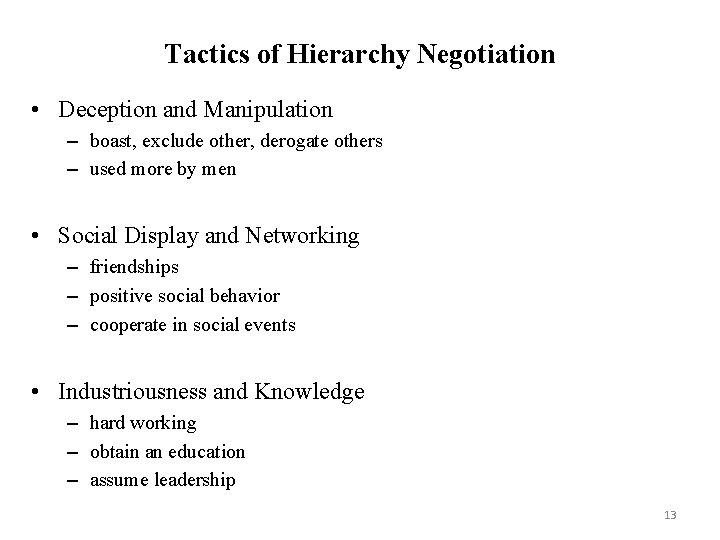
Tactics of Hierarchy Negotiation • Deception and Manipulation – boast, exclude other, derogate others – used more by men • Social Display and Networking – friendships – positive social behavior – cooperate in social events • Industriousness and Knowledge – hard working – obtain an education – assume leadership 13
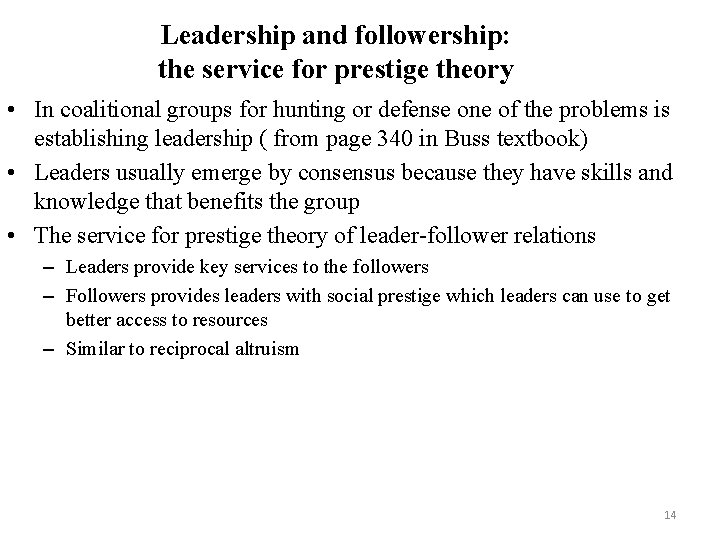
Leadership and followership: the service for prestige theory • In coalitional groups for hunting or defense one of the problems is establishing leadership ( from page 340 in Buss textbook) • Leaders usually emerge by consensus because they have skills and knowledge that benefits the group • The service for prestige theory of leader-follower relations – Leaders provide key services to the followers – Followers provides leaders with social prestige which leaders can use to get better access to resources – Similar to reciprocal altruism 14
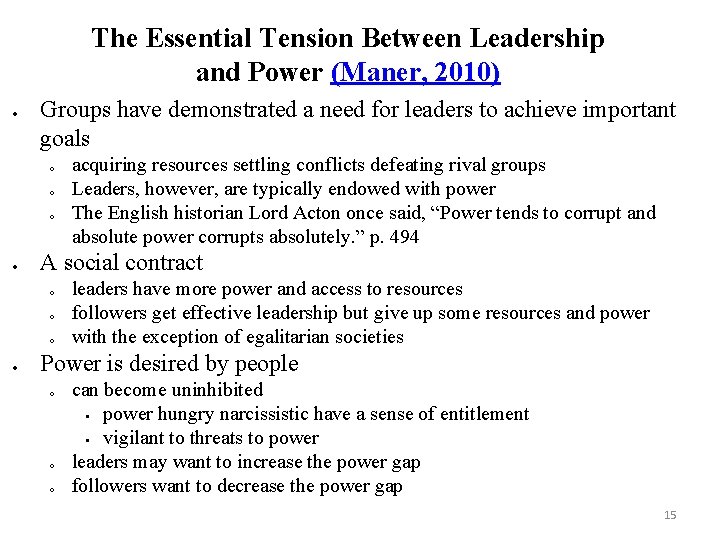
The Essential Tension Between Leadership and Power (Maner, 2010) Groups have demonstrated a need for leaders to achieve important goals o o o A social contract o o o acquiring resources settling conflicts defeating rival groups Leaders, however, are typically endowed with power The English historian Lord Acton once said, “Power tends to corrupt and absolute power corrupts absolutely. ” p. 494 leaders have more power and access to resources followers get effective leadership but give up some resources and power with the exception of egalitarian societies Power is desired by people o o o can become uninhibited power hungry narcissistic have a sense of entitlement vigilant to threats to power leaders may want to increase the power gap followers want to decrease the power gap 15
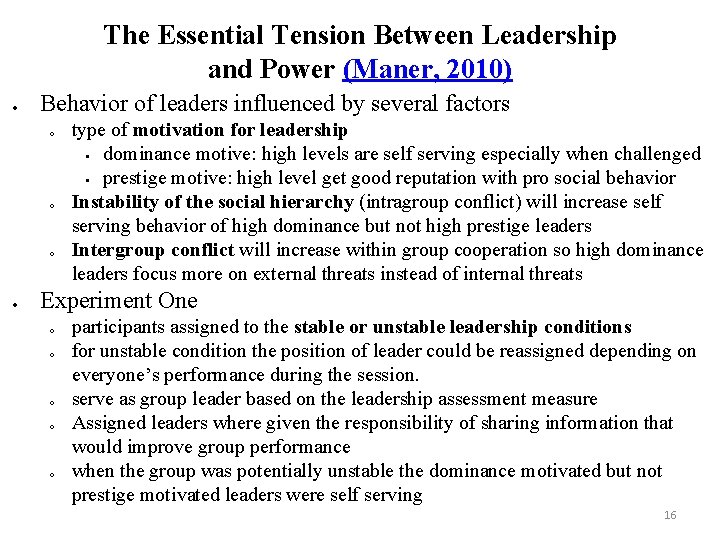
The Essential Tension Between Leadership and Power (Maner, 2010) Behavior of leaders influenced by several factors o o o type of motivation for leadership dominance motive: high levels are self serving especially when challenged prestige motive: high level get good reputation with pro social behavior Instability of the social hierarchy (intragroup conflict) will increase self serving behavior of high dominance but not high prestige leaders Intergroup conflict will increase within group cooperation so high dominance leaders focus more on external threats instead of internal threats Experiment One o o o participants assigned to the stable or unstable leadership conditions for unstable condition the position of leader could be reassigned depending on everyone’s performance during the session. serve as group leader based on the leadership assessment measure Assigned leaders where given the responsibility of sharing information that would improve group performance when the group was potentially unstable the dominance motivated but not prestige motivated leaders were self serving 16