Social Research Methods Introduction Chapter 1 Neuman and


- Slides: 14
Social Research Methods Introduction Chapter 1 Neuman and Robson
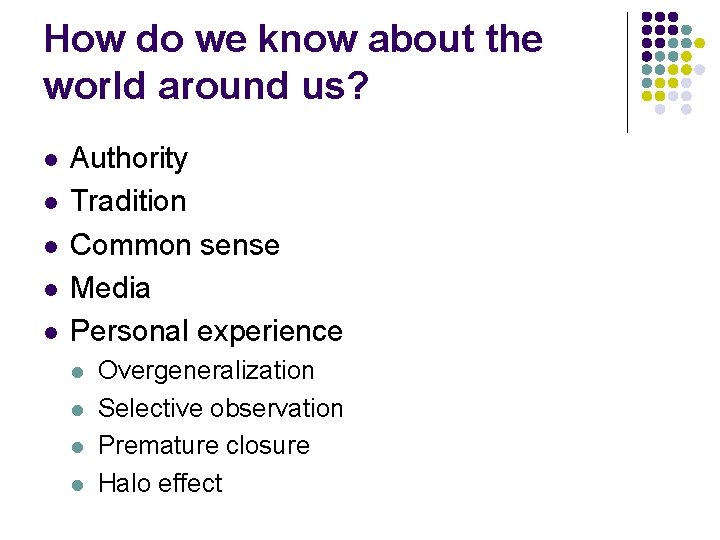
How do we know about the world around us? l l l Authority Tradition Common sense Media Personal experience l l Overgeneralization Selective observation Premature closure Halo effect
“Confirmation Bias” l l l Read Bob Mc. Donald’s “Howling at the Moon” We tend to interpret information in a manner that confirms our existing beliefs At the same time we ignore or overlook any new information that contradicts what we already “know”
The Nature of Scientific Theory l A. The Two Tasks of Science l l l Discovery Explanation B. Properties of scientific knowledge l l l Assertions about relationships Empirical referents Sensory verification Deductive structure Allows for prediction
The Nature of Scientific Theory (cont. ) l C. Desirable characteristics of science l l D. Goals of science l l Abstract, verifiable, intersubjective agreement Provide method to understand causality and to predict E. Causality l l Association Time order Non-spuriousness Theoretical justification
The Nature of Scientific Theory (cont. ) l F. Testable propositions and parsimonious explanations l G. Problems unique to the social sciences l l l Empirical measurement Control Ethics Bias The human subject
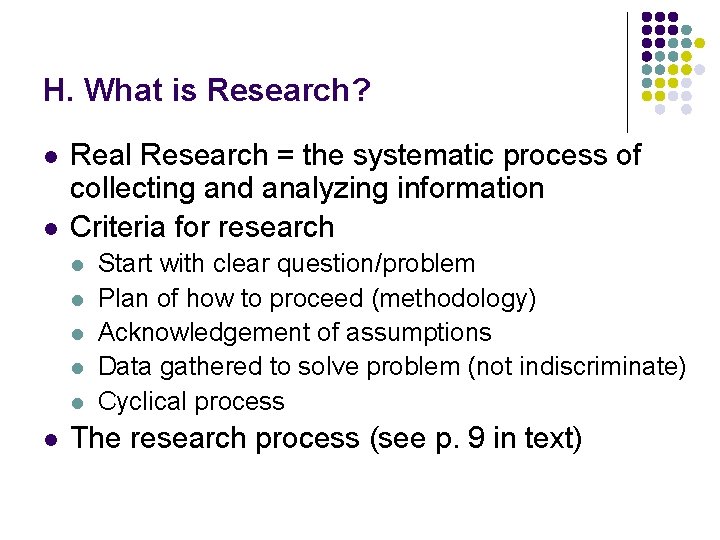
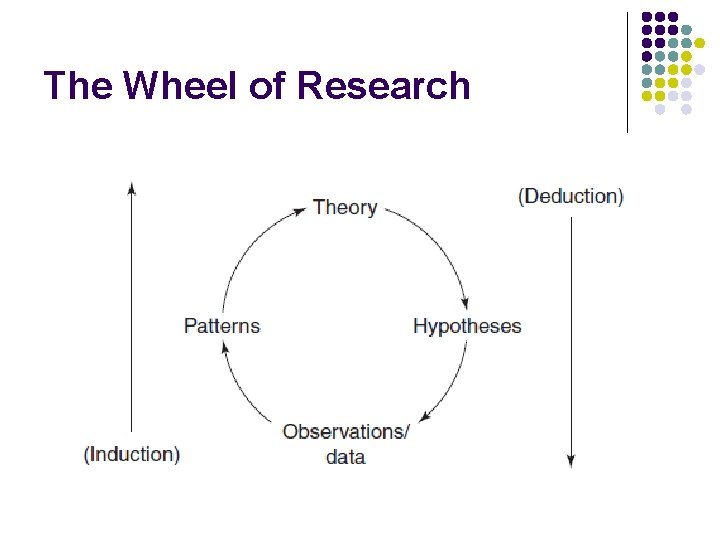
H. What is Research? l l Real Research = the systematic process of collecting and analyzing information Criteria for research l l l Start with clear question/problem Plan of how to proceed (methodology) Acknowledgement of assumptions Data gathered to solve problem (not indiscriminate) Cyclical process The research process (see p. 9 in text)
Research Design l Influenced by: l Current knowledge l Cost l Ethics l Skills
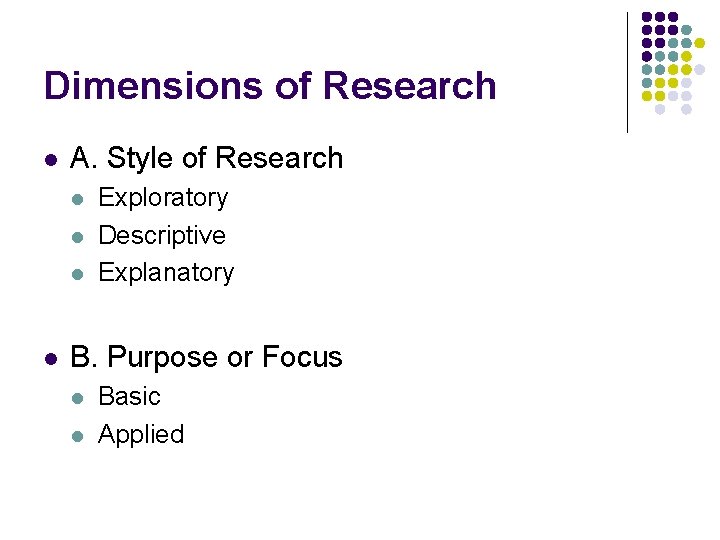
Dimensions of Research l A. Style of Research l l Exploratory Descriptive Explanatory B. Purpose or Focus l l Basic Applied
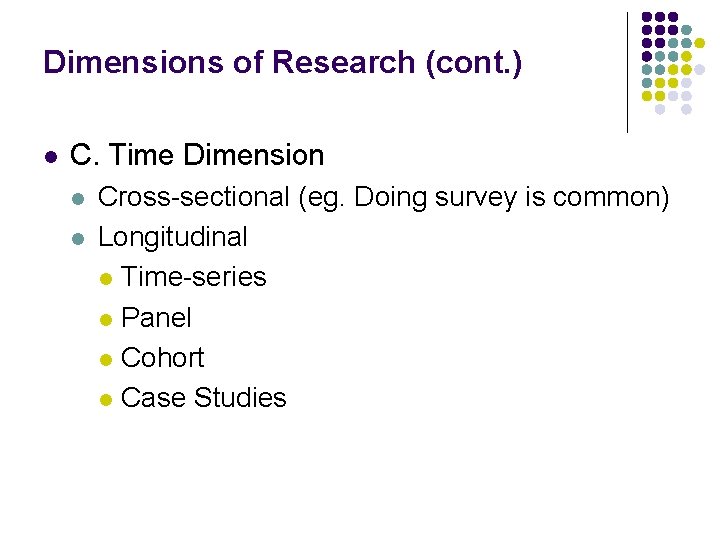
Dimensions of Research (cont. ) l C. Time Dimension l l Cross-sectional (eg. Doing survey is common) Longitudinal l Time-series l Panel l Cohort l Case Studies
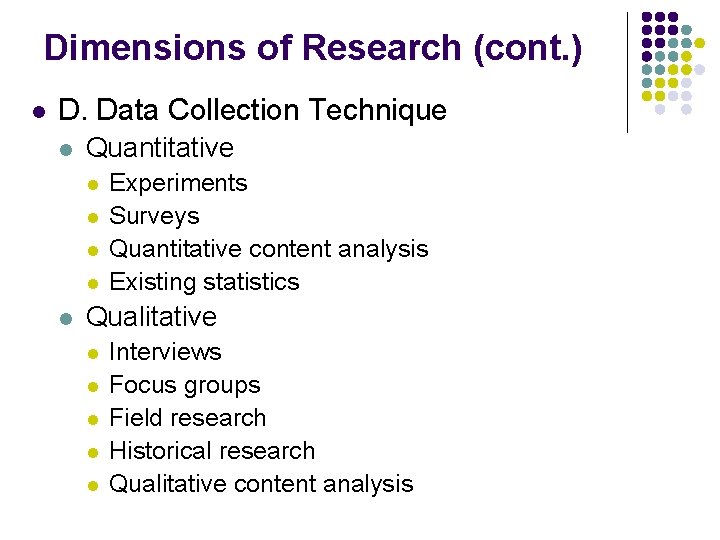
Dimensions of Research (cont. ) l D. Data Collection Technique l Quantitative l l l Experiments Surveys Quantitative content analysis Existing statistics Qualitative l l l Interviews Focus groups Field research Historical research Qualitative content analysis
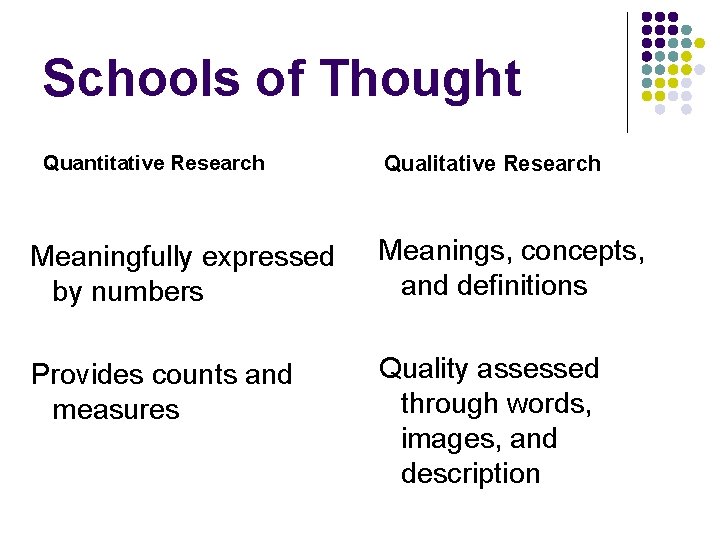
Schools of Thought Quantitative Research Qualitative Research Meaningfully expressed by numbers Meanings, concepts, and definitions Provides counts and measures Quality assessed through words, images, and description Copyright © Allyn & Bacon 2010
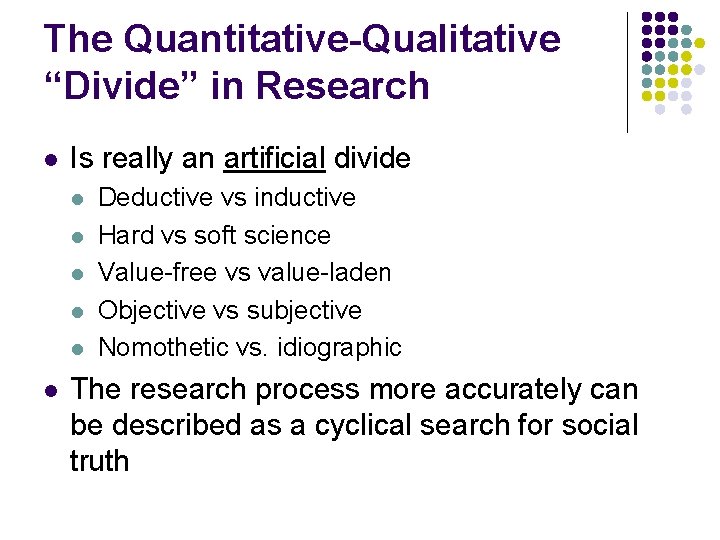
The Quantitative-Qualitative “Divide” in Research l Is really an artificial divide l l l Deductive vs inductive Hard vs soft science Value-free vs value-laden Objective vs subjective Nomothetic vs. idiographic The research process more accurately can be described as a cyclical search for social truth
The Wheel of Research